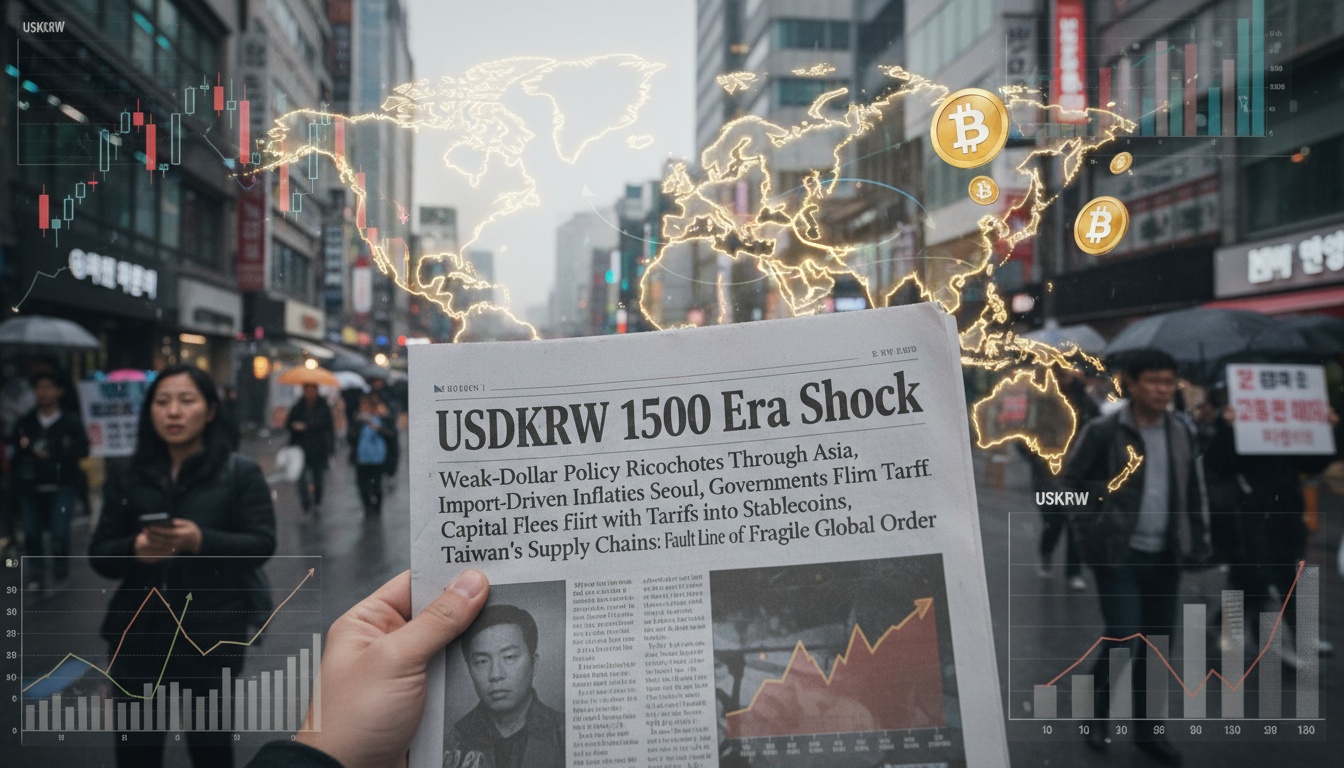
● Weak-but-Dominant Dollar, Stablecoin Coup, Won Nears 1500
Post-Dollar Order: ‘Weak-but-Dominant Dollar’ and Stablecoins, Tariff Risks, and Practical Strategies for the Won–Dollar 1,500 Era
Today’s article covers the true meaning behind the weak-dollar-dominance strategy, the cascade effects triggered when the exchange rate re-breaks 1,500, a 5–10 year scenario of recurring inflation, the power shift of “government bond yields” transferred via stablecoins, the hidden costs of tariffs on dollar hegemony and interest rates, and practical responses for Korean investors and businesses.
It has been organized to be immediately useful in investment and business decision-making by considering both global economic and AI trends.
[News Briefing] 7 Core Changes Happening Now
Since the re-emergence of the Trump administration, the U.S. dollar policy is being reoriented towards a “weak-but-dominant USD.”
By employing measures such as strengthening tariffs, pressing for interest rate cuts, and encouraging reshoring to boost domestic employment and investment while allowing allied currencies to strengthen to balance globally, the plan is evident.
However, with geopolitical, tariff, and fiscal deficit pressures converging, the dollar index has rebounded with renewed strength, and the Won–Dollar exchange rate is hinting at a renewed challenge in the 1,500 range.
Kenneth Rogoff warns of the possibility of recurring high inflation within 5–10 years, pointing out that fiscal deficits and political pressures could undermine the Federal Reserve’s credibility in inflation targeting.
Stablecoins represent both the new wings of the dollar and a potential threat. While growing under regulations requiring 100% reserve assets in U.S. Treasuries or cash, the transfer of Treasury yields to the private sector could erode the bank deposit base.
The U.S. is toying with a “selective default” approach through sanctions and debt restructuring measures, which may add a risk premium to the long-term rates (term premium) in view of the dynamics of foreign U.S. Treasury holdings.
Korea, as a key partner in the core supply chains of both the U.S. and China, faces a currency basket structure that, spanning both the yuan and the dollar, could serve as a channel for amplified exchange rate volatility.
Trump-Era Dollar Strategy: The True Meaning of a Weak-but-Dominant Dollar
The key is not an absolutely strong dollar but a “tactical weak dollar” aimed at bolstering U.S. industrial competitiveness and sharing global economic balance with allies.
Stephen Milburn’s “Mara Agreement” concept combines pressure for interest rate cuts with tariffs and reshoring policies to bring manufacturing back to the U.S. while inducing allied currencies to strengthen.
However, tariffs place additional costs on the global supply chain, stimulating inflation as they drive demand for safe-haven assets that push the dollar upward, thus creating a paradox that conflicts with policy objectives.
As a result, the uncomfortable combination of a “strong dollar–high interest rates–high tariffs” is becoming a reality for the time being.
Modern Triffin Dilemma: Fiscal Deficits, Inflation, and the Credibility of Bonds
With the U.S. GDP share declining and external debt rising, expanding the circulation of the dollar as the global reserve currency ultimately requires larger domestic debt and deficits.
When inflation rises, bond prices fall, and U.S. Treasuries, with high foreign ownership, attract a risk premium (inflation risk premium) that drives long-term interest rates higher.
The credibility of the Federal Reserve plays the role of the “new gold standard” in an era where the gold convertibility has disappeared.
Should politics unsettle the Fed, the inflation anchor—the core of dollar hegemony—could weaken, leading to greater volatility in the global economy.
The Mechanism of the Won–Dollar 1,500 Era: What is Pushing Up Prices
Increased tariffs and geopolitical risks stimulate costs in Korea, intensifying inflationary pressures, and the market demands higher neutral and long-term interest rates (term premium).
The possibility of foreign holders reducing their U.S. Treasury holdings and the risk of a “selective default” diminish the safety premium of reserve currency assets, thereby exerting upward pressure on exchange rates and interest rates.
If the trend of Asian bloc formation deepens alongside a persistently weak yuan, Korea’s currency basket is likely to translate into a weaker won.
The higher the cost of maintaining dollar hegemony, the more the global economy will suffer from a combination of high interest rates, high exchange rates, and sluggish growth.
Stablecoins: An Extension of the Dollar or an Erosion of Banks?
While regulations enforcing a 100% reserve asset standard mitigate bank run risks, if those reserve assets are U.S. Treasuries, the private issuers receive the Treasury yields rather than the central bank, transferring part of the “yield sovereignty.”
Should deposits migrate to stablecoins, the lending capabilities of banks may weaken, slowing credit creation and exacerbating downside risks during economic cycles.
If interest-bearing stablecoins are permitted, competition with bank deposits will intensify, and regulations are likely to converge towards “bank-like regulations.”
The legalization of underground dollar channels expands the dollar network, but traffic related to tax evasion and sanction circumvention increases regulatory and sanction risks, thereby stimulating exchange rate volatility.
China and Asia’s Attempt to Détach and Korea’s Choice
China is pursuing the internationalization of its currency by establishing alternative payment systems and settling raw material transactions in its own currency to reduce dependence on the dollar system.
Asia accounts for half of the dollar bloc, and Korea, as a core trading partner for both the U.S. and China, experiences simultaneous impacts on its exchange rate, exports, and investment decisions.
Korea’s monetary policy reflects the dual signals from the dollar and the yuan, a structural factor that amplifies exchange rate volatility.
Should tariffs become normalized, Korea’s export pricing and margins will face pressure, and the stock market’s valuation sensitivity to interest rates and exchange rates will increase.
AI Trends Transforming the Exchange Rate and Interest Rate Game
Large language models and time-series AI are expediting the microstructure changes of exchange rates and interest rates by interpreting central bank communications, tariff and sanction news, and on-chain flows in real time.
The tokenization of Treasury bonds within stablecoin reserves promotes 24/7 price discovery, quickly transmitting bond volatility into the foreign exchange market.
News regarding CBAM, tariffs, and supply chains is being classified and simulated by AI, directly linking to immediate decisions on hedging and pricing shifts by companies.
As a result, exchange rates may experience more frequent and larger fluctuations, and the cycle of inflation and interest rate trajectories could shorten.
The Most Important Point Rarely Addressed in Other YouTube Videos and News
Tariffs erode the “seigniorage” of dollar hegemony.
While rising trade costs may temporarily stimulate global demand for dollars, in the medium to long term, the costs associated with alternative settlement methods and reshoring weaken the network effects of the dollar, thereby reducing its safety premium.
The signal of a “selective default” means that if a specific country’s U.S. Treasuries are used as a tool of sanctions, the risk premium will spread to all foreign holders, entrenching upward pressure on long-term interest rates.
The transfer of Treasury yields via stablecoins redistributes the central bank’s “interest issuance power” to the private sector.
This quietly redefines the structure of the Federal Reserve’s balance sheet profit and loss, and the interplay between fiscal and monetary policy—a game changer in its own right.
The Won–Dollar 1,500 level could be a signal of a “regime shift” rather than just a numerical milestone.
It may compel corporate strategies in hedging, price transfer, and interest rate swaps to be redesigned, and this could be more than a temporary fluctuation.
Kenneth Rogoff’s Warning: A 5–10 Year Scenario for Recurring Inflation
Chronic fiscal deficits, the costs associated with tariffs and geopolitical risks, aging demographics, and supply chain restructuring are structural factors driving prices upward.
If the Fed becomes vulnerable to political pressures, its inflation anchor could falter, leading U.S. dollar bonds to incur an inflation risk surcharge.
For the “weak-but-dominant dollar” to persist, fiscal normalization and the restoration of monetary policy independence must be prerequisites.
Otherwise, even if dollar hegemony persists, it will transform into a “hegemony with rapidly escalating costs.”
Three-Tier Response for Korean Investors and Businesses
Portfolio
- Short-term: Increase the proportion of cash, ultra-short-term bonds, and dollar cash equivalents, and diversify with commodities (gold) to hedge against exchange rate fluctuations and inflation.
- Mid-term: Focus on global stocks of high-quality companies with visible cash flows, and select sectors likely to benefit from AI, semiconductors, and supply chain restructuring.
- Bonds: Enter in phases with divided durations, recognize the risk of rising long-term interest rates, but gradually extend durations during periods of economic slowdown.
Hedging
- For an assumed won–dollar exchange rate fluctuation band between 1,450–1,520, employ phased call spread and NDF strategies, and export-oriented companies should preemptively reflect natural hedging in price transfer.
- For companies exposed to the yuan, adopt a three-legged hedging model (dollar–yuan–won) to manage basket risk.
Interest Rates and Financing
- Execute debt refinancing in phases during the first half of the year, increase the proportion of fixed-rate borrowings to cushion against term premium fluctuations.
- Reassess the net present value of capital investments and M&A by simulating tariffs, subsidies, and reshoring incentives with AI.
6–12 Month Scenario and Probabilistic Perspectives
Base Case (45%): Tariff and geopolitical pressures persist, sticky inflation, plateauing long-term interest rates, and a won–dollar range within a 1,420–1,520 box.
Strong Dollar (35%): Heightened global risk aversion, accentuation of selective default signals, rising dollar index, and increased frequency of surpassing the won–dollar 1,500 level.
Easing (20%): Expectations of fiscal tightening and tariff relaxation, subsiding inflation, downward pressure on long-term interest rates, and attempts to return to the won–dollar range in the 1,350s.
Checklist: Monitoring Points
Monitor U.S. congressional fiscal negotiations and the composition of Federal Reserve appointments, as well as signals of monetary policy independence.
Keep abreast of tariff and sanction package updates, and watch for actions or remarks related to “selective default.”
Review public disclosures on stablecoin reserve assets, whether interest payments are permitted, and trends in the tokenization of U.S. Treasuries.
Observe China’s stance on yuan policy, Korea’s current account balance, export pricing, and the semiconductor cycle.
Assess whether AI and automation are offsetting inflation through cost savings or, alternatively, exerting upward pressure on data and electricity costs.
Conclusion: Conditions for the Persistence of a Weak-but-Dominant Dollar
Fiscal normalization, the restoration of monetary policy credibility, and the management of tariff and geopolitical costs are prerequisites for the weak-but-dominant dollar to function.
Otherwise, even if dollar hegemony is maintained, escalating costs and volatility will accumulate fatigue in the global economy and foreign exchange markets.
Investors and businesses must assume that the triple shocks of exchange rates, interest rates, and tariffs are constant, and urgently establish AI-based data-driven decision-making systems.
This is the new competitive edge in the era of the Fourth Industrial Revolution.
< Summary >
The combined pressures of tariffs, fiscal deficits, and political influences have placed the dollar in a regime characterized by short-term strength, high interest rates, and high exchange rates, contrary to the objective of a “weak-but-dominant” stance.
The risk of recurring inflation remains valid over a 5–10 year horizon, with the Fed’s credibility being the key determinant of dollar hegemony.
Stablecoins may expand the dollar network, but they also introduce a structural shift through the transfer of bank and Treasury yield sovereignty.
Korea is exposed to basket risks spanning both the U.S. dollar and the yuan, leading to greater exchange rate volatility, making currency hedging, fixed interest rate strategies, and AI-based decision-making essential.
[Related Articles…]
- Won–Dollar 1500 Era Investment Strategy: Checklist for Interest Rates, Inflation, and Stock Markets
- How AI is Transforming the Global Economy: A 2025 Roadmap for Stablecoins and Treasury Tokenization
*Source: [ Jun’s economy lab ]
– 이상한 환율과 달러인데스, 달러 이후의 질서
● Generational Debt Bomb, Student Loans Strangle Consumption and Housing
US Student Loans, The Era of Debt Affecting Three Generations Simultaneously: Risks Shaking Consumption, Real Estate, and Childbearing, and the Paradox of AI
This article covers the link between the resumption of repayment and the surge in delinquencies alongside the slowdown in consumption, the Parent PLUS structure that burdens even parents and grandparents with debt, the risk of wage garnishment, the structural reasons behind the abnormal rise in tuition prices, the preventive measures South Korea must immediately consider, and how generative AI is rewriting the ROI of degrees and the landscape of the labor market.
At the end, a checklist of strategies for investment, policy, and individuals is summarized along with what I see as the “core points that are rarely addressed elsewhere.”
1) News Summary: What Is Happening and How Serious Is It
According to the original report, after a three-and-a-half-year grace period during the pandemic, the resumption of federal student loan repayment in October 2023 has led to a surge in delinquencies.
Based on data from the New York Fed, the proportion of delinquencies over 90 days reached 10.2% within just a few months, with an estimated 24% of borrowers currently delinquent.
The total amount is about $1.81 trillion, involving around 42.7 million borrowers, which accounts for roughly 13% of the entire U.S. population.
Tuition fees at Ivy League and major metropolitan universities exceed $70,000 per year, and when adding living, dormitory, and other expenses, costs soar into the $90,000 range annually.
When an individual exhausts their personal borrowing limit, Parent PLUS, which shifts the debt burden to parents, becomes active, and its interest rates are reportedly higher than those of standard student loans.
The original text mentions that from May 2025, actions such as wage garnishment of 15–25% may resume, warning of further impacts on household cash flow.
In terms of consumption, indicators show that over half of responses indicate “I can’t buy a house because of debt,” and the proportion of first-time homebuyers has dropped from 50% in 2010 to 24%.
Essential and discretionary consumption such as marriage, childbirth, car purchases, travel, and dining out are all being delayed or reduced.
In contrast, loan servicing companies are set to structurally benefit from increased fee and interest income due to the resumption of repayments and long-term delinquencies.
2) Why It Happened: Inflation, Interest Rates, and the Distortion of Pricing Mechanisms
Amid the shock of global inflation, wages have not kept pace sufficiently.
The three-and-a-half-year repayment moratorium created an “illusion of cash flow,” and its end immediately reversed into a shock that cut monthly cash flow.
The surge in tuition fees resulted from a complex interplay of abundant liquidity from government-guaranteed loans, increased administrative costs at universities, competition in facilities and branding, and pricing discrimination (Need-aware/Merit-aid strategies).
Designs like Parent PLUS that extend leverage to parents and grandparents spread the risk across all age groups in household balance sheets.
The longer the phase of entrenched interest rates lasts, both fixed and variable rate student loans, as well as refinancing discounts, deteriorate simultaneously.
3) Economic Ripple Effects: The Chain of Shrinking Consumption → Real Estate Downturn → Slowed Growth
Youth in the United States has a high marginal propensity to consume and contributes significantly to the business cycle.
If their cash flow is tied up in student loan repayments, spending on durable goods, travel, and dining out is the first to decrease, putting downward pressure on retail, services, advertising, and employment.
In the housing market, while delayed first-time home purchases increase rental demand, high rents further discourage savings and delay the transition to home ownership.
Delays in marriage and childbirth add downside risks to the demographic structure and long-term potential growth rates.
The stress of debt repayment may spread to delinquencies in other household sectors such as credit cards and auto loans, potentially triggering a contagion in the credit cycle.
4) AI Trends: Reassessing the ROI of Degrees and New Financing Models
The spread of generative AI is shifting the labor market’s focus from a “degree premium” to a “skills premium.”
Companies are now more quickly verifying project portfolios, coding abilities, prompting skills, and data processing records rather than relying solely on academic degrees.
Mobile learning, micro-credentials, nano-degrees, and MOOC plus coaching enable low-cost, high-frequency reeducation, thereby diminishing the relative value of degree ROI.
In loan servicing and risk management, AI can reduce costs by predicting delinquency probabilities, personalizing repayment schedules, and detecting inaccuracies in credit records.
However, if performance-based pricing is reinforced, differentiated interest rates across majors and schools could fuel social equity debates.
Income Share Agreements (ISAs), where a portion of post-graduation income is allocated over a set period, are emerging as an alternative that combines AI underwriting to reflect the true ROI of degrees and training.
5) A Caution for Korea: “It’s Not Unrelated to Us”
Korea already faces high household debt, low birthrates, and burdensome housing costs.
If student loans expand into multi-generational debt, the same constraints on youth consumption, real estate, and childbirth could converge.
This is intertwined with issues such as university restructuring, debates over tuition fee freezes versus deregulation, and the potential disappearance of regional universities, necessitating an integrated design of fiscal, labor, and educational policies.
6) Policy and Market Scenario Checkpoints (2025–2026)
If the interest rate trajectory remains “high and prolonged,” the repayment burden will persist even longer.
A delay in the slowdown of inflation will also postpone the recovery of real wages, extending the tail of delinquencies and consumption downturn.
Policy choices, such as enhancements to income-driven repayment (IDR) with partial debt forgiveness, restructuring of Parent PLUS limits and interest rates, and expanding repayment moratorium and refinancing options, will be decisive in terms of market impact.
Loan servicing companies, fintech, and edutech face both opportunities and regulatory risks, while sectors like housing, retail, travel, and automobiles need close monitoring due to their high demand sensitivity.
7) Practical Checklist: For Individuals, Companies, and Policies
– Individuals: Check whether income-driven repayment plans (IDR) or PSLF apply, and consider consolidating or refinancing multiple loans.
– Individuals: Reprioritize repayment starting with high-interest debts and actively utilize employer tuition support or upskilling programs.
– Companies: Reassess the demand fluctuations and the resilience of inventory and marketing for sectors sensitive to youth (fashion, dining, travel, entertainment, automotive).
– Companies: Reduce dependency on academic degrees in hiring and transition to evaluations based on projects and courses to broaden the talent pool.
– Policies: Mandate transparent disclosure of tuition by major, including data on median income, unemployment, and repayment burdens at 1, 3, and 5 years after graduation, cap interest rates, and restructure programs similar to Parent PLUS.
– Policies: Implement realistic bankruptcy and debt restructuring guidelines, and support alternative degree pathways with edutech vouchers and regional reskilling hubs.
8) A Core Point Rarely Addressed Elsewhere: The Real Risk Is the Collapse of Pricing Power
With AI driving the shift from degrees to skills as the new pricing determinant, the pricing power of universities may rapidly erode.
This could lead to a polarization where tuition hikes are curtailed, resulting in selective deflation (for low ROI majors) and premium concentration (for a very small number of top majors and institutions).
The realignment of university demand may ripple through local commercial districts, rental markets, and local government finances, potentially creating “campus deleveraging.”
Ultimately, the core issue with student loan debt is not merely a matter of repayment technology, but a structural change redefining the price, value, and substitutes of educational commodities.
9) Investment Perspective Points
It is essential to assess the elasticity of demand in sectors sensitive to interest rates, inflation, and the U.S. economy.
Though loan servicing, refinancing, and debt collection benefit from the cycle, they must also prepare for regulatory tightening and policy risks.
Edutech, AI tutoring, automated assessment, and micro-credential certification infrastructure are structurally favored sectors, with non-university “education providers” likely to increase their market share.
In the housing sector, if delays in first-time home purchases persist, rental REITs and Built-to-Rent (BTR) may emerge as relative beneficiaries.
10) A Korean-Style Response Roadmap (Summary Proposal)
– Transition to data-driven regulation by mandating disclosure of actual ROI by major and institution and implementing tuition increase controls.
– Increase scholarships and grants for low-income groups and prevent unlimited guarantees in structures similar to Parent PLUS.
– Support regional reskilling hubs and industry-linked micro-credentials with tax credits.
– Implement realistic bankruptcy and debt restructuring guidelines for student loans to mitigate the “lifetime subscription” risk.
Data and Terminology References
The figures for total student loan amounts, delinquency rates, and the proportion of first-time homebuyers are all cited from the original report.
The policy and market scenarios are forward-looking interpretations based on currently available general mechanisms and past cycle experiences.
< Summary >
Following the resumption of repayment, delinquencies have surged, and the chain reaction affecting consumption, real estate, and childbirth is becoming evident.
Structures like Parent PLUS extend debt across three generations, straining household cash flow.
The key issue lies in the collapse of tuition pricing power and degree ROI, while the spread of AI is opening a market centered on skills.
Policy must be directed by data-based disclosure, expanded grants, and repayment system reforms, while individuals and companies must rethink their cash flow, hiring, and educational strategies.
[Related Articles…]
US Interest Rates and Consumption Slowdown: Next Cycle Checkpoints
The Practical Impact of Generative AI on Jobs and Wages
*Source: [ Maeil Business Newspaper ]
– 할머니, 부모, 손자 3대가 함께 지는 빚 ‘학자금’ | 매일뉴욕 스페셜
● Taiwan Strait War, Global Supply Collapse, AI Chip Famine
Reality Check of a Taiwan Strait War: The Essence of the ‘Chinese Airborne Unit Annihilation’ Debate and Its Impact on the Global Economy and AI Supply Chain
This article covers why the preliminary deployment of airborne and heliborne forces, which is the most vulnerable link in a potential Chinese invasion of Taiwan, is structurally difficult; how Taiwan’s densely concentrated air defense network and artillery operations alter the battlefield; and how the resulting effects immediately impact the global economy, inflation, interest rates, geopolitical risks, energy prices, and the AI semiconductor supply chain.
The piece compiles logistical, fuel, port control, and insurance premium details often neglected by the media, along with numerical-based logistical realities and tactical nuances such as pre-coordinated artillery targeting of airborne landing zones.
News Briefing: The Essentials at a Glance
In the event of a Chinese invasion of Taiwan, the pre-emptive deployment of airborne and heliborne forces is likely to suffer heavy losses in the initial phase due to Taiwan’s high-density air defense network (PAC-3, Sky Bow III, etc.) and pre-coordinated artillery fire.
Taiwan has deployed a high density of Patriot systems, along with low-altitude air defense capabilities including MANPADS, anti-aircraft guns, and integrated drone-counterdrone systems, creating an environment unfavorable to airborne assaults.
A massive airborne operation by the Chinese People’s Liberation Army requires absolute air supremacy, simultaneous mass deployment of transport aircraft/helis, and secured supply ports, all of which are highly challenging to achieve in a short period with current capabilities and logistics.
Internal command and audit risks within the Chinese military (such as personnel changes in the Central Military Commission and issues related to the Rocket Force) further undermine the credibility of its combat readiness.
If the risk of war increases, the geopolitical risk premium on the global economy will expand, immediately reflecting on inflation, energy prices, interest rate trajectories, and the AI semiconductor supply chain.
Military Fact Check: Airborne Forces vs. Taiwan’s IADS (Integrated Air Defense)
Condition 1 – Air Supremacy: For airborne forces to land successfully, air supremacy and suppressive SEAD/DEAD operations are essential, yet Taiwan maintains a long-range SAM system (PAC-3, Sky Bow III) and detection-intercept systems with F-16V/E-2K early warning aircraft.
Condition 2 – Transport Assets: Deploying forces on the scale of an airborne division requires hundreds of sorties with rapid turnaround, making the numbers and operational cycle of Y-20/Il-76, as well as fuel and maintenance cycles, critical bottlenecks.
Condition 3 – Landing and Assembly: With limited drop zones (DZ) and helipads, Taiwan’s pre-targeted artillery fire (FM operations) can concentrate strikes on designated DZs before assembly.
Condition 4 – Low Altitude Threats: MANPADS, close-range air defenses (LPWS), and anti-aircraft guns can neutralize low-altitude helicopters and assault aircraft, while drone reconnaissance ties the system to real-time fire control.
Condition 5 – Limitations of Missile Strikes: Even with a pre-emptive strike using a large number of ballistic and cruise missiles, China cannot completely neutralize Taiwan’s air defense with its distributed deployments, deception, and bunkering tactics, and the rapid drop in efficiency during reloading and resupply poses additional difficulties.
In conclusion, a ‘massive airborne breakthrough in the opening phase’ would entail a high risk of losses due to Taiwan’s multi-layered air defense and integrated artillery-drone coordination.
Physical Constraints on Conducting War: Strait, Weather, Ports, Logistics
Sea-based A2/AD: Taiwan can pressure landing and transport vessels with anti-ship missiles (Hsiung Feng), Harpoon missiles, mines, submarines, and coastal artillery batteries.
Securing Ports: Large-scale logistics require control of ports; if ports are destroyed or if mines remain, the efficiency of mobilizing civilian Ro-Ro vessels drops sharply.
Weather and Currents: Wind, waves, and currents in the Taiwan Strait significantly constrain operations involving small landing craft and heliborne assaults.
Fuel and Maintenance: The fuel rotation and field maintenance capabilities of air and naval assets determine the sustainability of prolonged operations.
Internal Risks: Command and Audit Issues and Operational Confidence
Elements such as personnel changes in the Central Military Commission, allegations surrounding the Rocket Force, and procurement/quality risks lower the confidence in large-scale joint operations.
If the command system is unstable, the simultaneous integration of SEAD/DEAD operations, airborne forces, and amphibious landings becomes jeopardized.
China’s Alternative Scenarios: Gray Zone and Incremental Warfare
Strengthened Blockades and Inspections: Instead of full-scale war, China might intensify maritime inspections, financial, insurance, and communications pressure to accumulate economic costs.
Cyber and Space Warfare: Asymmetric options such as cyber and space attacks could be preferred to disrupt infrastructure and command-control systems, thereby reducing the efficiency of Taiwan’s IADS.
Limited Targeted Strikes: Incremental strikes on specific targets such as ports, fuel depots, and radar installations could create negotiation leverage.
Impact on the Global Economy: Immediate Reactions in Prices, Interest Rates, and Exchange Rates
Geopolitical Risk Premium: Rising maritime insurance rates and freight charges, along with deteriorating global economic sentiment, contribute to an immediate repricing.
Inflation Trajectory: Disruptions in semiconductor, component, and shipping sectors push up the prices of ‘non-energy commodities,’ while energy prices face upward pressure due to stockpiling for safety.
Interest Rates and Bonds: Fears of a reheated inflation can slow down central banks’ easing measures, causing a recalibration of short- and long-term interest rate trajectories.
Exchange Rates: A flight to safe assets will strengthen the dollar, weaken Asian currencies, and increase volatility in export-dependent sectors.
Impact on the AI and Semiconductor Supply Chain: TSMC Risks Mean Higher AI Costs
Concentration of Foundries: The concentration of advanced node (3–5nm) production in Taiwan is a bottleneck for expanding AI accelerators and data centers.
Equipment and Materials: If lithography, packaging, and substrate processes face disruptions, AI training costs and lead times will surge.
Corporate Impact: Global cloud and big-tech companies may see delays or adjustments in CapEx plans and diversify GPU/ASIC procurement strategies.
Alternative Scenarios: While capacity expansion in the US, Japan, Europe, and South Korea is a long-term solution, short-term shocks remain unavoidable.
The Most Important Point Often Overlooked by the Media
Pre-coordinated Artillery: Taiwan pre-inputs artillery coordinates into the ‘FM system’ at anticipated airborne landing zones, maximizing kill rates before landing and assembly.
Transport Calculation: An airborne division-sized deployment requires simultaneous sorties accounting for turnaround, fuel, and maintenance, but the current transport assets and fuel nodes create bottlenecks for massive initial drops and sustained supply.
Ports = The Lifeline of War: Without securing, restoring, and clearing mines from ports, protracted ground engagements will see logistics collapse over time.
Insurance and Payment Infrastructure: Even on the eve of full-scale war, trade can grind to a halt due to insurers refusing coverage and delays in LC payments.
Vulnerability of Civilian Ro-Ro Mobilization: Militarized civilian vessels are susceptible to anti-ship missiles, drones, and mines, and if reinforcements are delayed, sustaining the battlefield becomes challenging.
12–24 Month Watchlist: Key Signals to Monitor
China: Watch for the codification of additional mobilization of civilian Ro-Ro and transport aircraft, the frequency and scale of joint amphibious exercises, and enhancements in electronic warfare and cyber drills.
Taiwan: Monitor redeployments of air defense, progress in dispersed bases and tunnel construction, regular live-fire exercises by reservists and artillery units, and advancements in the drone-counterdrone network.
International: Sudden shifts in maritime insurance premiums and freight rates, rapid increases in semiconductor lead times, heightened energy price volatility, and the activation level of diplomatic channels.
Checklist for Investors and Corporations
Supply Chain: Dual sourcing of components from Taiwan and China, increasing safety stock, and pre-contracting alternative logistics routes.
Price and Cost: Prepare pass-through plans for surging freight and insurance costs and update hedging strategies accordingly.
IT and AI: Monitor lead times for semiconductors and packaging, and design alternative GPU options (multi-sourcing, generational mix) proactively.
Risk Management: Integrate geopolitical risk scenarios into management KPIs and establish emergency communication channels.
Summary: Why Arguments for a ‘Complete Taiwan Invasion Deception’ Are Exaggerated and an ‘Instant Full-Scale War’ Is Unrealistic
The combination of airborne and amphibious operations is likely to be thwarted by Taiwan’s multi-layered air defense, artillery, and drone networks, compounded by significant logistical, port, and weather constraints.
However, the risk is not zero.
Gray zone coercion and limited targeted strikes remain constant options, and even these scenarios impose ongoing premiums on the global economy, inflation, interest rates, energy prices, and the AI semiconductor supply chain.
The key point is that a scenario of ‘massive amphibious-airborne political posturing’ is less realistic than a scenario involving cumulative economic pressures over the long term.
Data Points: The Significance of the ‘Chinese Airborne Unit Annihilation’ Debate
Taiwan’s air defense density is above the regional average, and the combination of low-altitude air defense and coordinated artillery FM operations causes a nonlinear spike in casualties for airborne units.
Even if the Chinese military were to push through despite high casualties, without securing ports the continuous resupply necessary for deep operations will be hindered.
Thus, an initial scenario focused on airborne assaults may have political or psychological effects, but it is constrained from being a decisive military move.
Market Memo: Positioning Hints
Risk-On Signals: Simultaneous surges in insurance premiums, freight rates, semiconductor lead times, and crude oil/refined margins.
Defensive Positioning: Favor sectors with stable cash flows, as well as beneficiaries in energy, defense, and reshoring initiatives in North America and Europe.
AI Exposure: Prepare for short-term volatility and, in the medium to long term, select stocks likely to benefit from capacity expansion outside of Taiwan nodes.
Risk Management: Link geopolitical risk scenarios to business KPIs and establish emergency communication channels.
One-Line Conclusion
Considering the military and logistical realities of a Taiwan invasion, the idea of an ‘instant full-scale war’ is unrealistic, and a prolonged gray zone conflict is the new baseline scenario for the global economy and AI supply chain.
< Summary >
The deployment of Chinese airborne and heliborne forces is likely to incur heavy losses in the initial phase due to Taiwan’s dense air defense and artillery FM operations.
Logistical, port, and weather constraints make large-scale amphibious operations and sustained resupply extremely difficult, compounded by internal command risks.
Instead of full-scale war, a gray zone strategy involving blockades, cyber attacks, and limited strikes appears more realistic—and this scenario continuously imposes a premium on the global economy, inflation, interest rates, geopolitical risks, energy prices, and the AI semiconductor supply chain.
[Related Articles…]
Taiwan Strait Risks and the Restructuring Scenario for the Global Semiconductor and AI Supply Chain
Three Impacts of Geopolitical Risk on Interest Rates and Inflation
*Source: [ 달란트투자 ]
– “중국 공수부대 전멸 가능” 99%가 잘못 알고 있다. 대만침공 완전 허풍이다|김대영 군사평론가 3부 #디펜스뉴스