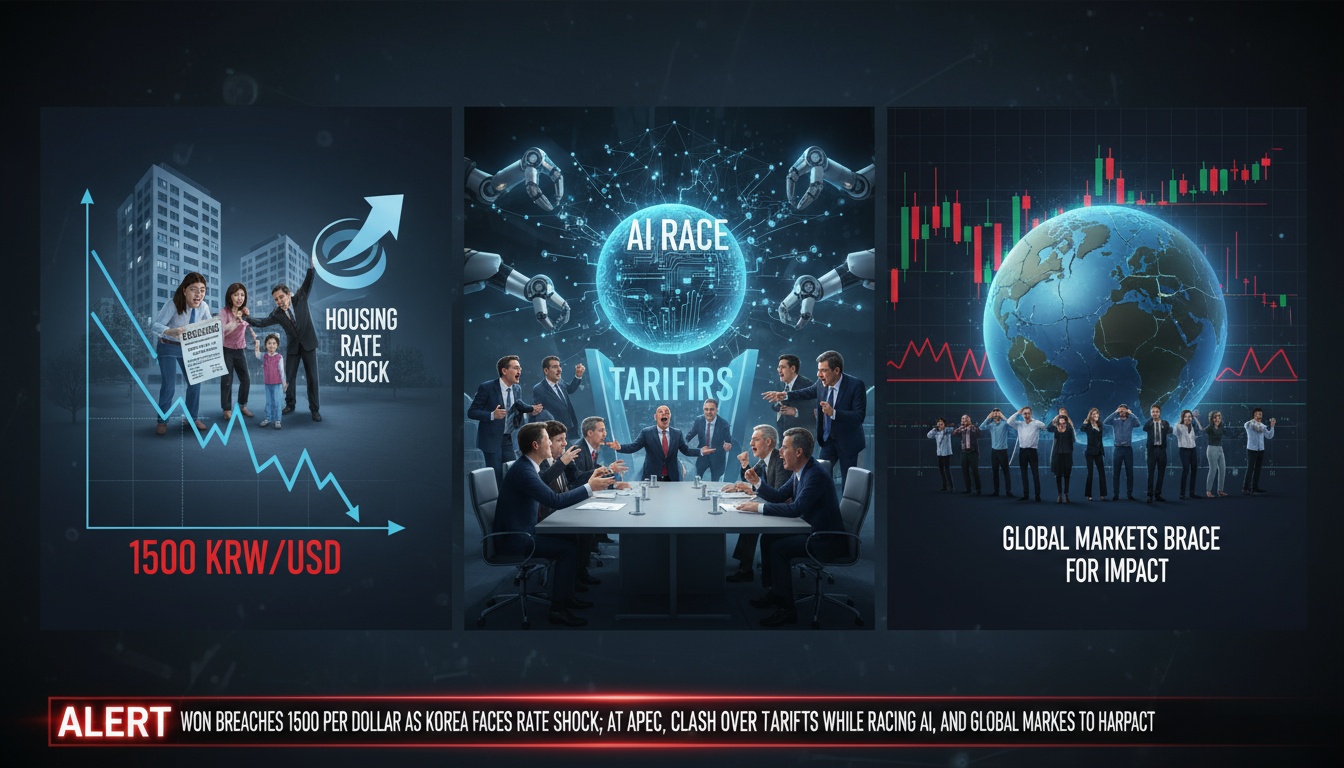
● Housing Bubble, 1500 Shock, Fed Pivot, AI Goldrush
[Immediate Analysis] How House Prices, Exchange Rates, and Employment are Changing the Korean Economy: A Comprehensive Overview of the 1500 Won Exchange Rate Benchmark, Interest Rate Outlook, and AI Investment Cycle
Today’s article includes the structural reasons why rising house prices erode growth rates.
It deciphers the actual triggers of the 1500 won exchange rate threshold and the impact of the Korea-US summit and currency swap in numerical terms.
It outlines the political-economic linkages by examining how Trump’s actions and employment data affect the FOMC and interest rate outlook.
It also adds the less-discussed effects of the AI investment cycle, data center revenues, and stablecoin dollar liquidity on exchange rate forecasts and the real estate market.
Within the global economic flow, it realistically outlines the checklist of choices for the Bank of Korea’s benchmark interest rate.
Today’s Headlines at a Glance
House prices and the economy: Rising housing and interest costs erode disposable income and reinforce the channel through which potential growth rates are reduced.
Exchange rates and the economy: The 1500 won exchange rate is both a psychological threshold and a trigger for import prices and energy costs; while the Korea-US summit and currency swap influence market sentiment, the real factors are determined by the current account and covered interest rate differential.
Employment and interest rates: A slight slowdown in employment data may ease wage pressures, providing a rationale for the Fed to cut rates, while the Bank of Korea navigates among exchange rate, inflation, and growth in search of gradual easing conditions.
AI and Fourth Industrial Revolution factors: Investments in data centers and the semiconductor cycle simultaneously stimulate the current account, electricity, and real estate demand, offering a new framework for exchange rate and interest rate outlooks.
(1) House Prices and the Economy: Why Rising Real Estate Prices Erode Growth Rates
Key mechanism: Increasing housing and interest costs reduce household disposable income, dampening consumption and domestic growth.
From a corporate perspective, higher labor attraction costs and rent reduce investment capacity, and capital is diverted to the real estate market instead of productive investments, lowering total factor productivity (TFP).
The housing cost burden on young people restricts fertility, migration, and entrepreneurship, weakening labor supply and innovation capacity.
Indicator checklist: Rising PIR (price-to-income ratio) and DSR (total debt service ratio), narrowing or inversion of the rental-sale gap, disparity between pre-sale prices and median income, and the share and spread of variable-rate loans serve as warning signals.
As these indicators worsen, the downside pressure on potential growth rates intensifies.
Policy points: A shift to ownership tax-centric measures, easing transaction costs, and enhancing predictability in the rental market, along with decentralized supply pipelines, are needed.
Strengthening housing welfare while curbing excessive leverage through macroprudential policies strikes a balance.
Investor actions: Conduct stress tests based on leverage sensitivity (interest rates + income changes) and restructure portfolios toward assets with high cash flow recovery potential.
Remember that the three elements of population, jobs, and transportation in each region are key to resilience.
(2) Exchange Rates and the Economy: The Real Effects of the 1500 Won Threshold and the Korea-US Summit/Currency Swap
The significance of 1500 won: 1500 won per dollar is not just a number, but a critical threshold that triggers increases in import prices as well as energy and food costs.
At this range, the volatility of corporate margins and consumer sentiment widens.
Upside triggers (weaker won): Continued strengthening of the dollar index, oil prices staying above 90–100 dollars, rising trade negotiation uncertainties, distortions in domestic/foreign covered interest rate differentials and basis, and foreign investor dividend and rebalancing flows together build pressure for a move above 1500 won.
Downside defense (stronger won): Robust exports related to semiconductors and AI can expand the current account surplus, while a boost in economic activity from China and Asia, micro-level market stabilization measures by policymakers, and expectations over currency swap lines help stabilize sentiment.
Korea-US summit and currency swap: The summit primarily affects risk premiums and expectation formation rather than fundamentally altering the exchange rate outlook.
While the swap helps mitigate liquidity shocks, the medium-to-long-term exchange rate is determined by sustained trade surpluses, interest rate, and growth differentials.
In conclusion, the swap acts as a “breakwater” rather than a “current changer.”
Implications for businesses and households: A rising exchange rate drives up import prices and energy costs, which are reflected in consumer prices with a lag of one to two quarters.
Exchange rate outlook can inversely impact interest rate expectations, potentially constraining the pace of easing by the Bank of Korea.
Monitoring checklist: Keep an eye on the 1M NDF-spot gap, Brent/WTI crude oil, leading indicators of semiconductor exports, seasonal patterns in the current account, the three-month currency hedging basis, and the composition and duration of foreign exchange reserves.
(3) Employment and Interest Rates: Why a Slowdown in Employment is Key to an Interest Rate Cut
Political-economic context: A gradual slowdown in employment data eases wage pressures and cools core inflation.
In the context of Trump’s policies, adjustments in immigration, tariffs, and regulations in both past and present administrations have shaken labor supply and corporate cost structures, indirectly affecting the FOMC’s reaction function.
The US-Korea linkage: A slowdown in US employment data can lead to lower long-term rates and a moderation in dollar strength, both of which provide easing factors for Korea’s exchange rate and interest rate outlook.
In Korea, given the asymmetry between the service sector and manufacturing adjustments, it is important to consider not only headline unemployment but also the quality of employment and changes in working hours.
Conditional easing by the Bank of Korea: There is a gradual easing track when exchange rate volatility subsides, core inflation trends downward, and the growth gap widens.
However, if the exchange rate stays above 1500 won for an extended period, the pace of easing is likely to be delayed.
AI and Fourth Industrial Revolution Perspective: The Hidden Effects of the Investment Cycle on Exchange Rates, Interest Rates, and Real Estate
Data center investments and exchange rates: Expansion of AI data centers involves importing expensive servers, GPUs, and power equipment, which may burden the current account in the short term.
Even if favorable semiconductor exports offset this effect with a lag, an initial phase of pressure on the won is likely.
Electricity and real estate demand: Data center locations, due to requirements related to the power grid, land, and cooling water, tend to concentrate demand in specific areas, structurally driving up local rents and land prices.
This demand can distort the price signals of both residential and commercial real estate, necessitating proactive infrastructure expansion by local governments.
Reinterpreting employment indicators: AI automation reduces demand for back-office regular positions while sharply increasing demand for specialists in data, MLOps, and power engineering.
Even if headline employment data appears robust, increasing mismatches across job categories can widen the wage-productivity gap, which central banks may struggle to detect ahead of inflation.
Stablecoins and exchange rate microstructure: On-chain dollar liquidity via stablecoins can amplify the effect of emerging market currency appreciation during risk-on phases and have the opposite effect in risk-off phases.
Unregulated expansion of stablecoins may create loopholes in foreign exchange regulations, which should be addressed alongside frameworks for foreign exchange soundness and anti-money laundering.
Numerical Guide to the Threshold: Risk Boundary Checklist
Exchange rate: 1450 won is the boundary, 1500 won is the psychological and price trigger, and surpassing 1550 won is an area where policy communication intensifies.
Interest rates: When the 3-year government bond yield breaks above the 3.2–3.8% range, tightening in financial conditions is likely to be felt.
Oil: Prolonged periods above 90 dollars could reignite cost-push inflation.
Real estate: If Seoul’s PIR remains persistently above 16 times, household consumption constraints become structural.
Employment: A slowdown in the growth of regular positions and whether average hourly wage growth stabilizes in the 3% range are keys to a change in interest rate trends.
Positioning Checklist: What to Look for for Businesses and Individuals
For Corporations/CFOs: Review currency hedging limits based on the triggers at 1450 and 1500 won, oil price sensitivity, and the maturity profile of dollar-denominated debt.
For real estate and capital investments, avoid overly long cash flow recovery periods and prioritize assets with high accessibility to power and data infrastructure.
For Individuals/Households: Reduce exposure to variable rates and assess repayment capability at stress interest rates (currently +150bp).
Before signals of an exchange rate peak emerge, approach overseas investments gradually and be mindful of increased volatility in growth stocks during periods of employment slowdown.
Key Points Not Often Mentioned Elsewhere
Currency swaps are a safety net that calms surges in spreads and settlement risks; they are not a means to change the direction of the exchange rate.
The expansion of AI data center imports could exert short-term weakening pressure on the won, and the lag between robust semiconductor exports may increase exchange rate volatility.
Changes in the rental-sale spread affect consumer sentiment faster than interest rates, so overlooking this may result in mistiming the onset of domestic demand slowdown.
The covered interest rate differential and basis directly shape the won NDF price, hence judging the exchange rate solely based on interest rate differentials can be misleading.
Scenario Map: Base, Upside, and Downside
Base: The fundamental path is marked by robust semiconductor exports, gradual easing of inflation, exchange rates oscillating in the high 1400s, the Bank of Korea hinting at gradual easing in the second half of the year, and deepening regional polarization in the real estate market.
Upside Risk: If surges in oil prices, a strengthening dollar index, and heightened trade negotiation tensions occur simultaneously, the exchange rate may persist above 1500 won, delaying interest rate cuts and leading to a slowdown in real estate transactions.
Downside Opportunity: A slowdown in US employment data could lead to lower interest rates and a shift to a weaker dollar, and an upcycle in semiconductors could restore exchange rates to the 1300s, which may foster renewed appetite for risk assets.
Calendar: What to Watch and When
Monitor the tone regarding employment, wages, and interest rate trajectories during the FOMC meeting and Powell’s press conference.
Keep an eye on changes in phrasing related to the Korea-US summit outcomes and currency swap communications.
Key events are the Bank of Korea’s Monetary Policy Committee meeting, US CPI/PCE figures, Korean employment trends, the current account, semiconductor export performance, and oil inventory indicators.
References and Further Reading
For discussions on stablecoins and the reconfiguration of global liquidity, as well as economic outlooks for 2026, please refer to analyses of changes in foreign exchange microstructures both domestically and internationally.
Emphasizing structural variables over short-term events can improve the quality of positioning.
< Summary >
Rising house prices erode disposable income and investment capacity, thereby lowering potential growth rates.
An exchange rate of 1500 won serves as both a psychological and price trigger, while swaps act merely as breakwaters; the fundamentals are driven by the current account and covered interest rate differential.
A slowdown in employment creates conditions for Fed easing, thereby influencing the pace of monetary policy adjustments by the Bank of Korea.
It is essential to consider the combined impacts of AI data centers and stablecoins on exchange rates, interest rates, and real estate.
A checklist-based positioning approach helps reduce losses in periods of volatility.
[Related Articles…]
2026 Exchange Rate Trend Checklist
The New Equilibrium between AI Investment Cycles and Interest Rates
*Source: [ 경제 읽어주는 남자(김광석TV) ]
– [LIVE] (1)집값과 경제 (2)환율과 경제 (3)고용과 금리 [즉시분석]
● Tariff Timebomb
APEC Tariff Big Deal or Prelude to Shock? A Comprehensive Summary of Trump’s Strategy and the Calculations of Korea, China, and Japan
This article covers three possible scenarios that could emerge at the APEC summit, Trump’s ‘shock and individually defeat’ strategy, Korea’s available foreign exchange limits and exchange rate risks, the role of Japan’s new leadership, China’s negotiating space, and conditional momentum on themes such as shipbuilding, North Korea, and the Arctic shipping route.
In particular, it separately outlines points that are rarely addressed elsewhere, such as why the “announcement venue for the agreement” itself represents negotiating power, and the impact of Korea’s “available foreign exchange” signal on capital markets.
This Week’s Key News Points: What Has Already Been Priced In
This week’s stock market rebound reflects both expectations for APEC and for declining interest rates.
Combined with the FOMC’s dovish signals, signs of easing inflation are fueling expectations of a peak in the dollar’s strength.
APEC gathers leaders from the U.S., China, Japan, and Korea, providing a rare stage where tariff, supply chain, and security issues can be addressed at one table.
The positive scenario is one of reduced tariff risks and a stabilized supply chain, while the negative scenario involves increased volatility through a progression of “hawkish remarks → negotiation breakdown → subsequent bilateral negotiations.”
Trump’s Negotiation Blueprint: All-at-Once vs. Individually Defeating
When possessing strong leverage, it is standard to consolidate and settle everything at once; when leverage is lacking, the norm is to break matters down and address them individually.
Although APEC is a stage for an “all-at-once settlement,” if Trump deems that he cannot maintain control, he has strong incentives to deliberately shake up the arena and later switch to bilateral negotiations.
Firstly, if the agreement is reached in Asia, the credit would be diffused among the host or mediating countries.
Secondly, orchestrating the final agreement at the White House offers greater political leverage.
Thirdly, if the U.S. stock and interest rate environment is favorable, there is less reason to make concessions.
Therefore, at APEC the basic scenario is to deliver a “shock” with hawkish messaging, followed by individually tailored bilateral negotiations in the order of U.S.-Korea, U.S.-Japan, and U.S.-China.
The Real Stakes of the Tariff and Investment Mega-Deal: Korea’s Constraints Viewed Through Numbers
Various rumors exist in the market regarding Korea’s framework for U.S. investment and guarantees.
The key point is that nominal foreign exchange reserves differ from the actual “available foreign exchange.”
Available foreign exchange is akin to liquid, safe assets – essentially a tangible concept excluding swaps, deposits, and valuation losses.
Any commitments exceeding the annual available range can directly undermine exchange rate defense capabilities.
Reports suggesting that the U.S. prefers around $25 billion per year while Korea prefers around $15 to $20 billion per year demonstrate that the “limit game” is crucial, regardless of their factual accuracy.
The moment this discussion becomes public, exchange rate sensitivity increases, potentially driving up dollar demand and amplifying short-term volatility.
The more Korea’s forex reserves as a proportion of GDP are compared to those of Taiwan and Japan, the more “reserve management” becomes a key issue.
In summary, while a mega-deal is possible, it is highly likely to be structured within the confines of the “annual available foreign exchange limit.”
The Japan Factor: U.S.-Japan Alliance Realignment and the Risk of Containing Korea
With the launch of Japan’s new leadership, it is highly likely that a message to strengthen the U.S.-Japan alliance will quickly emerge.
Closer U.S.-Japan ties enhance Japan’s voice in negotiations, and create incentives for Japan to advise the U.S. with Korea’s relative position in mind.
In a scenario where both Korea and Japan face simultaneous tariff and regulatory pressures, the key is securing conditions that are “less painful relative to others.”
Non-tariff barrier tools such as semiconductor materials, equipment, and licensing can also be reactivated, necessitating caution against the risk of finely tuned export restrictions.
China’s Options and the Domestic Costs in the U.S.
It is unlikely that China will make significant concessions at APEC.
Instead, mutually retaliatory tariff increases could lead to a re-heating of inflation in the U.S., higher consumer burdens, and increased supply chain costs.
A scenario with tariffs exceeding 100% would result in an effective rate higher than the nominal rate, simultaneously stimulating import prices, exchange rates, and dollar demand.
Given that the U.S. must consider the balance between interest rates and inflation, it is highly likely that hawkish rhetoric and practical compromises will be separated.
An Agenda Beyond the Agenda: Conditional Momentum in Shipyards, North Korea, and the Arctic Shipping Route
There is mention of the possibility that Trump might visit a Northeast Asian shipyard to inspect naval power augmentation and repair/build capabilities.
This is connected to the long-term order cycles of the Korean and Japanese shipbuilding chains.
The opening of engagement with North Korea will only occur when there is a match of “political symbolism + economic benefits.”
Keywords such as Wonsan, the Kumgang region, the Arctic shipping route, and U.S. Navy forward deployment create an engaging narrative that ties together geopolitics and logistics.
However, without managing the Russia-Ukraine risks, redesigning the sanction regime, and resolving the China factor, it is difficult for this to materialize.
In conclusion, this theme is driven by events, and it is advisable to approach it gradually as policy signals become confirmed.
Three Market Scenarios and an Asset-by-Asset Checklist
Scenario A: Managed Reconciliation.
Suspending tariff increases and maintaining dialogue channels are favorable for risk assets, stabilizing the won exchange rate and benefiting export-oriented stocks on the KOSPI.
This scenario brings favorable winds to semiconductors, automobiles, and shipbuilding, while the dollar’s strength subsides.
Scenario B: Shock Followed by Individual Confrontations.
After causing turbulence in stock prices and exchange rates with hawkish remarks at APEC, partial agreements are reached through bilateral negotiations.
In a volatile market, defensive and dividend-paying stocks, as well as big tech companies with solid cash flow, may perform relatively well.
Scenario C: Breakdown and Tariff Increase.
An expansion of tariffs and import restrictions could lead to a re-heating of inflation and a delay in interest rate cuts.
This scenario may coincide with a stronger dollar, increased exchange rate volatility, and rising commodity prices, potentially leading to a style rotation towards gold, defense, energy, and consumer staples.
Check Points: Data and Event Calendar
The tone of leaders’ remarks at APEC and the strength of the joint statement’s wording.
Whether an announcement is made upon returning to the White House and the venue of the agreement.
The U.S. Trade Representative (USTR)’s roadmap for tariff review and whether China takes corresponding measures.
The foreign exchange communications from Korea’s Ministry of Economy and Finance and the Bank of Korea, as well as dollar demand patterns at month-end and quarter-end.
U.S. CPI, PCE, inflation expectations, the Federal Reserve’s dot plot guidance, and the path of interest rates.
Baltic Dry Index, shipbuilding order announcements, and semiconductor equipment export statistics.
Key Points Often Overlooked by Other YouTube and News Outlets
The politics of the “venue” for announcing the agreement.
Where the announcement is made determines negotiating power and the allocation of credit, which in turn directly affects future elections and policy leverage.
The signaling effect of “available foreign exchange.”
More than the numbers themselves, the message released to the market can have a greater impact on exchange rates and credit spreads.
Japan’s “relative comparison strategy.”
By securing conditions more favorable than Korea’s, Japan can reap tangible benefits and thus has the incentive to advise the U.S. to take a tougher stance.
The logistics corridor from the Arctic shipping route to Wonsan, Vladivostok, and Busan.
If this corridor is connected, it would lead to a simultaneous reconfiguration of shipping rates, energy routes, and naval deployments.
The timetable for the shock-and-segmentation strategy.
One must be wary of the potential double-stage tactic, where the arena is shaken at APEC and “results” are announced at the White House upon returning.
Risk Management and Positioning Ideas
Pre-assessing tariff and exchange rate hedge ratios, and taking a phased approach before and after events, is effective.
Create a checklist for tariff sensitivity by value chain (including the proportion of Chinese components in costs and the percentage of U.S. sales).
It is rational to adopt a rotation strategy: defend with gold, energy, defense, and consumer staples if the dollar strengthens again, and pivot to export stocks, semiconductors, and shipbuilding when it eases.
For policy beneficiaries (such as shipbuilding, maritime, and logistics), approach only after confirming the “fact chain” through official documents, budgets, and bid announcements.
Always consider macro keywords such as interest rates, inflation, exchange rates, the dollar, and GDP together, and connect event interpretations with numerical data.
Investor Memo: Guidelines for Interpretation
Expectations for APEC have already been partially priced in.
React to the intensity of the remarks, but the practical negotiations and the White House announcement are key.
Decoding the “political performance” by considering the numbers, location, and procedures together ultimately determines returns.
< Summary >
At APEC, it is highly likely that hawkish remarks will be followed by a shift to bilateral negotiations.
Korea’s “available foreign exchange” limit effectively constrains the negotiating scope.
Closer U.S.-Japan ties bolster Japan’s strategy to maximize its relative benefits.
China is unlikely to make significant concessions, leading to the coexistence of tariff and inflation risks.
It is reasonable to track themes such as shipbuilding, the Arctic shipping route, and North Korea only after the events are confirmed.
[Related Articles…]
The Arctic Shipping Route Era: The Intersection of Korean Shipbuilding and a Strong Dollar
*Source: [ Jun’s economy lab ]
– APEC회담 대박일까? 아사리판이 될까? (ft.트럼프의 전략)
● Rare Earths Weaponized, Tariff Truce, Risk-On Rally
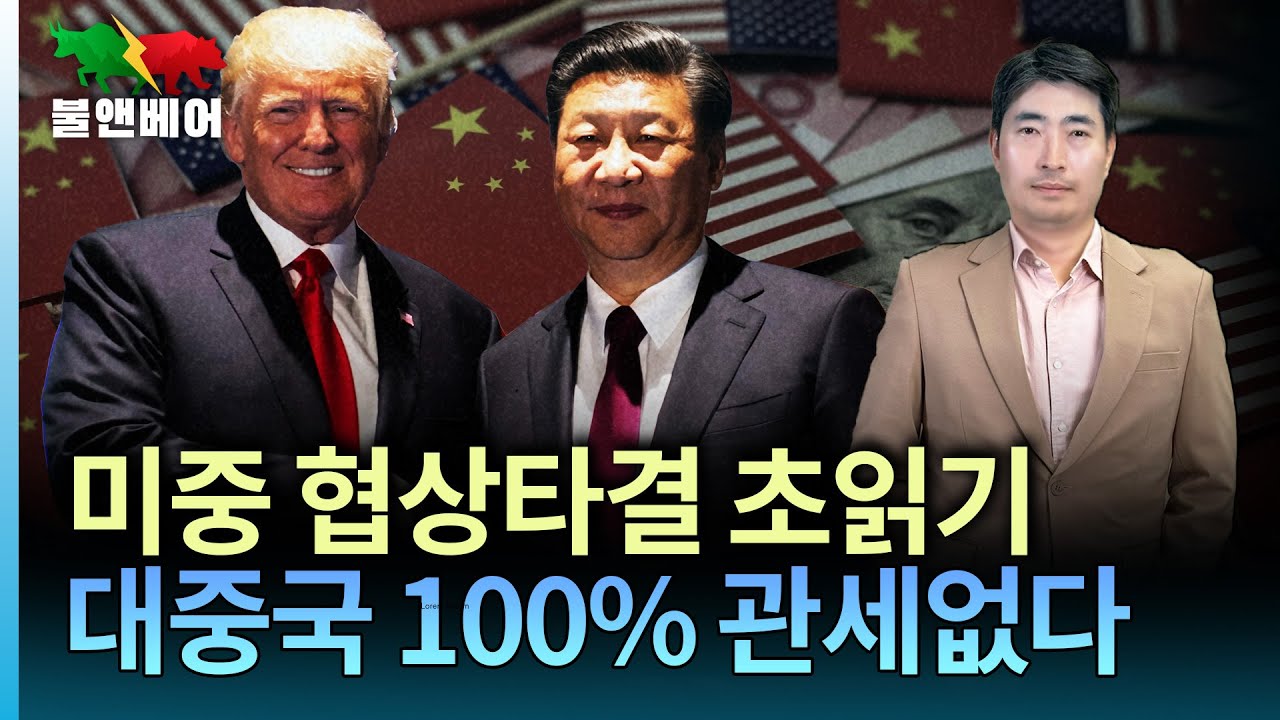
US-China “Draft Agreement” Emerges: Rare Earths, Tariffs, Risks – What Changes and Where Are the Opportunities?
The US and China have signaled that they have established an agreement framework including rare earths and tariffs.
A summary is provided that connects the flow from a draft agreement before the summit, the possibility of a tariff increase on November 1 and a relaxation of China’s rare earth export controls, to the rebound of risky assets including Bitcoin.
In particular, this article highlights the often-overlooked core points: the “limited legal binding nature of the framework,” “the rare earth value chain risk extending to AI, data centers, and EV motors,” and “changes in the trajectory of the dollar and interest rates and the reactivation of supply chains.”
It also provides a detailed investment checklist from the perspectives of the global economy, the dollar, interest rates, inflation, and supply chains.
News Summary: Core Points from the Original Text
- According to the original text, a US Treasury spokesperson (referred to as “Besent”) stated that “both countries have established a basic framework for a summit,” “a partial postponement of China’s rare earth export controls is expected,” and “the issue of an additional 100% tariff scheduled for November 1 is included.”
- The Chinese side (citing a statement from Deputy Director Li Qinggang of the Ministry of Commerce) also confirmed, “an initial agreement has been reached at the bureaucratic level,” and “this is the result of comprehensive discussions covering trade-related issues and fentanyl export controls.”
- Market participants reacted positively to risky assets, and Bitcoin was observed to rebound immediately.
- This agreement is interpreted as a “practical agreement before the summit → confirmation at the summit level” procedure, reflecting a modified negotiation process between the US, which prefers top-down decisions, and China, which values preliminary practical agreements.
Why This Issue Is Important: Structural Points
- The framework is close to a “principled agreement.”
- Its legal binding nature may be weak, and the detailed implementation will need to be confirmed later through documents (memorandums, regulatory notices, administrative orders, tariff announcements, etc.).
- Rare earths are strategic materials widely used in EV drive motors, wind power, robots/drones, and data center cooling fans/servers.
- With low supply elasticity, policy news alone can cause significant price and spread volatility.
- If tariffs are eased, there is potential for relieving global supply chain bottlenecks → easing dollar strength pressure → dampening inflation; conversely, if the agreement is delayed, risks may expand quickly.
Five Key Points Often Overlooked Elsewhere
- The gap between the framework and the final agreement: Actual changes in tariff rates must be confirmed by publication in the Federal Register or an announcement by the USTR.
- Rare earths = an auxiliary pillar for AI infrastructure: Demand for rare earth magnets is growing in data center fans, server actuators, robotic logistics, and cooling system motors rather than in GPUs themselves.
- Continued ‘motor demand’ in the transition to SSDs: Despite a decrease in HDD proportions, in-rack cooling and power components continue to grow with AI expansion.
- The ‘snapback’ risk of export controls within China: Even with an agreement, there is an inherent option for controls to be reinstated during geopolitical events.
- The asymmetry of exchange rate and interest rate trajectories: News of tariff easing can trigger sensitivity with a weaker dollar and lower interest rates, but delays in the agreement can cause a more exaggerated reversal.
Scenario Outlook: Global Economy, Dollar, Interest Rates, Inflation, Supply Chains
- Base Scenario (high probability): The framework is maintained, rare earth controls are partially postponed, and additional tariffs are withheld or reduced.
Expect a gradual adjustment in the dollar index, stabilization or slight decline in US Treasury yields, renewed expectations of easing inflation, and reflection of supply chain normalization. - Bullish Scenario: Announcements of mutual concessions at the summit (partial tariff withdrawal and clear relaxation of controls).
This would trigger a global risky asset rally, with strong performance in sectors like semiconductors, intermediate goods, new energy, and reopening-related industries, while commodities show mixed results (copper ↑, rare earth volatility ↓). - Bearish Scenario: Delays in the final settlement due to differences in specific wording, reactivation of the November 1 tariff variable, and a snapback of Chinese controls.
This could lead to a return of a stronger dollar, rising interest rates, a surge in volatility, pressure on emerging markets and export stocks, and heightened risks of inflation resurgence.
Sector and Asset Strategy: What to Buy and What to Avoid
- Semiconductors and AI Infrastructure: Focus on the value chain in servers, power, and cooling (power modules, cooling systems, racks, cabling, switching).
- Rare Earth Alternatives and Domestic Production: Look at NdFeB magnet recycling, dysprosium reduction technologies, and non-rare-earth motor solutions (switched reluctance motors).
- Minerals and Materials: Identify rare earth and copper projects in Australia and the US, firms with separation and refining technologies, and companies that have secured long-term offtake agreements.
- Korean Beneficiaries: Companies in memory, post-processing, power semiconductor materials, motors, gearboxes, secondary battery precursors/copper foils, and data center power facilities.
- Crypto: With tariff easing → renewed risk-on sentiments, Bitcoin and Ethereum momentum may strengthen.
- Bonds: In both the base and bullish scenarios, some exposure to duration is effective. For the bearish scenario, hedge using short duration and volatility calls.
- Exchange Rates: In a weak dollar phase, the won and Asian currencies may also strengthen; however, in the event of a delayed agreement, a rapid reversal is possible.
Investment Checklist: Actionable Items
- Verify official documents: Look out for announcements from the USTR and the Treasury, and publication in the Federal Register.
- Check the original texts of export control notices from China’s Ministry of Commerce and the National Development and Reform Commission.
- Monitor rare earth prices (neodymium, dysprosium), their spreads, and logistics lead times.
- Track the direction of the CNH (offshore yuan), the dollar index, and the US 10-year yield.
- Monitor semiconductor and AI server order data, leading export indicators for Korea, and port cargo volumes.
From an AI Trend Perspective: LLM Expansion and the Realignment of Materials and Components
- Expansion of data centers (power and cooling) is a bottleneck for AI performance improvements.
- Although rare earths do not directly produce GPUs, they are key to powering cooling fans, servo motors for servers, AGVs, and robots, making their demand linked to AI infrastructure expansion.
- In the medium to long term, the trend is toward diversifying risk through non-rare-earth motors, recycling technologies, and supply diversification (US, Australia, Japan, EU).
- The spread of on-device AI increases demand for electric motors and sensor-driven components, requiring resilience throughout the materials chain.
Risk Management: Positioning and Hedging
- Avoid excessive bets until the agreement is finalized, and adopt a segmented approach to event risks.
- Combine downside hedging using options (index put spreads, long volatility) with correlated hedges in bonds and the dollar.
- Given the sensitivity of materials and minerals to news, establish pre-defined stop-loss and profit-taking rules.
Q&A Recap
- Will tariffs disappear immediately?
It cannot be definitively stated without official announcements. Detailed implementation documents need to be reviewed. - Will rare earth prices drop if controls are lifted?
Short-term easing may reduce volatility, but the snapback risk can maintain an upward premium. - How will this affect the Korean stock market?
It is favorable for semiconductors, power, and industrials, and in a weak dollar phase, it benefits foreign inflows. - Will the crypto rebound persist?
There is potential if the risk-on environment persists, but any delay in the agreement can quickly reverse this sentiment. - What should be monitored?
Monitor USTR and Chinese Ministry of Commerce notices, the dollar and interest rates, rare earth market prices, and data center CAPEX guidance.
One-Line Key Takeaway
The framework is just the beginning; the true value of this agreement depends on how well the link between rare earths, tariffs, AI infrastructure, and the dollar/interest rates is stabilized.
Implications for Korean Investors
- As the global economic cycle reactivates, Korea, which is highly export sensitive, could see a significant leverage effect.
- Prepare for a rotation towards sectors such as semiconductors, power, and materials, and monitor companies with rare earth reduction or substitution technologies for potential re-rating.
- It is crucial to maintain hedges against a bearish scenario at all times to manage volatility shocks.
Timeline Guide (Assumptions)
- T0: Signals of a practical ‘framework’ being formed by the negotiators.
- T0~T+2 weeks: Adjustment of language around the summit and potential official announcements around the time of the summit.
- T+1~2 months: Economic data reflecting the actual implementation or postponement of tariffs and export controls.
- Ongoing: Simultaneous monitoring of rare earth prices, CNH, DXY, and the US 10-year yield.
Sample Investment Ideas (For Educational Purposes)
- Base Scenario: A basket of AI infrastructure value chain stocks (power, cooling, racks) combined with a selective mix of long and short-term interest rate exposure.
- Bullish Scenario: Increased exposure to Korean/Asian export stocks, long positions in the won, and exposure to copper and industrial metals.
- Bearish Scenario: Long volatility positions, long dollar positions, and a focus on short-term bonds and defensive sectors.
Conclusion
This is a phase for confirming “evidence of implementation” rather than focusing solely on the direction of the news.
The real challenge and opportunity of the agreement lie in managing both risks and opportunities across the interconnected chain of rare earths, tariffs, AI infrastructure, and the dollar/interest rates.
< Summary >
- The US and China have established a framework ahead of the summit, with key issues being the partial postponement of rare earth controls and additional tariff issues.
- The framework itself has weak legal binding power, so official announcements must be used for confirmation.
- With the expansion of AI infrastructure, rare earths play a critical role in data centers, robotics, and EV motors, and their prices may experience significant volatility.
- In the base scenario, expectations of easing in the dollar and interest rates and supply chain normalization favor risky assets.
- Investment strategies that mix offensive positions in AI infrastructure and substitute materials with defensive positions using options and the dollar are effective.
[Related Articles…]
- The Impact of a Strong Dollar and Supply Chain Reconfiguration on Korea’s Semiconductors
- AI Supply Chain and Rare Earth Strategies: Korea’s Next Card
*Source: [ Maeil Business Newspaper ]
– [홍장원의 불앤베어] 미중간 합의 초안 나와, 이제 싸움은 끝인 걸까