*Source: https://www.hankyung.com/article/202510225493i

● Samsung’s XR Glasses Game-Changer for AI, Fashion, Market Disruption
Samsung unveils ‘Galaxy XR’, a deep dive into its smart glasses strategy — partners, market, AI monetization at a glance
Key insights after Samsung Electronics’ new product announcement:
- With the launch of Galaxy XR, Samsung is preparing ‘glasses-type smart glasses’.
- Collaborating with key partners Gentle Monster and Warby Parker to attempt popularization through design and fashion strategy.
- Smart glasses are seen as the ‘end destination’ device for bringing generative AI into everyday life and real use cases.
- Although Meta is currently leading the market, it is still in the early stages, allowing for significant market shifts.
- Points of interest from investment, supply chain, regulation, and privacy aspects that businesses and investors should note.
Product Strategy: Expanding Form Factor from XR to Smart Glasses
Samsung announced plans for form factor expansion within the XR ecosystem alongside the unveiling of the Galaxy XR.While Galaxy XR is in the form of a headset worn over the head, Samsung had originally planned with glasses-type (smart glasses) in mind.Smart glasses, being wearable daily, are evaluated as the ‘end destination’ of XR.By providing functions such as real-time navigation, photography, voice, and translation through glasses lenses and external speakers, combined with generative AI, usability is expected to greatly increase.Samsung announced partnerships with Gentle Monster and Warby Parker to enhance design and fashion receptivity.
Core message:Smart glasses are likely to evolve beyond a mere device launch into platform competition that combines consumer’s daily life with AI services to create a profit model.
The Importance of Partnership and Design
Unlike traditional headsets, smart glasses are a visible fashion item.A representative example is Meta’s collaboration with EssilorLuxottica, the owner of Ray-Ban and Oakley brands, to dominate the market.Samsung aims to secure brand trust, distribution networks, and fashion sensibility by collaborating with K-eyewear powerhouse Gentle Monster and the American Warby Parker.This strategy encompasses not only hardware competition but also distribution and branding competition.
Core message:Without fashion and brand partnerships, rapid diffusion into consumers’ daily lives is challenging. Samsung’s partner lineup is highly strategic.
Market Share and Competitive Landscape
Current market indicators (as of the first half of this year) show Meta holding approximately 73% share.Chinese companies like Huawei, TCL, and Xiaomi collectively hold about 10%.Meta, collaborating with Ray-Ban, sold over one million smart glasses last year, tripling sales compared to the previous year.However, the overall market size remains small.According to MarketsandMarkets data, the global smart glasses market was only about $5.87 billion (approximately 8.4 trillion won) last year.
Core message:While Meta’s dominance is clear, the market is still in its early stages, allowing entrants like Samsung, Chinese companies, and startups to quickly change the landscape.
The Integration of Generative AI and Smart Glasses — Real Usage Scenarios
Smart glasses enable an ‘augmented daily life’ by utilizing generative AI in real-time.Main usage scenarios:
- Navigation: Real-time navigation and information overlay on the landscape ahead.
- Meeting assistance: Real-time search and summary of queries during meetings.
- Interpreter/subtitles: Real-time foreign language translation provided via glasses speakers and subtitles.
- Photo/video content creation: Media capture based on the field of view and AI editing/summarization.
- Shopping/advertisements: Instant display of product information and purchase links in the user’s view.
Core message:The integration of generative AI determines the ‘utility’ of smart glasses. Service and data ecosystems are likely to dictate long-term revenue more than device sales.
Economic Impact: Supply Chain, Investment, Monetization Points
Supply chain perspective:
- Increased demand for key components (micro-displays, waveguides, sensors, low-power processors, batteries).
- Possible expansion of revenues for related semiconductor, optical, and sensor companies.
Investment perspective:
- Potential investments are hardware component companies, eyewear brands, AR/VR software platforms, and cloud/AI infrastructure providers.
- The potential for value increase is significant in companies providing ‘platforms (software/services)’ in the early-stage market.
Monetization model:
- Device sales (hardware)
- Subscription services (AR navigation, real-time translation, etc.)
- Advertising/local commerce (AR advertisements, store overlays)
- B2B solutions (remote collaboration, field support)
Core message:While short-term interest is in device sales, long-term value will be created in the AI data/service ecosystem and platform business.
Regulation, Privacy, and Social Acceptance Issues
Privacy:
- Cameras and voice recording in glasses raise concerns about privacy invasion.
- Potential strengthening of regulations regarding public space filming and data collection.
Safety and ethics:
- AR content’s risk of reality confusion, liability issues if incorrect information is exposed.
- Need for functionality to prevent false generative AI products (deep fakes, etc.).
Social acceptance:
- Resolution of issues related to design, weight, battery, and price is needed for widespread acceptance.
- Public etiquette and legal norms will govern the speed of proliferation.
Core message:Technological progress alone is not enough. Regulations, ethics, and social consensus must quickly catch up for smooth commercialization.
Implications for Companies and Investors (Immediate Actions Recommended)
For companies:
- Collaborate with fashion and distribution partners to enhance consumer accessibility.
- Develop tightly integrated plans with generative AI and cloud partners (e.g., Google).
- Design privacy and safety features from the early stages of product development.
For investors:
- Examine stocks related to key AR components (micro-optics, sensors, low-power chips).
- Monitor initial growth indicators of platform/service (AR SDK, content production tools) companies.
- Include regulatory risks and consumer acceptance variables in investment risks.
Core message:Focus on medium to long-term platform and data value rather than short-term profits when constructing your portfolio.
The ‘Most Important’ Insights Not Covered Well by Other Media
1) Design partnerships are not just brand associations.
- Gentle Monster and Warby Parker provide distribution channels and offline experience spaces.
- A rapid ‘data-feedback loop’ is formed through consumer wearing experience, directly affecting product improvement and service conversion rates.
2) Hardware competition converges into a platform war.
- Ultimately, long-term competitiveness depends on who dominates the software and cloud stack collecting user data.
- The key confrontation point is Samsung’s linkage with Google (Android XR) and Meta’s own ecosystem strategy.
3) The “invisible company” in the supply chain may actually be the winner.
- Companies that monopolize or secure key components such as waveguides, µLEDs, and AR-specific ISP (image signal processors) early may enjoy high added value.
4) Regulation and privacy determine speed of proliferation and revenue models.
- Strict shooting restrictions and data regulations could delay monetization from advertisements and local commerce.
- Therefore, companies must invest proactively in legal and ethical design.
Core message:Observing only the external competition (devices, brands) is not enough. The invisible supply chain, data platforms, and regulatory response capabilities determine the real outcome.
< Summary >Samsung Electronics announced its plan to launch glasses-type smart glasses along with the Galaxy XR unveiling, collaborating with Gentle Monster and Warby Parker.Smart glasses, combined with generative AI, are expected to expand into a platform offering services like information, translation, photos, and advertising in daily life.While Meta currently leads the market, the small market size allows for rapid shifts in the landscape.In terms of investment and supply chain, component manufacturers for optics, sensors, and low-power chips, as well as AR software and cloud service providers, are key beneficiaries.Regulation, privacy, and social acceptance will influence the speed of proliferation and revenue models, requiring a preemptive response.
[Related articles…]Samsung Smart Glasses Strategy AnalysisGlobal Smart Glasses Market Outlook
● Property Bubble, Currency Crisis, Fed on Edge
[LIVE Immediate Analysis] Housing Prices, Exchange Rates, Employment, and Interest Rates: What Will Change in This Week’s ‘Big Week’
In this article, I will first firmly state that it covers three key points.
- It explains with figures and pathways why rising housing prices reduce potential growth.
- It outlines in a scenario the reasons why the USD/KRW exchange rate is hovering around 1500 won and the conditions for a “drastic reversal” following the Korea-US summit.
- It deconstructs whether the employment slowdown is “policy-induced” and explains, through the FOMC reaction function, the impact this has on the policy interest rate path and inflation.
It also separately covers the often-overlooked link between credit allocation, productivity, and growth, as well as the perspective that “fund structure” conditions trigger the exchange rate far more directly than currency swaps.
1) Housing Prices and the Economy — The True Channel Through Which Rising Real Estate Prices Erode Potential Growth
Key points summarized first.
- Inequality/Social Stability: A surge in the PIR (price-to-income ratio) cuts off the ladder to homeownership for the middle class, simultaneously triggering asset inequality and dampening consumption.
- Potential Growth Path: Potential growth is determined by the sum of three components—labor input, capital input, and total factor productivity (TFP).
- Distorted Credit Allocation: When loans are excessively directed toward real estate and construction, funds that could have been channeled into high-productivity manufacturing and new industries dry up.
- Bank Profit Structure: Business models based on net interest income tend to favor real estate collateralized loans that lower risk-weighted assets, thereby reinforcing the concentration, while innovative finance based on non-interest income is stifled.
News format summary.
- Fact: Overvalued housing prices and a rising PIR increase the share of housing expenses in disposable income, constraining private consumption.
- Causality: A bias in lending toward real estate → reduced investment/employment in innovative industries → lower TFP → decline in potential growth.
- Policy Evaluation: Even if short-term regulations curb the expansion, the phenomenon may simply transfer by region (Seoul → Capital area → metropolitan cities).
- Alternative Direction: A combination of realistic property taxes with reduced transaction taxes, institutionalizing the rental market (incentives for monthly rent supply), and expanding policy finance allocations for productivity industries must be implemented concurrently.
Key points to watch here.
- Monetary Policy Dilemma: Even if there are signals of easing inflation and the economy, rising housing prices and exacerbated household debt risks constrain any move to lower the policy rate.
- Logic of the Solution: Fiscal and real estate policies must create a “protective barrier” to prevent liquidity from flowing into overheated sectors so that monetary policy can focus on the economy and inflation.
- In other words, a failure in the policy mix forces an upward shift in the neutral level of the policy interest rate.
Takeaway from the economic outlook perspective.
- Real estate regulations alone are not enough to safeguard the growth rate.
- The turning point for the growth rate will be determined by a triple shift in “financial-fiscal-tax” policies that redirects credit allocation back to the productivity sector.
2) Exchange Rates and the Economy — Is the 1500 Won Era Coming, and Three Ways the Korea-US Summit Can Change the Game
Let’s first set the current picture.
- Even though the Dollar Index has been on a gradual decline, the USD/KRW exchange rate remains at a high level.
- This means that the “risk premium on the won” has increased more than the “dollar strength.”
- The core risk is not the currency swap itself but the “cash, prepayment, and profit allocation” conditions of U.S.-bound investment funds.
Why the fund structure is more important than swaps.
- Currency swaps are essentially a short-term liquidity safety net, but their purpose differs from the conditions required for large-scale and long-term investments.
- A considerable portion of foreign exchange reserves is held in marketable securities with limited immediate cash availability, so a demand for “large-scale cash prepayments” increases the uncertainty premium in the foreign exchange market.
This week’s scenario tree.
- Scenario A (Favorable Agreement): A slight reduction in cash requirements, staggered payments, and allowance for a portion of profits to be reinvested → leads to uncertainty subsiding, making it likely that 1440 won represented the peak → the rate could enter a stable range in the upper 1300s to lower 1400s.
- Scenario B (Tight Agreement): High demands for cash prepayment and profit repatriation → potentially testing the 1500 won level, followed by reduced volatility due to the “conclusive” effect.
- Scenario C (Delay/Failure): Prolonged uncertainty → level increases with a widening spread, and proactive hedging by companies may drive the level even higher.
Check levels from a trading/risk perspective.
- Technical Pivot: Monitor the duration and trading volume in the 1440, 1500, and 1530 zones.
- Macro Triggers: Watch for changes in phrases such as “employment-inflation balance” in the FOMC statement, the tone from U.S.-China summit talks, and keywords from trade negotiations (tariff rates, exceptions, permits).
- Real Economy Scales: Look for clues regarding tariffs/subsidies for semiconductors and automobiles, and supply chain guidelines for raw materials (heat-resistant alloys/battery materials).
In summary, the dramatic reversal in the exchange rate comes not from swaps but from the “fund conditions” and the achievement of a “clear conclusion.”
Once a conclusion is reached, regardless of the direction, volatility subsides, and the level is realigned based on fundamentals, interest rate differentials, and trade surpluses/deficits.
3) Employment and Interest Rates — The ‘Intentional’ Employment Slowdown and the Policy Rate Path
The nature of the employment slowdown is structurally broken down.
- Demand-side Factors: Increased tariffs compress margins for importers, leading them to adjust wage expenses (resulting in reduced hiring).
- Supply-side Factors: Reduced immigration decreases the labor supply, thereby intensifying wage and price rigidity and restricting aggregate supply.
- Government Efficiency/Shutdown: Cuts in federal employment and delays in expenditure dampen non-defense demand and cool employment.
News format summary.
- Fact: Although the unemployment rate is not at historically crisis-levels, it has clearly begun an upward trend.
- Interpretation: Policy-induced factors have a greater contribution than cyclical shocks.
- FOMC Reaction: Chairman Powell’s message of “a shift in the risk balance” signals that there may be greater sensitivity toward employment stability compared to inflation.
Policy Rate and Liquidity Signals.
- An employment slowdown → strengthens bets on rate cuts → eases financial conditions → triggers a re-expansion of M2 liquidity → may result in an asset price rally and a “lagging” overheating of inflation.
- According to the Phillips Curve logic, a scenario of “moderate employment cooling plus easing inflation” would justify a rate cut, but if inflation reasserts itself, the policy path may be aborted.
Important points from an investment perspective.
- The liquidity rally will cease if inflation re-heats beyond a critical threshold.
- In other words, the “round trip” of liquidity-inflation-interest rates could occur repeatedly over a one-to-two-year time frame.
Policy Recommendations — From Regulation to a Policy Mix, Safeguarding the Growth Rate
- Real Estate: Mitigate economic distortions from holding and transactions by rationalizing property taxes and reducing transaction taxes, thus restructuring towards genuine demand.
- Rental Market: Ease housing cost inflation by institutionalizing incentives for monthly rent suppliers.
- Financial Allocation: Revamp policy finance and guarantee schemes to focus on productivity industries (semiconductors, batteries, AI, robotics) to boost TFP.
- Coordination Between Monetary and Fiscal Policies: If fiscal measures can create a “barrier” to overheating sectors, monetary policy can concentrate on the economy and inflation, thereby enhancing the efficiency of the policy rate.
Key Points Highlighted Only Here (Aspects Not Often Discussed Elsewhere)
- The Credit Allocation → TFP Channel: Policies should target the structural correlation of “increased real estate loan share ↔ decreased TFP, increased manufacturing loan share ↔ increased TFP” in order to protect the growth rate.
- The Real Trigger for Exchange Rates: It is the conditions of U.S. fund structures (cash ratio, payment schedule, profit allocation) that determine the exchange rate level, rather than short-term swap news.
- The “No-Barrier” Analogy in Monetary Policy: If fiscal and real estate measures do not shield the overheated sectors, the policy rate cannot be easily lowered even during economic recovery.
- Policy-Induced Employment Slowdown: If the combined effects of tariffs, immigration restrictions, and public efficiency measures produce an “intentional cooling,” the FOMC may react more sensitively to employment than to inflation.
- The Return and Exit of Liquidity: It should not be forgotten that the exit signal for this rally is the official confirmation that the “critical threshold of reheated inflation” has been reached.
Data/Indicator Calendar & Key Points to Watch
- Summit: Read the tone and keywords (tariff rates, exceptions, profit allocation, supply chain) from the Korea-US and US-China summit outcome announcements as if they were market-moving pre-announcements.
- FOMC: Pay attention to the phrase “employment-inflation balance” in the statement and any changes in the neutral rate estimates in the dot plot.
- Employment Indicators: The trends in the unemployment rate, nonfarm payrolls, and wage growth will signal the future path of interest rates.
- Price Indicators: The momentum shift in core CPI/PCE directly impacts the lifespan of the liquidity rally.
- Exchange Rate Levels: Monitor the duration and volume in the 1440/1500 zones for USD/KRW, along with DXY levels at 100/105 and the 2-year/10-year U.S. yield spread.
Portfolio Checklist (Practical Strategies)
- FX Hedge: For exporting companies, gradually increase hedge ratios above the 1440 level; for importing companies, employ a staggered unwind strategy during periods of reduced volatility after the negotiation results are announced.
- Interest Rate Duration: Assuming a gradual curve steepening (short-term down, long-term conservatively positioned), consider increasing exposure in the medium duration (3–5 years).
- Equities: Trade on headline risks surrounding the summit for trade-sensitive industries, and focus on structural growth sectors such as AI, semiconductors, and batteries where productivity leverage is strong.
- Real Estate: Take a conservative approach to leverage expansion, focusing on assets with improved rental cash flow during rebalancing.
< Summary >
- Rising real estate prices erode TFP and lower potential growth through distorted credit allocation.
- The key to a dramatic shift in the exchange rate lies not in currency swaps but in U.S. fund “conditions” and the resolution of uncertainty.
- The employment slowdown is largely policy-induced, which stimulates bets on rate cuts, though a reheating of inflation signifies the exit signal.
- The policy mix ultimately determines both the operating range of monetary policy and the floor for the growth rate.
[Related Articles…]
- Key Checkpoints for a ‘Dramatic Reversal’ in the Korean Exchange Rate
- Understanding the Relationship Between Housing Prices and Potential Growth
*Source: [ 경제 읽어주는 남자(김광석TV) ]
– [LIVE] (1)집값과 경제 (2)환율과 경제 (3)고용과 금리 [즉시분석]
● Trade Truce, Tech Cold War, Rare Earth Relief
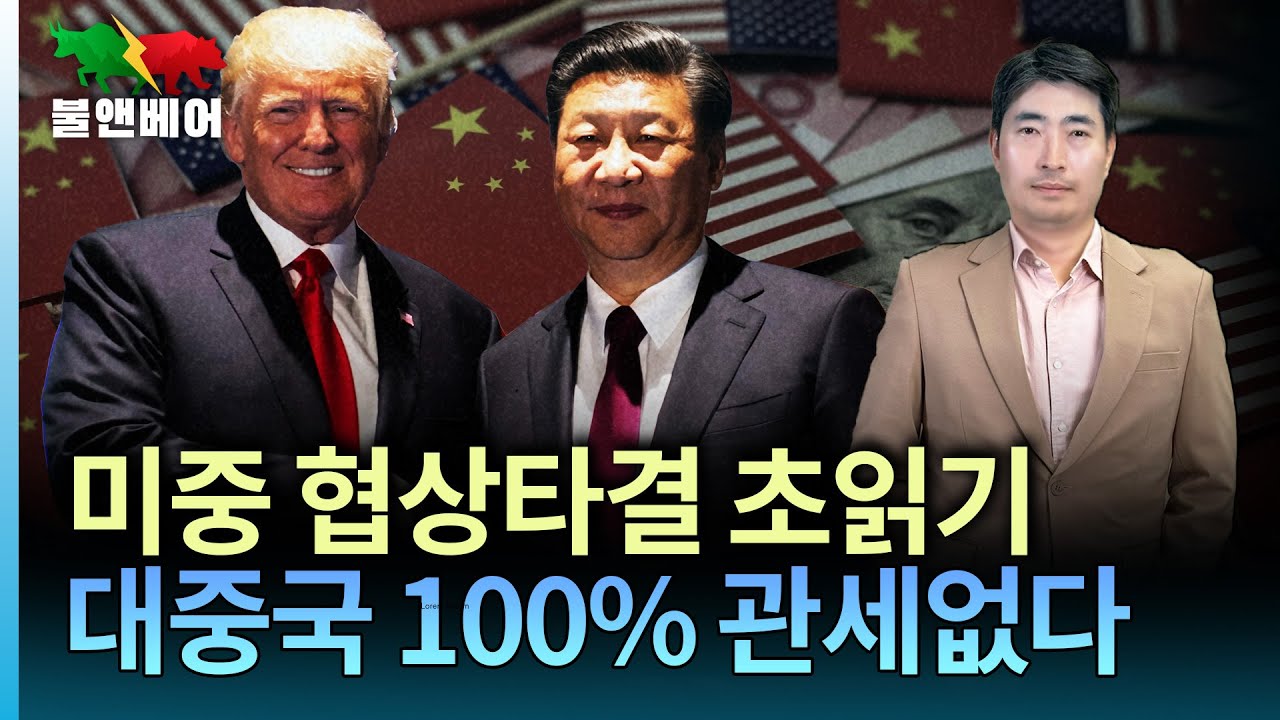
[Draft US-China Agreement] Easing of Rare Earth Controls, 100% Tariff Suspension, Fentanyl Control… The Real Impact of This Agreement on the Stock Market and AI Supply Chains
This article covers 1) the actual ripple effects of easing rare earth export controls and the possibility of a 100% tariff suspension, 2) the impact of top‐down vs bottom‐up negotiation frameworks on market volatility, 3) the short‐term shocks and medium‐term equilibrium on interest rates, exchange rates, and inflation trajectories, 4) the winners and losers across sectors such as AI hardware, EVs, wind energy, and semiconductors, and 5) the “gaps in the agreement” that other media rarely touch upon along with a risk management checklist.
Let’s summarize the key points immediately to reduce the time spent on investment decision-making.
News at a Glance: Who, What, When, and Why It Matters?
Reports have emerged that the United States and China have essentially reached a “framework” on an agreement ahead of the summit.
The issues include easing rare earth export controls, the possibility of suspending the 100% additional tariff scheduled for November 1, and enhanced cooperation on fentanyl crackdowns.
The U.S. financial team indicated that a basic framework for summit-level talks has been established, while the Chinese technical team referred to it as a “provisional agreement.”
Risk assets have been interpreted as positive news, with Bitcoin and some growth stocks rebounding as a result.
The key point is that the term “framework” might indicate a conditional suspension or easing rather than an immediate withdrawal of tariffs and export controls.
Why is the ‘Framework’ Important: The Clash Between Top-Down and Bottom-Up Approaches
The United States has favored a top-down approach with presidential-level talks, establishing an overall agreement first and adjusting the details later.
China, on the other hand, prefers a bottom-up approach where technical agreements come first, followed by summit-level sign-offs and confirmations.
The emergence of a “framework” at this stage means that both countries have established a safeguard to avoid short-term clashes on sensitive items (rare earths) and politically symbolic issues (fentanyl).
However, structural issues such as technology export controls (advanced semiconductors and AI GPUs) are likely to remain outside the framework.
In other words, while the sparks of the trade war may subside, the tech hegemony battle is expected to continue.
Rare Earths, Tariffs, Fentanyl: Specific Issues and Market Ripple Effects
- Easing rare earth export controls: The alleviation of supply tensions for critical permanent magnet materials like NdPr, Dy, Tb provides instant benefits for EV motors and wind turbines.
Reducing supply chain risk premiums may lower price volatility for these materials. - Possibility of suspending the 100% additional tariff: This would avoid immediate amplification of inflationary pressures and, in the short term, alleviate upward pressure on consumer prices.
This could exert a mild downward pressure on interest rate trajectories and act as a factor to ease the strength of the dollar in terms of exchange rates. - Cooperation on fentanyl crackdowns: This has strong diplomatic symbolism and reduces the probability of triggering secondary sanctions, thereby helping to cushion financial market volatility.
Tracking Macro Variables: Interest Rates, Exchange Rates, Inflation, Economic Growth Trajectories
- Interest Rates: Tariff suspensions help restrain upward price pressures, strengthening the signal of reaching a mid-term peak in nominal interest rates.
However, if the rally in growth stocks overheats, volatility in long-term interest rates could actually increase. - Exchange Rates: In a phase of recovering risk appetite, a weaker dollar and stronger won are favorable; however, if technology sanctions remain in place, the yuan is likely to be confined within a box range with limited upside.
- Inflation: If tariff hikes cease, the price shock transmitted through import prices will subside, but service prices and wages will become key focal points.
- Economic Growth: Reduction in trade uncertainty improves investor sentiment in trade-sensitive sectors; however, ongoing structural decoupling will place an upper cap on global economic growth.
Sector Impact: Winners and Losers
- Rare Earths/Renewable Energy: Preference will strengthen along the value chain for EV motors and wind turbines (magnets, powders, parts).
Visibility of capital expenditure from non-Chinese suppliers (Australia, United States) will also increase. - Semiconductors/AI: Export restrictions on AI GPUs for data centers remain a key risk.
Restrictions on cloud workarounds and cross-border AI service governance remain, so equipment, EDA, and OSAT could benefit from regional diversification of investments, while some domestic Chinese AI may pivot towards edge computing. - Consumer/Retail: Suspension of tariffs would help restore margin leverage, benefiting low-cost electronics, home appliances, and apparel.
- Industrials/Logistics: Reduction in supply chain uncertainty premiums will slow down freight volatility and improve the pace of inventory normalization.
- Commodities: The excessive risk premium on NdPr prices is expected to ease, and copper and nickel may trade independently of domestic Chinese demand momentum.
From an AI Trends Perspective: Reconfiguring ‘Core and Edge’ Post-Agreement
- Data Center Core: Advanced GPU export restrictions are likely to remain, and AI core infrastructure centered on the United States and its allies will continue to concentrate.
Investments in AI servers, networking, cooling, and power infrastructure will be dispersed through reshoring/friend-shoring within the West. - Edge AI: China and emerging markets will accelerate a pivot towards edge NPUs, lightweight models, and on-device AI.
As inferences increase in mobile, PC, and IoT environments, local demand for memory and storage will also rise. - Materials/Components: Easing rare earth controls is positive for stabilizing actuator costs in motors, robotics, and AR/XR.
This is a positive development for the roadmap visibility of AI and robotics convergence products.
Investment Checklist by Scenario
- Base Case (High Probability): Tariff suspension + easing of rare earth controls, while technology sanctions remain in effect.
Strategy: Increase allocation in quality growth stocks (with robust cash flows), core value chains in EV/wind energy, and U.S.-based semiconductor equipment and foundry beneficiaries through diversification. - Adverse Scenario: Escalation of tariffs due to a breakdown in summit talks.
Strategy: Hedge volatility by reducing exposure to dollar, short-term bonds, consumer staples, and low-volatility factors, alongside cutting cyclical stocks and using covered calls/put spreads. - Favorable Surprise: Temporary exceptions for certain technology items.
Strategy: Leverage short-term trading in data center capex-sensitive stocks (power, switching, cooling) as well as server OEMs and HPC networking companies.
Timeline and Key Indicators
- Schedule: Monitor the announcement of the summit result, tariff declarations (Federal Register/USTR), and announcements from China’s Ministry of Commerce.
- Prices/Indicators: Spot NdPr prices, rare earth magnet premium, semiconductor equipment orders, global PMI, import prices, breakeven inflation, and the dollar index/dollar-yuan exchange rate.
- Policy Signals: U.S. regulations on cloud services for China and cross-border data norms, and China’s scope for reciprocal sanctions and cybersecurity reviews.
5 Key Points Overlooked by Other Media
1) The agreement’s “framework” might include automatic extension/automatic termination triggers.
It may automatically adjust tariff suspensions based on indicators such as prices, trade balances, and execution status.
2) Even with easing rare earth controls, a bottleneck could recur in the downstream stage known as “magnets.”
One must separately assess the resilience of the entire value chain from raw ore to refining, powder, and magnets.
3) Cooperation on fentanyl opens a de-escalation channel for financial sanctions, thereby curbing volatility.
In other words, financial and payment infrastructure risks may ease before those in foreign exchange and trade.
4) The invisible barriers in the services/data sphere are likely to persist.
There could be subtle regulations on big tech’s mainstream services, model APIs, and edge software distribution.
5) The pattern of “agreement drives a rally, but details lead to adjustments” may repeat.
The stock market may price in headline positive news, but be prepared for a two-stage process where valuations are re-adjusted after detailed wording is disclosed.
Risk Management and Practical Tips
- Factor Neutrality: Keep growth/value and large-cap/small-cap exposures relatively neutral while targeting alpha through sector and theme bets.
- Basket Approach: Diversify using a basket of EV motor/wind magnet value chain stocks instead of relying solely on individual rare earth stocks.
- Derivative Strategies: Avoid short-dated straddles/strangles around events; instead, using skewed protective puts can be effective.
- Currency Hedging: Partially hedge during strong won periods, and increase hedging ratios when technology sanction news flows intensify.
One-Line Conclusion
Tariffs and rare earths represent an evolutionary truce, while technology remains structurally divided.
The stock market appears to have priced in the positive news, with AI core concentrated in the West, and the edge and materials sectors likely to benefit from a restructuring.
< Summary >
- Key Points: Tariff suspension combined with easing of rare earth controls is favorable for stabilizing inflation and exchange rates while reinforcing the argument for a peak in interest rates.
- Market: Stocks benefiting from EV/wind energy and reshoring are likely to outperform, while ongoing technology sanctions keep the focus on AI core in the West.
- Strategy: Prepare for volatility during the phase when detailed wording is disclosed after a headline rally, and manage risk through baskets and hedging.
[Related Articles…]
- US-China Trade War Risks and Exchange Rate Volatility Guide
- AI Supply Chain Restructuring and Data Center Investment Cycle
*Source: [ Maeil Business Newspaper ]
– [홍장원의 불앤베어] 미중간 합의 초안 나와, 이제 싸움은 끝인 걸까