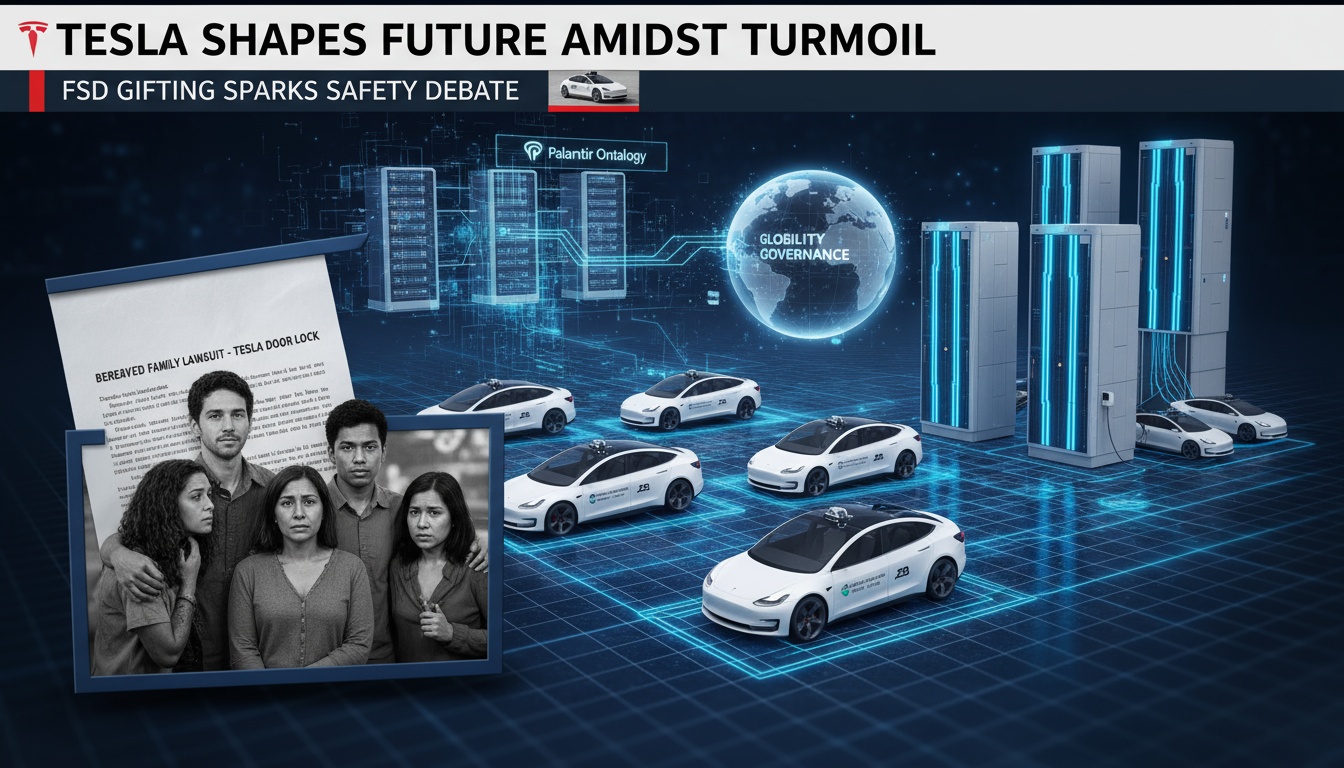
● Tesla’s Gamble, Lawsuit Fury, Battery Empire, Robo-Taxi Blitz, FSD Cashgrab, Space AI
Tesla Door Design Controversy to Samsung SDI ESS Alliance, 24-Hour Robo-Taxi, FSD Gifting, and ‘Space-Grade’ AI Chips — Decisive Changes in the Global Economy and AI Trends
In this article, there are five key points you can check immediately.The legal issues of the Wisconsin Tesla fire and the lawsuit by bereaved families versus the reality of design controversy.The structural changes in the data center and renewable energy markets driven by the Tesla-Samsung SDI $2 billion ESS alliance.The commercial roadmap implied by Tesla’s preparation for 24-hour robo-taxi conversion and its expanded hiring.The revenue model transformation of FSD subscription “gifting.”And the strategic implications of Tesla’s AI chip roadmap extending to “space applications” with possible SpaceX integration.
Breaking News Summary — Get Today’s Core News Quickly
Family members of the Wisconsin accident have filed a lawsuit against Tesla.The issue is the accessibility of the electronic door and the emergency manual release when power is cut off.Tesla refutes by saying “every vehicle is equipped with a manual release lever.”The NHTSA (U.S. National Highway Traffic Safety Administration) is also conducting a preliminary investigation into the door’s power supply and operational reliability.Tesla-Samsung SDI, approximately a $2 billion ESS battery agreement.It is reported that the scope has expanded from cells for Megapacks to production capacity targeting 30GWh+ annually at the North American production base.Tesla is simultaneously hiring night operation support personnel in several U.S. areas to prepare for 24-hour robo-taxi operations.Musk mentioned his goal of deploying 500 vehicles in Austin and 1,000 in the Bay Area by year-end (subject to schedule variations).FSD monthly subscription has been reduced to $99, alongside the announcement of a “gifting” feature.The shift to software revenue is expected to accelerate.Tesla mentioned its next-generation AI chips (AI5/AI6/AI7/AI8).AI8 is said to indicate the possibility of space applications.It may be integrated with SpaceX’s next-generation satellite and space data center concepts.
Issue 1 | Controversy and Design Debate in the Wisconsin Fire and Bereaved Families’ Lawsuit
Case Overview.An accident in Wisconsin led to a fire, and the bereaved families claim that because the electronic door didn’t operate due to a power cut, escape was difficult.Court hearings are ongoing, and the facts have not been confirmed.Tesla’s Position.Tesla refutes by stating that a manual release lever is installed on the front seat, allowing the door to be opened even in the event of a power loss.The driver and passenger seats are designed to open instantly via a door trim lever at the top.Key Usability Issue.The manual release for the rear seats is often hidden beneath elements like a metal tab under the seat cushion, making it difficult to locate quickly in situations full of smoke, flames, and panic.Some owners have retrofitted third-party auxiliary levers to improve accessibility.In short, while the function exists, the issue is the low ergonomic discoverability of the design.Regulatory and Comparative Context.Flush (integrated) electronic handles have become common in many electric vehicles, and similar controversies have arisen.China is reviewing a draft for strengthened safety standards for electronic door handles.The NHTSA has also initiated a preliminary investigation into the power supply reliability and possible malfunctions.Future Change Points.Tesla is reportedly considering improvements to the accessibility of the emergency release mechanism.It is likely to adopt a dual approach with both electronic buttons and mechanical releases, as well as enhanced visual indicators and tactile feedback.User education and HMI improvements are also likely to be implemented.
Issue 2 | Samsung SDI and the $2 Billion ESS Alliance — The “Baseloading” of Data Centers and Renewable Energy
Contract Structure.Samsung SDI will supply large industrial cells for Tesla Megapacks, centered around its North American plant.An annual production capacity of 30GWh+ is being discussed based on industry reports.Demand Background.There is a surge in the power demand of AI data centers and expanded renewable energy, which has increased peak variability.Energy storage systems (ESS) have become a core infrastructure for stabilizing power grids through demand response, peak shaving, and frequency regulation.Economic Impact.Battery demand, which was previously concentrated on electric vehicles, is structurally diversifying into ESS.The margin structure is shifting towards long-term supply agreements with stable margins, and Megapacks will become a key component in improving Tesla’s energy sales and cash flow.In terms of supply chain, both the reduction of dependency on China and the localization in North America are taking place simultaneously.Strategic Significance.Tesla is expanding its position from an “automotive company” to an “energy platform company.”It is building an ecosystem that bundles renewable energy, ESS, and AI data centers, in line with the global transition in power infrastructure.
Issue 3 | Signal for 24-Hour Robo-Taxi Conversion — Commercialization Phase of Operations, Maintenance, and Support Systems
Expanded Hiring.Tesla is recruiting night operation support personnel simultaneously in several U.S. cities.This indicates preparations for multi-region operations beyond single-city trials.Deployment Plans.Musk mentioned deploying 500 vehicles in Austin and 1,000 in the Bay Area by year-end.The timeline is highly subject to change based on regulatory approvals and quality data.Key Points to Watch.The establishment of maintenance, remote diagnostics, and on-site response systems that can bring vehicle uptime close to 24 hours is critical.Profitability will depend on vehicle utilization, insurance/accident costs, and autonomous driving software performance scores (accidents/mile, interventions/mile).
Issue 4 | FSD “Gifting” — Optimizing CAC in the Software Revenue Model
Policy Changes.In the U.S., the FSD monthly subscription is $99.The “gifting” feature, which allows subscription transfers on a month-by-month basis to family or acquaintances, is expected to be launched by year-end.Meaning and Impact.It serves as a viral device to lower customer acquisition costs (CAC) by enhancing conversion based on trial experiences.It aligns with the strategy to enhance cumulative margins through software after hardware sales.It is a key card to boost software ARPU during the phase of expanding electric vehicle adoption.Risks.Differences in regional regulations, performance perception discrepancies, and insurance/liability issues may affect the conversion rate.
Issue 5 | Tesla AI Chip Roadmap and ‘Space-Grade’ Expansion — Synergy with SpaceX System
Outline of the Roadmap.Musk mentioned multiple generations of chips such as AI5, AI6, AI7, and AI8.He affirmed that AI8 is “accurate” in its indication of space applications, hinting at integration with SpaceX.Why Space?There is a growing need for super-large computational infrastructure that surpasses terrestrial limitations in power and cooling.The concept of a satellite network (e.g., next-generation Starlink) and space data centers presents a new architecture from the perspectives of latency, heat management, and resiliency.Economic and Industrial Impact.AI computation as a core infrastructure vertically integrates the power industry, communication satellites, and terrestrial/space clouds.A new value chain in batteries, thermal management, and radiation-hardened semiconductors is emerging.
Market and Policy Watch Points — Where Investment and Regulation Intersect
Regulations.The NHTSA’s investigation into door safety may expand, and both China and the EU are trending toward stricter safety standards for electronic handles.For robo-taxis, obtaining city-specific operating permits and establishing insurance and liability frameworks are crucial.Supply Chain.With Samsung SDI joining, the diversification of ESS cells in North America will accelerate.Cost competitiveness will be determined by compliance with the IRA (U.S. Inflation Reduction Act) incentives and localization requirements.Demand Side.Megapack orders could structurally increase, driven by the demand for peak response in AI data centers and absorbing variability in renewable energy.Along with rising electric vehicle penetration, the share of software revenue is expected to expand.Risks.Potential lawsuits/recalls, risks in autonomous driving performance perception, supply chain investment timing, and interest rate levels are variables affecting valuations.
The Most Important Details Not Often Addressed Elsewhere
Ergonomic Discoverability.“There is a difference between ‘being there’ and being instantly accessible.”The lack of immediate visual and tactile discoverability of the rear seat emergency release poses an inherent design risk.A “zero learning” design that includes HMI/UI improvements and essential offline guidance (stickers, glow tags, tactile ribs) is necessary.Accounting Treatment for ESS in Data Centers.Megapacks are not just storage units but assets optimized for demand response, peak shaving, and revenue maximization.A financial structure that boosts IRR through bundled power rate avoidance, frequency regulation revenue, and renewable energy PPA is key.Cost Function of Space-Grade AI Compute.Despite high launch costs compared to terrestrial setups, when energy, cooling expenses, and gains in fault resiliency are summed up, space edge compute can be economically viable for specific workloads.It could be a game changer in communications, surveillance, and autonomous navigation data processing.Network Effects of FSD “Gifting.”Word-of-mouth diffusion based on user experiences directly contributes to acquiring learning data for specific regions.It is a strategic card that accelerates not just software margins but also model training speed.
Checklist — What to Watch Now
Safety and Regulations.Keep an eye on the results of the NHTSA investigation and whether Tesla discloses improvements in the visibility of its emergency release.There is also a key point in the possibility of short-term recalls or service campaigns.Energy.Watch the timeline for Samsung SDI’s production line, Megapack lead times, North American ESS order trends, and the classification guidelines for data center BESS.Autonomous Driving.The issuance of city-specific operating permits for robo-taxis, the KPIs for night operation, and the disclosure of intervention/mile metrics are critical.Software.Check the conversion rate of the FSD gifting feature, refund/liability policies, and the rate of regional expansion.Chips and Space.Watch for the release roadmap of AI chips and any demonstration issues regarding integration with SpaceX’s satellite/terrestrial gateway systems.
- The core issue of the bereaved families’ lawsuit is the “discoverability of the emergency release” and the operational reliability during a power loss.
- The ESS alliance with Samsung SDI accelerates Tesla’s transformation into an energy platform by integrating with AI data centers and renewable energy.
- The preparation for 24-hour robo-taxi operations signals the commercialization of the operational system, with success hinging on uptime, safety, and regulations.
- The FSD gifting feature is expected to contribute to expanding software margins by lowering CAC through a viral mechanism.
- Space-grade AI chips promise a compute architecture that overcomes power and cooling limitations, opening up the possibility for vertical integration with SpaceX.
[Related Articles…]
- The Economics of Data Center ESS Opened by the Tesla-Samsung SDI ‘Energy Alliance’
- 24-Hour Robo-Taxi Commercialization Checklist: Regulations, Profitability, Operational Metrics
*Source: [ 오늘의 테슬라 뉴스 ]
– 美유족 “차 문 못 열어 사망했다”…테슬라 상대로 소송 제기? 테슬라의 반박과 설계 논란의 전말은?
● Microsoft IREN 9.7B AI Shock, Power Race Sparks Data Center Frenzy
Wall Street Checkpoint: MS-IREN $9.7 Billion Mega Contract, S&P500 83% Earnings Surprise, and Shutdown Black Friday?
Key Points to Watch in This Article
It structurally explains where the ‘real money flows’ from Microsoft’s 5-year, $9.7 billion AI infrastructure deal with IREN will lead.
It summarizes why 83% of S&P500 companies beat EPS expectations and how to evaluate valuations amid widening gaps between stock prices and performance.
It provides a news-style quick understanding of the implications that a prolonged government shutdown has on employment indicators, GDP, and the interest rate trajectory.
It maps the supply chain bottlenecks of AI capital expenditures, including data center power, cooling, and transformer lead times, from a practical investment perspective—points not often discussed elsewhere.
US Market Opening Tone: AI Giants Leading the Index
At the market open, the Nasdaq started with about a 1% gain, driven by Nvidia reaching an all-time high and Amazon surging in the 5% range, pushing the index higher.
The S&P500 opened higher, while the Dow and Russell showed mixed results, reaffirming the tilt toward large-cap tech stocks.
AI-related stocks like Palantir and Micron remained strong, and Meta showed a recovery from some of its previous losses.
The key message is that the stock market is still betting on the combination of AI momentum and strong earnings power along the ‘Quality + Growth’ axis.
Earnings Season Briefing: 83% of the S&P500 Beat on EPS
As of October 31, 83% of reporting companies surpassed EPS consensus, and 79% exceeded sales expectations.
This represents strong upside, surpassing the 5-year average of 78% and the 10-year average of 75%, with an average earnings surprise margin of about 4%, higher than the past average of 3.5%.
Among sectors, infotech, healthcare, and energy drove earnings improvements and contributed significantly to the index.
However, since the mid-2024 period, the widening gap between stock prices and forward EPS indicates that a valuation re-assessment is in order.
The current 12-month forward PER of the S&P500 is around 23 times, higher than the 10-year average of 18.6 times, which makes it sensitive to the interest rate and inflation trajectory.
AI Capital Expenditure Supercycle: The Rationale for ‘Investing Where You Can See It’
Big tech companies are aggressively expanding capital expenditures on data centers and cloud, and unlike the dot-com era, their earnings and revenue are growing in tandem.
Amazon has presented plans to double its data center capacity over the next two years alongside accelerating its cloud revenue.
Meta has maintained its CAPEX aggression, yet short-term results visibility issues have increased its stock volatility.
Microsoft has chosen a strategy that drives both external AI compute procurement and internal cloud growth by signing a 5-year, $9.7 billion AI infrastructure partnership with IREN.
IREN is a large data center operator in North America, expanding its capacity to provide AI compute based on high-performance accelerators.
The key is ‘who secures how many chips and who holds the power capacity,’ and this contract partially provides an answer to that question.
There is significant leverage in terms of memory (HBM) and storage, as well as power infrastructure.
In Korea, SK Hynix and Samsung Electronics are being revalued as beneficiaries of the AI cycle, while in the US, bets on Micron’s improved market conditions are gaining strength.
Short-Term Risks and Responses: Three Factors Identified by Morgan Stanley
First, if the pace of interest rate cuts slows amid the heavy valuation burden, there could be a risk of multiple contraction.
Second, if signals of stress in the fundraising market reemerge, volatility among growth stocks may increase.
Third, if the market continues to narrow its focus (heavy concentration in large tech stocks), even if the index holds, the realized returns could weaken.
The strategic point is to overweight firms that can defend their multiples with strong earnings and cash flows, while adjusting position beta around key interest rate events.
Policy Risks: The Possibility and Implications of an Extended Shutdown
There is an increasing bet that political negotiation difficulties will lead to a shutdown extending until Black Friday (November 28).
If the shutdown is prolonged, gaps in official indicators such as employment reports will occur, making it harder for the Fed to gauge interest rate decisions, and increasing market volatility.
Q3 GDP growth slowed to 2.8% (annualized), and the impact of the shutdown is likely to be more fully reflected in figures from after October.
The interaction among the pace of easing inflation, the interest rate trajectory, and GDP momentum will determine the strength of the year-end rally.
Calendar Check: Major Earnings and Events
This week, earnings from Palantir, AMD, Uber, Shopify, Qualcomm, and ARM, among others in the AI, consumer, and mobility sectors, are packed closely together.
Attention should be paid to CAPEX, cloud demand, AI workload mix, and advertising cycle signals in the earnings guidance.
Alternative indicators like ADP employment and PMI should be monitored as supplements during this gap in official indicators.
Sector Idea: Structural Growth in the US School Bus Electrification Market
There are about 480,000 school buses operating in the US, and although the proportion of electric school buses is still low, subsidies and regulations are accelerating their adoption.
The overall market grows at 4~5% per year, while electric school buses are recording high growth rates of 25~33% annually.
BlueBird (BLBD), having supplied over 2,000 units to date, has secured industry leadership, making it one of the most clearly positioned stocks to benefit from policy drives.
Key variables for mid- to long-term margin improvements include power infrastructure, charging, battery residual value, and the residual value model.
The ‘Most Important Point’ Not Addressed Elsewhere
- Connecting the dots of AI capital expenditure distribution: Chip (Accelerator) → HBM/DRAM → Substrate/Foundry → Power Facilities (Transformers and Switchgear) → Cooling (Immersion/Water Cooling) → Data Center Land/Real Estate.
- The current bottleneck is not just the chips: Transformer lead times, grid expansion, water-cooled modules, and high-voltage cables are all concurrently tight.
- The true asset of data centers is the ‘power capacity’: The operator that secures power first leads in rental rates and margins.
- The paradox of indicator gaps: During a shutdown, noise in official employment/GDP figures increases, and signals for quant and macro funds can become unreliable.
- Investment points for Korea: HBM and advanced packaging, power semiconductors, immersion/water cooling components, and ultra-high voltage transformer chains all benefit simultaneously.
Practical Checklist
- Valuation: Consider the set of interest rate direction and multiples, focusing on core stocks with sustained upward revisions in performance.
- Cash Flow: Prioritize companies with clear timelines for revenue realization, even if they benefit from AI CAPEX.
- Risk Management: Adjust beta positions before and after policy events (shutdown, FOMC) and check for market breadth recovery as a benchmark.
- Simultaneous Review of Leaders/ Ecosystems: The duration of the cycle is determined by whether big tech (demand) and HBM, power, and cooling (supply) move in tandem.
One-Line Summary from a Korean Investor’s Perspective
Following the ‘path of cash flow’ of the AI supercycle reveals an extended map of beneficiaries, from semiconductor memory and packaging to data center power, cooling, and real estate.
While interest rates, inflation, and shutdown factors affect the speed, there is insufficient evidence to suggest they will change the overall direction.
< Summary >
The MS-IREN $9.7 billion deal shows that the competition to secure AI compute and power capacity is entering full swing.
83% of the S&P500 beat EPS expectations, and while valuations are high, earnings help defend them.
An extended shutdown creates gaps in indicators and adds noise to interest rate and GDP trajectories.
The key investment takeaway is the speed at which bottlenecks—from chips to HBM to power to cooling to land—are being resolved and which operators secure power capacity.
[Related Articles…]
- AI Data Center Power Crisis: The Investment Key is in Power Capacity
- S&P500 Earnings Surprises and Valuations: The Sector Opening the Next Cycle
*Source: [ Maeil Business Newspaper ]
– MS, IREN과 5년간 97억 달러 계약 체결ㅣS&P500 기업 83%가 EPS 예상치 상회ㅣ장기화되는 셧다운, 블프때까지 계속?ㅣ홍키자의 매일뉴욕
● Palantir Skyrockets, Commercial Boom Sparks AI Monopoly
Palantir, Rule of 40 at 114% · The True Meaning of a 121% Surge in U.S. Commercial Sales and the Conclusion of the “Stock Is About to Drop” Debate
This article dissects the numbers behind overachievement, the qualitative change in commercial sales with a 121% surge, the mechanism by which a surge in RPO translates into next year’s revenue, the essence of the collaboration between NVIDIA and Ontology, the checklist for signals that “the stock is about to drop” in an overvalued range, and the scenario linking macro variables such as interest rates, inflation, and GDP with the stock market.
It also separately summarizes the practical implications of “domain lock-in created by AIP” and “SaaS restructuring triggered by LLM operational systemization,” which other media have only briefly mentioned.
Earnings Breaking: Let the Numbers Speak First
EPS of $0.21 surpassed the consensus of $0.17 by more than 20%.
Revenues exceeded expectations by approximately 10%, registering a double-digit surprise.
The stock price rose about 3% on the main market and continued to climb in after-hours trading, but the surge was limited due to an overbought condition already reflected.
The Rule of 40 reached 114%, reaffirming its high level while proving both growth and profitability.
U.S. commercial sales surged by 121% year-over-year, and government sales increased by 52%, confirming the dual engine.
Why Did the Stock Only Rise by 3% Despite “Superb Earnings”?
Expectations had already been priced in before the earnings, which led to high valuation multiples.
When the numbers are too strong, a ‘good news is sell-the-news’ pattern triggers short-term profit-taking.
Uncertainty over macro interest rate levels and the pace of inflation slowdown is temporarily restraining the expansion of growth stock multiples.
In conclusion, the interpretation is that the direction is upward but at a moderated pace.
AIP and Ontology: Palantir’s Domain Lock-In
AIP lowers the adoption barrier by enabling non-developers to design workflows through the LLM layer.
Palantir Ontology embeds an organization’s unique rules, processes, and data relationships into the software, turning it into an enterprise-wide operational standard.
This “structured anchoring” is a true entry barrier that is difficult for competitors to replicate and serves as a source of ROI.
The collaboration with NVIDIA enables the Ontology model to run with GPU acceleration and in edge environments, expanding it to real-time decision-making.
SaaS Landscape Transformation: When LLM Essentially Becomes the Operating System
When general-purpose LLMs replace simple apps, shallow SaaS functionalities are likely to be integrated or become obsolete.
The two conditions for surviving AI services are vertical integration based on domain expertise and a refined user experience.
Palantir has met both conditions by anchoring domains with Ontology and expanding usability through AIP.
Contract Backlog and Revenue Visibility: “Next Year’s Numbers” Are Already in Place
Over 50 large contracts exceeding $10 million have been secured, qualitatively improving the pipeline.
The remaining performance obligations and total contract value surged by 342% year-over-year, piling up substantial future revenue.
This serves as a shield to defend revenue visibility even during an economic downturn.
Macro Variables Check: Linking Interest Rates, Inflation, and GDP with the Stock Market
If high interest rates persist, growth stock multiples may be pressured; however, companies like Palantir that improve cash flow and margins display relative strength.
In a scenario of reheated inflation, AI projects that directly boost productivity within IT spending will be prioritized in budgets, enhancing defense.
If GDP growth slows down, new customer acquisition might decelerate, but cost-saving applications could accelerate adoption.
The stock market is sensitive to the Fed’s stance and a strong dollar, so positioning should account for volatility around the 10-year Treasury yield and CPI announcement week.
Qualitative Indicators: Confirming the ‘Quality’ Behind the Numbers
The 121% growth in commercial sales signifies customer diversification and the expansion of use cases.
The 52% increase in government sales indicates that references in the defense and public sectors are acting as trust signals for private sector expansion.
The productized AIP adoption period has shortened to about five weeks, and the realized ROI is evident in the numbers.
Risks and Defensive Logic
High valuations may lead to increased beta during interest rate shocks or stock market corrections.
Dependence on large clients and risks associated with long-term contract renewals must be continually monitored.
Heightened competition from open-source and hyperscaler AI toolkits could result in margin pressures.
However, the Ontology-based lock-in, rapid deployment, and adherence to security and compliance standards provide a valid defensive rationale.
Short-Term “Stock Is About to Drop” Checklist vs. Mid-Term Outlook
Delta hedging positions around option expirations and post-earnings unwinding can amplify short-term volatility.
Triggers for a stock adjustment include U.S. CPI/PCE announcements and a rebound in the 10-year Treasury yield.
However, as long as RPO and commercial adoption rates continue and the Rule of 40 is maintained, the mid-term upward scenario remains valid.
The Most Important Point Rarely Addressed Elsewhere
Ontology creates a “data seat.”
Once it becomes a standard, an organization’s decision-making framework increasingly relies on the platform, exponentially increasing switching costs.
There are signs that AIP pricing is being restructured from “per seat” to “workflow/performance-based,” suggesting significant potential for price increases.
The expansion of edge inference and OT network intersections will drive structural market share gains in manufacturing and energy sectors.
Under accounting standards, high remaining performance obligations mitigate quarterly revenue volatility and enhance guidance credibility.
Investment Checklist and Timing Guide
The key KPIs are the net increase in U.S. commercial customers, RPO growth rate, adjusted operating margin, cash flow margin, and the shortened implementation period.
On the macro side, monitoring involves confirming if interest rates have peaked, maintaining a trend of slowing inflation, and checking for GDP surprises.
Technically, a partial approach at the earnings gap support zone and re-confirmation after a high breakout is considered rational.
One-Line Conclusion
The numbers indicate “high-quality growth,” and although short-term volatility may occur, the long-term compounding story driven by domain lock-in and AIP expansion remains in progress.
< Summary >
EPS and revenue significantly exceeded consensus, and a Rule of 40 at 114% reinforces both profitability and growth.
A 121% surge in U.S. commercial sales and a 342% increase in RPO offer high revenue visibility for the next year.
The collaboration with NVIDIA signifies the expansion of Ontology into edge computing, further strengthening domain lock-in.
While short-term corrections might occur due to macro factors such as interest rates, inflation, or GDP, the relative strength within the stock market is likely to be maintained.
The key lies in the structural margin generated by “structured anchoring” and “workflow-based pricing.”
[Related Articles…]
How the NVIDIA-Palantir Collaboration Will Change the Next Phase of the Enterprise AI Stack
The Conditions for Vertical Integration SaaS to Survive When LLM Replaces the App Store
*Source: [ 월텍남 – 월스트리트 테크남 ]
– “주가 곧 떨어진다” 충격적 지표에 CEO가 한마디 합니다..ㄷㄷ