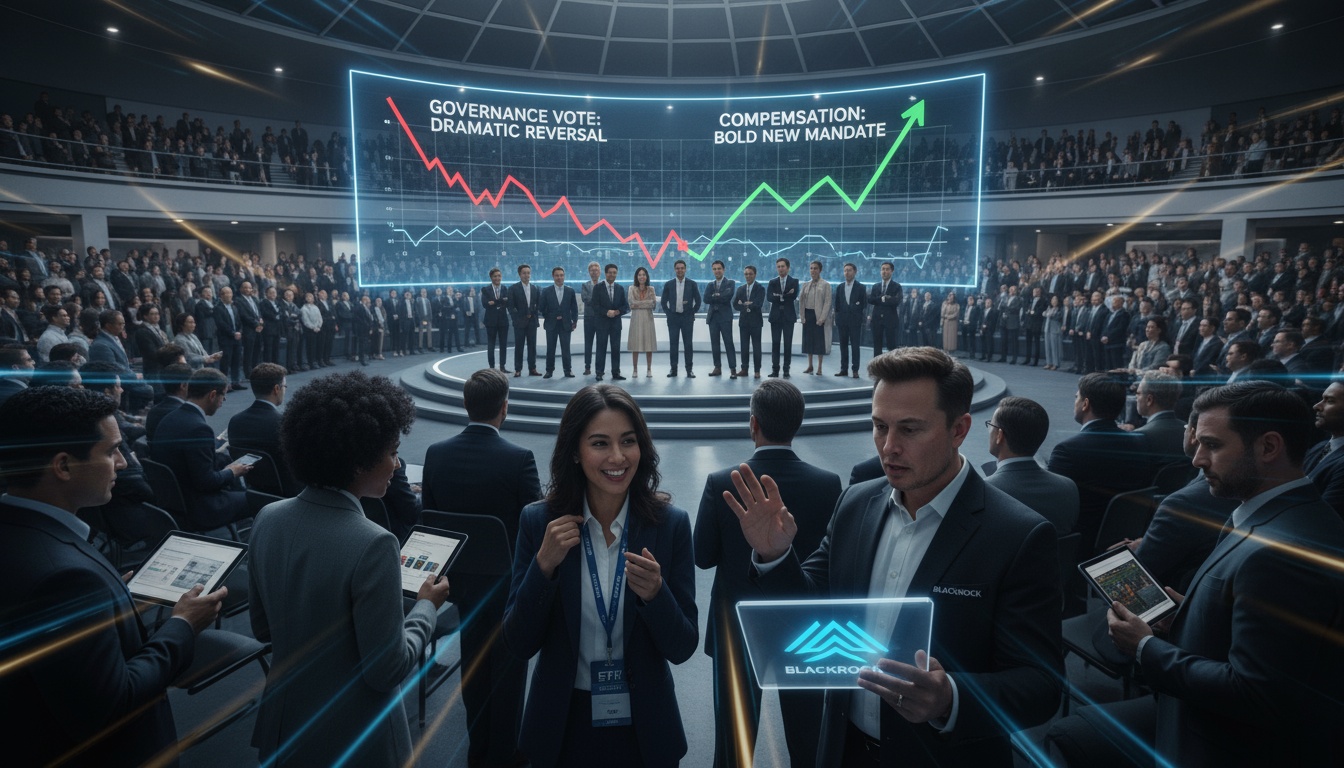
● Proxy Showdown, Norway Revolt, ETF Mutiny, BlackRock Decides
Tesla Shareholders Meeting Situation Rapid Change Summary: Norway Sovereign Wealth Fund’s ‘Opposition’, Charles Schwab ETF’s ‘Sign of Turning’, and BlackRock & Vanguard’s Final Variable
This article includes: 1) the reasons behind the Norway Sovereign Wealth Fund’s opposition and the change in the voting rights landscape on Wall Street, 2) signs of a pivot from the Charles Schwab ETF due to client sentiment and the ETF voting mechanism, 3) Delaware legal variables and the ‘approval rate threshold’, 4) the impact of global economic factors (interest rates, inflation) on the stock market, and 5) Tesla business updates (production of the Berlin Standard Trim, utilization of Sentry Mode in investigations of shooting incidents, and Cybertruck’s resilience).
Instead of focusing on superficial issues covered by the news, this article pinpoints the decisive factors of ‘voting structure’ and ‘legal consistency’ with numbers and context.
Headline Briefing: Facts Confirmed So Far
The Norway Sovereign Wealth Fund (NBIM) has officially opposed Elon Musk’s compensation plan.
The fund holds approximately 1.14% of Tesla’s shares and cited the size of the compensation and the key-man risk as reasons.
Charles Schwab’s multiple ETFs were initially reported to have cast a vote against.
Subsequently, mounting pressure from investors has led to spreading news through community channels that they have ‘switched to support’ the proposal.
However, an official announcement from their headquarters is still pending.
ISS and Glass Lewis have recommended voting against.
ARK Invest and some pension funds have expressed their support.
BlackRock and Vanguard have not yet given a clear final signal.
Production of the Model Y Standard Trim at the Berlin factory has begun.
Tesla’s Sentry Mode has been used as key evidence in the investigation of a mass shooting in the United States.
The Cybertruck incident in Las Vegas has been concluded to be caused by external flammable materials, and the vehicle’s structural resilience has been confirmed.
Battling Over the Compensation Plan: Who Acts and Why
The Norway Sovereign Wealth Fund’s logic is “while performance is recognized, the scale of compensation is excessive and the key-man risk is significant.”
This reflects the typical frame of mind of institutions that value sustainable governance.
The Charles Schwab ETF initially encountered intense backlash from individual shareholders for voting against, with fears of customer exodus emerging as a real concern.
Internally, signs of a switch to support have surfaced, signaling that even institutions cannot ignore pressure from their clients.
ISS and Glass Lewis play a reference role for large institutions.
They recommended voting against by citing the size of the compensation and concerns about precedent, thereby influencing traditionally conservative capital.
ARK Invest and innovation-oriented capital view Tesla as an AI and energy platform.
They consider Musk’s leadership as key to accelerating ‘AI innovation’ and are therefore pushing for support.
ETF Voting Mechanism: Why Individual Shareholders Are Outraged
In the ETF structure, the fund exercises the voting rights of its held stocks, making it difficult for individual investors to cast votes directly.
Thus, the voting philosophy of the fund house is reflected in the aggregate votes.
In this case, ETF customers felt, “It’s our money, yet our opinions are not reflected.”
As a result, there have been complaints to customer service centers, email campaigns, and social media pressure, with some signs of a shift in the fund managers’ stance.
The meaning is clear.
In an era of massive passive capital, the ‘governance responsibility’ of fund managers in directing votes has emerged as a market risk.
Furthermore, large global firms are gradually expanding the option of ‘pass-through voting’.
As the influence of individual opinions increases, the strategic importance of voter campaigns grows.
Legal Variables: The Real Meaning of Delaware and the ‘Approval Rate Threshold’
This vote goes beyond simply passing a resolution; it is also a process of accumulating ‘political capital’ that can resolve subsequent legal controversies.
The market interprets an approval rate of approximately 70% or higher as a strong justification, while below 55% it may rekindle controversy.
A high approval rate emphasizes the legitimacy of the reapproval action, the clarity of shareholder intent, and can serve as a shield in potential lawsuits.
Conversely, a narrow passing margin may lead to governance pressure from institutions and impose constraints on future compensation design.
Stock Market Scenarios: Reflecting Global Economic Variables in Three Branches
Scenario A, with overwhelming support.
Uncertainty diminishes, reducing the risk premium in the stock market, and the narrative of AI and energy platforms may be re-emphasized.
If expectations of declining interest rates in the global economy persist, it is favorable for the expansion of growth stock multiples.
Scenario B, narrowly passing.
There may be short-term relief, but governance discounts and residual litigation risks could weigh on valuations.
If inflation heats up again or long-term interest rates rebound, volatility may increase.
Scenario C, rejection.
A loss of leadership visibility may create re-rating pressure, and bold strategic moves could be dulled.
However, if a ‘new roadmap’ such as a redesigned compensation plan or board restructuring is presented quickly, some of the decline could be recovered.
Core Business Updates: Price Strategy, Safety, Data
The commencement of production of the Berlin Model Y Standard Trim signifies a strengthening of price positioning in Europe.
In an environment of reduced subsidies and higher interest rates, the undercutting strategy by $40,000 is an effective card for defending volume.
Although there has been controversy over option reductions, it provides performance resilience in sectors with high demand elasticity.
Sentry Mode is establishing itself as a “mobile evidence collection device” in urban crime investigations.
The data generated by vehicles contributes to public safety, simultaneously building brand trust and network effects.
The Cybertruck incident has been resolved as due to external flammable materials, with the structural strength and battery protection being verified in real scenarios.
The safety reputation proven in extreme events is positive for the broader EV demand.
In the medium to long term, FSD, robo-taxi, and energy storage will be pillars that amplify the ‘platform premium’ centered on artificial intelligence.
However, standards for regulations, safety, and data responsibility will also rise, making governance capabilities a key variable in multiples.
Five Core Points Other Media Have Mentioned Less
1) Although vote advisory firms hold significant influence, it is not absolute.
If the risk of customer exodus from passive capital increases, fund managers may have an incentive to deviate from recommended votes.
2) The actual power of ETF customers has been confirmed.
Even if they cannot cast votes directly, the pressure from fund inflows/outflows and reputational risks directly translates into pressure on voting rights.
3) The key battleground in this vote is the ‘approval rate’.
Legal defensibility and the strength of strategic initiatives are determined by numbers.
4) BlackRock and Vanguard are market structure variables.
The decisions of these two houses not only affect vote counting but also influence the speed of expansion of pass-through voting.
5) Governance and AI execution are two sides of the same coin.
The more high-risk and high-reward a strategy is, the more transparent the design of the compensation plan and the checks and balances serve as a premium.
Checklist: Guide for Investor Actions
For brokerage account holders, please check the proxy deadline and the record date.
If you have already submitted your vote, inquire with your customer service center about whether it can be modified.
ETF holders often cannot vote directly.
Check the fund manager’s voting policy, channels for receiving customer opinions, and whether a pass-through option is provided.
When conveying opinions to institutions, including specific proposals such as conditional triggers in the compensation structure, retention mechanisms, and transparency in performance indicators will be more persuasive.
Key Points to Watch and Timeline
The disclosure of vote intentions from BlackRock and Vanguard is the top short-term variable.
Check whether the final approval rate exceeds 70%.
In the event of a rejection or a narrow passage, pay attention to any redesigned compensation plans or governance packages proposed by the board.
The trajectory of global interest rates and the possibility of an inflation resurgence will determine the sensitivity of valuation multiples.
The launch timeline of FSD, regulatory events, and the pace of energy storage expansion will determine the robustness of the medium to long-term narrative.
Data Points: Why Now Is a Structural Turning Point
In a stock market with high passive ownership, the issue of delegation of voting rights is no longer merely a technical matter.
How to bridge the gap between the owners of the capital and the owners of the votes is the core task of Governance 2.0.
This Tesla vote-off is a real-world case testing that solution.
Summary of Risks and Opportunities
Risks include residual litigation related to the compensation plan, the continuing influence of vote advisory firms, regulatory and safety issues, governance discounts, and macroeconomic volatility.
Opportunities include the resolution of uncertainty, revaluation of the AI and energy platform narrative, volume defense through price strategy, and strengthening of the data network.
Conclusion
This vote is not just about the ‘Musk compensation plan’ but about the balance of power surrounding ‘voting rights in the age of passive capital’ and ‘governance in the AI era’.
The numbers are reflected in the votes, and the premium is created by governance.
The final variables are BlackRock & Vanguard, and the approval rate.
< Summary >
The Norway Sovereign Wealth Fund opposed the plan due to the scale of the compensation and key-man risks.
While the Charles Schwab ETF shows signs of pivoting to support amidst customer pressure, official confirmation is pending.
ISS and Glass Lewis recommend voting against, whereas ARK and some pension funds support the plan.
The key to legal defensibility lies in the approval rate, with 70% or higher serving as a strong justification.
The paths of global interest rates and inflation determine valuation sensitivity.
The Berlin Standard Trim, Sentry Mode’s contribution to investigations, and the Cybertruck’s resilience complement the business fundamentals.
[Related Articles…]
Tesla Shareholders Meeting: Key Governance Recalibration Checkpoints
ETF Voting Rights Innovation and the Governance Dilemma of Passive Capital
*Source: [ 오늘의 테슬라 뉴스 ]
– $2조 노르웨이 펀드 반대, 월가 찬성? 일론 머스크 분노! 테슬라 주주총회 판세 급변했다!
● ETF Storm Pushes KOSPI Below 4000, AI Bubble Sparks 2026 Liquidity Risk
KOSPI 4000 Breather, AI Bubble Debate, and 2026 Outlook: The Next Profit Interval Interpreted Through ETFs, Liquidity, and Policy
What is needed now is not fear, but an eye to read the structure.
This article covers: 1) The precise mechanism by which ETF flows simultaneously sway the index and individual stocks, 2) The liquidity cycle from 2025 to 2026 and the realism of rate cut expectations, 3) An analysis of the earnings-valuation gap amidst the AI bubble debate, 4) Unique Korean market policy and tax momentum (separate taxation on dividend income) and sector rotation, 5) And practical strategies involving staggered selling, cash ratio, and checklist tactics.
This is not a brief mention of issues passed over on other YouTube channels or news outlets; it distills the essential elements that could truly alter one’s position.
Market Conditions: The Impact of a Weakened Nasdaq and the Departure from the KOSPI 4000
The initial shock of this correction began in large US stocks and then spread to the indices.
Domestically, the high weight of large-cap AI and semiconductor beneficiary stocks resulted in significant declines, and the KOSPI 4000 level was breached for a time.
With the recent rebound lacking strength, the market now stands at the crossroads between a “short-term rebound after correction” and a “mid-term downward turn.”
Key Point 1: Quality of the Rebound and the “Who is Selling?” Signal
The first thing to observe in a down market is the speed and magnitude of the rebound.
In a strong market, after the initial plunge, capital flows in immediately, and large-cap stocks quickly recover their losses.
Currently, the quality of the rebound is weak, signaling that apart from profit-taking sales, programmed and algorithmic selling, as well as potential portfolio adjustments by institutions, may be involved.
The point is “who is selling?” When systematic volumes (such as those from programs or ETFs) are driving the selling, the rebound tends to be shallow and short-lived.
Key Point 2: The Supply and Demand Mechanism in the ETF Era (What Other Media Overlook)
At present, ETFs are the instruments that move the indices.
When ETF capital flows in, it simultaneously purchases all constituent stocks, causing both indices and sectors to rise; conversely, when it flows out, even “good stocks” are sold off together.
In particular, if there is a need to reduce the weight of specific big tech or semiconductor stocks, an ETF will execute a simultaneous sell-off of the entire basket to maintain weight conformity.
Short-term funds (such as novice investors who flowed in after Chuseok) can rapidly enter through ETFs, but when the excitement fades, their simultaneous exit increases volatility.
In conclusion, regardless of the fundamentals of individual companies, the influx and outflow of ETF capital drive the price movements during this phase.
Key Point 3: The Liquidity Cycle and Policy Variables (2025~2026)
Corrections in phases where liquidity is increasing usually end quickly or mildly.
After the financial system stabilization measures from 2023 to 2024, liquidity re-expanded and asset prices (especially in AI and big tech) surged.
The concern is that starting in 2025, the potential for further liquidity expansion may slow down.
However, policy remains a variable.
While growing expectations for rate cuts are positive for risk assets, if inflation re-heats, the pace of cuts may slow down.
With the Federal Reserve Chair’s term expiring in May 2026, uncertainties around appointments and policies may gradually be priced in.
This phase can be seen as a transitional period where signals of “renewed liquidity expansion” are weighed against those of “slowdown.”
The AI Bubble Debate: Why Do Stocks Waver Despite Strong Earnings?
Some AI-themed stocks are experiencing a phase of “multiple (valuation) compression” where, despite improved earnings, their stock prices are falling.
The larger the premium that is priced in during an upswing, the more even minor disappointments or short-selling issues can amplify price fluctuations.
The key issue is not whether the bubble will burst, but rather to what extent the “normalization of valuation relative to earnings growth rate” will proceed.
During this process, the differentiation between the top-tier AI stocks and the second and third tiers is likely to widen.
Distinctive Features of the Korean Stock Market: Non-AI Sectors, Policy Momentum, and Re-rating
While the U.S. market is concentrated in big tech, Korea’s market is diversified across sectors such as manufacturing, platforms, domestic consumption, and finance.
Should the government prioritize revitalizing the capital markets over real estate, tax, disclosure, and dividend policies could drive a re-rating of the KOSPI.
If the separate taxation of dividend income materializes, it could prompt a revaluation of high-dividend, strong cash flow stocks.
There is potential for expansion in sectors that suffered smaller declines due to low AI exposure, as well as those that may benefit secondarily from a recovery in semiconductor exports (equipment, materials, and components).
What to Buy: Three Baskets for the Next Round
1) Re-rating Basket: Undervalued, net cash, and stable dividend growth stocks.
If expectations for separate taxation of dividend income align, this group of stocks can experience a multiple expansion.
2) Secondary Beneficiaries of Semiconductor Exports: Across the entire value chain – equipment, materials, back-end processes, testing, and packaging – in conjunction with improvements in the memory cycle.
These should be evaluated based on earnings visibility and order momentum.
3) Non-AI Digital Transformation and Industrial Software: Demand for efficiency in public and industrial sectors is relatively defensive compared to cyclicality.
Focus on revenue models based on subscription and maintenance rather than one-off sales.
Trading Strategy: A Checklist to Apply Immediately
Staggered selling and cash ratio: If volatility increases, reducing the size of your position—even at the cost of some returns—can lower psychological risk.
Rebound quality: Ensure that large-cap stocks lead, trading volumes recover, and there is continuity in upward movement (the 3-day rule).
ETF signal: Monitor the premium/discount of major index and sector ETFs, as well as trends in creation and redemption.
Liquidity indicators: Observe the balance between rate cut expectations and inflation surprises, along with the direction of dollar strength and credit spreads.
Earnings and guidance: Wait for a point where top-down momentum aligns with bottom-up earnings.
Distilling the Key Points That Are Rarely Mentioned Elsewhere
ETF rebalancing can force the simultaneous selling of even “news-free stocks.”
Therefore, one should consider not only the fundamentals of individual companies but also the inflow/outflow and weight change of ETF capital.
The essence of the AI debate is not about a bubble burst, but rather the speed of multiple normalization, with the spread between top-tier companies with high-quality earnings and the rest likely to widen.
The Korean market, on the other hand, has significant potential for re-rating purely through policy and tax changes, and rotation into non-AI sectors could bolster index resilience.
The approach of the Fed Chair’s term (expiring in May 2026) could raise a policy uncertainty premium, necessitating heightened sensitivity to liquidity signals for 2025-2026.
Risk Scenarios and Responses
If inflation re-heats and rate cut expectations recede, valuation pressures will widen once more.
If the pace of adjustments in the AI investment cycle slows, the premium on growth stocks may normalize further.
The response is simple.
Gradually increase the cash ratio and reallocate part of the portfolio from overvalued, high-volatility assets to undervalued, cash-flow rich assets.
Once the quality of the rebound is confirmed, re-enter in stages.
Keyword Memo: Liquidity, ETF capital, rate cuts, inflation, semiconductor exports.
< Summary >
This correction marks a phase where a decline centered on large-cap stocks combined with ETF flow dynamics has amplified volatility.
The key elements are the quality of the rebound, ETF capital signals, and the liquidity and rate trajectories for 2025-2026.
It is more reasonable to view AI in terms of “multiple normalization” rather than a “bubble burst,” and the Korean market holds re-rating potential through policy and tax momentum in non-AI sectors.
The strategy is to reduce risk through staggered selling and prepare for the next round by focusing on high dividend and cash flow stocks, secondary beneficiaries of semiconductors, and industrial software.
[Related Articles…]
Why Separate Taxation on Dividend Income Could Trigger a Re-rating of the KOSPI
The Structure of ETF Capital Inflows That Amplify Volatility and the Corresponding Strategies
*Source: [ Jun’s economy lab ]
– 코스피 4000 숨고르기와 AI버블 논란
● Wendys Chili, Zero-Waste Profit Shield
Wendy’s Chili Soup, Why It Became the Ace in Sales Defense: The Secret Behind the 83 Million Servings “Sold Out”, A Triple Effect Created by Cost, Demand, and AI
The core takeaways that can only be found in this article are threefold.
- The cost structure and margin defense mechanism of the Chili Soup that transforms leftover patties into a “Zero-Waste P&L”.
- The menu mix strategy that leverages seasonal demand and its positioning in the value meal war.
- How drive-thru AI and mobile data boost chili sales and cross-selling, along with an investment perspective checklist.
News at a Glance
- Since its founding in 1969, Wendy’s has redefined its brand identity with the “Fresh, Never Frozen” philosophy and Chili Soup.
- According to the video, the Chili Soup has become a steady seller, with 83 million servings sold in one year.
- The Chili transforms leftover hamburger patties into a reimagined dish that reduces waste, mitigating the impact of cost volatility (especially beef), thereby contributing to operating margin defense.
- Wendy’s is increasing its AI-based order and drive-thru automation and accelerating its global expansion (in Europe and Asia) while boosting its digital sales proportion.
- In an environment of U.S. inflation and high interest rates, Wendy’s responds to consumer trends with value meals and health-oriented menus, and investors view its cash generation and global scalability as key points.
Brand Story and the Birth of “Chili”: Translating Warmth and Freshness into a Menu
- Founder Dave Thomas, drawing on his early experience with KFC, pursued “fast but honest food.”
- In the early 1970s, leftover hamburger patties were stewed with peppers, beans, and tomatoes to create chili, which became a huge hit and turned into a signature item.
- The “Fresh, Never Frozen” philosophy and the Chili work in tandem. The unavoidable surplus in fresh patty usage is transformed into chili, achieving quality, ESG, and cost savings simultaneously.
Menu Strategy: Chili + Baked Potato, the Intersection of Health and Fullness
- Based on beef, tomatoes, and beans, the Chili Soup offers a well-balanced combination of protein and dietary fiber, and its pairing with baked potatoes maximizes satiety.
- With a lower proportion of fried items and bread compared to hamburgers, it is perceived as a “light meal” and caters to diet and wellness consumption trends.
- Meeting regional, religious, and environmental needs, the lineup is being expanded to include plant-based menus, building a health-oriented brand image that goes beyond fast food.
Wendy’s and Market Context by the Numbers
- According to the video, the U.S. fast food market is worth approximately $950 billion annually, with McDonald’s in the lead and Burger King and Wendy’s chasing closely.
- Wendy’s operates several thousand stores and has expanded into about 30 countries globally.
- Data indicates that in Q2 2025, Wendy’s revenue was approximately $560 million (a -1.7% change year-over-year), operating income around $104.3 million (+4.8%), and net income about $55.1 million (+0.9%), demonstrating robust profitability defense.
- Experts believe that “cost management and operational efficiency” sustained the profit margins, with the reimagined Chili-centric strategy and menu mix likely contributing.
Value Meal War and Consumer Trends: The Equation in an Inflationary Era
- In the past two to three years, rising restaurant prices have made consumers sensitive to “value.”
- Wendy’s has introduced two-person, value-focused meal deals, reinforcing a “rational premium” positioning in tight economic conditions.
- Macroeconomic factors such as persistent inflation and high interest rates have altered consumer spending patterns, pushing dining establishments to optimize their composition and increase promotional frequency rather than raising prices, while investors focus on the quality of the margins.
How AI and Data are Transforming Wendy’s Operations
- Drive-Thru AI Voice Order: Reduces labor costs while standardizing menu recommendations and upselling. It can improve the cross-selling rate of Chili when paired with fries and mini burgers.
- Mobile/Loyalty Data: Predicts Chili demand by time, weather, and region to fine-tune production, thereby reducing waste and wait times.
- Kitchen Forecasting (Prep Forecasting): Optimizes the batch sizes of beef, beans, and sauce in real time to minimize the trade-off between freshness, stockouts, and waste.
- International Expansion: Quickly localizes the menu by learning local preferences for spiciness and vegetarian options through local data, setting the standardization and adaptation range of recipes while considering supply chain lead times.
Key Insights That Other YouTube/News Outlets Often Overlook
- The Chili competes on “cost, not price.” By reprocessing leftover patties to enhance the perceived beef content while lowering actual variable costs, the margins remain less affected even in the value meal war.
- It serves as a hedge against seasonality. High demand for Chili in winter compensates for the slowdown in burger sales, stabilizing average spending per customer and traffic throughout the year.
- It acts as an insurance effect in the menu mix. Even if beef prices surge, the Chili dilutes the beef proportion with beans and tomatoes, absorbing the cost spike.
- It is the catalyst of data. By automating Chili recommendations under triggers such as “cold weather, lunch peak, and drive-thru,” the upselling lifetime value increases. Chili, with its high recommendation accuracy, is an anchor menu favorable for AI learning.
- ESG and storytelling. The “remake strategy” converts waste reduction performance into a clear message that boosts brand favorability and loyalty, potentially leading to a valuation premium in the stock market.
Competitive Landscape: Differentiation from McDonald’s, Burger King, and Panera
- McDonald’s: Excels with ultra-low-priced value meals and an extensive digital ecosystem, but it is relatively weaker in signature items like Chili with a story.
- Burger King: Known for the distinctive flame-grilled Whopper, yet Wendy’s stands out with its health-oriented lineup and remake story.
- Panera: Boasts a strong healthy image with its soups and breads, but consumer feedback suggests that the perceived beef content and value-for-money advantage favor Wendy’s Chili.
Consumer Experience Tips: Balancing Value, Health, and Satisfaction
- The Chili Soup + Baked Potato combination provides fullness with a lower calorie burden.
- Adding a spicy sauce topping brings out a “sauce-laden Bolognese” flavor profile.
- When paired with mini burgers, it allows more flexible adjustments in calories and price compared to typical value meals.
Investment Checklist (from the Stock Market Perspective)
- Trends in Same-Store Sales (SSS) and digital sales proportion. How campaigns for Chili and value meals reflect in traffic and average spending.
- Cost sensitivity. Changes in the mix of beef, vegetables, and energy costs relative to the Chili mix, and how much waste reduction has been achieved through the remake strategy.
- Labor costs and AI ROI. The adoption rate of drive-thru automation, order accuracy, and metrics on reduced wait times.
- Pace of international expansion. The payback period of new outlets in Europe and Asia, and the success rate of localized menu items.
- Brand indicators. Loyalty app monthly active users (MAU), revisit rates, and communications around ESG/waste reduction performance.
Macro Positioning: Survival Tactics Amid U.S. Economic and High Interest Rate/Inflation Conditions
- In an inflationary period, consumers look for “value beyond price.” The Chili provides “tangible protein and satiety,” which eases price resistance.
- Amid continued household burdens in a high-interest rate environment, value meals and health-oriented menus drive demand from multiple angles.
- Under upward pressures on restaurant prices and wages, Wendy’s stands out as a prime example of margin defense through its remake strategy and AI-driven efficiencies.
On-Site Snapshot: Balancing Price, Volume, and Satisfaction
- According to video experiences, the Chili offers a perceived reduction in beef content while maintaining a reasonable price point, with easy flavor adjustments via sauce topping.
- Pairing with nuggets and mini burgers effectively balances “value and health.”
- During a cold snap in New York, franchise outlets confirmed high demand for “soup-based items,” reinforcing Chili’s role as a seasonal anchor.
< Summary >
- Wendy’s Chili Soup is a “margin shield” that simultaneously addresses cost and ESG by remaking leftover patties.
- It captures seasonal demand and value meal trends, creating a structure capable of selling 83 million servings in a year.
- Enhanced by AI orders and mobile data, it refines recommendations and forecasting to improve cross-selling and reduce waste.
- Amid inflation and high interest rates, it strengthens its “value and health” image, with global expansion and digital transformation supporting mid- to long-term cash flows.
- Investors should monitor key metrics such as SSS, digital sales proportion, cost sensitivity, AI ROI, and the pace of international expansion.
[Related Articles…]
- The Moment Drive-Thru AI Transforms the Profit Structure of the Food Service Industry
- The Winners in the U.S. Restaurant Inflation and Value Meal Wars
*Source: [ Maeil Business Newspaper ]
– [어바웃 뉴욕] “한 해에만 8,300만 인분 완판? 남은 패티가 매출 1등 공신으로” | 길금희 특파원