● Bloodbath
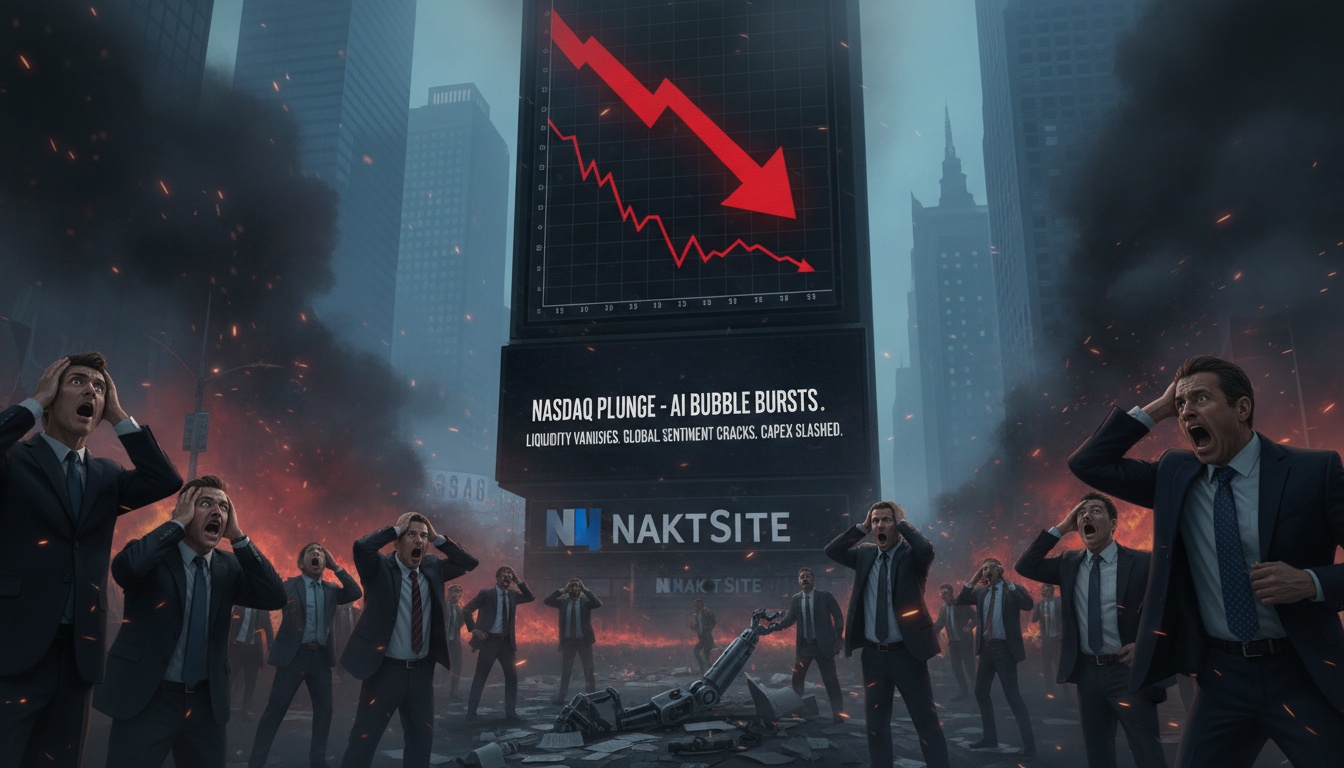
Comprehensive Summary of the NASDAQ Plunge and AI Bubble Debate: Sharp Drop in Consumer Sentiment, Evaporation of Short-Term Liquidity, and Even Ken Fisher’s ‘Real Bubble’ Signal
Today’s post centers on three key points.
It explains why the NASDAQ is repeatedly falling, how data gaps and short-term liquidity are shaking the market, and provides a clear criterion from Ken Fisher’s perspective on whether the current situation is a collapse of the ‘AI bubble’ or not.
Additionally, it covers points that are rarely addressed in other news outlets, such as power grid bottlenecks, the liquidity impact caused by the issuance of T-Bills (U.S. short-term bonds), and the unit economics of AI monetization.
It will clearly show you the key issues related to economic outlook, interest rates, inflation, NASDAQ, and AI in a news-style summary and actionable checklist.
What Triggered Today’s Market Decline
– A sharp drop in the University of Michigan Consumer Sentiment Index.
Headlines reported that it reached its lowest level since 2022, reflecting a rapid contraction in the perceived state of the economy, which immediately affected stock prices.
Since sentiment often precedes retail sales and corporate earnings (especially in cyclical sectors), the market reacted sensitively.
– Key data gaps due to the government shutdown.
With some federal statistics delayed, an environment has been created where investors are overreacting to one of the few available pieces of data.
While major datasets like the employment report are missing, the market is adding an uncertainty premium.
– Concerns over a slowdown in the labor market resurface.
Negative signals from reports such as the Challenger Downsizing Report have increased fears that “missing the golden time” could significantly raise the risk of a recession.
Shift in Short-Term Liquidity: How U.S. Short-Term Bond Issuance Weighs on the Market
– A one-line summary of the mechanism.
When the U.S. Treasury issues a large amount of short-term government bonds (T-Bills), money market funds (MMF) chase the higher yields and get drawn into these short-term bonds.
This reduces the short-term liquidity that would otherwise flow into risk assets like stocks, cryptocurrencies, and gold, and particularly increases the discounting of growth stocks with longer-term cash flows (e.g., those related to AI long-term growth stories).
– The link between interest rates and valuation.
If the risk-free short-term rate remains high, the discount rate on stocks increases, and companies whose earnings are expected in the future face greater multiple pressures.
This explains why the NASDAQ has been particularly weak from a liquidity perspective.
Overvalued AI? Checking for a ‘Real Bubble’ through Ken Fisher’s Lens
– The core argument of Ken Fisher.
Nowadays, the term “bubble” is too easily attached even with a slight stock price increase, but historically, during a true bubble period, fear almost disappears from the market.
The point is that active doubts and skepticism exist, and the current atmosphere, which is hypersensitive to price fluctuations, is more akin to a “healthy tension.”
– Comparison of typical bubble signals with the current situation.
Typical bubble: widespread euphoria, uncritical acceptance of a “new era” narrative, a surge in credit leverage, indiscriminate IPOs and convertible bond issuances, and dominance of a few sectors in the market index.
Current situation: skepticism about AI remains high, there is strong demand for verifying earnings and cash flows, and funds are continuously redeployed based on interest rate and inflation variables.
While valuations are high, the environment cannot be seen as one of “fearlessness.”
Market Checklist Verified by Numbers
– Earnings spread: Whether profit improvements are spreading widely from semiconductors (especially HBM, AI GPUs/ASICs), networking (high-bandwidth switches/optical modules), cloud, to power and data center REITs.
– Hyperscaler CAPEX: Whether there is a balance maintained between guidance on AI infrastructure investments and free cash flow (FCF).
– Power grid bottlenecks: Whether delays in lead times for substation, transformer, and transmission permits are imposing constraints on data center power capacity expansion.
– Supply chain tightness: The lead times and margin trends of key components such as HBM, CoWoS packaging, and high-bandwidth NICs/switches.
– Labor market: Whether wage inflation and trends in hiring/job-switching are leading to a secondary impact on service prices.
– Treasury issuance mix: How the change in the proportion of Notes/Bonds relative to Bills affects the balances of MMFs and reverse repos (RRP).
– Valuation and interest rates: Checking the spread between the equity risk premium and the real rate (inflation-indexed treasury bonds).
– Credit spreads: Whether spreads in high-yield and BBB bonds serve as a leading indicator for stock market volatility.
Three Scenarios and Positioning Ideas
– Scenario A: Soft landing.
If inflation gradually cools down and interest rates are moderately adjusted, profit growth and quality stocks will be revalued.
In the case of AI, companies whose revenue sources expand from infrastructure to applications will benefit.
– Scenario B: Reemergence of recession fears.
If consumer sentiment and employment further weaken, downward revisions in earnings estimates and multiple compressions may occur.
In this case, reducing exposure by favoring cash-rich, short-term bonds, defensive dividend stocks, and high-quality, profitable core AI sectors (such as semiconductor equipment and essential networking) is advisable.
– Scenario C: Reheating and persistent inflation.
If high interest rates persist for a long time, the relative returns on real assets related to value, energy, and commodities may improve.
In AI, selecting companies that present a roadmap for power accessibility and cost reduction per unit of performance is key.
News-Style Summary: Key Briefing for Today
- NASDAQ weakness continues. A sharp drop in consumer sentiment and gaps in data amplified volatility.
- An expansion in short-term bond issuance absorbs cash into money markets, resulting in a contraction of short-term liquidity for risk assets.
- Concerns over a slowdown in the labor market have increased the recession premium.
- Although the AI bubble debate persists, from Ken Fisher’s perspective, a state of heightened fear does not indicate the core of a typical bubble.
- From an investor’s standpoint, the determining factors are the liquidity pathway, power grid bottlenecks, the sustainability of hyperscaler CAPEX, and the spread of earnings.
The Most Critical Content Rarely Covered Elsewhere
– The power grid is the ‘real ceiling’ for AI growth.
If the permit lead times for data center power intake, substation facilities, and transmission increase, merely adding more servers will not boost throughput.
Power accessibility is directly linked to the reliability of the performance guidance for AI infrastructure companies and cloud providers.
– The liquidity pipeline effect: The switch between T-Bills ↔ MMF ↔ RRP.
A single change in the Treasury issuance mix can abruptly alter the flow of short-term liquidity.
This structure exerts market influence beyond just the level of interest rates, and should be seen as a key catalyst for short-term volatility.
– AI unit economics and the speed of monetization.
Although the inference cost of ultra-large models continues to decrease, if it does not balance with revenue per user (ARPU), the premium on growth stocks will be adjusted.
AI with an ‘efficiency edge’ and strong ‘cash flow’ is sustainable.
– Lag in application revenue.
Infrastructure sales may boom first, while applications and enterprise adoption, following budget cycles, lag behind.
This lag creates a risk of disappointing short-term earnings expectations.
Practical Investment Guide (Not Investment Advice)
– Risk management.
Avoid excessive concentration in leverage and blind bets; set clear stop-loss criteria and position limits in advance.
– Monitoring routine.
Weekly: Check real interest rates, the short-term bond issuance calendar, MMF and RRP balances, and credit spreads.
Monthly/Quarterly: Monitor hyperscaler CAPEX, semiconductor and networking order books/lead times, and news on data center power capacity expansions.
– Portfolio barbells.
Focus on a selective approach combining an AI infrastructure core (semiconductors, equipment, networking, cooling) with cash-generating platforms/applications.
At the same time, diversify interest rate risk by laddering short-term bonds.
– Verify the alignment of economic variables and narratives.
Every quarter, check whether economic outlook, the inflation trajectory, and the direction of interest rates are consistent with companies’ earnings paths.
Perspective Summary: ‘Data and Liquidity’ over the Word ‘Bubble’
The bubble debate can easily become mere noise.
The current phase hinges on two factors: the short-term liquidity pathway and the spread of earnings.
A state of high fear is not an immediate signal of collapse, but if liquidity contraction and earnings downgrades occur simultaneously, further valuation adjustments may follow.
In conclusion, while AI remains a structural growth story, careful selection and timing will determine outcomes given the practical constraints of power, CAPEX, and unit economics.
One-Page Investment Checklist
- NASDAQ volatility: Check the short-term bond issuance schedule and the inflow/outflow of MMF funds.
- Interest rates/Inflation: Monitor real interest rates, service prices, and wage pressure trends.
- AI supply chain: Verify whether bottlenecks in HBM, packaging, and networking components are being resolved.
- Power grid accessibility: Check news on data center power capacity expansions and power costs.
- Spread of earnings: Confirm the transition from infrastructure to application revenue.
< Summary >
- A sharp drop in consumer sentiment and data gaps amplified the NASDAQ decline, while expanded short-term bond issuance siphoned liquidity, weighing on growth stock valuations.
- According to Ken Fisher, the current state of skepticism and fear does not typify the core of a bubble.
- Key future battles will be determined by the liquidity pathway, power grid bottlenecks, the sustainability of hyperscaler CAPEX, and the spread of earnings.
- A barbell strategy combining defensive measures with selective offensive moves is effective under different scenarios.
[Related Articles…]
- AI Infrastructure Investment and Power Grid Bottlenecks: The Hidden Variable for Growth in 2025
- Liquidity Cycles and NASDAQ Volatility: The Ripple Effect of Short-Term Bond Issuance
*Source: [ 내일은 투자왕 – 김단테 ]
– 연이어 폭락하는 나스닥. 인공지능 버블 붕괴 진짜 시작인가 (ft. 켄피셔)