● Memory Shortage Sparks AI Goldrush
Is It an AI Bubble or a Nascent Stage? Memory Shortage Rekindled, HBM Dominance Battle, and the Real Reason Why ‘Physical AI’ is Calling Korea
Now the article contains the following:
- The sharp rise in memory prices within a month and concrete evidence of a semiconductor supercycle.
- The core issues and investment strategies in the stock market debate where “bubble” and “nascent stage” collide.
- The background behind NVIDIA’s choice of Korea, and changes in the quality, price, and supply structure of HBM3/4.
- A super simple structural explanation: GPU = highway, HBM = lane and toll gate.
- The overlooked “physical AI” with its data gravity, power and network bottlenecks, and Korea’s model as a sovereign AI export hub.
Headline News Summary
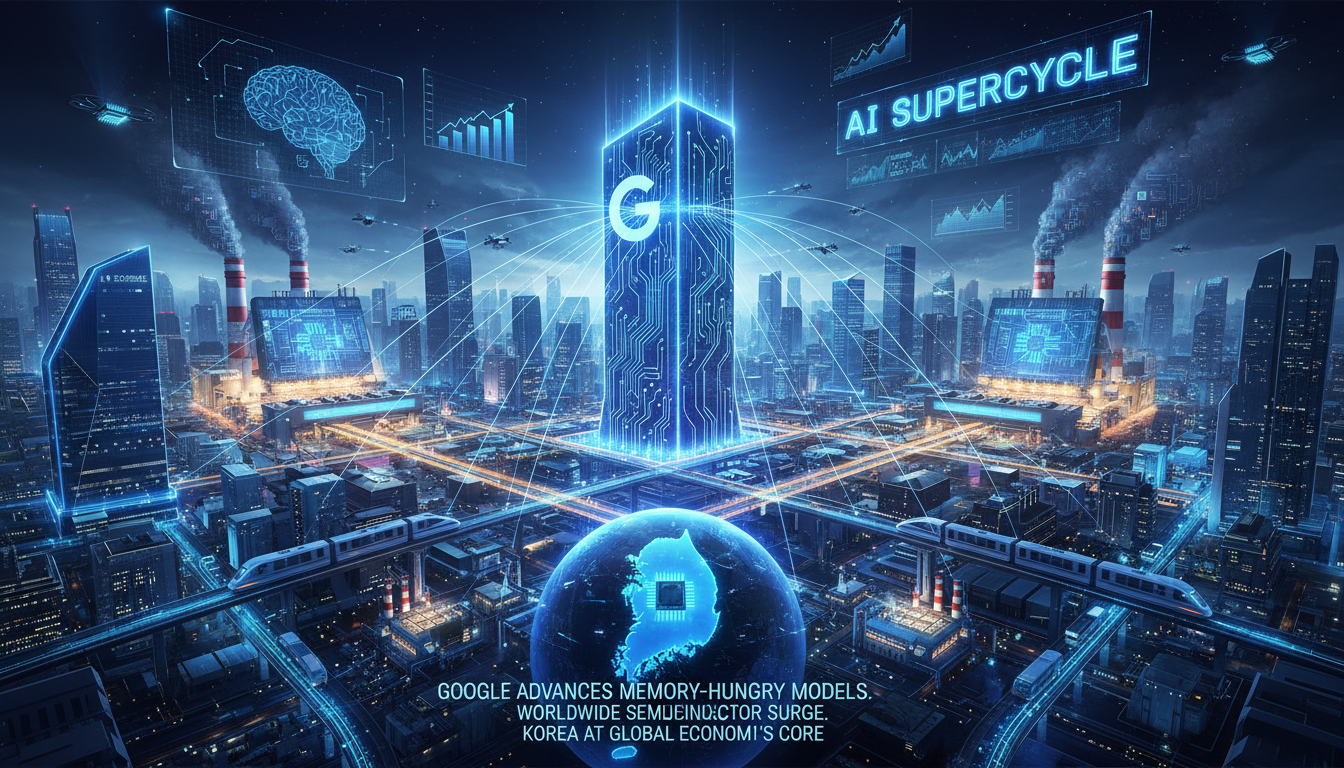
- The rekindling of the memory shortage has increased the probability of a semiconductor supercycle.
- Demand for AI servers has remained strong, and from the second half of this year, even the replacement demand for general CPU servers has emerged.
- Spot prices for general-purpose memory such as DDR5 have surged tens of percent within a month, with some items nearly doubling, leading to temporary suspension of contract price negotiations.
- Although the valuation debate persists, there is an observation that the pace of upward EPS revisions is outpacing stock prices, leading to a clash between “beginning of a bubble” vs. “not a bubble yet” perspectives.
- HBM3 has passed some quality tests, with adjustments underway concerning price and yield conditions.
- Korea is emerging as a ‘physical AI hub’ equipped with manufacturing data, communication and power infrastructures, and automotive/robotic demand centers.
1) Bubble or Nascent Stage: The Core Arguments of Two Perspectives
- Not a bubble (argument): The upward revision in memory and AI infrastructure earnings supports stock prices, and big tech companies have been outperforming expectations.
- A bubble that just won’t fade out (argument): Global economic liquidity is likely to persist until 2026, and the concentration of capital towards semiconductors and AI results in a premium.
- Investment interpretation point: The key variable is not valuation but the EPS trend, and volatility will inherently expand in the event of earnings misses or guidance omissions.
- SEO keyword consideration: It is necessary to monitor both global economic variables (interest rates, inflation) and the liquidity flow of the stock market.
2) Evidence of the Semiconductor Supercycle: Demand, Supply, and Price
- Structural demand shift: The end-use demand for memory is being restructured from B2C (smartphones, PCs) to B2B (servers).
- Dual demand engine: Since the end of 2022, AI server demand has been consistently strong, and the replacement cycle for general servers, built between 2016 and 2018, is set to join in from the second half of 2024.
- Price signal: Some general-purpose memory items such as DDR5/DDR4 have surged 50–100% within a month, with some cases even seeing a temporary halt in monthly contract price negotiations.
- Change in cycle length: The previous 4-year cycle theory has been rendered ineffective by the AI arms race, with the industry increasingly reflecting an extended scenario until 2026–2027.
3) HBM Frontline: NVIDIA, Samsung, SK Hynix, Micron
- HBM3 (Blackwell) has passed some quality tests; adjustments are underway regarding price and yield conditions.
- HBM4 (Rubin) is the main event, and NVIDIA has a strong incentive to pursue multi-sourcing for price and supply stability.
- SK Hynix leads in technology and yield, securing strong pricing negotiating power.
- Micron faces high opportunity costs for switching to new HBM production in light of the high-profit environment for general-purpose DRAM, indicating a cautious pace in investment.
- The importance of Korea: As the memory bottleneck overtakes the foundry (advanced packaging) bottleneck, the supply chain focus is partly shifting from Taiwan to Korea.
4) GPUs as the ‘AI Highway’, HBM as the ‘Lane and Toll Gate’
- GPUs are highways that handle massive parallel computations simultaneously.
- While CPUs work sequentially with a few experts, GPUs can be likened to 100,000 middle school students doing arithmetic simultaneously.
- HBM acts as an ultra-high-speed delivery system that can transport 100,000 exam papers at once, so bandwidth directly translates to performance.
- Conclusion: GPU performance = core performance × memory bandwidth × network efficiency, making both HBM and AI networking equally important.
5) Why Korea: The Criteria for a Physical AI Hub
- A manufacturing data powerhouse: High-quality operational data from all industries such as semiconductors, displays, automobiles, home appliances, steel, and chemicals have been accumulated.
- Clustered value chain: Memory suppliers (Samsung, SK), demanders (Hyundai, NAVER), communication infrastructure (SK Telecom), power infrastructure, and government coordination capabilities coexist in one country.
- Geopolitical practicality: Amid the US–China decoupling, Korea’s strategic value is rising as an R&D and testbed target for the Asian market.
- Data gravity: As manufacturing data accumulates on NVIDIA’s CUDA, Omniverse, and robotics stacks, platform lock-in is strengthened, providing Korean companies with more bargaining chips.
6) “Shouldn’t We Build Our Own GPUs?” Barriers in the Ecosystem and Korea’s Solution
- Realistic barriers: The CUDA ecosystem is the de facto standard, with even AMD chasing CUDA compatibility through ROCm.
- Implications from China: Companies like Cambricon have carved out niches using a “CUDA-compatible” strategy, but a complete replacement is still far off.
- Korea’s strength: Companies such as Rebellions and FuriosaAI are rapidly growing in specialized chip design for inference (both edge and data centers).
- Roadmap for solutions: 1) In the short term, leverage the NVIDIA ecosystem to secure momentum, 2) In the medium term, develop a Korean sovereign AI package (encompassing data centers, models, and domestically produced accelerators) for export, 3) In the long term, invest in system semiconductor talent, EDA, and IP ecosystems to increase domestic participation.
- Policy points: Simultaneous measures such as incentives for engineering sectors, salary increases, enhancement of foundry competitiveness, and the establishment of public–private data hubs are essential.
7) Industrial Impact of Physical AI: Where Does the Money Move First?
- Mobility: Increased demand for sophisticated ADAS/autonomous driving, automotive SoCs, sensors, and AI stacks.
- Robotics/Logistics: A rapid surge in demand for humanoid, warehouse, and last-mile robots, alongside simulation (Omniverse) requirements.
- Manufacturing: Process optimization based on digital twins, defect prediction, and energy optimization.
- Healthcare: Assistance in image reading, remote monitoring, and personalized treatment.
- Infrastructure: Capital is moving towards data centers, power (substations, SMR), cooling systems, and AI networking (InfiniBand/Ethernet, CPO).
8) Investment Strategy: “Track the Shortage”
- Phase 1 Shortage: GPU shortage → NVIDIA, advanced packaging, CoWoS.
- Phase 2 Shortage: Data center construction/server racks → DC build, cooling, ramp-up equipment.
- Phase 3 Shortage: Power/transmission → Transformers, cables, SMR, linked to renewable energy.
- Phase 4 Shortage: Memory (HBM, DDR5) → The three memory companies and related supply chains.
- Phase 5 Shortage: AI networking → Switches, optical modules, Co-Packaged Optics.
- Risk management: A rebound in interest rates, re-heating of inflation, export restrictions, adjustments in government or customer CapEx, and improvements in model efficiency may cause temporary slowdowns in computing demand.
9) Timeline and Scenario Check
- 2025: General server replacement demand and AI demand operate concurrently, with sustained upward pressure on memory prices.
- 2026: Full-scale production of HBM4 begins, the multi-sourcing structure becomes confirmed, and the transition from PoC to commercialization in physical AI accelerates.
- 2027: Normalization of GPU and memory supply, with power and networking emerging as the final bottlenecks.
- Cycle termination triggers: 1) Emergence of oversupply, 2) Diminishment of macro liquidity, 3) Sudden drop in computing demand due to efficiency innovations, 4) Intensification of regulatory/security issues.
10) Key Points Overlooked by Other Media (Deep Dive)
- Shift of bottlenecks: While foundry packaging was the bottleneck in 2023–24, memory and power will take center stage in 2025–26.
- Negotiation power from data gravity: As Korean manufacturing data accumulates on NVIDIA’s platform, the bargaining power of Korean companies increases.
- Micron’s decision: The recovery of margins in general-purpose DRAM raises the opportunity cost of switching to HBM, temporarily reinforcing Korea’s dual memory leadership.
- Sovereign AI export model: A package of “new city + data center + domestic accelerator + Korean model” could potentially expand into Southeast Asia, the Middle East, and Africa.
- Power approval as the final key: The bottleneck in securing permits for substations and transmission will determine the upper limit for AI scaling, making long-term power infrastructure the next major beneficiary.
11) Checklist: 8 Practical Research Questions
- Is the gap between memory contract prices and spot prices narrowing?
- What are the progress rates of HBM4 customer qualification and the proportion of multi-sourcing?
- Are customer CapEx guidances being raised, maintained, or are they conservative?
- How delayed are the lead times from data center construction to power hookup and rack installation?
- What are the selection process and conversion costs for AI networking (InfiniBand/Ethernet)?
- To what extent will improvements in model efficiency (compression, low precision, human feedback) offset computing demand?
- Are the trajectories of interest rates and inflation favorable to the liquidity environment?
- How will changes in regulations and export controls affect domestic benefits/risks?
12) Conclusion: Korea, the Starting Point of the Physical AI Highway
- Korea is a rare hub that possesses memory supremacy, vast manufacturing data, communication and power infrastructures, and demand centers in industries like automotive and robotics.
- As long as investments continue in AI infrastructure, capital will flow towards where shortages exist.
- Although the bubble debate will continue, opportunities remain valid as long as EPS revisions and CapEx realities are confirmed.
- The strategy is simple: track the shortage and assess based on the speed of earnings improvement.
- The mid-to-long-term task is clear: invest in system semiconductor talent and ecosystems, develop a sovereign AI export model, and expand power and networking infrastructures.
< Summary >
The rekindling of the memory shortage has increased the probability of a supercycle.The pace of upward EPS revisions defends stock prices, coexisting with the bubble debate in a liquidity-driven market.Multi-sourcing of HBM4, power and network bottlenecks, and the ‘platform gravity’ of manufacturing data enhance Korea’s opportunity.The investment strategy can be summed up in one line: Track the shortage and confirm the speed of earnings improvement.
SEO Keywords: Global economy, stock market, investment strategy, interest rates, inflation
[Related Articles…]
HBM4 Battle: The Turning Point of Korean Semiconductors
Redefining Manufacturing with Physical AI
*Source: [ 경제 읽어주는 남자(김광석TV) ]
– [풀버전] “한 달 사이 가격이 폭등한다” AI 수요 불 붙었다. 반도체 슈퍼사이클 어디까지 일까 | 경읽남과 토론합시다 | 이형수 대표
● Buffett Bets Big on Google, Abandons Apple
Buffett’s Final Bet Hints at the 2026 Economic Outlook and a Comprehensive Guide to AI Investment
Key Points to Note in Today’s Article
Interpreting the background of Buffett’s reduction in Apple exposure and new purchase of Google using numbers and structure.
Identifying the root of excess profits created by Google’s vertical integration (TPU-Cloud-Gemini) within the AI three-stage value chain.
Proposing a multi-trigger for multiple re-rating by comparing big tech’s relative value using PER, cash flow, and capital efficiency two years from now.
Explaining Google’s deployment power and data advantage in physical AI (robots, autonomous driving, smartphones) through actual market share.
Outlining the pathways through which interest rates, inflation, and exchange rates affect tech stock valuations and market volatility from a 2026 Economic Outlook perspective.
Providing a separate checklist for risk management along with three hidden variables—“power, data, and browser monopolies”—that are rarely covered in other YouTube channels or news outlets.
News Briefing: Summary of Buffett’s Portfolio Changes
Buffett, who signaled his impending retirement, has recently reduced his Apple exposure and newly acquired Alphabet (Google) according to his quarterly public disclosures.
Apple’s weight has been continuously decreasing, while Google has entered as one of the top 10 holdings.
The market views Buffett’s choice of Google amid the “AI bubble controversy” as having catalyzed a return of confidence.
A reduction in bank stock exposure and a selective adjustment of specific energy and top-cap tech stocks are also noted.
The exact figures and timing require verification through official filings such as 13F statements.
Investment decisions should be approached reasonably by considering the gap between reports and official disclosures.
Why Reduce Apple While Increasing Google: Three Frames
It is based on whether the speed of cash generation and the reinvestment of surplus cash are directly linked to growth drivers.
Apple, centered on hardware, has a slower cycle and lags in AI differentiation, whereas Google immediately reinvests the cash generated from its search and YouTube operations into AI large models and the cloud.
Among the AI three-stage value chain, Google possesses all three components—chip (TPU), cloud (Google Cloud), and applications (Gemini)—forming a structure that lowers its cost curve internally.
Within the top three cloud providers, it has a relatively lower multiple and considerable potential for share repurchase and dividend increases, clearly serving as a trigger for multiple re-rating.
Microsoft might have been influenced by relational factors, Amazon by value burdens, and Nvidia by cycle volatility.
The AI Three-Stage Value Chain and Google’s Vertical Integration
The first stage is equipment, where GPUs like those from Nvidia and Google’s TPU are key.
The second stage is infrastructure, generating usage-based revenue from AI data centers and the cloud.
The third stage is applications, where AI functionalities are embedded in Gemini, Search, YouTube, and Workspace, leading to an increase in ARPU.
Google reduces learning and inference costs with its TPU, sells them in bulk on the cloud, and feeds user data from search and YouTube back into learning.
Simultaneous cost and distribution advantages lead to margin improvement and market share expansion.
This implies that even amid a global economic phase of rising power costs, cost competitiveness can be maintained.
Valuation and Capital Efficiency: A Comparison Two Years from Now
Buffett’s approach of “good companies at fair prices” aligns with a segmented way of looking at earnings two years down the line rather than focusing solely on a low PER right now.
When comparing PER and market cap/sales, market cap/cash flow two years from now, Meta and Google appear relatively undervalued, Nvidia carries a high-growth premium, and Microsoft and Amazon maintain their premium valuation ranges.
Google has significant room for improvement in ROIC and capital efficiency compared to Apple and Nvidia, and increases in share buybacks and dividends could serve as triggers for multiple re-rating.
The key is whether surplus cash reinvested in AI infrastructure and models can simultaneously drive growth and return capital to shareholders through a “two-pronged strategy.”
Physical AI: Deployment Capabilities in Waymo, Robotics, and Smartphones
Waymo has top-tier technology in autonomous driving, and real-world city operation data enhances the quality of its learning.
In the era of robotics, the software stack is the essence of profitability over hardware, and Google’s competitive advantage in multimodal models for vision, language, and manipulation is strong.
As premium smartphones increasingly incorporate AI, higher adoption of Gemini in iPhones and Galaxies is expected to boost paid AI ARPU.
Platforms connected with browsers, search, maps, payments, and YouTube integrate user data pipelines, strengthening user lock-in.
This advantage enhances market share defense and the resiliency of ad recovery even during economic downturns.
The Cash Engine of Search and YouTube and the AI Reinvestment Loop
Search and YouTube consistently generate substantial cash flow based on high margins and a vast advertising ecosystem.
As advertising recovers, the capacity to absorb CapEx for AI infrastructure increases, which in turn lowers cost per unit and reinforces competitiveness.
If cloud revenue continues its high growth and AI functionalities for Gemini, Workspace, and YouTube Shorts are fully commercialized, the overall platform ARPU will improve.
When the exchange rate moves to a strong dollar, big tech companies with higher overseas revenue shares may face headwinds, but Google can partially offset this with volume growth.
2026 Economic Outlook: Signals from Interest Rates, Inflation, and Exchange Rates for Tech Stocks
The interest rate path is summarized in two scenarios: “higher, but for longer” or gradual cuts.
A gradual cut is favorable for DCF valuations of growth stocks, yet re-accelerated real inflation could further pressure valuations.
If inflation is driven by services and wages, cost pressures on tech stocks may increase, although efficiency gains from AI could partially buffer this.
A strong dollar deteriorates the translation of overseas earnings for big tech, but if oil prices stabilize and a pivot in interest rates occurs, a weakening dollar could mitigate the risks.
Electricity prices and bottlenecks in power grids directly influence data center expansion and AI inference costs.
This is a critical variable that will determine whether, despite rising AI demand, margins remain intact or are eroded by higher power costs.
In a phase of expanding global economic volatility, rotations between tech and defensive stocks may accelerate, making portfolio beta management essential.
Risks and Checklist
Regulatory risks.
Antitrust and privacy regulations may intensify due to monopolies in search, browsers, app stores, and data privacy issues.
Power and CapEx risks.
Overheating in data center power supply and AI CapEx cycles could lead to a decline in ROIC.
Model competition risks.
If the gap narrows with competitors like OpenAI, Anthropic, Meta, and Tesla, price competition may intensify.
Advertising sensitivity to economic cycles.
During a downturn, ad prices may fall, though performance advertising tends to remain relatively defensive.
Key indicators to monitor include cloud quarterly growth and operating margin trends, TPU adoption rates and inference costs, YouTube ARPU, share buyback pace, electricity cost indicators, as well as the direction of exchange rates and interest rates.
Points Rarely Covered Elsewhere (The Real Core)
Electricity economics.
The marginal cost of AI is transitioning from being determined by models and chips to being decided at the power grid level, and Google’s ability to control performance per unit of electricity with its TPU and optimized in-house stack suggests it could be a relative winner in an environment of rising power costs.
Browser-search-OS gateways.
The combination of Chrome and Search practically reduces the deployment cost of Gemini to nearly zero, allowing for low-cost, repeatable experiments in paid conversion.
Shareholder return leverage.
While Apple and Nvidia have largely optimized their capital efficiency, limiting further improvements, Google has significant scope for increasing buybacks and dividends, forming the basis for multiple re-rating.
Action Ideas and Points to Monitor
A strategy of gradual buying with event-driven checks is more favorable than short-term chase buying.
Check for guidance on CapEx, power, and share buybacks in 13F filings, shareholder letters, and quarterly conference calls.
Key drivers include announcements of reduced AI unit costs, large-scale customer cases using Gemini officially, the expansion of Waymo’s operations in cities, and monetization metrics from YouTube Commerce and Shorts.
From a macro perspective, signals such as the confirmation of peak interest rates, easing inflation, and a shift to a weakening dollar are crucial for tech stock multiple expansion.
Diversification is essential.
Considering a diversified approach along the value chain—Nvidia (Stage 1), MS, Amazon, and Google (Stage 2), OpenAI, Meta, and Google Apps (Stage 3)—can help offset economic and regulatory risks.
Conclusion
Buffett’s choice of Google is interpreted not as a defense of an AI bubble, but as a calculated bet on cost curves, distribution advantages, and the potential for improved capital efficiency.
While interest rates, inflation, and exchange rate trajectories will influence tech stock valuations until 2026, the unseen factors of power grids and data are the true determinants of success.
Google is one of the rare players capable of controlling both factors simultaneously, which appears to be the core logic behind reducing exposure to Apple and increasing exposure to Google.
< Summary >
Buffett’s reduction in Apple and increased exposure to Google is a bet on AI vertical integration, cost advantages, and potential improvements in capital efficiency.
Google integrates the three-stage value chain with its TPU, Cloud, and Gemini, reinvesting cash from search and YouTube into AI.
In the 2026 economic outlook, interest rates, inflation, exchange rates, and power costs are key variables affecting tech stock multiples.
Approach this investment with a strategy of diversification and phased buying while keeping regulatory, power, and model competition risks in check.
This article is intended for informational purposes and is not investment advice. Results may vary depending on changes in global economic factors such as interest rates, inflation, and exchange rates.
[Related Articles…]
Nvidia’s Era of No. 1 Market Cap: Reexamining the Semiconductor Cycle and AI Demand
Physical AI and Robotics Investment Strategies: The Role of Power, Models, and Data
*Source: [ Jun’s economy lab ]
– 버핏의 마지막 인생베팅은 구글이었습니다
● Rent Revolt
Peter Thiel’s Reading of “The Rise of Socialism in New York” and the Link between Global Economy & AI Trends: Interest Rates, Inflation, Real Estate Market, Wages, and Investment Points
This article summarizes the key insights from Peter Thiel’s interview, the background to the spread of socialist support among young New Yorkers, the chain reaction between the real estate market and interest rates, the impact of AI trends on wages and political landscape, and even portfolio strategies.
A separate section outlines the hidden link between “generational economics” and “AI-housing-politics” that other media have overlooked.
News Summary: The Background of Young People’s Shift Toward Socialism as Seen by Peter Thiel
Peter Thiel stated, “Capitalism no longer works for the younger generation.”
He explained that Millennials and Generation Z cannot afford to buy homes, face overwhelming student debt, and experience stagnant wage growth while inflation and rents soar.
He cites skyrocketing housing costs and the collapse of the perceived ladder of opportunity as the reasons for the rise of socialist-leaning candidates in New York politics.
He warns that socialist solutions such as rent control may reduce supply, which could further increase property prices and rents.
His message is that it is not politics but structural issues at stake; if the loops of supply, finance, and regulation are not broken, “another form of injustice” will only be reproduced.
Core Structural Diagnosis: The Housing Crisis Created by the Global Economy, Interest Rates, and Inflation
- Shock of the Interest Rate Regime Shift.
The rapid transition from a zero-interest-rate (ZIRP) environment to high rates has bound current homeowners with a “golden shackle” in the form of a 30-year fixed low rate, while creating a “barrier to entry” through skyrocketing monthly payments for those without homes.
This has resulted in a lack of available properties and a transaction freeze, with supply shortages simultaneously driving up rents and home prices. - The Gap between Headline Inflation and Real Wages.
While headline inflation has shown signs of easing, shelter inflation has remained high due to delayed effects, intensifying the pain felt by households.
Real wage recovery has not kept pace with rising housing costs, turning the sense of deprivation among young people into political choices. - Regulation and Land Use.
Local regulations such as housing density limits, rent control, and NIMBY practices have hindered new construction, reducing supply elasticity.
The bottleneck in the real estate market also burdens the global economy’s growth potential, leading to weakened urban competitiveness.
Political Economy Points: Why “Youth Socialism” Appears First in New York
- The Paradox of High-Cost Cities.
Global economic centers often have a mix of high-paying jobs and steep housing costs.
However, if remote work and AI automation weaken the premium of high wages, justifying high rents becomes difficult and leads to growing anger. - Asymmetry in Intergenerational Redistribution.
An aging population and increased welfare spending tend to disproportionately favor the elderly who currently hold the voting power.
As Peter Thiel put it, “grandma and grandpa socialism” strengthens first, leaving the younger generation feeling even more marginalized. - The Political Appeal of Regulatory Solutions.
Rent controls, which promise immediate price reductions, are politically attractive.
However, by reducing supply and ultimately driving up prices in the long run, they create a gap between short-term relief and long-term structural solutions.
Connecting the AI Trend: The Invisible Hand Reshaping Wages, Housing, and Politics
- The Dual Effects of AI on Wages.
AI boosts productivity and enhances the global economy’s growth potential, but it can also lower the wage premium for repetitive information processing and back-office tasks.
If entry-level and mid-skilled jobs are hit, the purchasing power in high-rent metropolitan areas could deteriorate even faster. - Big Tech’s Investment Frenzy and the Cost of Capital.
While AI infrastructure investments may lead to cost reductions in the long term, in the short term they concentrate capital into power, data centers, and semiconductors, leaving less credit available for “non-AI sectors.”
This could put pressure on construction and development finance, making new real estate supply even more challenging. - Using AI to Solve the Supply Bottleneck.
Technologies such as modular and prefabricated construction, simulation-based design, on-site robotics, and demand-driven permit optimization have significant potential to reduce both costs and construction time.
Incorporating AI trends into “housing supply innovation” could pave the way to reducing effective rents without resorting to socialist price controls.
Investment Insights: Portfolio Strategies and a Sector-by-Sector Checklist
- Beneficiaries in the Housing Supply Chain.
Companies specializing in modular construction, lightweight building materials, and construction automation, regional homebuilders, and suburban multifamily developers may benefit structurally.
Pay attention to local players in regions where permit deregulation is underway. - Selective Approach to Interest Rate Sensitive Assets.
If both short- and long-term interest rates remain steady or decline, homebuilders and certain mortgage REITs may show resilient recovery.
Conversely, office and retail REITs in areas with high rent control risks could continue to be discounted. - Long on AI Infrastructure, Cautious on “Non-AI” Credit.
Data centers, power (transmission and distribution, gas turbines, HVDC), HBM memory, and AI server supply chains represent mid- to long-term growth pillars.
In contrast, companies in real estate development and those with high leverage vulnerable to high interest rates and credit constraints must be selected with care. - Consumer and Generational Positioning.
Until the disposable income of the younger generation improves, categories like “value-driven consumption,” “mid-to-low cost subscriptions,” and “used/refurbished products” are expected to remain resilient.
AI productivity tools could become a means for freelancers and SMBs to defend their incomes, so related SaaS offerings are worth keeping on the radar.
Economic Outlook by Policy Scenario: Socialism vs. Supply-Side
- Rent Control Intensification Scenario.
While immediate price relief may occur, the shortage of new supply could leave shelter inflation sticky in the medium to long term.
Interest rates may remain “high but decline slowly,” and the global economy’s potential growth rate could face downward pressure. - Supply Expansion-Centered Scenario.
If measures such as raising floor area ratios, streamlining permits, deploying comprehensive transportation infrastructure packages, and using a blend of public-private models are implemented, the shelter CPI may slow in 2–4 years, alleviating inflationary pressures.
This could broaden the scope for interest rate cuts and normalize real estate transactions, thereby reducing the risk premium.
Key Points Overlooked by Other Media: Generational Economics and “Stagnant Inflation”
- It Is Not Inflation but Housing that Fuels Anger.
The gap between the shelter CPI and wages, rather than headline inflation, creates tangible inequalities.
This gap cannot be reduced solely by monetary policy; it is also a problem of land use, construction productivity, and the permit system. - The Ambivalence of AI-Induced Urban Premium Erosion.
AI and remote work may weaken the income premium of metropolitan areas, prompting an exodus; at the same time, they create opportunities in urban commercial real estate vacancies and redevelopment.
If regulatory innovations accelerate the conversion from office to residential use, a structural pathway to reducing rents without price controls may emerge. - The Fiscal Dynamics of “Grandma and Grandpa Socialism.”
Increased fiscal spending favoring the elderly perpetuates fiscal deficits and, through the inflation tax (especially during times of rising money multipliers), indirectly burdens the younger generation.
This is the fundamental driver behind the rapid shift in the political leanings of young people.
Checklist: Data and Triggers to Monitor Moving Forward
- Check whether the gaps between building permits, housing starts, and completions are narrowing.
- Monitor the intersection between the slowdown in the shelter CPI and the pace of wage growth.
- Compare regional differences in indicators such as rent control and floor area ratio relaxations.
- Track the impact of data center power demand and power facility investment cycles on credit in non-AI sectors.
- Keep a close eye on the disposable income of young people and the tangible effects of policies aimed at easing student loan burdens.
Conclusion: We Must Focus on “Supply and Productivity” Rather Than “Price Controls”
Peter Thiel’s message is simple.
The reason for the shift toward socialism among young people is not ideology but structural failure, with the core issue lying in the disconnect between the real estate market and wages.
As the global economy seeks a new balance between interest rates and inflation, we must reduce effective rents by expanding supply and enhancing productivity through AI.
In this process, investors need to position themselves by carefully selecting risks across the housing supply chain, AI infrastructure, power, and mid-to-low-cost consumer sectors.
< Summary >
Peter Thiel believes that young people’s turn to socialism stems from structural issues such as soaring housing costs, stagnant wages, and heavy student debt.
While rent controls might provide short-term relief, they could ultimately increase inflation by reducing new supply.
AI trends are shaking up wage structures and urban income premiums, yet solutions in construction, power, and data centers offer opportunities to improve housing supply.
From an investment standpoint, strategies focusing on the housing supply chain, AI infrastructure, and power, along with a careful selection of regional regulatory risks, are effective.
[Related Articles…]
- The Structural Transition of U.S. Interest Rates and the Real Estate Market
- The Impact of AI Trends on the Labor Market and Inflation
*Source: [ Maeil Business Newspaper ]
– 트럼프 지지자 피터틸이 전한 뉴욕의 사회주의 득세 원인 | 불앤베어 포커스