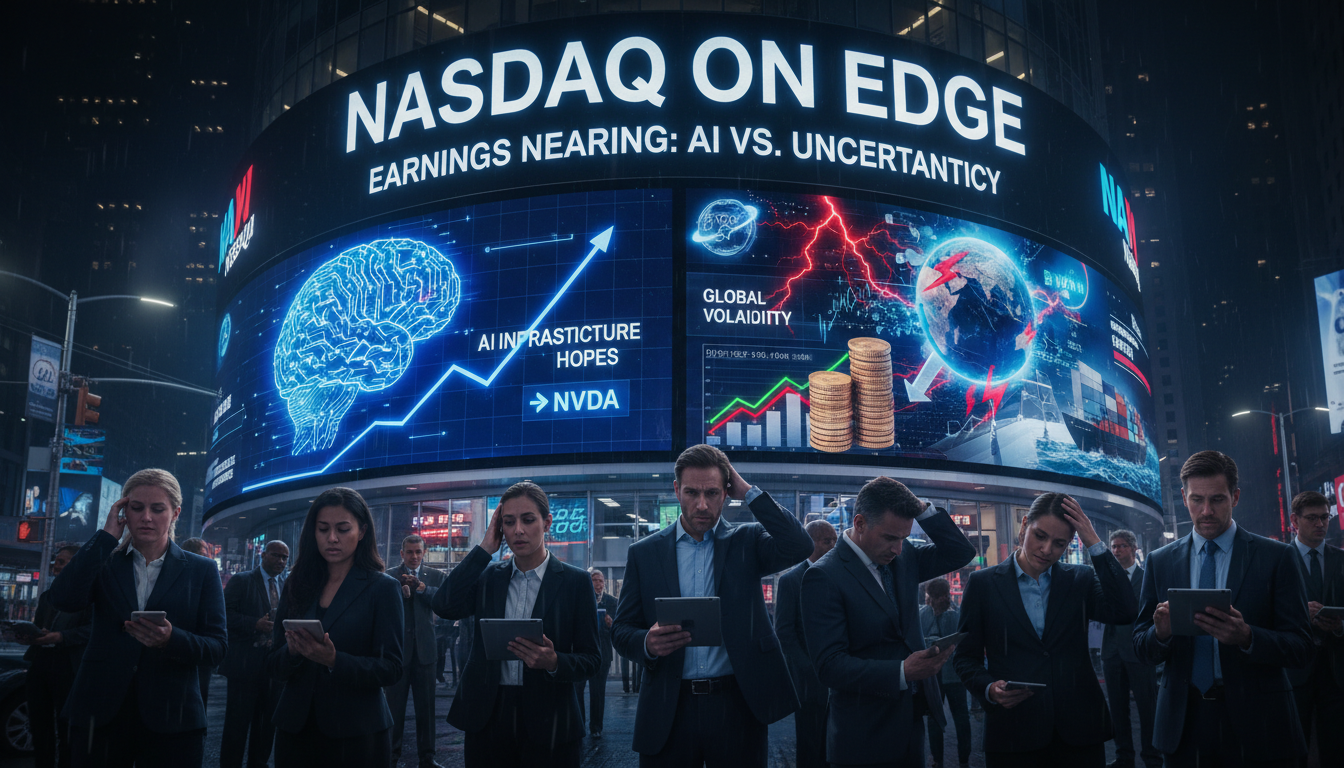
● Nasdaq on Edge, Nvidia Earnings D-1 – AI Bubble Time Bomb, Power Crunch Threat
Once Again Hesitating Nasdaq, Growing “AI Circular Capital” Risk Amid Nvidia Earnings D-1 and Anthropic Investment Controversy
This article will first address exactly three points.
Whether the key catalyst for the Nasdaq pullback is “uncertainty over Nvidia’s earnings” or “a reassessment of the AI bubble”.
Why the reports of investment/prepayment agreements between Microsoft, Nvidia, and Anthropic are heightening fears of “circular investment”.
And the most important point that most news outlets are overlooking: the structural impact that depreciation, power, and utilization of AI infrastructure will have on future valuations and stock market volatility.
We will summarize key keywords such as the stock market, interest rates, inflation, valuation, and economic slowdown all at once.
Nasdaq Correction: Uncertainty Ahead of Nvidia Earnings and “Pre-Reflecting Risk”
In the market, there is anxiety that “if things go slightly awry, the entire tech sector could be shaken” ahead of Nvidia’s earnings announcement.
As recent AI-related news noise has accumulated, some funds are moving to reduce risk until the earnings are confirmed.
In such times, since expectations have already been lowered, directional bets may increase immediately after the earnings announcement.
Rather than the numbers themselves, guidance, whether the data center revenue growth rate will slow, and comments on inference profitability are likely to have a greater impact on the stock market.
Microsoft·NVIDIA x Anthropic Investment/Prepayment Agreement Reports: Why They Heighten Fears of “Circular Investment”
According to market reports and industry comments, signs are emerging of an expanding structure where big tech and AI model labs engage in “investing, and in return receiving prepayments for cloud/AI infrastructure”.
The gist is that the investor puts in money, and the investee agrees to use a larger amount of specific cloud and AI accelerator resources, sparking a virtuous cycle that boosts semiconductor/infrastructure demand.
However, this structure makes the market sensitive because it may obscure the “substance of demand” and “independence of profitability”.
In other words, while revenue appears on the financial statements, doubts are growing as to whether cash flow, margins, and capital efficiency are actually improving.
Anthropic’s enterprise value is cited in reports with some variation, but is generally discussed in the range of tens of billions of dollars (several trillion won).
OpenAI has also been valued by the market in the range of tens of billions of dollars.
The exact investment amount and terms vary depending on the timing and source, so it is necessary to verify based on official disclosures and announcements.
The key is not the numbers themselves, but how much the “committed demand” transforms into endogenous demand, and at what point the cost of fulfilling the agreements eats into the margins.
Wall Street Tone: Signals of “AI Reassessment” and Survey on Bubble Risk
Some senior executives from major global financial institutions are calling for a reassessment of the valuation of the rapidly growing AI sector.
Another research house has downgraded Microsoft and Amazon from a buy to a neutral rating, arguing that “the margin structure of generative AI is weaker than expected”.
Points raised include assumptions of a longer depreciation period compared to early Cloud 1.0 (e.g., 5–6 years), and the possibility of inefficiency and overbuilding due to the accelerated pace of expansion.
In global fund manager surveys, the “AI bubble” has increasingly been identified as the biggest tail risk.
However, when everyone fears a bubble, one must also consider the possibility that much of the risk is already priced in.
Interest rates, inflation trends, and updates to earnings (especially guidance) become key variables that could move valuation multiples again.
Key Point 1: Depreciation, Power, and Utilization Determine Margins
The longer the assumed depreciation period for AI infrastructure such as GPUs, the more the book profits might look good immediately, but the greater the gap may become between cash outflow and maintenance/upgrading cycles.
Power (electricity) and cooling are now key components of the cost structure.
Power Purchase Agreements (PPAs), securing power capacity for data centers, and lead times for transmission and distribution infrastructure can constrain growth.
Utilization and model efficiency (cost per token) are indicators that determine the overall inference margin.
If the “committed cloud usage” does not convert into actual user traffic, a gap may emerge between the recorded prepayment revenue and actual cash flow.
Key Point 2: Differences Between Cloud 1.0 and Generative AI
Cloud 1.0 has seen continued inherent demand for general-purpose computing, structurally reducing unit costs.
In contrast, generative AI undergoes faster model replacement, and if the drop in cost per token fails to keep pace with the surge in demand, margins could narrow.
A “multi-model” strategy that serves several models simultaneously increases options for customers, but for providers, maintaining platform profitability and differentiation becomes a challenge.
Model Race: Benchmark vs. User Experience of Gemini, Claude, and GPT
Recently, there have been claims in the industry that Google’s latest version of Gemini outperforms competing models on various benchmarks.
However, users’ perceived quality can vary depending on the work, domain, and tool integration, and in actual commercial use, stability, security, and cost are evaluated together.
Benchmark scores alone cannot explain profitability; customer retention and the pace of enterprise deployment are emerging as more important metrics.
News Format Summary
– The Nasdaq is experiencing increased volatility due to anxious sentiment ahead of Nvidia’s earnings announcement.
– Reports of prepayment agreements between big tech and AI model labs are stirring controversy over “circular investment,” raising doubts about both the quality of demand and margin independence.
– Some research houses have downgraded the investment opinions for MS and AMZN as they adjust revenue assumptions for generative AI more conservatively.
– Global surveys have pointed to the “AI bubble” as the biggest tail risk, and interest rates, inflation, and earnings guidance are expected to influence valuations.
– Depreciation of AI infrastructure, securing power, and utilization rates are emerging as key variables that determine actual margins and cash flow.
The Most Important Point Others Often Overlook
– Quality of Committed Demand: The structure of investment–prepayment–revenue recognition that appears to be a virtuous cycle must always be separated from actual user demand and cash flow.
– Real Economy Impact of Power Constraints: The lead time for expanding the power grid is typically 2–5 years.
If the pace of expanding AI infrastructure outstrips the reality of power and transmission networks, both utilization and margins could come under simultaneous pressure.
– Risk of Depreciation Assumptions: They can widen the gap between book profits and cash generation, and the risk is greater for hardware with faster upgrade cycles.
– Price Pressure in the Multi-Model Era: As the substitutability among models increases, pressure to lower the cost per token/subscription fees intensifies, potentially leading to long-term margin declines.
– True Leading Indicators: Rather than GPU order volumes, first look at “inference utilization, power contracts (annual MWh), unit token costs, and enterprise retention rates.”
Investment Checklist: Points for Earnings Season
– Nvidia: Data center revenue QoQ/YoY, inference ratio, progress on software/platform transformation, comments on power and supply chain, changes in inventory/advance payments.
– Big Tech Cloud: Mix of AI workloads, contracted revenue vs. usage-based revenue, trends in AI-related COGS, accounting for GPU depreciation/leases.
– Model Labs/Applications: Enterprise ARPU, retention, trends in cost per token/query relative to usage, demand for security and compliance.
– Macro: Interest rate levels and real interest rates, the pace of inflation easing, sensitivity of multiples to economic slowdown signals.
Strategic Ideas: Managing Volatility Phases
– Defensive: Adjust exposure toward companies with high cash flow visibility in infrastructure/power, cooling, and grid players, AI cost-saving software, and firms with essential data.
– Offensive: Target core players with significant room for upward guidance revisions in the short term, but adopt a phased approach after confirming comments on utilization and margins.
– Risk Management: In preparation for valuation pressure if interest rates rebound, consider options/spread strategies for earnings misses and reduce exposure during event-sensitive periods.
Key Takeaway in One Line
It is the “cash generation, considering utilization, power, and depreciation,” not the “revenue created by investment,” that determines the true premium.
This earnings season is the time to verify that.
Notes on Cautions and Fact Verification
The investment and valuation figures related to Anthropic and OpenAI vary by timing and source, and some reports may be based on rumors.
It is recommended to reconfirm the exact conditions based on each company’s official announcements and disclosures.
< Summary >
– The anxiety ahead of Nvidia’s earnings is the key factor in the Nasdaq correction, with guidance and inference margin comments being critical rather than the numbers themselves.
– The cycle linking big tech, model labs, and semiconductors through an “investment–prepayment–revenue” chain raises doubts about the quality of demand and margin independence.
– Wall Street is intensifying the tone for a reassessment of AI valuations, with the bubble risk emerging as the biggest tail risk.
– Depreciation, power, and utilization are the determining variables for identifying AI clues and cash flow.
– The checklist focuses on Nvidia’s data center growth, cloud contracted vs. usage-based revenue, unit costs/retention, and trends in interest rates and inflation.
[Related Articles…]
How AI Infrastructure Margins Can Truly Improve After Nvidia’s Earnings
Conditions for Big Tech Valuations to Remain Resilient Amid Interest Rate Rebounds
*Source: [ 내일은 투자왕 – 김단테 ]
– 또다시 나스닥을 멈춰세운 엔비디아
● NVIDIA Frenzy, Debt-Fueled AI Arms Race, Bitcoin Crash, Cloudflare SPOF
NVIDIA Earnings D-1, Winners and Risks in the Era of ‘B2 (Debt-Driven) AI Infrastructure’, Post-Bitcoin 90K Collapse Scenario, Consumer Signals from Home Depot Guidance Revision, and the Single Point of Failure in the Market Highlighted by the ‘Cloudflare Outage’
Today’s article focuses on four key points.
1) Why NVIDIA’s earnings are considered the “Super Bowl of the tech industry” and the meaning of the 12:1 demand/supply ratio as seen by Wall Street.
2) The era of “B2 AI Infrastructure” beginning with Amazon’s large-scale corporate bond issuance, a comparison of the three big tech companies that have not issued bonds, and Oracle’s leverage risks.
3) The Bitcoin 90K collapse and the decoupling indicated by a 25% drop in the overall crypto market cap over six weeks, with macro and dollar liquidity points suggested by comments from MSTR and Winklevoss.
4) How Home Depot’s downward guidance revision reveals a K-shaped polarization in U.S. consumer spending, with diverging trends in housing, interest rates, and discretionary spending.
Today’s News Briefing: A Snapshot of the U.S. Stock Market
An outage at Cloudflare caused access issues for PinBiz and some other services.
During certain periods, services including X (Twitter), ChatGPT, Spotify, Canva, Zoom, Uber, DoorDash, and Claude AI were also affected.
The U.S. stock market opened weak this morning.
The S&P 500, Dow, and Nasdaq all started lower, and during the day the Nasdaq fell by around 1%, and the S&P 500 dropped by about 0.9% at one point.
NVIDIA, Amazon, AMD, Micron, and other tech/AI semiconductor stocks generally showed weakness.
Amazon’s news of a large-scale corporate bond issuance the previous day sparked a debate over “AI Infrastructure B2 (Debt-Driven)”.
In contrast, it was noted that NVIDIA, Microsoft, and Tesla have not recently issued any new corporate bonds.
Home Depot’s stock widened its decline following a downward revision of its guidance.
The company cited factors such as the absence of hurricanes, consumer uncertainty, pressures in the housing market, and a decrease in customer transactions.
Bitcoin experienced a collapse at 90K, a level not seen in 210 days, and subsequently rebounded to near the 91K mark.
Over the past six weeks, the total crypto market capitalization has shrunk by about 25%.
NVIDIA: “12:1 Demand/Supply” and the Implications of the “Tech Industry Super Bowl”
Wedbush’s Dan Ives predicted that NVIDIA’s earnings would “easily beat” Wall Street expectations.
After recent on-site inspections in Asia, he stated that “NVIDIA’s chip demand/supply is 12:1” and referred to the current phase as merely the “late innings” of the economic game.
Jon Münster noted, “It is unlikely that a competitor capable of replacing NVIDIA’s performance advantage will emerge in the next six quarters (roughly 1.5 years).” However, there is also caution that while a “surprise” might guard against downside risks, the upside gap-up may be limited as the stock already reflects high expectations.
The key risk lies in “concentration”.
NVIDIA’s revenue is concentrated among a few hyperscalers, so adjustments in these companies’ AI capital expenditures (CapEx) could lead to increased earnings volatility.
It is also important to recall the precedent when GPU inventories surged during the crypto collapse of 2022–2023.
The ‘B2 AI Infrastructure’ Era: Who Is Issuing Bonds and Who Is Not
Amazon’s bond issuance is interpreted as a long-term financing move for expanding its AI infrastructure.
Bonds, with interest rates below 5%, can be efficient for corporations, and for big tech companies with strong underlying business margins, this can be a rational choice.
Companies noted for not issuing new bonds recently include NVIDIA, Microsoft, and Tesla.
NVIDIA has robust cash flows generated from chip sales, and Microsoft is noted for having no new issuance issues until 2025.
Tesla, on the other hand, focuses more on its proprietary AI (e.g., for vehicles/robots) rather than data center AI infrastructure, thus having a lower need for large-scale B2 infrastructure financing.
Oracle, as an exception, is aggressively leveraging itself in a bid to become the “fourth hyperscaler”.
It has been mentioned that it aims to borrow around $25 billion annually, with cumulative plans up to about $100 billion, resulting in a high leverage risk with a D/E ratio in the 450% range.
In a slowdown of the AI cycle, the burden of this debt could significantly affect the income statement.
The point is not simply that “issuing bonds is bad”, but whether the company’s core cash flow can match the interest rate environment for financing and repayment.
Amazon, Meta, and Alphabet have diversified cash-generating bases through e-commerce, advertising, and cloud services, and are thus capable of absorbing interest rates around 5%.
Home Depot: What the Guidance Revision Reveals About Consumer Behavior
Home Depot revised its guidance downward for the third quarter and its stock adjusted by about -3% to -4%.
Temporary demand weakness due to the absence of hurricanes, consumer uncertainty, pressures in the housing market, and a decrease in customer transactions have collectively impacted its performance.
Mortgage rates remain at the mid-6% level, existing home sales are close to historic lows, and housing starts and building permits have recently declined to near record lows.
In this environment, households prioritize essential expenditures such as groceries, while discretionary spending on items like home repairs and remodeling is postponed, resulting in a K-shaped consumption pattern.
Although retail indicators on the surface appear stable, the segmentation in which “services and travel spending remain steady, while large discretionary expenditures contract” is being reflected in earnings data.
While it is too early to definitively declare an economic downturn, it is important to monitor areas where the “felt improvement” lags behind even after inflation eases and interest rates decrease.
Bitcoin 90K Collapse: A 25% Market Cap Contraction in Six Weeks and the Shadow of Dollar Liquidity
Bitcoin collapsed at 90K, a level not seen in 210 days, and then technically rebounded to near the 91K mark.
During this period, the overall crypto market capitalization contracted by about 25%, showing a short-term decoupling from the U.S. stock market.
Despite moves by major institutional investors on Wall Street to allow higher collateral and an expansion in derivative liquidity, volatility remains high.
MicroStrategy purchased an additional 8,178 BTC, bringing its holdings to roughly 640,000–650,000, with an average purchase price around $74,000.
Cameron Winklevoss commented that “below 90K is the last opportunity,” though determining the market direction remains a function of dollar liquidity, interest rates, and risk asset preferences.
Strategically, rather than increasing leverage, it is advisable to maintain a cash position and manage volatility through phased buying and selling.
Selecting Bitcoin over altcoins and focusing on on-chain sectors with solid cash flows (stablecoins and infrastructure) can be an effective defensive approach.
Cloudflare Outage: A Warning of a ‘Single Point of Failure (SPOF)’ in Market Infrastructure
Today, during certain timeframes, an outage at Cloudflare impacted multiple services such as X, ChatGPT, and Spotify concurrently.
This incident has highlighted the vulnerability of the current internet architecture, which is dependent on a few providers for security, CDN, and firewalls.
From an investment perspective, this conveys two messages.
1) There will be a structural growth in the demand for edge, multi-cloud, and web3-type distributed architectures.
2) The disruption in trading and data distribution could lead to a re-evaluation of volatility risks in ultra-short-term quant and options market microstructures.
U.S. “Private Security” Surpasses the Police: The Commercialization of Security (Not SaaS but ‘SaaSec’)
The U.S. has approximately 800,000 police officers and about 1,600,000 private security personnel, meaning that the private security sector already far exceeds public law enforcement.
The private security market, valued at around $24.4 billion, is projected to grow to $39.2 billion by 2030 at an annual rate in the 6% range.
This growth is the result of a culture of private property defense, a fragmented public safety structure at the state, county, and city levels, and changes in fiscal priorities following defunded police initiatives.
From an investment standpoint, the convergence of physical security and AI (video analytics, access control, threat detection), along with long-term growth in security demand in schools, shopping centers, and data centers, is noteworthy.
Key Points Others Might Overlook
1) The “debt cycle” for AI infrastructure is not inherently negative.
The issue is whether the core cash flow can align with the prevailing interest rate environment.
While aggressive leverage like Oracle’s can enhance beta in a rising market, it may prove more harmful than beneficial in a downturn.
2) The risk for NVIDIA does not stem from competitors but from customer concentration and a circular investment loop.
If customer CapEx declines, revenue could immediately be affected.
Thus, it is important to monitor both the customer portfolio and data center construction indicators.
3) The Cloudflare incident teaches that “distribution equals risk management.”
Balancing edge, multi-cloud, and on-premises edge architectures is the next solution for corporate IT.
4) K-shaped consumer polarization is likely to persist into 2025.
Even if interest rates are lowered, the recovery of large discretionary expenditures like housing and remodeling tends to be “lagging.”
5) Crypto is a subset affected by dollar liquidity.
The Bitcoin 90K struggle should be evaluated in conjunction with Federal Reserve interest rates, the strength/weakness of the dollar, and shifts between risk-on and risk-off environments.
Investment Checklist
- NVIDIA Earnings: Check data center revenue growth, customer CapEx guidance, and inventory turnover (DIO) trends.
- AI Infrastructure Bonds: Examine maturity structure, coupons, spreads, and EBITDA/FCF coverage relative to the financing scale.
- Consumer/Housing: Monitor mortgage rates, existing home sales, building permits/starts, and foot traffic indicators for home centers.
- Crypto: Track on-chain realized profit and loss, derivatives funding rates, stablecoin net inflows, and correlations with the Dollar Index (DXY).
- Infrastructure Risk: Evaluate companies exposed to multi-cloud distribution, CDN/security redundancy, data governance, and edge computing.
Macro Points: Interest Rates, Inflation, and the Dollar
Even if interest rate cuts begin, the tangible effects on the economy will take time.
During periods of easing inflation, wages, rents, and service prices need to gradually decrease to truly ease consumer pressures.
If the dollar remains strong, the expansion of multiples for risk assets will be limited, and volatility in emerging markets and crypto could increase.
This Week’s Calendar (Based on Broadcast Times)
Wednesday after market close: NVIDIA earnings announcement is scheduled.
Thursday before market open: Walmart earnings are scheduled.
Be sure to cross-check earnings commentary with AI semiconductor and consumer chain leading guidance.
Practical Wrap-Up: How to Respond
NVIDIA: Despite potential earnings surprises, volatility may remain elevated.
Instead of chasing full positions, adopt a phased approach, placing greater emphasis on customer CapEx commentary.
Companies issuing AI infrastructure bonds: Seize opportunities in firms with solid core margins and maturity structures during times of market turmoil.
Be cautious of companies with rapidly increasing leverage, such as Oracle, as missed guidance may lead to heightened volatility.
Consumer/Housing Chains: Prioritize essential consumption and services while gradually scaling up on large discretionary expenditures.
Maintain a cautious stance on aggressive positioning until there are clear signs of recovery in mortgage rates and housing transactions.
Bitcoin: Expect volatility to persist around the 90K level.
Maintain a strategy of reducing leverage, balancing spot positions with cash, and employing phased buying and selling.
Infrastructure/Security: Consider a mid-to-long term basket of companies exposed to multi-cloud, edge, and AI security.
Pay attention to the long-term growth in private security as well as the convergence of physical and AI-based security sectors.
< Summary >
NVIDIA’s earnings are the “Super Bowl of the tech industry”, with a sustained 12:1 demand/supply ratio; however, attention must be paid to the risks from customer concentration.
The “B2 AI Infrastructure” era hinges on the matching of interest rates with core cash flows, and Oracle’s leverage presents large betas on both the upside and downside.
Home Depot’s downward guidance revision confirms a K-shaped consumer pattern where housing and large discretionary spending are slow to recover.
The Bitcoin 90K collapse reflects ripple effects from the dollar and interest rate liquidity, emphasizing the effectiveness of reducing leverage and phased strategies.
The Cloudflare outage highlights the risk of a single point of failure in market infrastructure, driving the need for distributed architectures and increased AI security demand.
[Related Articles…]
Post-NVIDIA Earnings: The True Direction of AI Semiconductor Demand
The Bitcoin 90K Struggle: Interest Rate and Dollar Cycles and the Next Macro Trigger
*Source: [ Maeil Business Newspaper ]
– 홈디포 가이던스 하향에 주가 하락ㅣ웨드부시 “엔비디아 실적 예상치 뛰어넘을것”ㅣ비트코인, 210일만에 90K 붕괴ㅣ홍키자의 매일뉴욕