*Source: 서울경제TV
머스크, 끝내 ‘자체 팹’ 구축… ‘삼성·SK하닉’ 급소 찔렸다
● Musk’s Bold Semiconductor Fab Move Shakes Global Supply Chain
Musk’s Declaration to Build a ‘Self-Owned Fab’ — A Warning to Samsung and SK Hynix and Korea’s Options
The following key points are covered:
- Tesla and XAI’s plan and roadmap to establish their own semiconductor fab by 2026.
- Plans to reduce GPU dependency by designing an autonomous AI chip (Xenos) and transitioning from initial TSMC outsourcing to vertical integration within the US.
- The impact of a strategy to self-supply wafers, packaging (FLP), and post-processing within the US on Korea’s post-processing and packaging industry.
- Risks and opportunities in short, medium, and long-term scenarios, and strategies for Korean companies (Samsung Electronics, SK Hynix, Simtek, etc.).
- Core insights that other news outlets might overlook (actual repercussions of policy and supply chain reshuffling, changes in industry competitive advantage).
Situation Summary — What Musk is Doing and Why
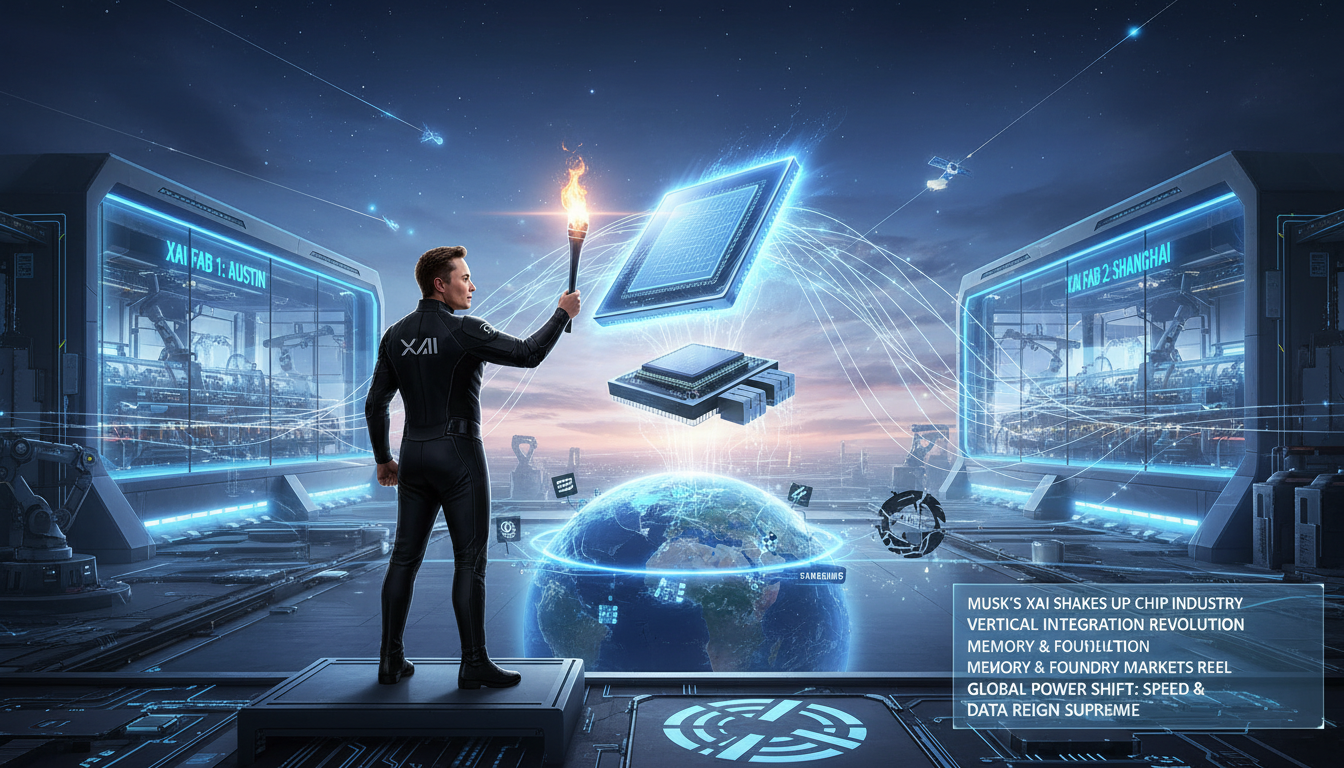
Musk (Tesla and XAI) has officially announced plans to establish an in-house semiconductor fab, including wafer production, packaging, and post-processing, by 2026.
The purpose is to move away from the existing GPU-centric AI computing system and meet the AI demands of Tesla, XAI, and the X platform with its AI chip (based on Xenos) to secure cost, performance, and supply stability.
The initial design is complete, and initial production will start with TSMC outsourcing, but the long-term plan is to secure a wafer production capacity of over 1 million sheets per month through a new fab in the US.
In particular, the emphasis is on processing packaging, substrates, and post-processing in-house through collaboration with US startups in FLP (panel-based packaging).
Technology and Production Plan Overview
- Chip Design: Completion of own AI chip (Xenos) design — aiming to optimize power efficiency, computational density, and cost compared to GPUs.
- Initial Production: Short-term (1-2 years) outsourcing production to foundries such as TSMC.
- Mid to Long-Term Transition: Construction of new fabs in the US, such as in Texas and Nevada, with a wafer monthly production capacity target of over 1 million sheets.
- Post-processing and Packaging: Introduction of an FLP-based panel-level packaging system, driving vertical integration through collaboration with US packaging startups.
- Vertical Integration Scope: Includes wafer → packaging → substrate → testing and assembly in a complete vertical integration model.
Direct Impact on Korean Semiconductors (e.g., Samsung, SK Hynix, Simtek)
- Transfer of Packaging Demand: Korea has traditionally had strengths in the fields of post-processing, packaging, and substrates. If Musk pursues localization, some of these demands might shift internally to the US.
- Changes in Foundry Reliance: In the short term, it will have to rely on TSMC and Samsung foundries, but if Tesla’s XAI demand surges, the percentage of in-house fabs may rapidly increase, causing confusion in long-term contracts and demand forecasts.
- Intensified Competition: If AI chip demand shifts en masse, foundry, packaging, and substrate competition will be restructured globally, and Korean companies may be re-evaluated in terms of price, lead time, and supply stability.
- Strategic Areas: The need to defend and enhance Korea’s technological advantage in high-density packaging (2.5D/3D, EMIB/FLP), special substrates, and advanced post-processing equipment and processes becomes more urgent.
Supply Chain and Geopolitical Impact
- When combined with US localization policies, the localization of semiconductor supply chains accelerates.
- There is potential for the existing system based on international labor division (design-foundry-packaging-assembly) to be disrupted.
- Korea must prepare defense strategies against geopolitical risks (US-China competition, US self-supply policy) concerning semiconductor export and production.
- Cooperation with allied countries (US, EU, Japan), strategic investment attraction, and partnership agreements are essential.
Short, Medium, Long-Term Scenarios
- Short-term (1 year): Maintain outsourcing production with TSMC and Samsung. Limited impact on Korean companies’ performance.
- Medium-term (2-4 years): If Tesla starts operating its packaging facilities and shifts some post-processing, Korean post-processing sales might decline.
- Long-term (5+ years): Once Tesla completes its self-sufficient wafer and packaging full stack, a significant portion of AI demand may shift to localized ecosystems — full-scale restructuring of global supply chains.
Korean Companies’ Response Roadmap
- Samsung Electronics: Refine foundry and packaging integration capabilities to secure high-value AI chip customers. Accelerate commercialization of FLP, chiplets, and 3D stacking technologies. Offer strategic customer-tailored services (integrated design-packaging-validation).
- SK Hynix: Differentiate through strengths in memory and integrated memory solutions for AI accelerators (HBM advancement). Consider expanding packaging partnerships and US production and collaboration.
- Post-processing and Packaging Companies (e.g., Simtek): Invest in the transition to FLP and panel-level technology, secure competitiveness through the localization and advancement of packaging materials and substrates.
- Tip (Common): Secure strategic inventories and multiple suppliers for externally dependent supply chains (especially core materials and equipment).
Business and Policy Recommendations (Korean Government and Industry)
- Industrial Policy: Initiate focused investment programs for advanced packaging and substrate R&D (FLP, 2.5D/3D, TSV, etc.).
- Finance and Tax: Provide tax benefits and long-term low-interest funding for investments in semiconductor post-processing and advanced packaging facilities.
- Talent Development: Strengthen packaging and post-processing specialist training programs through collaboration among universities, companies, and research institutes.
- International Cooperation: Participate in technology and supply chain negotiations with the US and EU to ensure market accessibility and regulatory responses.
- Business Strategy: Rapidly enhance technology and supply chains through strategic M&A and partnerships, securing niche areas.
The Most Important Point Other YouTube Channels and News Outlets Might Miss
- The core is not ‘simple investment’ but a ‘supply chain innovation premised on the AI era.’
This is not a strategy of a specific company (Tesla), but a signal that AI demand fundamentally redefines supply chain structures (who designs, who manufactures, where packaging occurs). - Packaging technologies (FLP, etc.) are not just simple assembly but critical variables for AI chip performance and price.
If the US packaging ecosystem becomes established, Korea’s highly profitable post-processing sector could structurally diminish, impacting the entire manufacturing equipment and material industry. - Technical advantage is determined not by a ‘single process’ but by a ‘process chain (wafer → chiplet → packaging → system integration).’
In other words, semiconductor competitiveness is redefined by the combination of foundry, packaging, OSAT (post-processing), and system integration capabilities. - Lastly, a company’s solo strategy (in-house fab) is most powerful when combined with national industrial and trade policies.
If Musk’s actions succeed, other large corporations may imitate similar strategies — the impact is cumulative.
Practical Checklist — What Companies and Governments Should Do Immediately
- Corporations: Diversify core customers (large AI services and clouds), reassess long-term contracts, clarify FLP and chiplet technology roadmaps.
- Government: Designate packaging and substrate fields as strategic industries and secure support budgets, prepare import-export risk management systems.
- Industry: Consult with the government to build shared infrastructure (panel testing and certification centers).
- Finance: Expand series investments in semiconductor post-processing and packaging startups, and establish a roadmap for returns.
[Related Articles…]
Summary of Korea’s Semiconductor Packaging Future Strategy
Practical Scenarios of AI Chip Competition and Global Supply Chain Restructuring