● AI Bubble Ticking, GPT Hype Fades, Power Crunch
Critical Point of the AI Hype Discourse and 2026 Economic Outlook: GPT-5 Perception Controversy, the Counterattack of Google, Claude, and Grok, and the Significance of Nvidia’s CPU Gap
This article precisely contains three elements.
- It includes a checklist to identify the “breaking point” of the AI hype based on actual data, as well as strategies to counter it.
- It summarizes the market signals from the limited perceived performance improvements of GPT-5 relative to expectations and the counterattacks from Google, Claude, and Grok.
- It outlines what Nvidia’s gap in the CPU release schedule means and examines the infrastructure cycle expanding to include power, memory, and SSDs.
News at a Glance: Key Briefing
- The root of the hype discourse.
The slowed tangible performance improvements of frontier models, data shortages, and the cost-efficiency debate have converged. - The prelude to the counterattack.
On the basis of user experience, Google’s Gemini lineup, Anthropic’s Claude, and xAI’s Grok are creating a diversified landscape. - The path to profit has opened.
OpenAI is experimenting with commerce- and advertising-based revenue through in-chat payments, shopping, and the integration of partner apps. - The truth about hardware.
Nvidia’s performance shows substance with a simultaneous increase in operating profits.
However, the lack of visibility in the CPU roadmap and bottlenecks in power and flash memory present new risks. - Economic outlook points.
Although AI CAPEX continues amid a global economic slowdown, variables such as interest rates, power prices, and regulations increase. - Investment focal points.
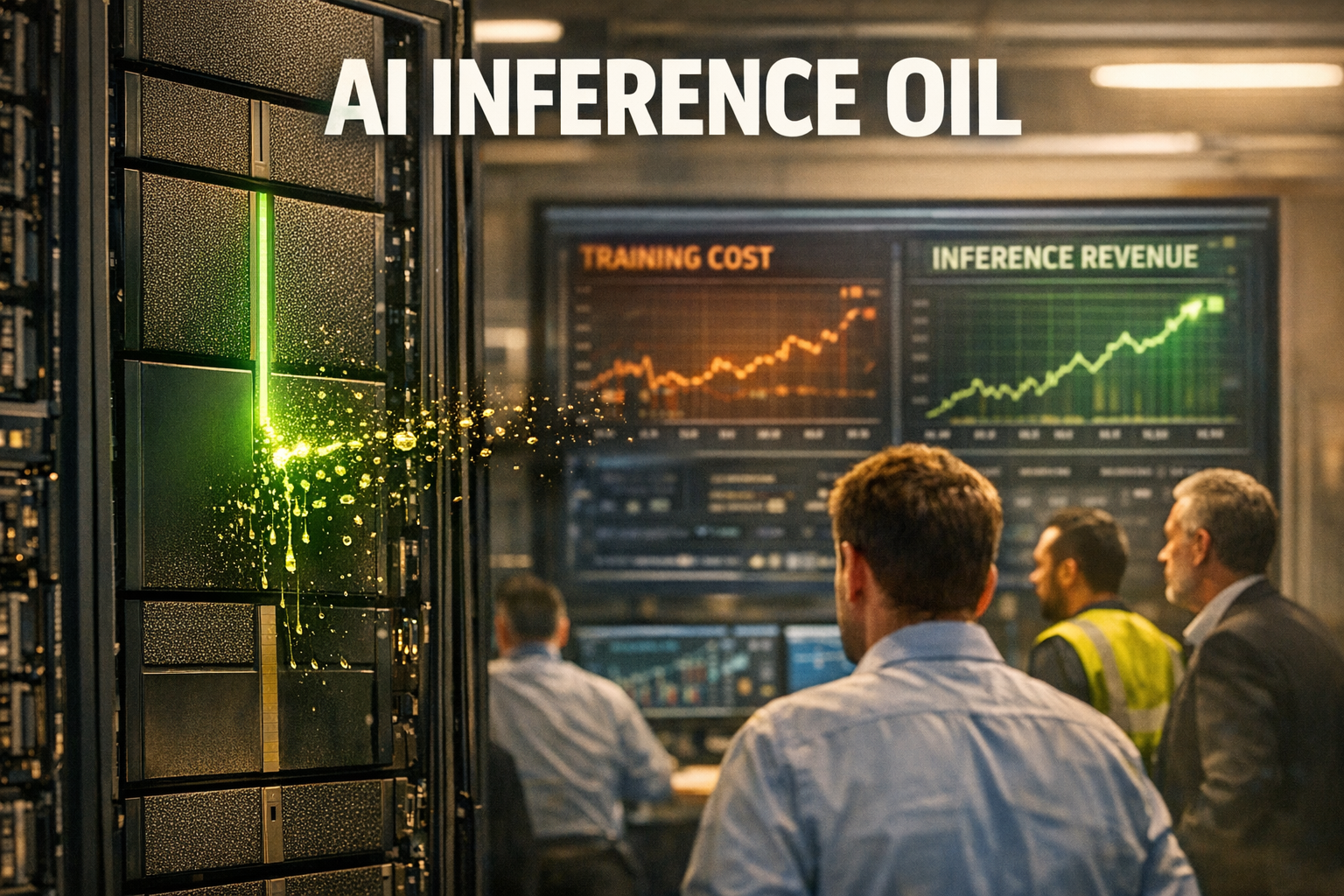
As the cost focus shifts from “training” to “inference,” the value chain expands to include SSDs, NVMe, power infrastructure, and cooling.
Generative AI Performance: Shifting Focus from ‘Big Leap’ to ‘Deep Inference’
- Perception relative to expectations.
A growing perception that the improvement in user experience is limited compared to a major version number change has fueled controversy over stagnation. - Data limitations.
The additional gains from web-crawled data have diminished, and the performance curve of models has flattened. - Countermeasure strategies.
By “extending thinking” through methods such as chain-of-thought, inference depth is increased, and the focus has shifted to longer computations with more GPUs. - Efficient counterattack.
Cost-efficiency approaches with open-source, lightweight models, and deep compression are rapidly leveling the playing field, narrowing the cost-effectiveness gap with frontier models. - Market interpretation.
The structure is evolving from “a monopoly by a single mega-model” to “custom combinations for specific tasks and domains.”
Platform Battle: OpenAI’s Super App Transformation and the Differentiation of Google, Claude, and Grok
- OpenAI.
It is experimenting with commerce- and advertising-based monetization by opening up payment and shopping functions within chats.
Travel, payment, and retail partners are entering the chat environment, forming an app store-like ecosystem.
There is a clear trend of enhancing personalized recommendations and commerce conversion rates with long-term memory. - Google Gemini.
The user experience has significantly improved in images, videos, and multimodal elements, with strengths in precise editing based on partial modifications and the integration of YouTube, photo, and map data.
It is aggressively competing with traditional tools like Adobe by encroaching on creative workflows through the combination of data and video assets. - Claude (Anthropic).
It is highly preferred in B2B, API quality, and safety, showing strength in enterprise adoption speed. - Grok (xAI).
Leveraging X-data, it is specialized in timeliness and social tone, and is pursuing a speed battle by mobilizing Tesla, power, and data center capabilities. - Implications from user evaluations.
In community-based rankings, different services are alternating at the top, solidifying a multipolar system.
Hardware & Infrastructure: Nvidia’s Strength, the CPU Gap, and the Battle over Power & Storage
- The significance of Nvidia’s performance.
It is evaluated as a cycle accompanied by substance, evidenced by not only a sharp rise in stock prices but also simultaneous increases in revenue and operating profits.
“Nvidia’s performance” is the most solid hard data in the hype debate. - The CPU release schedule gap.
While GPU roadmaps are detailed every quarter, the limited disclosure of CPU-related schedules and spec updates is a factor driving market volatility.
If the shift towards ARM servers and custom CPUs accelerates, it will bring variables in system balancing and cost structure. - From training to inference.
The cost focus for major services is shifting from training CAPEX to inference OPEX.
This shift stimulates demand across data center power, cooling, networking, SSDs, flash memory, and HBM. - Long-term memory and storage.
As personalized and state-maintaining agents increase, there is a surge in demand for NVMe SSDs, key-value caches, vector DBs, and memory disaggregation. - Power as the ultimate bottleneck.
Improvements in PUE, liquid cooling, substation infrastructure, and securing PPAs (power purchase agreements) are key competitive factors, with power pricing determining the cost of AI services.
Economic Outlook: Global Economy, Interest Rates, Regulatory Scenarios, and the AI Cycle
- Global economy.
Recovery in manufacturing and trade is gradual, while service and digital CAPEX show relative strength. - Interest rates.
Although prolonged high interest rates increase the pressure on inference OPEX, once revenue models are established, AI cash flows can remain attractive compared to government bonds.
In a easing phase, investments in data centers and power infrastructure will accelerate. - Regulation.
With the introduction of regulations on safety, copyright, and data localization, localized CAPEX increases and the adoption of multi-models by region becomes widespread. - Physical data.
The rapid expansion of new data centers, orders for SSDs and HBMs, and investments in power facilities serve as leading indicators.
As long as this trend remains unbroken, the weight of structural growth will exceed that of the hype.
AI Investment Strategy: Value Chain Basket and Risk Management
- Basket composition.
GPUs & accelerators.
Power, substations, and cooling.
Networking (NVLink/InfiniBand/400G and above).
HBM, DRAM, NAND, SSD controllers.
Storage software (NVMe-oF, vector DBs).
Platforms, agents, and super apps (commerce and advertising conversion).
Security, governance, and copyright tools. - Risks.
A surge in power and electricity prices, supply chain bottlenecks (HBM, packaging), volatility in the CPU roadmap, regulatory tightening, delays in demand shifts, and exchange rate fluctuations. - Checkpoints.
The quality of Nvidia’s performance, trends in power PPA agreements, shipments of SSDs and HBMs, user dwell time and payment conversion rates, API revenue per token, and the global interest rate regime. - Positioning.
Focus on areas with low sensitivity to inference OPEX and core weight in power and storage infrastructure, avoiding a single bet on frontier models.
Adjust the proportion of CAPEX-sensitive sectors flexibly based on economic outlook and interest rate scenarios.
Corporate Adoption Guide: 90-Day Execution Roadmap
- 0–30 days.
Identify high-load tasks by business, set boundaries for security and compliance, and select three pilot use cases. - 31–60 days.
Conduct a PoC using lightweight models with domain prompts and RAG, measure inference costs, conversion rates, and quality KPIs, and design to minimize vendor lock-in. - 61–90 days.
Apply long-term memory and personalization, integrate with payments and commerce, tune vector DBs and caches, finalize security, logging, and audit systems, and conduct internal training.
Points When the Hype Becomes Truly Dangerous: 7 Alarm Checklist
- The user-perceived improvement of new large model products becomes negligible for two consecutive quarters or more.
- The rate of decline in inference costs outpaces the growth rate of revenue per user.
- The launch of new services is delayed due to bottlenecks in power, HBM, and SSD supply.
- System balancing costs surge due to uncertainties in the CPU roadmap.
- Payment and commerce conversion rates within the platform fall short of expectations, resulting in a reversal where reliance on advertising increases.
- Regulatory risks restrict data movement and training, leading to fragmented services by region.
- In Nvidia’s performance, operating profit and cash flow growth lag behind revenue growth.
Key Points That Are Rarely Addressed Elsewhere
- The spread of state-maintaining agents is likely to be bottlenecked by “storage IOPS” rather than “tokens.”
NVMe-oF, SSD controllers, and flash-optimized file systems will benefit. - The true contest in AI costs is not “tokens per dollar” but “inferences per watt.”
Companies that disclose power efficiency metrics will command a premium. - Long-term memory is the foundation for monetizing personal information, preferences, and context.
Companies with a first-party data advantage will dominate commerce conversion rates. - Even after training CAPEX slows, inference OPEX will structurally expand.
Revenue from advertising and commerce conversion, rather than subscriptions, can offset this. - The CPU gap issue is not about “GPU monopoly” but about the uncertainty in system TCO.
A heterogeneous structure combining ARM, custom CPUs, and DPUs will become the standard.
Conclusion: This Is a Period of ‘Selective Hype Amid Structural Growth’
AI is solidifying its tangible base through platform diversification, commerce integration, and the expansion of infrastructure centered on power and storage.
However, the slowing of perceived performance improvements, bottlenecks in power and memory, and gaps in the CPU roadmap amplify valuation volatility.
If the global economy and interest rate trajectory ease, CAPEX may accelerate again, whereas prolonged high interest rates will make inference efficiency and conversion rates critical determinants of success.
Invest by approaching a value chain basket and risk scenario management rather than a single frontier model bet.
- The core of the hype discourse is the slowdown in perceived performance improvements, data limitations, and cost-efficiency.
- Revenue models are opening up through the rise of Google, Claude, and Grok and OpenAI’s integration of commerce and an app store model.
- While Nvidia’s performance demonstrates substance, the CPU schedule gap and bottlenecks in power and storage present new risks.
- Depending on the trajectory of the global economy and interest rates, the pace of AI CAPEX and inference OPEX will vary.
- Investment focal points are in infrastructure such as power, storage, and networking, platform conversion rates, and inference efficiency per watt.
[Related Articles…]
- AI Data Center Power Crisis: Who Will Dominate Electricity by 2026?
- Winners in the Era of Long-Term Memory: The Economics of NVMe, Flash, and Vector DBs
*Source: [ 경제 읽어주는 남자(김광석TV) ]
– CPU 출시 일정 발표 없는 엔비디아… “AI 거품론 정말 위험해지는 지점은?” GPT5 논란부터 구글·그록 반격 신호 | 경읽남과 토론합시다 | 김덕진 소장 2편

● AI Bubble Implosion
AI Bubble Debate: What to Watch Now: Nvidia, OpenAI Unit Economics, Power Constraints, and Investment Strategy
Let’s not delay the conclusion on whether it’s an AI bubble or not; this article settles it.
It covers AI data center power constraints and cost structure, Nvidia’s cash flow checkpoints, the unit economics of model businesses like OpenAI, the technical limitations of predictive AI, and even investment strategies to use in the stock market.
Key points have been reorganized from the perspective of the global economic outlook, inflation, interest rates, stock market, and investment strategies.
News Briefing: What’s Happening in the Market Now
The AI bubble theory is surging, and volatility in AI-related stocks is increasing.
As warnings of an AI bubble collapse emerge, a pattern of sharp short-term declines followed by rebounds has been observed.
The news of OpenAI’s substantial losses and its reliance on investments has become a hot topic.
Although issues such as delayed collections on accounts receivable, inventory, and accounting estimates (e.g., depreciation periods) related to Nvidia have been raised, the company has repeatedly refuted these items, according to reports.
Investor sentiment is gradually shifting from one-sided optimism, like three years ago, to a more differentiated phase.
Key Issue 1: 7 Signals That Differentiate “Bubble vs. Fundamentals”
1) Quality of Demand: Does a virtuous cycle convert investor funds into customer revenue?
2) Unit Economics: Does the revenue per 1k tokens exceed the cost per 1k tokens (computation + power + storage + network)?
3) Utilization: Is the usage of inference (rather than training) being filled by actual usage?
4) Price Elasticity: Do customers remain loyal even when model prices increase, or do they quickly downgrade or switch to open-source alternatives?
5) Power/Land Constraints: Do power purchase agreements (PPAs), PUE, and transmission line expansions keep pace with the investment speed?
6) Used GPU Market: A rapid drop in used prices signals overinvestment, whereas tight premiums indicate solid demand.
7) Regulation/Security: When data governance and model accountability regulations are implemented, do costs not surge drastically?
Key Issue 2: Nvidia Debate: Which Factors Are the Most Persuasive?
Accounts receivable and inventory always come under scrutiny at the cycle’s peak.
The key is whether the cash conversion cycle (CCC) deteriorates, and whether customer prepayments and long-term contracts increase to provide defense.
You must examine it on the same line as the final revenue growth of data center customers.
The depreciation period debate is better judged by residual values and the actual trading prices in the used market rather than accounting estimates.
If the liquidation price of used H100/B100-grade cards plummets relative to manufacturing costs, it could be interpreted as a signal of the cycle peak.
The pace at which bottlenecks in the networking (InfiniBand, Ethernet) and HBM supply chains are resolved directly affects the recovery of fixed costs.
Key Issue 3: OpenAI and Model Business Unit Economics: Let’s Break Down the Calculation
Revenue (per 1k tokens) = Rate per token × usage.
Cost (per 1k tokens) = Computation cost (GPU depreciation + capital cost) + power cost (kWh rate × PUE) + storage/network + RAG/search cost + quality control/moderation.
The breakeven point is determined by utilization, model efficiency (FLOPs per token), and power unit cost.
As the share of inference increases, the pressure to lower unit cost and optimize cache (knowledge reuse) becomes critical.
As multimodality becomes widespread, bandwidth and power costs will surge, making pricing increasingly important.
The faster the spread of open-source and lightweight techniques (quantization, distillation), the more the ‘economies of scale’ are eroded and customers may switch to self-managed or edge inference.
Key Issue 4: The Technical Limitations of Predictive AI—Why They Matter in the Bubble Debate
Unlike generative AI whose performance is immediately felt, predictive AI is vulnerable to data bias, data leakage, and feedback loops.
Similar to the debunked case of a hit song predicted at 97% due to data leakage, the most plausible results often arise from errors.
In medical cases, for instance, treatment protocols based on predictive models for asthma patients can lead to incorrect safety decisions.
Applications in recruitment, insurance, and judicial sectors, where accuracy drops can translate into social costs, necessitate explainability (XAI) and rigorous extrapolation validation.
The key issues are “on which demographic the model was trained and where it is applied” and “how humans might manipulate the algorithm.”
Invisible Determinants: Power, Supply Chain, and Regulation
Power is the real bottleneck in the AI cycle.
PPA prices, PUE, availability of renewable energy, and the speed of transmission line expansions become the limiting factors in data center expansion.
Rising power rates directly put pressure on model pricing and cloud margins.
The performance per rack and TCO vary depending on whether supplies of HBM, CoWoS, and high-speed networking improve.
Data security and sovereignty regulations by country may boost domestic model demand but undermine economies of scale.
Investment Strategy: A Roadmap for Positioning Based on Different Scenarios
Scenario A (Fundamentals Settle): Inference revenue becomes visible and overall revenue expands even with price reductions.
Increase exposure to data center operators, high-efficiency power and cooling, networking, and memory companies.
Scenario B (Pace Adjustment): Capex slows due to power, regulation, and the spread of open-source.
Efficiency software (compilers, schedulers, RAG platforms), edge AI, and industry-specific applications become more dispersed.
Scenario C (Bubble Contraction): Rapid drop in used GPU prices, decline in utilization, and reduced spending by large customers.
Defend with infrastructure REITs with solid cash flow, power utilities, and cost-cutting AI tools (with immediately measurable ROI).
Checklist: Indicators That Act First When the Market Really Improves or Deteriorates
– Actual transaction prices and inventory turnover for used H/HX/B-grade GPUs.
– The disclosed proportion of inference revenue from hyperscalers and customer retention rates.
– PPA contracted rates, PUE trends, and regional power supply plans.
– Retention rates 60–90 days after end-user price adjustments.
– Schedules for the implementation of AI regulations (transparency and accountability) by country and guidelines for compliance costs.
Industry Impact: Who Is Structurally Benefited/Risked
Beneficiaries: Power utilities, transmission companies, high-efficiency cooling, HBM/advanced packaging, high-speed networking, and model efficiency software.
Competitors: General-purpose LLM platforms vs. industry-specific small models, and cloud inference vs. edge inference.
Risks: Overcapacity in data centers, industries with high demands for explainability due to regulation, and flashy but ROI-uncertain B2C generative services.
Economic Context: Interest Rates, Inflation, the Stock Market, and the AI Cycle
Expansion in Capex near the peak of interest rates raises the cost of capital and increases ROI hurdles.
Energy-related inflation stimulates data center OPEX, passing on pricing pressures.
When the global economic outlook weakens, “efficient AI” selling efficiency is more defensive than “experiential AI.”
The stock market will be most sensitive to the reliability of inference revenue, the speed at which power constraints are resolved, and the clarity of regulatory guidelines.
Fundamental Takeaway from Books: The Question Posed by “An AI Bubble is Coming”
Princeton’s Arvind Narayanan’s new book asks, “Are we buying fantasies instead of technology?”
The core message is simple.
Predictive AI fails more often in context than it impresses with demos.
Before making policy or managerial decisions, default to extrapolative validation, explainability, and human oversight.
The Most Important Content Rarely Mentioned Elsewhere
1) The true price setter in AI is not semiconductors, but power.
Lower kWh rates and improved PUE are necessary for the structural decrease in token prices, which then reveals the true nature of demand.
2) The key variable in the inference S-curve is “content reuse rate.”
As RAG and cache optimize, the need for new computations for the same query drops sharply.
This can dampen revenue elasticity, meaning that “efficiency improvement = revenue growth” does not always hold.
3) Open-source and lightweight approaches erode the ‘economies of scale.’
The moment customers obtain sufficient quality with small models, high-end computational demand wanes.
4) Used GPU indicators transform all debates into numbers.
If the liquidation price converges rapidly toward manufacturing costs, it signals overinvestment; if it remains firm, it signals real demand.
Practical Investment Action Plan
– Defensive: Focus on those in the power, networking, and HBM value chains with excellent cash flow and pricing power.
– Alpha: Invest in model efficiency (compilers, schedulers, vector DB/RAG), industry-specific applications, and edge AI.
– Risk Management: Link trailing stops to used GPU prices and customer retention rates.
– Macro Turning Point: As signals of declining interest rates appear, expand beta exposure in Capex-sensitive sectors; in the event of re-heated energy inflation, rotate into utilities and cooling providers.
< Summary >
The key to judging an AI bubble is the “virtuous cycle of money” and “unit economics.”
In the Nvidia debate, verify through cash conversion, used GPU prices, and bottlenecks in networking and HBM.
For model businesses like OpenAI, profitability hinges on the per 1k token rate and variables of power and efficiency.
Predictive AI is vulnerable to extrapolation failures and manipulation, causing costs to spike in regulated industries.
Power is the real bottleneck, and open-source/lightweight techniques erode economies of scale.
The investment strategy is favorable when combining a defensive stance with a focus on power, networking, and HBM with an alpha tilt toward efficiency and edge AI.
[Related Articles…]
Impact of the Power Crisis on AI Data Center Investment
Post-Nvidia: The Next Contender in the AI Semiconductor Supply Chain
*Source: [ Jun’s economy lab ]
– AI 버블에 대한 생각 (ft. AI버블이 온다)