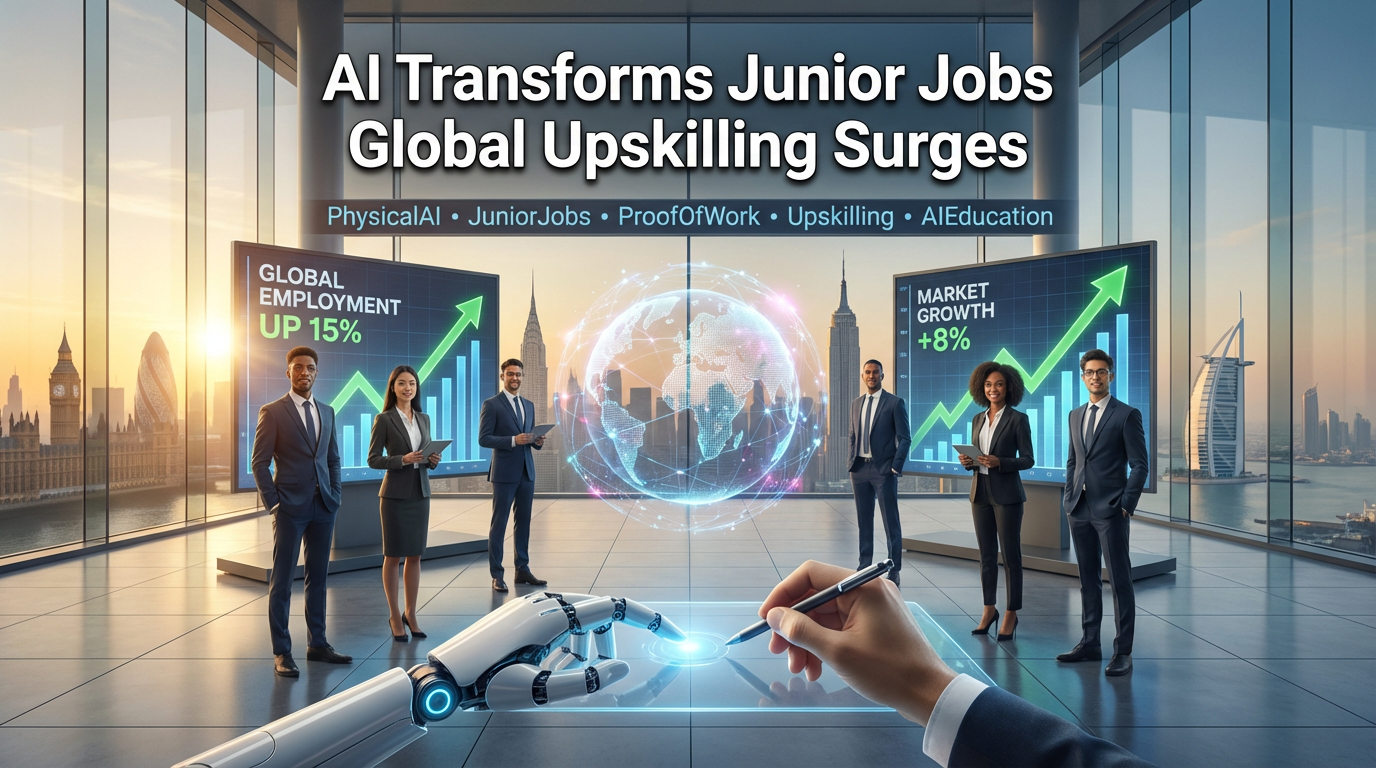
● Junior Jobs Annihilated, AI Oligarchs Ascend
Physical AI Era, Junior Job Restructuring, and the 2026 Economic Outlook Roadmap: An Action Guide for Education, Careers, and Entrepreneurship
This article covers the shock to the employment market centered on juniors driven by Physical AI, a three-stage AI integration education roadmap, a low-cost growth strategy for venturing into the global market as a solopreneur, an implementation checklist for corporate AX (AI Transformation), and the economic outlook and investment checkpoints for 2025–2026.
In particular, it realistically explains the “collapse of the career ladder” and the “proof-of-work portfolio” strategy that are rarely discussed elsewhere, as well as the structural impact of power and compute on employment and productivity.
News Briefing: Physical AI and Employment Market Restructuring
With the government formalizing investments in Physical AI, power supply and data center infrastructure expansion have taken center stage on the policy agenda.
AI kiosks, vision systems, and robotics are rapidly entering industrial sites, and task designs across the service, distribution, and manufacturing sectors are being restructured.
AI natives (teenagers to Generation Z) are already accustomed to conversational and companion services, altering consumption, learning, and counseling patterns.
In the employment market, it is not the reduction of seniors but the diminishment of junior roles that is underway, as lower-level tasks such as research assistance, preliminary analysis, and drafting are being partly replaced by generative AI.
(Introduced as a case in discussions) Similar to the downsizing of research assistants (RA) in global consulting, there is an observed phenomenon where the stepping stone for accumulating early career experience is diminishing.
As a result, the productivity gap is converging toward those who can skillfully manage and confirm AI outputs, and this trend also influences the structure of the global employment market and wage distribution.
Why Are Juniors Being Replaced First
As the barriers to using generative AI decrease, seniors with strong domain knowledge are able to ask better questions, provide clearer instructions, and perform more effective verifications, significantly improving the quality of outputs.
On the other hand, tasks that were the strengths of juniors such as drafting, organizing materials, and conducting research overlap with AI’s capabilities, concentrating the pressure for replacement.
While this shift may improve productivity and cost structures, having a positive effect on corporate performance, it leads to a reduction in entry-level opportunities in the employment market.
Amid inflation and interest rate cycles, the “increase in output per unit labor cost due to AI adoption” emerges as a key variable in economic forecasts.
Education Roadmap: Three-Stage AI Utilization (Junior → Middle → Senior)
Junior Stage: Use AI as a reference tool rather than an answer key.
Train in gathering evidence, seeking counterexamples, and verifying sources to reduce overdependence.
Middle (Team Lead) Stage: Utilize AI as a debate partner.
Enhance argumentation skills and improve decision-making quality by proposing alternatives, engaging in critical reviews, and using re-prompting.
Senior (Director/Professor-level) Stage: Use AI as a peer.
While embracing new perspectives, make the final judgment based on accumulated knowledge and experience.
Youth Guide: Since key services have a minimum age restriction of 13, train for principles of usage accompanied by a guardian and joint use, along with habits of fact-checking against incorrect answers.
Building analog foundational skills (reading newspapers, handwriting, debating, and reading) can translate the AI natives’ tool usage into depth.
Career Strategy: What Job Seekers and Those with 1–3 Years of Experience Should Do Immediately
Break down tasks from the perspective of deconstructing job roles to identify the parts that AI can replace first, while making human judgment, quality control, and relationship building the core of your portfolio.
Create a “Proof-of-Work Portfolio.”
Capture logs of prompts, outputs, verifications, and revisions along with quality indicators to quantitatively demonstrate your capabilities during the hiring process.
Leverage micro-apprenticeships.
Fill career ladder gaps by working on short-term projects with domain mentors.
Niche Global Strategy: With language barriers reduced, generate initial sales globally with a deep, focused solution in one specific area.
Combine public data and open source to swiftly move through the sequence of rapid MVP, paying users, and proof.
Solopreneur/Startup Guide: Capturing the Global Market with Minimal Investment
Niche Selection: Quantify the specific pain points where customers are “still spending money.”
For example: B2B report automation, multilingual customer Q&A copilot, and generating product descriptions from photos.
Pricing Strategy: Repackage at 150–200 relative to the LLM API cost (e.g., 100) to generate immediate cash flow.
Model Neutrality: Cross-test OpenAI, Claude, Geminai, and DeepSik, and set up automatic routing based on quality, cost, and latency criteria.
Global Entry: Open multi-language landing pages, payments, and support immediately using AI translation, localizing only policy and security terms.
Metric Management: Use LTV/CAC, repeat usage rate, margin per model call, and inference failure rate as key metrics.
Investment Timing: Opt for leveraged investments, using sales evidence and low churn, while avoiding excessive early dilution.
Corporate Strategy: AX Transformation and Upskill/Reskill
Upskilling individuals with legacy strengths occurs faster than digital personnel acquiring domain knowledge.
Prioritize the implementation of on-the-job co-pilots and workflow automation.
Data Governance: Operate within a Safe Zone using de-identification of PII, log collection, and approved prompt templates.
Evaluation Framework: Define task-specific quality standards (accuracy, rationale, bias, latency) and set human-in-the-loop verification as the default.
Job Re-design: Reassign roles so that, in the stages of drafting, verifying, and approving, AI handles the draft while seniors take charge of verification and approval.
Hiring Pipeline: Establish “project-based contracts” and “in-house apprenticeships” to supplement the reduction in intern and junior hires.
Policy Recommendations: A Checklist for Governments, Universities, and Local Authorities
Power and Compute: Alleviate AI infrastructure bottlenecks through power grid upgrades, efficient cooling, and promoting data centers linked to renewable energy.
Education: Mandate a “three-stage AI utilization” curriculum, along with modules on source citation, fact-checking, and copyright, in middle and higher education.
Labor Market: Establish national apprenticeships and standards for “proof-of-work portfolios” to address gaps in junior career experience.
Procurement and Investment: Support the first sales of initial AI solutions through public PoC tracks and pre-purchase schemes.
Ethics and Security: Proactively manage risks using AI evaluation sandboxes, data trusts, and sensitive role guidelines.
2025–2026 Timeline and Investment Checkpoints
Global Economic Inflection: Monitor the cyclical effects of the “AI CAPEX cycle” on investment and employment amidst interest rate trajectories and easing inflation.
Model Evolution: The GPT-5 generation, enhanced multimodality, and on-device model optimization reduce cost and latency, accelerating adoption.
Supply Chain: The phase during which constraints on GPUs, HBM memory, and power infrastructure are eased marks the timing of a secondary productivity leap for companies.
Regulations: The implementation of the EU AI Act and the U.S. safety guidelines directly affect companies’ adoption speed and evaluation costs.
Disappearing Jobs vs. Emerging Jobs
Tasks Likely to Be Replaced or Reduced: Research assistance, basic data organization, drafting content, L1 customer support, simple coding and QA, routine report generation.
New or Expanding Roles: AI product owner, workflow engineer, data curator, evaluation and red team specialist, AI ethics and governance operator, customer copilot coach, on-device optimization expert, and physical AI integration (robotics).
Key Points Overlooked Elsewhere
Collapse of the Career Ladder: With entry-level tasks disappearing, the pathway to learning through hands-on experience diminishes drastically, making national or corporate apprenticeships essential.
Proof-of-Work Portfolio: Instead of traditional recruitment documents, AI usage logs, quality improvements, and verification routines become evidence of actual competence.
Power = Productivity: Power, cooling, and location competitiveness become key determinants of regional productivity and employment.
Revaluation of Relational Skills: Amid technological standardization, human capabilities such as storytelling, negotiation, and deal structuring drive investment attraction and revenue conversion.
Practical Toolkit and Cautions
Model Stack: Design systems that cross-test OpenAI, Claude, Geminai, and DeepSik, with automatic routing based on cost, latency, and accuracy criteria.
Prompt Assetization: Standardize templates, checklists, and evaluation questionnaires in a team wiki.
Security/Legal: Treat de-identification of personal data, copyright and trademark checks, and adherence to model usage terms as fundamental safeguards.
Human Verification: Ensure that critical outputs always include a human-in-the-loop, along with source links and evidence for counterarguments.
< Summary >
The spread of Physical AI is rapidly restructuring junior-level tasks while enhancing the productivity advantage of seniors.
Education should be designed with a three-stage AI utilization roadmap—reference tool, debate partner, and peer—while juniors must fill career gaps with a proof-of-work portfolio.
Solopreneurs can immediately generate global revenue using a low-cost multimodal and translation stack.
Companies need to accelerate AX through upskilling/reskilling, governance, and job re-design, while governments require innovations in power, apprenticeships, and procurement.
The economic outlook for 2025–2026 will be determined by the intersection of inflation/interest rates and AI CAPEX/power infrastructure.
[Related Articles…]
Korean-Style Physical AI Strategy and the Future of Power Infrastructure
Junior Hiring Collapse and Survival Strategies in the Solopreneur Era
*Source: [ 경제 읽어주는 남자(김광석TV) ]
– AI가 일자리를 뺏어간다? 주니어부터 대체한다. AI 때문에 무너지는 직무와 새로 생기는 직무 | 경읽남과 토론합시다 | 김덕진 소장 3편
● China cash floods Seoul, housing prices explode
The Real Reason Why Chinese Capital Inflows Are Pushing Up Seoul House Prices Again: A Comprehensive Look at the Han River Belt, Interest Rates, Exchange Rates, and AI Trends
Key Points Covered in Today’s Article
The average sale price of Seoul apartments has reached an all-time high, and we detail the background and data behind the rapid surge in foreign, particularly Chinese, capital inflows along with the price transition signals extending from the Han River Belt to Bundang.
It explains why the interest rate cuts no longer boost consumption as they once did but rather only raise asset prices (the reversal of the “income effect” due to aging), the industrial structural reasons behind local oversupply and concentration in the metropolitan area, the policy and regulatory scenarios for 2025, the power of gold and virtual assets, and how AI trends impact real estate locations and liquidity—all delivered in a news format.
It helps connect key keywords like real estate, interest rates, inflation, exchange rates, and recession to the actual trends.
[Breaking News] Foreign Home Ownership Rises by 21% in Two Years…Among Them, Chinese by 25%
In the past two years, the number of foreign homeowners in the country has increased from approximately 47,900 to 59,700.
While the total number of foreigners increased by 21%, the Chinese saw a 25% increase, with estimates reaching around 60,000.
Since 2020, in the land transaction permit zones, 80% of the 3,756 permit cases granted to foreigners have been identified as Chinese.
In Seoul, foreign-owned apartments number about 12,500, with U.S. nationals accounting for roughly 40% by nationality; however, recent additional liquidity highlights a notable 2,500 Chinese-owned units.
The key point is that global capital is moving towards “a new destination with relaxed regulations,” and steady liquidity is flowing in as domestic trends of shared prosperity in China, external regulatory environments, and study abroad and residency demands connect to Korea.
[Field Report] Seoul House Prices Rebound…Spreading from the Han River Belt to Bundang
After 11 weeks of decline following tightened loan regulations in June, Seoul has seen a four-week consecutive rise starting at Seocho-gu at the end of September.
At the end of September, the average sale price of Seoul apartments surpassed roughly 1.5 billion KRW, reaching an all-time high.
The price trend was led by the Han River Belt, and signals spread from the three Gangnam districts to the riverside areas such as Yongsan, Mapo, and Gwangjin, eventually extending to Bundang.
The rental market is also on the rise. The average monthly rent in Seoul is around 650 million KRW, with leverage demand between sales and rentals still active.
Reconstruction and renovation projects face a 1.5 times cost increase and are slowed by conflicts between associations and developers, weakening the simple logic that “price will be controlled through supply expansion.”
[Analysis] The Paradox of Interest Rate Cuts: Assets Rise While Consumption Slows
Asset prices are determined by discounting future cash flows with interest rates, so interest rate cuts put upward pressure on both stocks and real estate prices.
However, as the aging population grows, a larger segment of the population relies on interest income, and when rates are cut, their income falls, leading to reduced consumption—a pronounced “income effect.”
As a result, the economic stimulus effect of interest rate cuts (substituting savings with consumption and investment, and the asset effect) weakens, giving rise to a polarized cycle where only asset prices react strongly.
Even in 2025, amidst subdued domestic demand and weakened local economies, further gradual cuts are likely, but their boosting effect will remain limited, setting up an asymmetry that favors real estate.
[Map] The Industrial Logic Behind the Polarization of the Metropolis and Provinces and Unsold Units
The provinces have a high proportion of traditional manufacturing and face structural pressures due to intensified global competition (with integrated models like “butcher shop + restaurant” in refining and petrochemicals and downstream expansions in the Middle East and China).
In contrast, the metropolitan area continues to attract population, income, and demand with high-income clusters in AI, semiconductors, and finance.
Consequently, unsold units in Gyeonggi-do remain high, and there is an accumulation of completed but unoccupied units, leading to severe differentiation even within the same metropolitan area based on “accessibility to Seoul” and “industry and jobs.”
While sectors such as defense and specific industrial clusters (in parts of Ulsan and Changwon) endure, most regions are expected to continue on a weak trajectory.
[Policy Radar] 2025 Scenario: Regulation, Supply, and Special Zones
As upward pressure increases, issues such as the expansion of land transaction permit zones, tax tightening, and the reinforcement of foreign acquisition regulations are likely to reemerge.
Supply expansion is hampered by cost, conflict, and profitability limits, making rapid progress difficult; rather, it may accelerate concentration in the metropolitan area and widen the gap between provinces and the capital.
The alternative is to create reasons for people to move: providing income tax cuts, settlement incentives, and bundled education and housing packages in high-tech and research special zones to attract high-skilled personnel to the provinces.
Policies centered on living conditions, such as public housing linked with childbirth and settlement, long-term leases, and education cost packages, could be effective in mitigating polarization.
[AI Trend] The Location Chosen by Data: Why Areas at the Intersection of Power, Networks, and Industry Are Expensive
AI infrastructure (data centers, semiconductor fabs, R&D campuses) is highly sensitive to access to power grids, cooling, fiber-optic cables, and specialized talent.
Within the metropolitan area, regions with superior power grids and networks (Pangyo-Yongin-Hwaseong, Gasan-Magok-Sangam) see overlapping demand from businesses, talent, and startups, continuously generating office and residential demand.
As AI refines demand forecasting, capital flows more quickly into areas with high scores in “transportation + proximity of work and residence + power infrastructure.”
In conclusion, regions overlapping with the AI economy and transportation corridors are likely to maintain a premium even in 2025.
[Checklist] Action Plan for Investors
- Seoul Core: Check the overheated zones of the Han River Belt. For areas that have risen relatively less, such as parts of Dongjak and some areas with views of the river, consider a cautious approach.
- Metropolitan Area: Within the same metropolitan region, screen based on ‘industry, proximity of work and residence, and power’ scores. Prioritize actual demand in areas like Bundang and Pangyo.
- Provinces: Monitor the pace of unsold unit resolution, regional industrial cycles, and population inflow indicators together, while selectively responding to clusters in defense and eco-friendly mobility.
- Interest Rates/Exchange Rates: Expectations of interest rate cuts and shifts in the dollar’s strength directly affect foreign capital flows. Be cautious in areas sensitive to foreign demand when exchange rate volatility increases.
- Cash/Leverage: Since “cash purchases” may predominate before regulatory tightening, stress testing for interest rate risks is essential when using leverage.
[Alternative Assets] Gold and Virtual Assets: What and Why to Buy
When virtual assets surge and gold appears undervalued in terms of relative value, capital that prioritizes tangibility and exchangeability may shift to gold.
The gold purchases by central banks of emerging economies such as those in BRICS support a shift towards dollar hedging and diversification of reserve assets.
Arguments around limited mining outputs apply to both virtual assets and gold, and in long-term diversification, gold plays a significant role in buffering volatility and hedging against crises.
In summary, while short-term volatility is to be expected, an increased strategic allocation to gold should be considered in 2025 amid global economic uncertainties and a resurgence of inflation.
[At a Glance] Data Summary
- Foreign home ownership: Increased by 21% over two years.
- Chinese ownership: Increased by 25% over the same period, estimated at around 60,000 individuals.
- Foreign permit cases in land transaction permit zones: Out of 3,756 cases, 80% were by Chinese.
- Foreign-owned apartments in Seoul: Approximately 12,500, with 2,500 owned by Chinese and about 40% by U.S. nationals.
- Average monthly rent in Seoul: Approximately 650 million KRW.
- Unsold units in Gyeonggi-do: Remain at high levels, with an accumulation of completed but unoccupied units.
[Points Overlooked by Other Media]
- The key to price stabilization is not supply expansion. Constraints due to cost, profitability, and conflicts limit the speed of expansion, potentially accelerating concentration in the metropolitan area and widening polarization.
- The “reversal of the income effect” from interest rate cuts: With an aging population, the stimulus effect is concentrated on assets rather than consumption, deepening policy dilemmas.
- AI infrastructure locations serve as the technical basis for real estate premiums. Areas where power, networks, and talent converge continue to generate excess returns.
- Foreign demand is structured around a combination of study abroad, residency, and asset refuge. Consideration of financial accessibility (domestic bank loans in their home country) is essential to grasp these trends.
< Summary >
Foreign demand, spearheaded by the Chinese, coupled with expectations of interest rate cuts and the concentration of AI industries and talents, continues to bolster the Seoul core—particularly the Han River Belt.
Due to structural limitations, supply expansion is slow, and provinces are likely to remain weak due to industrial competitiveness and restricted population inflows.
Interest rate cuts strongly impact assets but weakly affect consumption, potentially deepening polarization.
Alternative assets remain attractive as gold’s structural demand persists, warranting consideration of a higher allocation to gold amid 2025’s exchange rate and inflation volatility.
Policies that focus on high-tech and settlement incentives—essentially “strategies that retain people”—are key to addressing the challenges.
[Related Articles…]
- What Are Chinese Capitalists Targeting in Their Seoul Real Estate Acquisitions?
- The Intersection of the Han River Belt Polarization and the Interest Rate Cycle
*Source: [ Jun’s economy lab ]
– 중국이 서울 부동산을 사는 이유 (ft. 김경원 교수 6부)
● Energy Bombshell, AI Power Surge, Drive-Thru Takeover
New York Winter Electric Bill 600,000 Won Era? A Lifestyle Economy Report Covering U.S. Utility Bombs, Lax Road Surveillance, and the Drive-thru Economy All at Once.
It gets straight to the point from the start.
This article covers why U.S. electricity and gas rates have become so expensive in winter, the true impact of state-by-state power market structures and the electricity demand from artificial intelligence (AI) data centers on rates, the economic costs of lax road surveillance created by license plate, dashcam, and insurance systems, and the changes in consumption, real estate, and the labor market brought about by the drive-thru culture that has expanded to banks and pharmacies.
It explains the changes in the U.S. economy in daily life with numbers and on-site details, linking them with tangible macro variables such as inflation, interest rates, and exchange rates.
It also separately summarizes topics that other YouTube channels and news outlets rarely touch on: “How AI Electricity Demand Is Reshaping the Northeastern Rate Curve” and “The Investment Signal That Drive-thru Infrastructure Provides for Suburban Retail and REIT Yields.”
1) U.S. Utility Costs: Why Are They So High?
Let’s check the numbers.
The average monthly electricity bill for U.S. households is estimated to be around $152.
In Korean won, that translates to the mid to high 200,000 Won range, and in cold Northeastern or hot Southern regions, bills of over $250 are common.
In New York, if electric heating covers the winter, the perceived cost can jump to the 400,000 to 600,000 Won range.
Structural Factors.
The U.S. does not have a universal rate plan.
The 50 states each have their own regulations, rates, and market structures.
Many areas have private power companies that are de facto regional monopolies, limiting competition.
The lack of strong progressive rate safeguards means that a “more you use, more you pay” structure is common.
A high proportion of older homes built between the 1950s and 1970s have poor insulation.
Climate risks are directly passed on as costs.
Peaks occur in the summer with Southern air conditioning and in the winter with Northeastern electric heating.
The Emergence of the AI Variable.
Demand from data centers and AI training has become a constant load on the power grid.
In the Northeastern and Mid-Atlantic regions, capacity markets, transmission investments, and fuel costs are creating simultaneous upward pressure.
The adoption of time-of-use (TOU) pricing, demand response (DR), and virtual power plants (VPP) is accelerating.
Energy market volatility is an lurking factor that could reignite inflation.
Combined with persistently high interest rates, household utility burdens are unlikely to decrease easily.
Practical Points for Daily Life.
Home insulation, window replacement, and switching to heat pumps are key to reducing costs.
Smart thermostats and avoiding peak time rates help to lower the effective expense.
Optimization through bundling electricity, gas, and water is necessary.
Be sure to check for regional utility supports and tax credit benefits.
Macroeconomic Linkages.
Price instability in the energy market pushes up service inflation in the U.S. economy.
When the exchange rate favors a strong dollar, the perceived cost of imported energy increases even more.
Prolonged high interest rates increase the financing costs of power grid investments, which prevents rates from falling.
2) The Economics of “Lax” Road Surveillance Created by License Plates, Dashcams, and Insurance.
On the Ground.
There are quite a few states in the U.S. that do not require front license plates.
It is also common to see vehicles using temporary paper license plates.
Many times, identification becomes difficult when the plates are wet from rain or snow.
The Absence of Dashcam Culture.
Unlike in Korea, dashcams are not a standard feature in vehicles.
Due to high awareness of privacy and litigation risks, there is a strong aversion to being recorded.
Cars like Tesla that automatically save driving footage tend to have relatively higher satisfaction in accident handling.
Insurance Structure.
Many states adopt no-fault insurance, fostering a culture where individual insurers handle claims.
The incentive to determine fault through video evidence is relatively weak.
Because surveillance infrastructure is lax, the costs of road disorder are transferred to insurance premiums and social costs.
Economic Implications.
Insurance companies are expanding telematics-based risk pricing.
Demand for dashcams, ADAS, and vehicle cameras is rising slowly but steadily.
Since camera infrastructure and fine systems vary by city, everyday cost volatility is also high.
Practical Tips.
In areas prone to disputes like intersections and parking lots, a vehicle camera can serve as an effective safeguard.
When renting a car, carefully check the insurance coverage and security options.
Developing the habit of checking local traffic laws and license plate regulations can help reduce costs.
3) Drive-thrus at Banks and Pharmacies: The U.S. Where Cars Become Platforms.
History and the Present.
Drive-thru banking started in 1928 in Dallas, Texas.
With the popularization of automobiles, it expanded to banks, pharmacies, and fast food.
After the pandemic, as “minimizing contact” became the standard, it established a nationwide infrastructure.
Why Did It Spread?
It resulted from a combination of metropolitan commuting, low public transportation density, crime concerns, and the difficulties faced by infants and the elderly in transportation.
It became a rational choice to reduce the time and risks associated with getting out of the car.
Suburban shopping districts and drive-thru specific designs are transforming the value of commercial real estate.
Economic Impact.
Pharmacy chains see drive-thru windows boost both sales and turnover.
Banks reduce fixed costs per branch through teller automation and contactless services.
Logistics maximize the efficiency of the “last 50 meters” by combining with curbside pickup.
Drive-thru-friendly designs enhance rental income and remodeling demand in REITs.
Practical Tips.
Submitting prescriptions via apps and picking them up via drive-thru can minimize waiting times.
Handling banking tasks via mobile in advance, and only conducting cash or check transactions through the drive-thru, is more efficient.
During nighttime or less busy hours, consider using branches that are well-lit and open, taking security risks into account.
4) A Collection of the “Most Important Points” That Other News Outlets Rarely Mention.
Regional Premium of AI Electricity Demand.
The Northeastern and Mid-Atlantic regions, where data centers are heavily clustered, are likely to see an additional premium on wholesale electricity prices and capacity charges over the next 2–3 years.
For households in New York and New Jersey, switching to time-of-use pricing and participating in demand response programs can be an effective solution to reduce their perceived costs.
Electricity Rates Are Interest Rate-Sensitive Assets.
Investment in power grids and generation facilities is capital-intensive.
The longer the high interest rate phase lasts, the faster financing costs are passed on to electricity rates.
Regardless of a slowdown in inflation, the downward pressure on utility rates may be limited.
Turning Home Improvements into Investments.
Investments in insulation, windows, heat pumps, and smart meters are not just expenditures, but investments in reducing cash outflows.
Utilizing tax credits and rebates can shorten the actual payback period.
Cost Pass-Through of Road Surveillance.
The lax surveillance created by license plates, dashcams, and no-fault insurance increases insurance premiums and societal costs.
Managing risks at an individual level is essentially managing living expenses.
How Drive-Thrus Are Reshaping Commercial Districts.
Car-centric infrastructure enhances the resilience of suburban retail.
Lot size, lane design, and turnover data become key value factors in commercial real estate.
5) Region-Specific and Situation-Specific Checklists and Practical Cost-Saving Tips.
Utilities.
Check if you can enroll in a time-of-use (TOU) rate plan.
Automatically avoid peak hours with a smart thermostat.
Even simple inspections of window gaps, door sealing, and areas with heat loss can have a significant impact.
When using combined gas and electric heating, adjust operating times by comparing fuel prices and efficiency.
Transportation.
Check in advance the state-specific requirements for front license plates and temporary tag regulations.
Prioritize renting a car equipped with dashcams or front and rear cameras.
In no-fault insurance states, make sure to adequately increase your personal injury and property damage coverage limits.
Drive-thrus.
Reduce waiting times by more than half by using pharmacy apps for pre-prescriptions and scheduled pick-ups.
For banking, combine mobile check deposits with drive-thru cash withdrawals.
During night-time or less busy hours, consider using well-lit and open branches for security reasons.
From an Investment Perspective.
Keep an eye on energy efficiency, distributed power, demand response, and the supply chains for distribution network automation.
Pay attention to drive-thru friendly remodeling and turnover data in suburban retail REITs.
The ecosystem of insurance, telematics, and vehicle cameras is a gradually growing trend.
< Summary >
U.S. electricity rates average $152 due to a combination of state-specific market structures, poor insulation, climate, and the absence of progressive tariffs, with bills of over $250 being common in colder regions.
Electricity demand from AI data centers is driving a premium in Northeastern rates, fueling utility inflation.
The lax surveillance created by license plates, dashcams, and no-fault insurance increases insurance premiums and societal costs.
Drive-thrus, which have expanded to banks and pharmacies, bolster the resilience of suburban shopping districts and REITs.
Practical solutions include participating in TOU and DR programs, investing in insulation and heat pumps, managing transportation risks, and combining drive-thru and mobile services to save both time and money.
Optimizing living expenses is key, along with the flows of inflation, interest rates, exchange rates, the energy market, and the overall U.S. economy.
[Related Articles…]
The True Impact of AI Data Center Electricity Demand on Electricity Rates and Inflation
The Investment Signal That Drive-thru Infrastructure Provides for Suburban Retail and REIT Yields
*Source: [ Maeil Business Newspaper ]
– 뉴욕 겨울, 전기료만 최대 60만원? 부담되는 유틸리티 비용 | 홍키자의 美쿡 | 홍성용 특파원