● Liquidity-Fueled AI Mania
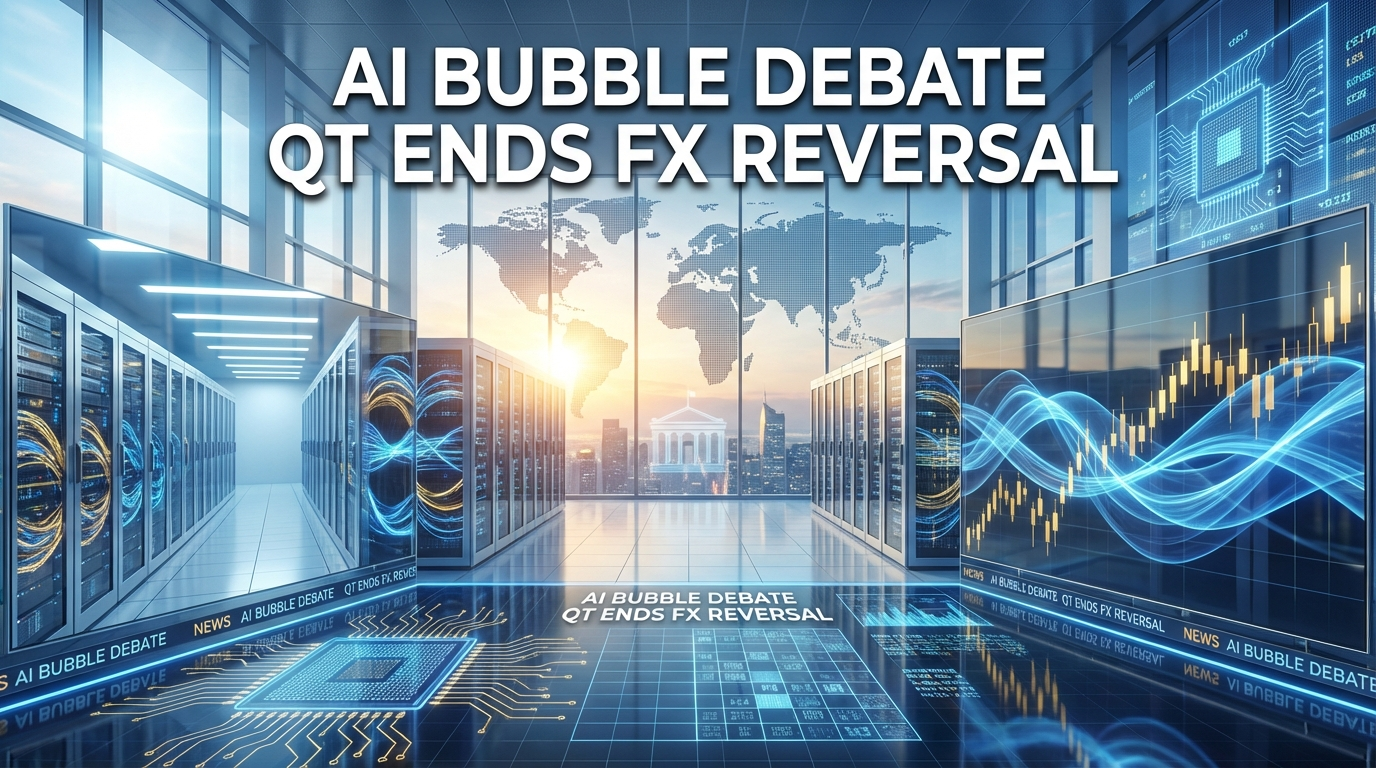
AI Bubble vs. Liquidity Transition: The TPU Challenge, Data Center Power Bottlenecks, and the Real Impact of QT Termination on the Exchange Rate
The key points you need to read now are threefold.First, the rationale behind the recurring appearance of the AI bubble theory and why the focus has now shifted from a bubble collapse to a battle over “earnings and infrastructure.”Second, the reasons why Google’s TPU cannot immediately replace NVIDIA’s GPU and the lock-in effect of the CUDA ecosystem.Third, that the end of QT (or transition to tapered QT) signals the beginning of a “liquidity party,” and that exchange rates are more strongly influenced by “relative liquidity” than by interest rate differentials.We have compiled an investment checklist today that brings together the key keywords of economic outlook, interest rates, liquidity, exchange rates, and inflation.
News Briefing: 5 Points That Will Move the Market This Week
What: The formalization or visibility of the Federal Reserve’s QT termination (or transition to tapered QT) as the monetary policy stance moves towards the end of tightening.Why: When at least one of the “dual cooling systems” – interest rates and balance sheet reduction (quantitative tightening) – is switched off, the strain on the funding chain eases.Numbers: The pace at which the Fed is reducing its total assets is slowing down, and countries are nearing their neutral interest rates. Expectations of a shift towards easing are linked to a reflow of risk assets (stocks and cryptocurrencies).Impact: If signals of the dollar peaking in strength emerge, downward pressure will apply to the KRW/USD exchange rate. Exchange rates are driven more by “relative liquidity (M2 growth rate, balance sheet changes)” than by interest rate differentials.Outlook: In periods where liquidity expectations are revived, leading stocks (NVIDIA, cloud, data centers, HBM) will move first, and volatility will remain while showing a trend towards moderation.
Fact Check on the AI Bubble Theory: “It’s Not Just Stock Prices Rising; Earnings and CAPEX Support It”
Header: Is it a bubble, an overvaluation, or a structural transition?Details:
- Although the weight of the top market capitalization companies (so-called M7) has increased, the difference from the past dot-com bubble is that the rise is accompanied by earnings.
- NVIDIA’s sales and profits have been increasing at rates in the “high double-digits to triple digits,” with data center revenue driving a structural boom.
- Major tech companies not only rise but also undertake aggressive CAPEX, creating new jobs and facilities. This is positive from a real economic perspective.The main points to convey:
- The dot-com bubble was characterized by “rising stock prices and falling earnings,” whereas now it is “rising stock prices with rising earnings and cash flows.”
- The “recycling investment” controversy is largely due to the interdependent structure present in most industries, and in AI, it is rather a phase of intensifying the competition to join the “inner circle.”
- In conclusion, while AI does have bubble elements, the grounds for a collapse are weak. The trio of liquidity, earnings, and infrastructure remains crucial.
TPU vs. GPU, and the CUDA Lock-In: A Short-Term Replacement is Difficult
Header: The rise of Google’s TPU and NVIDIA’s CUDA ecosystem.Details:
- GPUs are strong in general-purpose parallel computing, while TPUs are optimized for AI-specific operations and are power efficient.
- The problem lies in the software, libraries, and development tools of the CUDA ecosystem. Thousands of models and toolchains have already been optimized for CUDA.The main points to convey:
- Even if the TPU shows its strength in performance and efficiency, the transition costs, legacy adaptation, and steep learning curve for companies remain high.
- In the medium to long term, multi-backend (combination of GPU and TPU) usage will increase, but in the short term, the GPU-based data center hegemony will persist.
- This dynamic is not about an “AI collapse” but rather an issue of “separating the wheat from the chaff” within AI. The competition will drive further investment.
The Real Bottleneck in Data Centers: Power, Cooling, Communications, and HBM
Header: A transition where computing power has become a measure of national competitiveness.Details:
- Although the expansion of data centers is rapid, the power grid, cooling systems, optical transmission (6G), optical modules, and network switching are bottlenecks.
- Alongside the demand for GPUs, HBM, CPO (co-packaged optics), liquid immersion cooling, and power infrastructure (EPC, substation facilities) are emerging as beneficiary sectors.The main points to convey:
- There is a growing perception that “power infrastructure and communication networks are the true bottom assets for AI.”
- Data centers with pre-lease rates in the 90% range are structured such that “groundbreaking equals full sale,” leading to heated competition over securing candidate sites optimized for power, cooling, security, and low latency.
- In value chain investments, follow the shortage cycle. Evaluate in sequence: GPU/HBM → power/cooling → communications/optics → construction/EPC.
QT Termination and the Liquidity Party: “Turning Off the Air Conditioner and Only a Gentle Breeze from the Fan”
Header: Understanding the mechanism of the monetary policy shift.Details:
- QT is a tool used by central banks to absorb liquidity by shrinking their balance sheets.
- The end of QT (or the transition to its practical termination) is like “turning off the air conditioner.” Lowering interest rates is akin to reducing the intensity of the fan breeze.The main points to convey:
- When the air conditioner (QT) is turned off, the degree of tightening weakens immediately, and as interest rates approach neutral levels, the “cooling” essentially stops.
- Once easing begins in earnest, the preference for risk assets increases, with the leading sectors being AI, data centers, and cloud.
- Provided that inflation does not re-emerge, 2025–26 is likely to be a period with a high probability of a liquidity party.
The Real Variable in Exchange Rates: “Relative Liquidity” Over Interest Rate Differentials
Header: A more robust logic to explain “Why is the Korean won particularly weak?”Details:
- Exchange rates respond significantly to leading indicators and the speed of relative liquidity.
- The recent weakness of the won cannot be fully explained by the interest rate differential between Korea and the U.S., as factors such as each country’s M2 growth rate, policy stance, and balance sheet changes play a crucial role.The main points to convey:
- In the recent phase, if the pace of liquidity supply in Korea was relatively faster, the won was bound to be weaker.
- If the termination of QT coincides with signals of a weakening dollar, the sequence of movements could be a drop in the dollar index followed by a decline in the KRW/USD exchange rate.
- In conclusion, exchange rates are determined not solely by “interest rate differentials” but by a multifactor function of liquidity, policy, and expectations.
Investment Checklist: Volatility is an Opportunity, Follow the Bottlenecks
Header: Principles to prevent being swept away by news flow.Details:
- 1) Monitor the transition in liquidity: updates on the pace of QT, balance sheet changes, and interest rates and dot plots.
- 2) Exchange rate scenarios: check the direction of the dollar index and the gap in liquidity pace between Korea and the U.S.
- 3) AI value chain: monitor the supply of GPUs/HBM, power, cooling, optical, and network equipment, as well as the EPC pipeline for data centers.
- 4) Ecosystem risks: watch for signs of easing of the CUDA lock-in, the spread of mixed TPU/GPU usage, and the trend towards open source.
- 5) Verify earnings: each quarter, numerically assess ‘growth vs. overheating’ through CAPEX, order backlog, and margin changes.The main points to convey:
- In the early stages of a liquidity rally, the leading stocks are the first to shake. Pre-select candidates for a “Buy the dip” strategy during volatility.
- “Bottlenecks are opportunities.” Identify structural growth stories in power infrastructure, cooling, networking, optical modules, and HBM.
- Cultivate the habit of overlapping macro factors (economic outlook, interest rates, inflation) with micro factors (earnings, orders, lead times) to increase your success rate.
The Most Important Points Not Often Addressed by Other YouTube Channels or News Outlets
- Exchange rates react more significantly to “relative liquidity (M2 and balance sheet)” and “policy expectations” than to interest rate differentials.
- QT termination is not the beginning of quantitative easing but an intermediate stage signifying a reduction in the intensity of tightening; it is the process of turning off the air conditioner and switching to a gentler breeze from the fan.
- More critical than the performance issues of TPUs is the risk of “ecosystem transition costs.” The CUDA lock-in extends its short-term dominance.
- The real constraints in data centers are not the servers but the “power, cooling, optical, and communication infrastructures.” Read these factors to anticipate the cycle.
- AI is not a matter of “bubble debates” but “a competition in computing power.” Power grids and communication networks should be elevated to national strategic infrastructure.
< Summary >QT termination is a signal at the tail end of tightening, reviving liquidity expectations and restoring the preference for risk assets.Exchange rates are governed more by “relative liquidity” than by interest rate differentials, and if the dollar weakens, there is a greater likelihood of both the dollar index and the KRW/USD exchange rate declining.The AI bubble theory is supported by earnings and CAPEX, making the collapse argument weak, while the short-term focus remains on the CUDA ecosystem and data center bottlenecks (power, cooling, optics).Invest by following the bottlenecks, and use volatility as an opportunity to secure pre-designated candidates.
[Related Posts…]
- A One-Stop Overview of the Bottlenecks and Investment Points in AI Infrastructure
- The Real Variable Moving Exchange Rates: Interest Rate Differentials vs. Liquidity
*Source: [ 경제 읽어주는 남자(김광석TV) ]
– [LIVE] (1)AI 거품론은 사실인가? (2)QT 종료, 유동성 몰려오나? 원달 환율 반전 있을까? [즉시분석]