● Robots Trump EVs
US Government May Stop EV Drive and Shift to ‘Robot Acceleration’: A Complete Summary of Tesla’s 4% Surge Trigger and Global Economic Impact
This article covers ① specific numbers for fuel economy and emission regulation relaxation and the timeline for banning EV credit trading, ② the shift in US industrial policy toward robotics, pointed to as the key reason for Tesla’s 4% intraday surge, ③ FSD’s winter and European demonstration results, ④ the ripple effects on the global economy, US stock market, inflation, interest rates, and industrial policy, and ⑤ a critical point overlooked by other media outlets.
The complex news flow is reorganized in the order of policy – market – technology – geopolitics to present only the essentials.
Today’s Key News Briefing
Reports have emerged that the US Department of Transportation and NHTSA are announcing and reviewing plans to lower fuel efficiency targets.
There is talk of a plan to ban EV credit trading starting in 2028.
Although the policy appears unfavorable for electric vehicles, Tesla’s stock surged 4% during trading.
At the same time, reports indicate that the US Secretary of Commerce is in sequential meetings with CEOs of robotics companies and is reviewing an executive order on ‘robot acceleration.’
Tesla’s FSD v14 has released several videos showing improved driving stability in North American regions affected by its first cold wave and snowfall.
There is also news that the mayor of Rome experienced an FSD demonstration firsthand in a Model 3 on busy urban roads.
Interpreting Policy Changes with Numbers
An announcement and reports have emerged that have the character of a draft relaxing the trajectory for fuel economy standards.
According to the reports, the target for 2031 is cited to be lowered from the current 50.4 mpg to 34.5 mpg.
The rate of strengthening will also be slowed from 8–10% per year to 0.25–0.5%.
The meaning is clear.
It is a move that institutionally allows a significant share of hybrids and internal combustion engines, greatly reducing the pressure for a mandatory switch to electric vehicles.
In addition, the ban on EV credit trading from 2028 is being discussed.
This measure closes the ‘escape route’ that allowed latecomer OEMs to avoid fines by buying credits from Tesla.
It is important to note.
There remain regulatory authority conflicts between the federal and state governments, as well as litigation risks, and there is potential for changes until the final announcement in the Federal Register.
So Why Did Tesla Rise? The Market’s Read on ‘Robot Acceleration’
Despite the policy headwinds, the direct trigger for Tesla’s surge was a signal of the ‘US robot grand strategy.’
Reports indicate that the Department of Commerce is holding sequential meetings with robotics CEOs and that the White House is reviewing an executive order on robotics.
The market has priced in a trend that is expanding from AI to robotics.
Tesla is not just an automobile company; it is a company with the humanoid robot Optimus, which can replace and augment labor.
It is one of the few candidates that bundles together motor, battery, sensor, and FSD software for mass production.
If government industrial policy shifts toward robotics, Tesla’s identity could be re-evaluated from an automotive company to an ‘AI robotics + automation infrastructure’ provider.
FSD Performance Check: Winter, Europe, Licensing
In North American regions with heavy snowfall, multiple shared videos of FSD v14 show that it decelerates and proactively controls the vehicle’s posture even on roads where lane markings are faint.
In extreme conditions such as black ice and blizzards, warnings for human intervention still remain.
The key point is a signal that confidence is increasing as it begins to overcome seasonal barriers.
The mayor of Rome’s onboard demonstration holds symbolic significance amid the European regulatory approval phase.
Testimonies indicate that natural overtaking and lane changes were confirmed in narrow alleys with mixed traffic of scooters and bicycles.
Musk has proposed licensing FSD to other companies, but industry responses have been lukewarm.
Domestically, there have been personnel changes in traditional OEMs during their software transition process, signaling strategic realignment.
Global Economic Impact: Industrial Policy, Productivity, Inflation, Interest Rates, US Stock Market
If industrial policy shifts from enforcing EV regulations to enhancing robotics and automation competitiveness, there will be a partial realignment of sector leadership in the US stock market.
Automakers may extend cash flow from hybrids and ICE while capital expenditures move toward software and robotics.
The spread of robotics can raise unit labor productivity, reducing structural inflationary pressures, while initially driving capital goods demand through investment cycles.
If productivity gains are realized, it could lead to lower long-term interest rates and higher stock valuations.
Conversely, a slowdown in EV adoption may temper the battery and raw materials cycles, potentially causing adjustments and re-ratings in certain material stocks.
On the global supply chain front, demand for robotics and AI equipment is expected to connect with domestic manufacturing investments as reshoring in the US picks up pace.
Geopolitics and Robotics: China’s Numbers and the Changing Battlefield
According to the International Federation of Robotics (IFR), in recent years China has accounted for roughly half of the global new installations of industrial robots annually.
The number of robots installed in Chinese factories far exceeds that of the United States.
As drones and robots emerge as key assets on the battlefield, the boundaries between manufacturing, defense, and technology are disappearing.
The US rationale for elevating robotics to a national strategy is to simultaneously achieve manufacturing competitiveness and security superiority.
Therefore, robotics is not merely a growth industry but a decisive factor in global economic power struggles.
Investment Checklist (Not Opinions, Just Verification Points)
- Policy: The final text of the fuel economy regulation, the specific implementation timeline for the EV credit trading ban and any exemption clauses.
- Tesla: The planned deployment scale of Optimus within factories, plans for external sales models, unit pricing, and cost curves.
- FSD: North American safety indicators, linkage with insurance premiums, the European approval timeline, and urban expansion pace.
- Robotics Supply Chain: Demand for actuators, reducers, high-torque motors, AI SoC, and 3D vision modules.
- Macro: The direction of influence on inflation and interest rates when the robotics investment cycle leads to productivity improvements.
A Critical Point Overlooked by Other YouTube Channels and News Outlets
- The ban on EV credit trading reduces Tesla’s ‘existing revenue’ but places greater pressure on latecomer OEMs that heavily rely on credits.
- If policy relaxation slows down the transition to EVs, differentiation in software and robotics will become a more crucial competitive factor.
- Robotics serves both as ‘labor’ and an ‘inflation hedge.’ Productivity shocks can alter long-term interest rates and valuations.
- The convergence of defense and manufacturing will accelerate the spin-off of civilian robotics technologies. The true effectiveness of US industrial policy lies in its ‘dual-use’ capabilities.
- Tesla could be re-rated beyond an automobile company to become a ‘national infrastructure-level labor provider.’
Data Checkpoints
The cited figures mention that about 300,000 new industrial robot installations in China account for roughly half of the global total.
The number of robots installed in Chinese factories is mentioned to be around 1.8 million, which is far ahead of the United States.
These figures are based on IFR and local reports, and it is necessary to verify the latest updates from annual reports.
Risks and Next Signals to Watch
- Regulations: Conflicts and litigation between federal and state governments, changes in the detailed wording of the executive order, and any grace period for transition.
- Technology: The level of public disclosure regarding FSD’s accident and intervention rates during winter operations.
- Demand: The elasticity of EV demand and changes in the hybrid mix, along with any adjustments in pricing strategies.
- Policy: The scope of the robotics executive order (procurement, tax credits, standards, safety regulations) and the budget size.
3 Scenarios (12–24 Months)
- Base: Slower EV growth, expansion of hybrids, accelerated investment cycle in robotics and automation, and strengthened leadership in AI and robotics equipment in the US stock market.
- Bullish: Full-scale implementation of the robotics executive order and procurement, expanded deployment of Optimus in factories, intrinsic value rise linked to FSD insurance, productivity improvements leading to expectations of lower inflation and interest rates.
- Bearish: Prolonged regulatory uncertainty, deepening slowdown in EV demand, tougher safety regulations for robots, and delayed capital expenditure cycles.
< Summary >
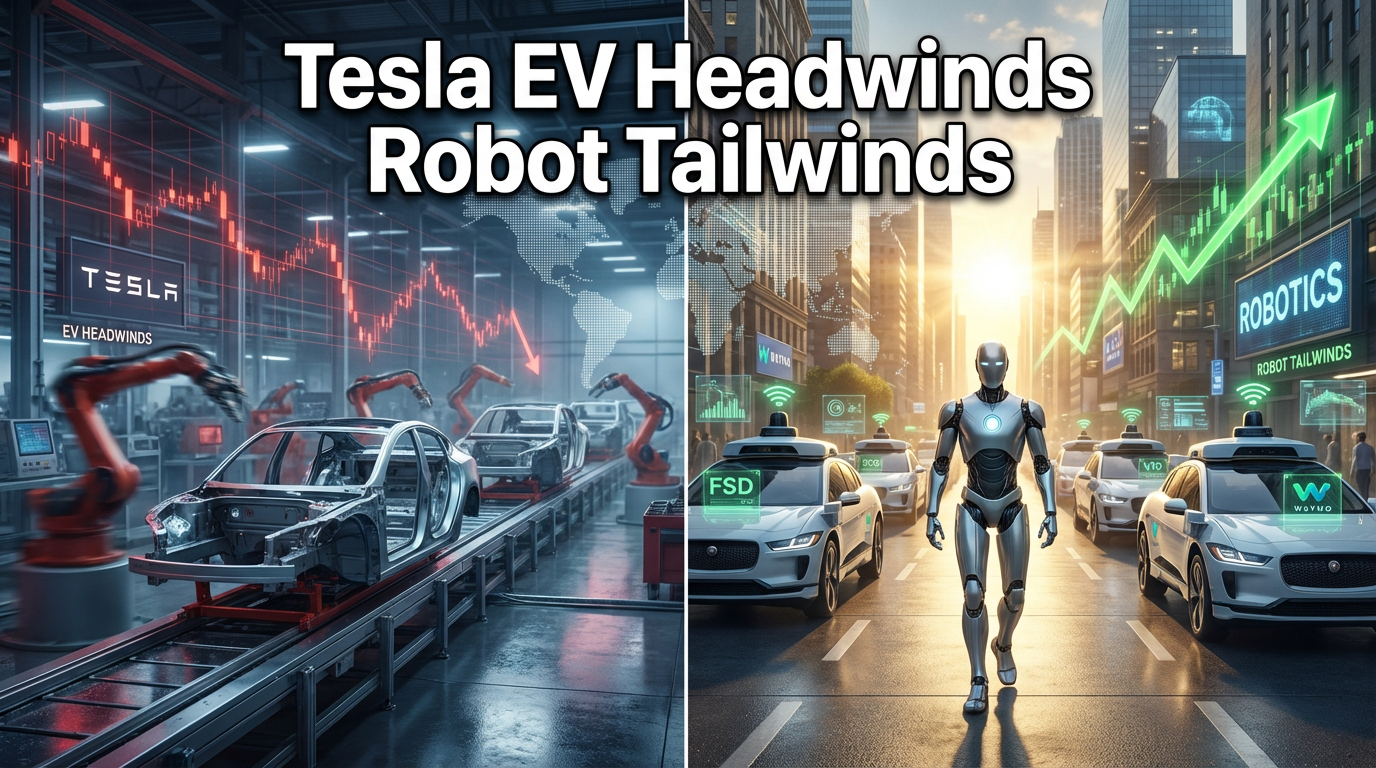
While policy presents headwinds for EVs, the market is interpreting the situation as a tailwind for robotics.
Reports of relaxed fuel economy standards and a ban on credit trading may have mixed short-term effects on Tesla, but the ‘US robot acceleration’ symbolizes a long-term re-rating trigger.
FSD has sent confidence signals in winter and European demonstrations, and the global economy’s productivity, inflation, and interest rate trajectories are increasingly likely to hinge on the pace of robotics adoption.
Key SEO Keywords: Global economy, inflation, interest rates, US stock market, industrial policy
Note: This article is an analysis based on public reports and industry data and is not investment advice.
[Related Articles…]
- The New Balance of Interest Rates and Productivity Driven by Robotics
- Tesla Optimus: Redefining Labor
*Source: [ 오늘의 테슬라 뉴스 ]
– 미 정부, EV 시대 사실상 종료 선언… 그런데 테슬라만 4% 폭등한 진짜 이유는 따로 있었다
● Tesla’s Economic Earthquake
Tesla’s ‘Speed’ is Changing the Economic Map: A Summary of Optimus Running, European FSD Experience, Waymo Expansion, Semi 1.2MW, and Musk’s 83(b)
This article covers the ripple effects of Europe’s FSD ride-along experience, the real reason why Optimus v2.5 “replaces human labor,” the logistics revolution that Semis will usher in by 2026, the investment implications of Musk’s 83(b) decision, and the industrial significance of Waymo’s expansion.
It breaks down how cost per mile and robot wages will impact the global economy and supply chains through numbers and logic.
Separate explanations of the “cost curve,” “regulatory timeline,” and “data network effect”—which are seldom covered by other YouTube/news outlets—are provided.
The Uniqueness of Optimus: A Robot that Replaces Human Labor, Not a Mere ‘Showcase Robot’
The key feature of Optimus v2.5 is not merely running but its versatility in replacing actual work through human-level hand manipulation and full-body coordination.
From the “wobbly” stage two and a half years ago, it has now progressed to running, embodying Elon’s keyword “speed.”
The decision to not expose the internal drive system and hand mechanism extensively indicates a strategic signal of prioritizing actual deployment and standardized modularization over mere “show.”
The upcoming Optimus v3, with a production target set for 2026, will likely focus on lightweight design, energy density, and integrated autonomous control software.
Economically, it is expected to trigger a surge in productivity through falling robot wages, a reduction in costs for certain service sectors, and an expanded long-term disinflationary pressure.
Globally, the issue of “labor shortage” is now transitioning into a matter of “deployment speed.”
Elon’s Speed: From Ridicule to the Standard, and a Game of Cost Curves
Electric vehicles, autonomous driving, and humanoids were all initially fraught with overvaluation and labeled as impossible, yet reality has repeatedly caught up within one to two-year increments.
The source of this momentum is the shortened cycle of the data-model-deployment loop, i.e., the compressed cycle of the artificial intelligence learning pipeline.
From an investment strategy perspective, the “decline in the cost curve” may determine long-term profitability more than the “valuation debate.”
European FSD Ride-Along Experience: Local Responses Claim “Now, You Cannot Buy a Car Without Autonomous Driving”
The FSD ride-along tests conducted in Germany, France, Italy, and other countries emphasized human-centric safety features such as smooth deceleration, pedestrian priority, and avoidance of speed bumps/potholes.
Instead of just maintaining straight-line and lane-keeping functions, the ability to handle exceptional situations like construction zones or complex intersections became the center of evaluation.
As demand surged to the point of discussions to extend the testing period, autonomous driving emerged as a key factor in future purchasing decisions.
However, Europe’s detailed safety and liability regulations at the national and UNECE levels mean that the scope and timing of commercialization may vary according to regulatory negotiations.
Although Elon has mentioned a target timeline for removing safety drivers, actual rollout hinges on approvals from various authorities and the fulfillment of safety metrics.
It is rational to understand this phase as a “regulatory sandbox” where policy and legal verifications proceed concurrently.
Waymo Expansion: The ‘Key-Opening Player’ and Ultimately a Per-Mile Cost Battle
Waymo’s urban expansion magnifies the industry’s regulatory learning effects, enhancing consumer awareness and regulatory acceptance.
Given its clearly improved safety compared to human drivers, the industry’s focus shifts from expanding service areas to competing on unit cost.
Ultimately, the crucial metric becomes the cost per mile, where the total cost—including vehicle cost, sensors/computing, insurance, and operations/maintenance—determines the outcome.
Tesla’s integrated software and extensive data network give it a structural advantage in steepening the decline of its cost curve.
Tesla in Korea: Surging Sales, Rising FSD Expectations, and the Potential Synergy of Starlink
Domestic sales have shown a marked increase compared to last year, and high-end models S/X are garnering interest alongside rising FSD expectations.
The potential domestic applications of Starlink include enhanced connectivity in rural areas and logistics hubs, thereby improving the operational efficiency of autonomous driving/robotics.
However, regulatory constraints and licensing scopes may cause variability in the pace and coverage of commercialization.
From an investment strategy perspective, it is important to also monitor companies in charging/communication infrastructures as well as those in the insurance, warranty, and maintenance ecosystems.
Musk’s 83(b): Is It a Choice to Save Taxes or a Signal of Conviction?
The 83(b) election bases taxation on the value of restricted stock at the time of award, aiming to convert future value increments into long-term capital gains.
If the conditions are not met and the stock cannot be received, or if the value declines, there is a significant risk of not being able to recover the taxes already paid.
One must file within 30 days from the grant date, and when selling the shares, an insider transaction disclosure (Form 4) is required within two business days based on the transaction date.
Whether cash tax payment will be accompanied by a sell-off of the stock or financed through external funds or collateral loans is a separate decision.
For investors, the very act of choosing 83(b) could be interpreted as a “signal of management’s long-term conviction in value realization,” though the outcome depends on execution, regulation, and market conditions.
Semi Trucks: 500 Miles and 1.2MW High-Speed Charging, the Turning Point for the 2026 Logistics Revolution
Semis are evolving in design to enhance loading efficiency and to be compatible with autonomous driving, with a proposed range of 500 miles and a maximum charge of 1.2MW.
Combined with the spread of MW-scale charging infrastructure, turnaround time and total cost of ownership (TCO) could become competitive relative to internal combustion engines.
If autonomous driving is integrated, the reduction in ton-mile costs may apply disinflationary pressure on logistics, distribution, and producer price indices (PPI).
Should continuous overnight or long-distance non-stop operation become feasible across the supply chain, the design of “urban-hub” networks will need to be reoptimized.
Regulatory and Risk Checklist: Practical Hurdles
Regulatory Risks: Regional safety standards, the reformation of liability and insurance frameworks, and data security/privacy issues will influence the pace of commercialization.
Technical Risks: Handling of exceptional safety scenarios, performance during adverse weather or construction, and the QA/certification cycle for model updates are crucial.
Financial Risks: CAPEX in robotics/computing (e.g., in-house supercomputers) could pressure short-term margins.
Macro Variables: Interest rate levels and credit spreads may heighten the sensitivity of investments in charging/data centers/logistics infrastructure as well as valuations.
Competitive Landscape: Waymo, traditional OEMs, and new robotics companies may employ differentiated regulatory and partnership strategies by region.
Key Points Rarely Discussed Elsewhere
The data network effect is the main game.
As the number of vehicles and robots increases, rare-event data multiplies, which in turn boosts model stability and safety metrics.
Ultimately, what accelerates the decline in the cost curve is the compression of the data collection-learning-deployment cycle.
The integration of the Optimus-vehicle software stack is what distinguishes the cost.
When a single autonomous system learns both manipulation and movement together, the maintenance costs of parts, computing, and software plummet, and the update speed accelerates.
The concept of robot wages becomes necessary.
If you calculate the cost per hour by combining power unit cost, battery cycles, maintenance intervals, and insurance premiums, certain jobs face downward wage pressure while others shift to design, oversight, and quality control.
The commercialization in the EU hinges less on “technology” and more on “liability and insurance.”
Once the quantification of autonomous safety superiority and insurance pricing are established, the pace of adoption will increase in steps.
The 83(b) election shows the direction of money more than words.
Choosing early tax finalization at the risk of paying cash could be a signal of internal conviction, but since funding methods and sell-side disclosures are separate, the market must distinguish between event risk and timing risk.
Action Points for Investors and Companies
Incorporate cost per mile and hourly robot wages as internal metrics to reassess project ROI.
Review surrounding infrastructure companies involved in charging, communications, insurance, and maintenance to optimize your supply chain position.
Diversify revenue recognition scenarios based on the regulatory calendar and pilot regions to mitigate interest rate fluctuation risks.
Focusing on reducing the data collection-learning-deployment cycle will drive simultaneous improvements in artificial intelligence efficiency and productivity.
< Summary >
Optimus’s real competitive edge lies in its integrated design that can replace human labor rather than just its running ability.
The European FSD ride-along experience has elevated autonomous driving to a key factor in future vehicle purchases, while regulations remain a variable influencing commercial scope.
Waymo’s expansion opens the industry, but ultimately the battle comes down to cost per mile.
The 1.2MW/500-mile design of semis, combined with autonomous driving, is set to trigger a logistics revolution and a reoptimization of supply chains.
The 83(b) decision might signal management’s conviction, yet tax payment, disclosure, and funding events carry separate timing risks.
From a global economic perspective, autonomous driving and robotics promise productivity gains and possibly stronger long-term disinflationary pressures.
[Related Articles…]
Robo-Taxi Price War: How Cost per Mile is Shaping Cities
Humanoid Productivity Shock: When Robot Wages Decline
*Source: [ 허니잼의 테슬라와 일론 ]
– [테슬라] “이제는 자율주행 없인 못 탄다”는 유럽 현지 반응 / 옵티머스가 다른 로봇들과 완전히 다른 결정적 이유 / 2026년 물류 혁명 시작점, 테슬라 세미의 현재 진행 상황
● Mediocre Startups Doomed
2026 Survival Guide for Self-Employment: ‘The Era of the Mediocre’ is Over — Experience Luxury, Solopreneurs, Interior Design & Pet Economy, and AI Trends to Survive
The core of this article is that it outlines where the real money-making “new market” lies in 2026, along with the structural reasons why businesses are failing in an era of one million closures.
Under price polarization, conventional startups are doomed to fail, and this article explains through case studies why experience luxury, interior design, the pet economy, and solopreneurs are promising.
It also explains from an economic forecast perspective how interest rates, inflation, and the shift from “hiring” to “recruiting” in the labor market impact self-employment.
Finally, it includes critical details rarely covered in the news and a 30-day MVP execution checklist.
News Summary: The Real Causes of 1 Million Closures and the 2026 Survival Framework
Key Lead: The surge in closures is not merely an issue of the economy, but a fundamental failure to respond to change.
If you stick to traditional industries out of inertia, the failure rate increases sharply.
Prices have restructured into a barbell model where you only sell “either extremely expensive or extremely cheap” products.
Experience luxury is replacing ownership luxury, making “experience design” essential for every industry.
Entrepreneurship after retirement is particularly risky, and information/knowledge-based solopreneur models are emerging as an alternative.
The housing experience market—spanning interior design, premium views, lighting, furniture, and windows—will grow structurally.
The pet economy and digital companion market continue to grow, as expenditures shift from human relationships to “tool/substitute relationships.”
The labor market is shifting from “hiring” to “recruiting,” leaving those in their 20s without portfolios the most vulnerable.
Why ‘Mediocre Startups’ Fail
Consumption is split between the top 10% premium and ultra-low-cost segments.
Mid-priced offerings cannot compete with large corporations and platforms in terms of price, logistics, and marketing.
Models centered on entertainment, such as dine-outs and bars, face structural headwinds due to “fewer gatherings and increased solo drinking.”
Trends must be a “sustained flow” rather than merely “peculiar.”
Thus, rather than selling the same chicken, examples such as an “AI Titan Concept Table” that offers an experience are emerging as successes.
The New Market Map Rising in 2026
1) Experience Luxury Business: Customers buy “stories and experiences,” not just products.
Promising sectors include themed dining, media collaboration tables, AI-driven productions (prompt menus, generative video interiors), snap/UGC studios, and experiential retail.
Checkpoint: Increase LTV by designing visit duration, filming paths, automating hashtags/reviews, and offering goods/membership programs.
2) Explosive Growth in Interior Design, View Premium, Windows, Lighting, and Furniture: Even new apartments now commonly undergo post-renovation interior design.
There will be skyrocketing demand for window replacements, slim bezels, panoramic windows, balcony glass replacements, contour lighting, and customized furniture.
Opportunities lie in bundled offerings such as “view consulting,” “window+lighting packages,” and “living subscriptions (seasonal lighting/rugs/art).”
As you move into the high-end market, credibility in estimates, portfolios, and A/S processes directly translates into sales.
3) Pet Economy & Digital Companions: The pet diet (fresh food, allergen-specific), health monitoring, pet insurance subsidies, grooming subscriptions, and pet funeral services sectors are growing.
Toy-based digital companions, character costumes, accessories, and photography packages appeal to expenditures aimed at “tool relationships.”
Tip: Pet-friendly store layouts, measures against odors/noise, and pet photo zones greatly boost visit frequency.
4) Solopreneurs (Information & Knowledge-Based Startups): Operating solo while generating both entrepreneurial value and cash flow.
Promising examples include local SEO agencies, Notion/workflow templates, generative content studios, data newsletters, micro SaaS, and education/coaching (MVP, reviews, advertising).
The key is to repeatedly solve small B2B problems.
5) Seniors & Aging in Place: Non-slip bathrooms, threshold removal, simple handles, caregiver networking, and mobility aid rentals have enduring demand.
UX for seniors must be simple, clear, with large fonts, and support offline payment methods.
6) Payment & Fee Innovation: Introducing alternative payments that reduce card fees by 2–3% becomes increasingly important.
While digital wallets and bank transfers are standard, piloting stablecoin payments proves useful for foreign and digital-native customers.
Despite policy and tax issues, diversifying payment methods is a “cost weapon” to protect margins.
AI Trends: Designing an ‘AI Workforce’ for One-Person Businesses
Customer Service: Automate reservations, inquiries, and refunds 24/7 with a GPT-based chatbot.
Content: Use Claude, Midjourney, or Render AI to automatically produce menus, posters, and short-form content at least three times a week.
Reviews/UGC: Optimize blog posts and review responses in tone and keywords with automated prompt management to boost exposure.
Demand Forecasting: Combine POS, weather, and calendar data into a time-series model to optimize ordering and staffing.
Pricing Strategy: Improve turnover and margins simultaneously with dynamic pricing based on time slots and seating.
Training: Distribute internal guidelines and checklists as “AI summaries” to all employees to accelerate skill development.
Strategies for the 70s Generation Facing a Retirement Rush (Why Post-Retirement Entrepreneurship Is Particularly Risky and Its Alternatives)
Without the power of a corporate logo, only “service mindset, on-site skills, and sales” remain.
Face-to-face service industries must start without relying on rank, and the initial six months require hands-on involvement to truly understand the business.
Recommended Path: Rather than opting for a franchise, run 1–2 solopreneur models that address small B2B issues in parallel.
100-Hour Research Rule: Standardize a Q&A form on industry regulations, cost structures, business districts, reviews, supply chains, and competition.
Runway: Set aside 12 months of living expenses plus 6 months of business funds separately, and drastically reduce monthly fixed costs.
Barbell Pricing Strategy: Choose either premium or ultra-low-cost, and decisively abandon mid-range pricing.
The Realities of the Z & Alpha Generation Labor Market: Transitioning from ‘Hiring’ to ‘Recruiting’
Large companies are no longer relying on mass recruitment; they are looking for individuals who can be effective “from tomorrow.”
Portfolios, GitHub profiles, on-site internships, and side projects have replaced traditional resumes.
Vocational school graduates and hands-on career paths are on the rise, with blue-collar skills honed for seven years commanding compensation on par with master’s levels.
For many, a “4-month intensive practical experience” is more valuable than the opportunity cost of four years in college.
Practical Checklist: 30-Day MVP Execution
Days 1–3: Define two types of personas and conduct interviews with 10 people on problems, situations, and willingness to pay.
Days 4–7: Set up Instagram, Naver Place, and Google Maps; secure 20 photos and 5 initial reviews.
Days 8–14: Launch two pilot offers (premium/ultra-low-cost) and run A/B tests on pricing and composition.
Days 15–21: Produce 9 short-form videos, repeatedly use hashtags and local keywords, and systematize UGC reposting.
Days 22–27: Launch referral and membership programs (benefits on the second round and friend invitations) and automate customer data collection.
Days 28–30: Review re-visit rates, CAC, and conversion rates; select only the top offer and discard the rest.
Risk Management in Numbers (Simplified Model)
Break-even Point = Monthly Fixed Costs ÷ (Average Spend per Customer × Gross Profit Margin).
Example: With monthly fixed costs of 3 million (rent) + 3 million (labor) + 2 million (other) = 8 million won, an average spend of 22,000 won per customer, and a GPM of 60%, the required daily sales amount to approximately 440,000 won.
With 20 seats, even a 1.0 turnover rate is insufficient.
Expanding single-dining and bar seating, along with increasing the takeout proportion, is essential.
Cost Hedging: In a high-interest and inflation period, diversify supply contracts and blend in some long-term fixed-price contracts for essential raw materials.
Economic Outlook Perspective: Incorporating Interest Rates, Inflation, and Restructuring Risks into Business Planning
If interest rates remain high, there will be increased pressure on rent, inventory, and capital investments.
Initially, opt for a lean, small-asset model and shift capital equipment to rental arrangements.
As inflation becomes structural, reducing composition rather than simply raising prices often meets with less customer resistance.
The expected expansion of restructuring in 2026 will make it difficult to rely solely on B2C domestic sales.
Incorporate a portfolio of B2B, export-oriented digital products, and platform supplies into your strategy.
During the transition of the Fourth Industrial Revolution, survival rates improve when digital transformation and on-site execution work in tandem.
Seven Critical Details Rarely Covered in the News
1) The Cost of Experience: A 10-minute reduction in dwell time is equivalent to a 20% improvement in turnover.
Simplifying the menu, implementing self-payment, and optimizing filming paths directly boost margins.
2) Seat Mix: Reconfigure seating to include at least 30% single seats, 50% two-seaters, and 20% for groups of four or more to cater to the solo dining and drinking trend.
3) Local SEO Generates 50% of Sales: Repeatedly reveal 5 Naver keywords and 5 local hashtags over 4 weeks.
4) Diversifying Payment Methods Protects Margins: Instead of a 2.5% card fee, employ bank transfers, digital payments, and partially incorporate stablecoins to safeguard margins.
5) Data Ownership: If you do not collect reservations, reviews, and memberships into your own database, advertising expenses will continuously leak away.
6) Collaborative Economy: Offering bundled packages for interior design, lighting, furniture, and windows can double the average spend per customer.
7) AI Is an Extension, Not a Replacement: A one-person business will stall its expansion unless at least three tasks are automated.
Case Insight: What Kkamboo Chicken’s “AI Set” Suggests
Customers didn’t buy chicken; they bought the experience of “sitting at a table with AI titans.”
In an era of product sameness, “concept, narrative, and photogenic appeal” become driving factors for purchase.
Smaller brands, in particular, must quickly combine media collaborations with memes.
Industry-Specific Immediate Implementation Guide
Food & Beverage: Focus on three signature items, create a designated filming zone/shot guide, and introduce a unique reservation concept (naming seats/time slots with a narrative).
Cafés: Offer goods and seasonal cards, provide a light/sound experience, and host “Photo Barista Days” to secure UGC.
Living & Interior Design: Launch a “view package (window + lighting + tone)” and a “30-day move-in plan,” and include before-and-after comparison content.
Pet Services: Provide daily fresh food packs, integrate with a health record app, and maintain regular pet photo days and birthday subscription services.
Solopreneurs: Combine local SEO services with content bundles, develop a micro SaaS (for reservation/review automation), and create a three-tiered education package.
< Summary >
Mediocre startups cannot win on price, experience, or operations.
The solution for 2026 lies in experience luxury, interior design/view premium, the pet economy, solopreneurs, and payment/AI automation.
In an environment of high interest rates and inflation, reduce fixed costs and protect margins through barbell pricing, local SEO, and data ownership.
Post-retirement entrepreneurship requires 100 hours of research and a 30-day MVP validation, with the baseline of automating three or more AI tasks.
In a labor market that has shifted from hiring to recruiting, portfolios have replaced resumes.
[Related Articles…]
2026 Experience Luxury Sparks a Major Shift in Self-Employment
The Era of Solopreneurs: Survival Strategies for One-Person Businesses Powered by AI
*Source: [ 경제 읽어주는 남자(김광석TV) ]
– ‘어중간한 창업’은 망하는 구조 2026년 자영업이 살아남는 ‘새로운 시장’은 따로 있다. 100만 폐업 시대… 왜 이렇게 무너질까? | 경읽남과 토론합시다 | 김용섭 소장 3편