● Musk gambles, FSD breaks rules, robots replace workers, insurance implodes
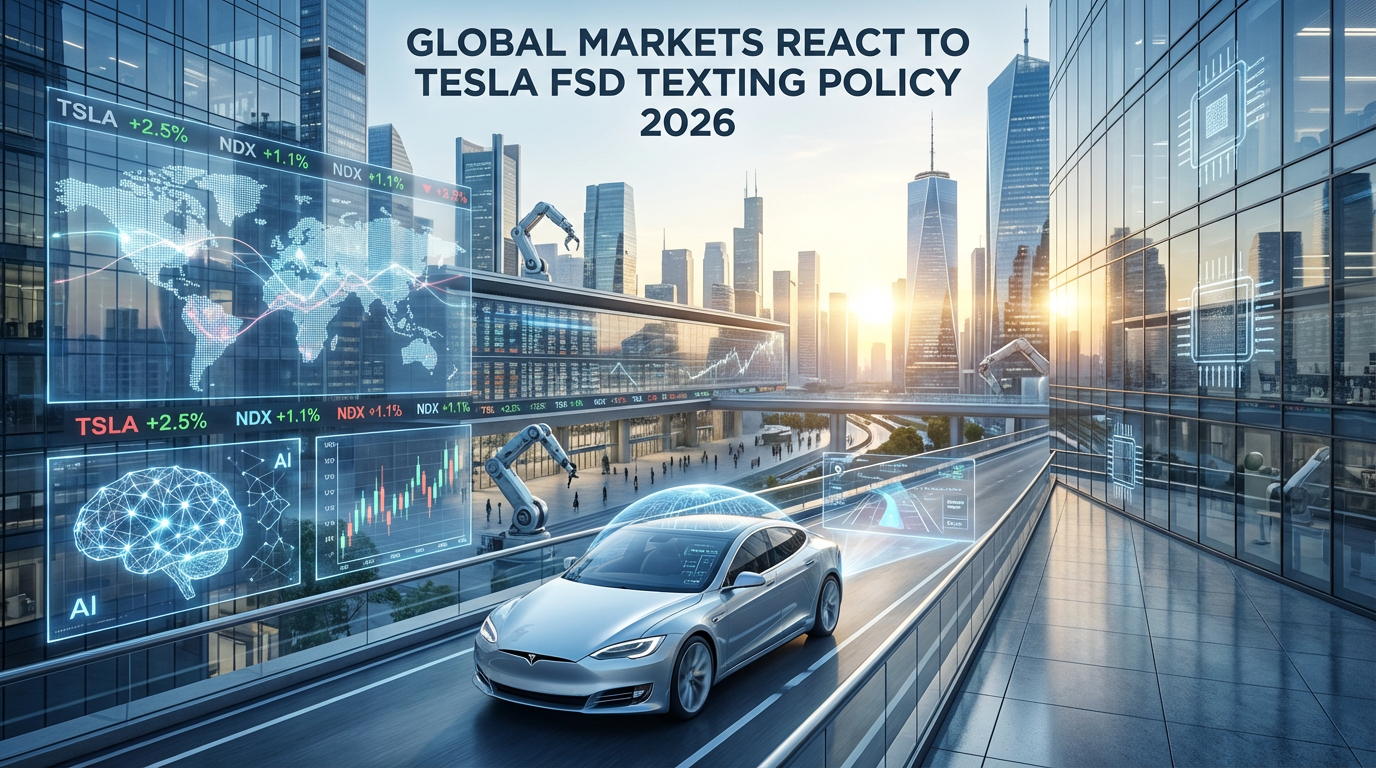
Musk’s “Allowing Texting While Driving” Ripple Analysis: Reading Signals of FSD Level 4, European Approval Campaign, Explosive Demand in China, and a $12 Trillion Robot Economy All at Once
Key Points You Must See in This Article
- It dissects the true purpose behind why Musk publicly stated “texting is allowed depending on the situation” amidst nationwide U.S. regulations banning texting while driving.
- It outlines the reasons why Tesla’s FSD is interpreted as having effectively entered the early stage of Level 4, and the safety assessment framework that regulators will have to change.
- It reviews the structural changes that the expansion of Europe’s FSD rider-long program, the explosive wait times for China’s Model YL, and the semi-trucks entering U.S. logistics may have on the global economy, electric vehicles, and autonomous driving ecosystem.
- It summarizes the investment points in robotics and AI innovation implied by RBC’s projection of a $12 trillion humanoid robot market by 2050 and ARK’s even faster timeline.
- It separately highlights the key pitfalls from the perspectives of insurance, liability, data, interest rates, and inflation—issues often overlooked elsewhere.
Breaking Summary: This Week’s Tesla and AI Trend Briefing
- The texting allowance controversy was sparked by Musk’s answer of “It’s okay depending on the surrounding traffic conditions” to the question on X, “Is texting possible while using FSD v14.2.1?”
- Since texting/phone use while driving is illegal in most U.S. states, the regulation and safety communities reacted immediately, and the market interpreted it as a demonstration of Tesla’s technological confidence.
- A private pre-production meeting took place with Keller Logistic Group in the U.S. regarding the introduction of Tesla semi-trucks, with practical evaluations of regional logistics TCO, charging infrastructure, and government incentives.
- The demand for China’s Model YL is so strong that the waiting period has recently been pushed back to early 2026, demonstrating the success of Tesla’s locally optimized strategy in the competitive electric vehicle market.
- Europe’s FSD rider-long program has been extended due to surging demand, with reservations in major cities like Germany, France, and Italy selling out quickly, signaling a consumer-driven shift in perception.
- RBC has projected the humanoid robot market to reach up to $12 trillion by 2050, while ARK expects a serious explosion starting in the 2030s, with software and AI service revenues at the core.
Data Check: The Gap Between Safety and Regulation
- Statistics repeatedly show that about 40,000 people die in traffic accidents each year in the U.S.
- Thousands of deaths are reported due to distracted driving, and accidents attributed to cellphone use are also disclosed at the level of hundreds each year.
- Similarly, in South Korea, thousands lose their lives on the roads every year, and cellphone-related accidents occur consistently.
- The reality is that “people text even when it’s banned,” and once FSD becomes significantly safer than humans, there is a high likelihood that the regulatory framework will shift from “prohibiting actions” to “result-based safety.”
- According to ARK’s view, if the data proves reduced fatalities in line with a public safety goal, the political and social grounds for blocking autonomous driving will weaken.
The Real Purpose of Musk’s Remark: Testing a Shift in the Regulatory Framework
- Musk’s “allowed depending on the situation” is interpreted not as arbitrary permission, but as a message that the vehicle can read its environment and manage driver distraction when safety margins allow.
- This is a communication aimed at shifting regulation from “action-based restrictions” to a focus on “system risk,” and it signals the intent to enter Level 4 (conditional non-intervention).
- At the same time, it aims to gradually introduce the public to a “dynamic allow/deny” user experience that combines Driver Monitoring Systems (DMS), situation awareness (OCC and multi-sensors), and motion planning.
- Simply put, the intention is to pioneer a paradigm shift from “safety achieved by human restraint” to one where “AI continuously calculates risks and manages permissible limits for safety.”
On the Ground in Europe, China, and the U.S.: A Sense of Commercialization Speed
- Although Europe has the strictest regulations, consumer-driven positive reviews are shifting public opinion thanks to the rider-long extension and encouragement of SNS sharing.
- In China, by precisely targeting demand with the local trim (YL), production, supply chains, and pricing policies are being adjusted swiftly.
- U.S. logistics is comprehensively evaluating aspects such as semi-truck TCO, charging, driving patterns, and public incentives, with efforts escalating to pinpoint the commercialization threshold.
The Rise of the Robot Economy: $12 Trillion and Beyond
- RBC projects $9 trillion in humanoid robot hardware and $3 trillion in OS/app/subscription revenues by 2050, envisioning expansion into manufacturing, logistics, agriculture, and home use.
- ARK accelerates the timeline, predicting a full-scale explosion starting in the 2030s, placing software and AI service revenues at the core.
- Tesla benefits from vertical integration strengths spanning actuators, batteries, sensors, FSD-based perception, and learning infrastructure, positioning itself in a structure where software and service LTV become more critical than hardware margins.
Here’s the Real Point: Core Elements That YouTube and News Often Overlook
- A repricing of insurance is underway.
Result-based safety metrics (accident rates, intervention distances, collision severity) will determine insurance premiums, and the autonomous driving insurance segment could transform into recurring revenue for Tesla. - A shift in liability will occur.
As risk transitions from the human to the manufacturer/software, contract, logging, and OTA auditing systems will become standardized, and regulations are likely to change to a “log-first” approach. - Communication and platform integration are hidden variables.
If vehicles, cloud, and messaging apps integrate via API, the FSD will delay and summarize alerts in high-risk zones and allow interaction only in safe zones, becoming the standard “driving aware UI.” - The inflation structure will change.
Autonomous logistics and humanoid robots will reduce labor and time costs in service and manufacturing, creating structural disinflationary pressure. - Interest rate sensitivity is twofold.
High interest rates suppress infrastructure and compute CAPEX, but at the same time, improvements in productivity reduce costs in the real economy, helping to defend against economic downturns. - The territorialization of data is both a core risk and a barrier to entry.
While data localization in the EU and China slows down competitors’ catch-up, Tesla’s localized learning and operational systems enhance network effects.
Investment Checklist (KPI) and Key Points to Watch
- FSD Safety Metrics: Check for disclosure of intervention distances, low-speed/high-speed collision rates, and performance trends in nighttime/inclement weather.
- Regulatory Pilots: Monitor the expansion of pilot zones in European cities and the pace of policy easing by U.S. states.
- Insurance Ancillary Revenue: Company insurance subscription rates, premium discount structures, and data on accident processing speeds are key.
- Semi-Truck TCO: Look at customer case metrics on fuel, maintenance, and uptime rates along with charging infrastructure CAPEX subsidy policies.
- China Waiting Period/Delivery Volume: Observe the local trim mix, price elasticity, and the durability of demand.
- Robot Pilots: Check the actual deployment numbers in manufacturing (pick-and-place, line assistance), logistics hubs, and home beta testing.
Risks and Responses
- There exists a risk of rapid public opinion shifts and regulatory brakes due to a single major accident.
- Stricter EU regulations on personal information and video data processing could restrict rollout speeds.
- A sharp rise in supply chain and compute costs (NPU/GPU) will burden costs.
- Aggressive pricing from local competitors in China is a factor putting pressure on margins.
- The response should involve transparent disclosure of safety data, gradual expansion of ODD, and strengthening local partnerships and insurance-linked products.
Timeline Scenarios (Personal View)
- 6–12 months: Expansion of Europe’s rider-long program, limited L4 pilot programs in certain North American zones, and the launch of commercial models combined with insurance and fleets are anticipated.
- 12–24 months: Legislative discussions on the adoption of result-based safety metrics by regulators will intensify, with an expansion in the disclosure of semi-truck customer cases and the emergence of paid robot pilot PoCs.
- Circa 2028: Partial commercialization around urban and logistics hubs, an increase in the share of software revenue in the robotics industry, and a scenario in which electric vehicles, autonomous driving, and robotics become core pillars of global economic productivity are highly likely.
Summary of Policy and Economic Ripple Effects
- A decline in logistics and mobility costs will disrupt consumer goods pricing and distribution margin structures, thereby easing inflationary pressures.
- Robotics and autonomous driving will help bridge the productivity gap relative to demographic aging, contributing to safeguarding potential growth rates.
- Energy demand will be restructured by accelerated electrification, and the sensitivity of oil to transportation demand may be structurally reduced.
- While interest rates raise CAPEX burdens, if expectations for productivity improvements support a preference for risk assets, valuations may experience an upcycle.
- Country-specific industrial policies (subsidies, tax credits, regulatory sandboxes) are likely to restructure hubs for electric vehicles, autonomous driving, and robotics.
< Summary >
- Musk’s “texting allowed depending on the situation” is a message of confidence in entering Level 4 for FSD and an attempt to shift the regulatory framework from “prohibiting actions” to “result-based safety.”
- Europe is preparing for approval through a consumer-driven shift in perception, China is locking in demand with its local trim strategy, and U.S. logistics is beginning to verify TCO for semis.
- The humanoid robot market projects a potential of $12 trillion by 2050, and as the share of software and subscription revenue increases, Tesla’s LTV grows.
- Insurance, liability, data, interest rates, and inflation are key variables, and safety metrics, regulatory pilots, insurance ancillary revenue, and robot PoCs are critical for performance leverage.
- While there are short-term shock risks, once result-based safety data accumulates, it is highly likely that regulatory and market directions will align along the same axis.
[Related Links…]
- Impact of FSD Regulatory Changes on the Auto Insurance Industry
- The Era of $12 Trillion Humanoid Robots: Opportunities and Strategies for Korea
*Source: [ 오늘의 테슬라 뉴스 ]
– 머스크 금기를 깨다!… ‘운전 중 문자 허용’ 선언의 진짜 목적, 미국이 충격에 빠진 이유는?
● Tesla’s FSD Revolution, Italy Data Goldmine, 2026 Autonomy Tipping Point
WSJ’s “Paradigm Shift” and the 2026 Great Transformation: An Investment Strategy Covering Italian FSD Data, Unsupervised Robo-Taxi Timeline, AI5/Optimus, and the Logistics Supply Chain All at Once
Key Points Included in This Article
WSJ praises Tesla’s FSD and explains the background of the change in evaluation along with the economics of consumer perception shift.
It interprets the meaning of “data hot spot” as proven on specialized Italian roads and in dense fog environments.
It cross-checks the identity of what Elon Musk mentioned as “a very special year in 2026” and the timeline of prediction markets.
It discusses the “text checking during autonomous driving” function in FSD v14.2.1 and reviews the legal and safety considerations.
It analyzes the impact of DHL’s adoption of the Tesla Semi on supply chain, logistics costs, and inflation.
It presents the investment strategy considering the sales trends in China, Japan, and Europe, earnings sensitivity, and what is needed right now.
It analyzes the “extreme integration” direction of Tesla’s AI5 chip and the essence of humanoid Phase 2 (Optimus vs competitors).
1) Europe’s “Data Hot Spot” Italy: Why FSD Gets Smarter Faster in More Challenging Conditions
Italian roads with narrow one-lane alleys operating in two directions pose a significant challenge for novice drivers.
Instances where FSD has driven steadily even in dense fog, with motorcycles, and on sections where oncoming vehicles intersect have been confirmed.
In a passenger video in Rome, FSD was highly praised for recognizing stop signals and signs solely with its cameras.
The focus on sensor (camera)-based perception rather than map dependency is advantageous for accumulating complex environmental data in Europe.
The “negotiation of crossings” data gathered on complex roads is critical for policy training and accelerates generalization performance.
As European ride-along cities expand, both the quality and quantity of the data pool are increasing simultaneously.
2) WSJ’s Change in Stance: The Emotional Challenge of “Letting Go of Control” is Harder than the Technology
The WSJ column emphasizes the “sense of liberation” experienced personally when FSD alleviated the tension of traffic congestion.
The key term is “control”; the moment the psychological barrier of letting go of control is crossed, the adoption rate can accelerate exponentially.
From an investment perspective, this is interpreted as a signal that the inflection point of the adoption curve (shift in perception) has come into view.
Attention should be paid to the pivot from hardware-centered sales to software subscription-based margin restructuring.
3) Why 2026 is a “Very Special Year”: The Reality Stage of Unsupervised Autonomous Driving
Musk has singled out 2026 as a special year, and Tesla engineer Yunta Chai emphasized “large-scale autonomous driving that works anywhere.”
In prediction markets, there is a prevailing probability scenario for “unsupervised autonomous driving starting before June 2026.”
The roadmap where robo-taxis begin with a safety driver and gradually transition to unsupervised operation is becoming the market consensus.
It is necessary to consider that regional differences in pace may occur as regulations, insurance, and liability responsibilities become aligned.
4) FSD v14.2.1 “Text Checking During Autonomous Driving” Feature: Safety and Legal Requirements Take Precedence Over Convenience
Musk officially mentioned the text checking feature during autonomous driving in FSD v14.2.1.
The availability of this feature is limited by surrounding conditions and must strictly adhere to local traffic laws.
FSD remains a supervised feature where the “driver’s attention duty” is maintained, and safety is the foremost principle.
5) DHL’s Adoption of the Tesla Semi: The Ripple Effects on the Logistics Supply Chain and Inflation
Global logistics company DHL has adopted the Tesla Semi, with additional deliveries planned as production ramps up.
The total cost of ownership (TCO) of electric semis secures its competitiveness over internal combustion engines through reduced fuel and maintenance costs and the benefits of regenerative braking.
When combined with optimized charging infrastructure, uptime, and load rates, the unit logistics cost for major customers can be reduced, contributing to easing inflation.
In the future, as autonomous driving is integrated, routes from long-haul night trips to hub-to-hub lines could become automated, further enhancing supply chain efficiency.
6) Demand Trends in China, Japan, and Europe and the Disconnect with Q4 Earnings
In China, Q4 delivery volumes are expected to be robust due to rising orders and delivery waitlists, though ASPs and margins tend to be lower due to regional characteristics.
Therefore, the global delivery increase does not immediately translate into earnings leverage.
In Japan, sales have more than doubled compared to the previous year, and in Europe, a clear recovery in Q4 is observed despite changes in subsidies.
If durable goods demand recovers due to expectations of lower interest rates in the global economic environment, a trend of strengthened demand is expected in 2025.
From an investment strategy viewpoint, it is reasonable to focus on the expansion of software revenue share and subscription ARPU rather than short-term earnings fluctuations.
7) AI5 Chip: The Triple Effect of Cost, Power, and Speed Driven by “Extreme Integration”
According to sources, Tesla’s AI5 aims for “extreme integration” by reducing reliance on Samsung’s design blocks and designing the entire chip in-house.
Optimization of performance per watt during inference along with vertically integrated memory and I/O design improves the latency and stability of on-device AI in vehicles.
When the training-to-inference pipeline is controlled, lower compute costs can structurally reduce the per-mile cost of autonomous driving.
If the same chip stack is used to drive the general-purpose model of the humanoid (Optimus), economies of scale directly translate into software margins.
8) Humanoid Phase 2: What Optimus’s “Tendon-based Hand” Signifies
Optimus is targeting human-like grip strength and flexibility by using a lever structure based on tendons.
While competitors have revealed running and basic movement demos, the key factors are “legality, generalization, and on-site work suitability” rather than just demos.
Tesla’s advantage lies in its ability to vertically integrate data, operations, and models at factories and logistics sites to establish a repeating learning loop.
If labor supply constraints and wage inflation persist, the productivity contributions of humanoids could help alleviate inflationary pressures.
9) Investment Strategy: Key KPIs and Risks to Monitor Now
The key KPIs include: FSD subscription attachment rate, MAU, disengagement per 1,000 km, the number of cities piloting robo-taxi operations, and the insurance product attachment rate.
As the share of software revenue increases, there is more potential for re-rating multiples, and in a declining interest rate environment, the discount burden on growth stocks diminishes.
Risks include regulatory delays, market sentiment downturn due to accident issues, compute supply chain bottlenecks, battery material prices, and geopolitical issues.
A phased and diversified approach to positioning is advisable, focusing on the probability-weighted expected value of the unsupervised transition scenario in 2026 rather than short-term earnings fluctuations.
10) The “Real Crucial Factors” That Other Media Overlook
- Data Complexity Premium: Italian-style “crossing negotiation” data dramatically boosts generalization performance.
- Fixed Cost-Variable Cost Inversion: Hardware represents the barrier to entry, while software forms the core margin, with FSD subscriptions redefining total margins.
- The True Bottleneck is the Compute Supply Chain: Vertical integration, as seen in AI5, simultaneously tackles cost, power, and thermal design to control expansion rates.
- The Crossover Point of Per-Mile Cost Curves: When robo-taxi fares fall below the average ride-hailing fare, demand increases non-linearly.
- Vertically Integrated Semis and Robo-Taxi Logistics: Once night autonomous driving between hubs is established, supply chain lead times and variable costs are structurally reduced.
11) Calendar & Checkpoints
Continued monitoring of the 14.x FSD update release notes and disengagement trends is necessary.
Pay close attention to the expansion of robo-taxi pilot cities and changes in regulatory guidelines.
Keep an eye on Q4 delivery volumes in China and Europe and the impact on ASPs and margins due to regional mix, as well as the direction of exchange rates and interest rate cycles.
Expansion of Semi production, charging infrastructure plans, AI5 tape-out and mass production timeline, and news of Optimus pilot deployments are potential catalysts.
An Overview of the Big Picture in Economic Keywords
In an environment of global economic interest rate adjustments, industry innovations such as autonomous driving and humanoids play a role in reducing inflation through productivity improvements.
Efficient supply chains and decreased transportation costs contribute to price stability, and a cash flow based on software subscriptions enhances valuation transparency for companies.
Ultimately, the focus of investment strategies is on which party first locks in the three pillars of “data scale, compute efficiency, and regulatory alignment.”
< Summary >
WSJ’s shift in evaluation signals not only technological maturity but also the breakdown of consumer psychological barriers.
Italian data is a key asset for enhancing generalization capabilities, and the unsupervised transition scenario in 2026 is gaining momentum.
DHL’s adoption of the Semi modifies the cost structure of the supply chain and holds significant potential for easing inflation.
Although increased deliveries led by China do not directly translate into a one-to-one earnings increase, the underlying transformation toward software margins is the real game.
AI5 and Optimus enhance the completeness of vertical integration to reduce per-mile costs, accelerating the inflection point in robo-taxi economics.
[Related Articles…]
Robo-Taxi Economics: The Point Where Cost per Mile Surpasses Uber
Investment Strategy 2025: The Bottlenecks in the AI Semiconductor Supply Chain
*Source: [ 허니잼의 테슬라와 일론 ]
– [테슬라] 갑자기 FSD 극찬을 시작한 WSJ / 일론, “2026년 특별한 해 맞다” & “이제 자율주행 중 문자 가능!” / 테슬라 세미 DHL 판매
● Physical AI Gold Rush
2026 Investment Core: The Year of ‘Physical AI’, with Two Pillars of the US (Alphabet & Nvidia) and Simultaneous Execution by Tesla & Hyundai Motor
This article contains the following points. The real issues behind the TPU vs GPU dynamics and Alphabet & Nvidia’s 2026 roadmap. The significance of Tesla FSD on Korean roads and the scenario for the spread of ‘Physical AI’. The restructuring of the demand chain that could affect Samsung Electronics and SK Hynix. The optimal positioning amidst the flow of interest rates, the dollar, and the Nasdaq within the liquidity cycle. And the reason why power, cooling, and data center infrastructure—which most news overlook—will determine earnings.
News Briefing: What the Market Sees Now
– Jensen Huang’s visit to Korea is not a show, but a signal. It is interpreted as a strategic move to accelerate the convergence of robotics, autonomous driving, and edge computing for Physical AI.
– Tesla FSD has immediately demonstrated adaptability on Korean roads, confirming the tangible quality gap. Even during a downturn in electric vehicle demand, the value of autonomous driving software supports its valuation.
– Alphabet’s Gemini and TPU stack are emerging as cost-effective alternatives, challenging the narrative of “GPU monopoly.” However, this is likely not a zero-sum battle with Nvidia but will result in a differentiated workload landscape.
– In Korea, there is a growing assessment that Hyundai Motor is simultaneously generating cash and creating option value by expanding hybrids and investing in robotics/autonomous driving.
– In semiconductors, a tight supply/demand balance centered on HBM will be maintained. If both Google TPU and Nvidia GPU grow simultaneously, Samsung Electronics and SK Hynix will be structurally favored.
– The macro environment is marked by a convergence of expectations for lower interest rates, a moderation of a strong dollar, and a resumption of Nasdaq strength. Liquidity is expected to remain for some time amid easing inflation.
The Two Companies Leading 2026: Alphabet (Google) and Nvidia
– Alphabet: The key lies in the performance leap of Gemini and the cost structure of its TPU. Optimized for its own workloads, the TPU lowers training/inference costs while protecting margins and accelerating product development. Although external sales remain hypothetical, should they materialize, there is significant potential for a ‘cloud + AI semiconductor’ dual momentum revaluation.
– Nvidia: Its irreplaceable areas remain broad. With its ecosystem (CUDA), software stack, hardware roadmap (next-generation accelerators), and partnerships, its full-stack advantage is robust. The rise of TPUs may cause short-term stock volatility, but it will ultimately enlarge the overall AI capital expenditure pie.
– Investment Perspective: The main game in 2026 is not a “chip battle” but a “system battle.” The total efficiency is determined by the optimization of computing + memory (HBM) + network + software. Both companies are poised to dominate their respective winning domains.
Tesla & Hyundai Motor: The Second Act of Automobiles Driven by Physical AI
– Tesla: The FSD tests on Korean roads have showcased the potential of an end-to-end approach with low dependency on maps. The valuation is increasingly based on a structure that emphasizes ‘autonomous driving + robotics + services’ rather than just ‘electric vehicle sales.’ Although debates about overvaluation will periodically resurface, premium pricing is likely to be defended if software development maintains its pace.
– Hyundai Motor/Kia: They exhibit both dividend (cash generation) and Physical AI option characteristics. The expansion of their hybrid lineup, centered on large SUVs, will immediately contribute to sales and profits in the US market. If the deployment of Boston Dynamics’ robotics and the construction of data centers proceed simultaneously, the learning-deployment loop for robotics/autonomous driving will accelerate.
– Positioning: If Tesla is the ‘leading software’ and Hyundai Motor/Kia are the ‘cash flow + options’ within the portfolio, their roles differ. A co-existing strategy is reasonable.
Domestic Semiconductors: Samsung Electronics & SK Hynix’s Delicate Balance
– SK Hynix: Its technological leadership honed in HBM will protect the core of Nvidia’s value chain. In the short term, supply-demand imbalances owing to TPU variables may ease, but the structural trend remains robust.
– Samsung Electronics: There is potential for simultaneous increases in TPU-related volume, HBM capacity expansion, and foundry orders. Its low dependency on specific customers reduces cycle risks.
– Key Point: The simultaneous growth of TPUs and GPUs will boost demand for ‘memory + packaging.’ HBM unit prices, yield, and advanced packaging capacity will determine profit volatility.
Macro Environment Check: Global Economic Outlook and Liquidity
– Interest Rates: As the US’s path to lower benchmark rates becomes clearer, growth stock premiums will recover. However, the pace will be dictated by inflation and wages.
– Inflation: If service inflation eases gradually, multiple expansions are possible. In case of reacceleration, increased volatility must be considered.
– Dollar: Signs of a peak in the strong dollar are a favorable sign for risk assets. A stronger won is positive for foreign inflows into Korean semiconductors and automobiles.
– Nasdaq: AI leadership is underpinning the resilience of the index. As long as earnings estimates continue to be revised upward, this trend is unlikely to falter.
Key Factors Overlooked by Other Media (Unofficial Down-Toned Analysis)
– The bottleneck is ‘power & cooling.’ The true constraint of 2026 will not be chips, but rather power infrastructure and the pace of transitioning cooling systems (from air to liquid immersion).
– TPU vs GPU is not a zero-sum game. Different optimal chips will emerge based on workloads such as training and inference, LLM and multimodal tasks, and in-house data pipelines. Overall AI capital expenditure will increase.
– A revaluation of the value of memory and packaging. HBM ASP and yield, along with advanced packaging lead times, will dictate margins. There is a high likelihood of deliberate ‘quality-focused’ capacity expansions that slow down oversupply.
– Physical AI will be determined by ‘on-site data.’ Companies that can swiftly learn and deploy from unstructured data generated in factories, logistics, roads, and robotics will create a decisive edge.
Individual Investment Strategy: Bet on the Big Picture, Not on Rotations
– Look at a 6–12 month timeframe. Rather than trying to predict short-term sector cycles, position yourself in anticipation of the maturation of themes.
– Physical AI axis: Connect the chain through Tesla (software leader), Hyundai Motor/Kia (cash flow + option), and Hyundai Autoever (software and data stack).
– Infrastructure axis: Consider core holdings in Samsung Electronics and SK Hynix (HBM/packaging) along with stocks related to power, cooling, and data center EPC themes.
– Gradual buying and cash management. A strategy of gradually acquiring shares during periods of index volatility is advantageous.
Risk Check (Consider in Advance)
– Regulation: Risks related to autonomous driving safety regulations, data localization, and semiconductor export controls.
– Technology: Risks of delays in FSD commercialization, uncertainties in external TPU sales, and next-generation HBM yield challenges.
– Macro: The risk that inflation re-acceleration delays interest rate cuts and that a stronger dollar increases valuation pressures.
Checklist in Numbers
– Alphabet: Improvement in cloud operating margins, indicators of TPU usage/external customer engagement.
– Nvidia: Timing of next-generation accelerator shipments, the proportion of revenue from software subscriptions.
– Tesla: Penetration rate of FSD additional revenue, roadmap updates for energy storage and robotics.
– Hyundai Motor/Kia: Proportion of North American hybrid sales, dividend/share buyback policies, progress in robotics/autonomous driving investments.
– Memory: HBM ASP and utilization rates, lead times for advanced packaging.
Positioning Guide (Summary Actions)
– US: Core holdings centered on Alphabet (cost optimization + platform), Nvidia (ecosystem advantage), and Tesla (software franchise).
– Korea: Core holdings in Samsung Electronics and SK Hynix (HBM/packaging); satellites in Hyundai Motor/Kia (cash flow + Physical AI options). Data center, power, and cooling infrastructure themes should be maintained with a diversified long-term allocation.
– Purchase Timing: Approach in a phased manner during market corrections, while monitoring the direction of interest rates and dollar movements simultaneously.
< Summary >
– The keyword for 2026 is Physical AI. The two American pillars are Alphabet and Nvidia, while Tesla and Hyundai Motor create tangible value through field applications.
– TPU vs GPU is not a battle but a differentiation. Overall AI investment is growing, and Korean semiconductors and data center infrastructure will be structurally favored.
– From a macro perspective, lower interest rates and a softer dollar are favorable for the Nasdaq and growth stocks. Only be cautious of a rebound in inflation.
– The strategy is simple. Do not chase rotations; instead, ride the major themes. Combine core (Alphabet, Nvidia, Samsung Electronics, SK Hynix) with options (Tesla, Hyundai Motor/Kia, infrastructure) and approach within a 6–12 month timeframe.
[Related Articles…]
- The Impact of Tesla FSD and Physical AI on the Automotive Value Chain
- HBM and Advanced Packaging: The Real Battleground of the 2026 Semiconductor Cycle
*Source: [ Jun’s economy lab ]
– 2026년에는 미국의 이 두 기업을 주목해야 합니다. (ft. 염승환 이사 2부)