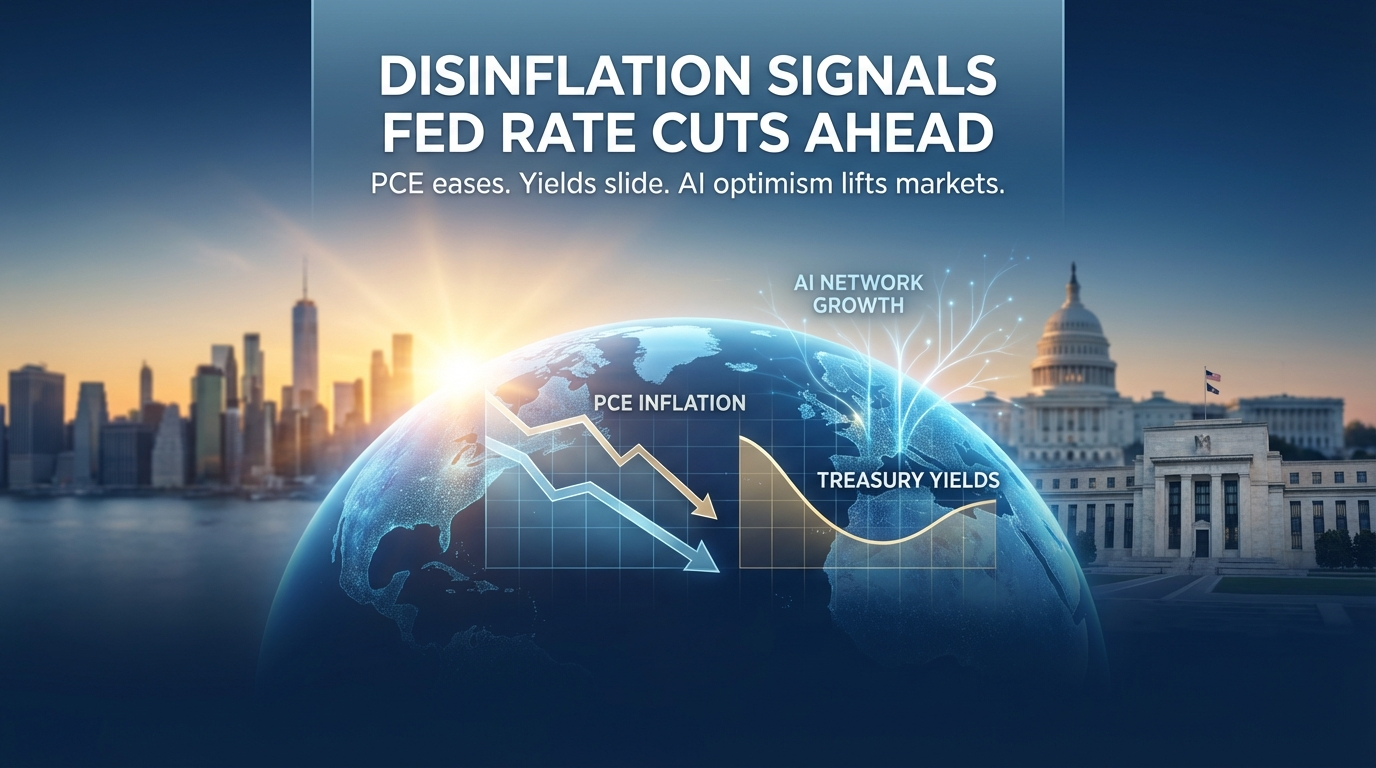
● PCE Dip Triggers Fed Cut Frenzy, Bond Steepening Threat, Dollar Slumps, AI Liquidity Bonanza
US PCE 2.8%: A Comprehensive Overview of December Rate Cut Expectations, ‘Stiffening Risks’, the Dollar Index, and the AI Liquidity Rally
This article highlights the implications of a 2.8% PCE, the December FOMC rate cut scenario, the trajectory of Treasury yields and the dollar index, curve stiffening risks, the true interactions between tariffs and prices, the impact on the Korean exchange rate and base rate, and the sustainability of the AI liquidity rally—all distilled into key points.
Instead of merely listing numbers, it provides interpretations and checklists that can be directly applied from an investment perspective.
Breaking News Summary: Today’s Numbers and Immediate Reactions
- Headline PCE at an annual rate of 2.8%. In line with consensus.
- Core PCE at an annual rate of 2.8%, slightly below market expectations (2.9%), reaffirming disinflation.
- The key takeaway is a “slightly higher headline, lower core” scenario. It is necessary to observe whether the deceleration in service prices is maintained.
- The 10-year Treasury yield shows limited directional movement with mild downward pressure. The positive real rate (policy rate – inflation) indicates room for a rate cut.
- The dollar index is slightly weaker, reflecting expectations of a rate cut.
- Stocks exhibit a slight improvement in risk asset appetite, albeit not a major surprise, adopting a ‘relief rally’ tone.
- Bitcoin and crypto assets could decouple from stocks due to separate factors (positions, regulations/on-chain flows). Today’s interpretation remains in line with that view.
Interpretation 1 | Inflation Trajectory and the Base Rate Track
A core PCE of 2.8% indicates that the Fed’s most reliable price index confirms a disinflation signal.
While the headline may fluctuate due to energy/food base effects, policy decisions place more weight on the core component.
The fact that inflation is lower relative to the policy rate means that the “real policy rate” remains restrictive.
Therefore, even if a December rate cut is implemented, the tightening stance will not disappear immediately.
In conclusion, the direction moves “toward easing with a gradual pace.”
Interpretation 2 | December FOMC, ‘Stiffening’ Risks, Treasury Yields, and the Dollar Index
The market is wary of “an early rate cut = a re-acceleration of long-term inflation,” a scenario where long-term yields (10-30 years) fall less or even rise, resulting in a curve stiffening.
If fiscal deficits and increased Treasury issuance, along with a re-establishment of term premia, converge, long-term yields may remain sticky even in an easing phase.
The dollar index maintains a moderately weak bias as long as rate cut expectations persist. However, given the relative interest rate gaps with Europe/China, the pace is expected to remain gradual.
The key point is the potential asymmetry where “policies ease, but long-term rates remain stubborn.”
Interpretation 3 | Tariffs and Prices: Viewing ‘Two-Way Pressures’ Simultaneously
Tariffs can stimulate import prices within the US, potentially raising short-term inflation.
Conversely, on a global scale, reduced factory operations, delayed investments, and increased dumping can generate downward (disinflationary) pressure on prices.
Within the US, it can also trigger a chain reaction—from margin compression to reduced employment, subsequently dampening income and demand—thus exerting downward pressure on prices.
In other words, instead of a one-dimensional interpretation of tariffs as purely inflationary, it is more appropriate to approach it as a “balance of upward and downward effects.”
Interpretation 4 | The Korean Variable: The Exchange Rate and the Options of the Bank of Korea
Should the volatility of the won/dollar exchange rate subside, the Bank of Korea will gain a rationale for a gradual shift toward easing.
However, it is necessary that external interest rate spreads, current account surplus/capital outflows, and the flows of foreign stocks and bonds stabilize simultaneously.
The repatriation of dollar-denominated funds by companies (through remittances from headquarters) and the hedging demands of institutions are highly sensitive to the exchange rate level.
The optimal approach at this point is to “prioritize exchange rate stability and proceed with easing incrementally.”
AI Trends | Liquidity Rally vs. Earnings Rally, 4 Key Points to Check Now
- Liquidity Aspect: If rate cut expectations persist, a premium could be reassigned to mega-cap AI stocks (in design/cloud) and major semiconductor companies.
- Earnings Aspect: The speed at which data center CapEx pipelines translate into actual revenues and cash flows is crucial.
- Value Chain Expansion: Beneficiaries could expand upstream to include memory (HBM), power/cooling, packaging, optical communication, printed circuit boards, etc., in a “fix-and-show” manner.
- Risk: If curve stiffening causes long-term discount rates to rise, the valuations of long-term growth stocks could once again be put to the test.
Scenario-Specific Checklist (from an Investment Perspective)
- Mild Disinflation (Baseline).
A gradual decline in Treasury yields and a weaker dollar index. Stronger risk assets, an expansive rally in AI/semiconductors, and a preference for intermediate-duration (5-7 years) bonds. - Sticky Service Price Inflation (Stiffening).
A fall in short-term rates, with long-term rates remaining steady to rising. Increased volatility in growth stocks. It is essential to select stocks with high quality growth and strong cash generation. - Re-accelerated Inflation (Shock).
A delay in the Fed’s easing. A rebound in the dollar, with both short- and long-term rates rising. Consider defensive stocks, increased cash holdings, and commodity hedges.
Today’s Key News Points (News Format Summary)
- Headline PCE at 2.8% and Core PCE at 2.8%, slightly below consensus expectations.
- December rate cut expectations remain intact. Even with a positive real policy rate, the logic of “restrictive even after easing” holds.
- The 10-year Treasury yield remains roughly unchanged, and the dollar index is slightly weaker. Equities adopt a relief/selection rally tone.
- The effects of tariffs induce both inflationary and disinflationary pressures. It is necessary to approach the issue with a balanced perspective rather than a one-sided interpretation.
- For Korea, gradual easing is possible only if exchange rate stability is achieved, with confirmation of external interest rate spreads and capital flows being critical.
Key Points Overlooked by Other Channels
- From the perspective of calculating real policy rates, even one or two rate cuts might not eliminate the “restrictive” policy stance.
- Curve stiffening risks recur in every easing cycle. Fiscal factors, issuance volumes, and term premia combine to create an asymmetry between short- and long-term rates.
- Tariffs trigger both short-term inflationary pressures within the US and global disinflationary pressures. It is important to consider the impacts on employment and margins as well.
- An increase in dollar liquidity does not always translate into a crypto rally. Factors such as positions, on-chain metrics, and regulatory changes operate differently from stocks.
- The AI rally requires both a “liquidity and earnings” boost. Instead of relying solely on rates, it is crucial to monitor the speed at which data center CapEx translates into actual sales.
Investment Checkpoints (Simple Action Guide)
- Portfolio: Construct a barbell portfolio with growth stocks (especially in the AI value chain) and defensive dividend/cash flow stocks.
- Interest Rates: Increase the allocation of intermediate-duration bonds while simultaneously re-evaluating the upper end of the 10-year yield to account for curve stiffening risks.
- Exchange Rate: Despite a weak bias in the dollar index, maintain partial hedges to protect against volatility during key events.
- Data: Trends in core service prices, wages, and employment reports will determine the next steps.
< Summary >
A core PCE of 2.8% reaffirms disinflation, and expectations for a December rate cut remain intact.
However, due to the curve stiffening that is characteristic of easing cycles, long-term Treasury yields might remain stubborn, necessitating caution regarding volatility in growth stocks.
The dollar index exhibits a gradual weakening bias, and Korea may see incremental easing if exchange rate stability is maintained.
For AI, both a liquidity rally and an earnings rally must coincide for sustainability. It is essential to closely monitor the speed at which data center CapEx converts to actual sales.
[Related Articles…]
The Impact of Dollar Index and Treasury Yield ‘Stiffening’ on Asset Markets
The Sustainability Conditions of the AI Liquidity Rally: Interest Rates, Earnings, and Bottlenecks in Power/Memory
*Source: [ 경제 읽어주는 남자(김광석TV) ]
– [LIVE] 미국 PCE ‘물가 쇼크’ 나올까? 12월 금리인하 사라지나? [즉시분석]
● Dovish Fed Panic, Bonds Spike, Santa Rally Stalls
Michigan Inflation Expectations Plummet · PCE is Modest, But… HartNet: “If the Fed is Too Dovish, It Will Actually Halt the Santa Rally”
Key Points to Check in Today’s Article
This article dissects the mechanism behind why an “excessively dovish Fed” signal can be a negative for the stock market.
It specifically outlines the conditions under which the “bear steepening” scenario, characterized by a surge in long-term rates, could materialize.
It summarizes the dual signal to risk assets: PCE easing and the sharp drop in Michigan inflation expectations are boosting bets on rate cuts.
It provides three FOMC scenarios for December along with an asset-class strategy map.
It separately summarizes the secret variables of the “liquidity, fiscal, and QT clash,” a topic rarely covered by other news.
Headline News Summary
The US core PCE price index eased to 2.8% YoY, and the headline PCE was 2.8%, in line with forecasts.
Michigan inflation expectations sharply dropped to 4.1%, indicating improved sentiment.
Recently weak ADP private-sector employment figures have fueled expectations of a rate cut.
While the stock market reacted moderately upward in the short term, BofA HartNet warns, “If the Fed becomes excessively dovish, market volatility will actually increase.”
Today’s Key Points in Numbers
Core PCE YoY at 2.8%, easing compared to the previous month.
Headline PCE YoY at 2.8%, matching consensus expectations.
Michigan inflation expectations at 4.1%, a sharp drop, reinforcing a signal for stability.
Interpretation: With easing inflation and a slowdown in economic growth, bets on rate cuts are rapidly increasing.
HartNet’s Concern: “Why is Being Too Dovish Dangerous?”
If the Fed switches to dovish guidance along with a rate cut, the market might interpret it as the Fed foreseeing some “hidden economic shock” that we cannot see.
In that case, the risk premium for stocks would need to be re-priced, and valuation pressures would increase.
Simultaneously, long-term rates may not fall due to recession fears, but instead rise to reflect fiscal deficits, government bond supply, and an acceptable inflation regime.
Ultimately, the combination of “stock decline + rising long-term rates” through bear steepening can halt the Santa rally.
Three FOMC Scenarios and Market Reactions
Scenario A) Baseline: A modest rate cut with a neutral tone.
Impact: Moderately positive for the stock market, with continued strength in mega-cap growth stocks, slight declines in short- and long-term rates, and a slightly stable dollar.
Scenario B) Excessively Dovish: Indications of a significant rate cut or an emphasis on economic slowdown.
Impact: A re-rating due to recession concerns, with cyclical and small-cap stocks underperforming, paradoxical rises in long-term rates, and a jump in the volatility index.
Scenario C) Hawkish Pause/Prudent: Managing the pace of cuts and emphasizing data dependency.
Impact: Steady short-term rates, stable long-term rates, and relative strength in quality and strong cash flow stocks.
Asset-Class Strategy Map
Stock Market: While rate cuts are favorable for valuations, an excessively dovish stance signals an earnings per share downside cycle, so focus should be on quality stocks and defensive growth.
Interest Rate Bonds: Short-term bonds are sensitive to the rate cut path and tend to perform well, whereas long-term bonds, affected by fiscal supply and term premium pressures, require steepening risk management.
Credit: Investment grade (IG) is relatively safe, while high yield (HY) may see widening spreads due to signals of economic slowdown.
Dollar: A faster rate cut pace compared to other central banks could weaken the dollar, although the dollar might strengthen in a risk-off scenario.
Commodities & Gold: Determined by real rates and the dollar; a dovish shift combined with increased uncertainty could be supportive for gold prices.
Digital Assets: Sensitive to liquidity improvements, but caution is needed for volatility spikes during risk-off phases.
Summary of Other Underreported “Key Variables”
Government Bond Net Supply and Term Premium: An expanding fiscal deficit and diminished liquidity in the repo market may widen the mismatch between long-term demand and supply, driving up the floor of long-term rates.
QT and Reserve Threshold: When quantitative tightening nears the reserve threshold for banks, a flight to avoid stress can reduce demand for longer maturities, leading to rising long-term rates.
Mortgage Convexity Hedge: In periods of rapid rate changes, hedging activities for MBS duration can trigger long-term bond selling, increasing upward volatility in rates.
Volatility Control & CTA Positioning: A dovish surprise reinterpreted as a signal of economic downturn could trigger system strategies to shorten duration and reduce stock beta.
The bottom line is simple: Easing inflation and rate cuts do not automatically guarantee a decline in long-term rates.
Investor Checklist
Portfolio Duration: Prioritize capturing the benefits of rate cuts with emphasis on 2- to 5-year maturities, and consider hedging steepening risk with positions in maturities over 10 years (e.g., 2s10s spread trade).
Quality Bias: Maintain a portfolio weighted towards large, quality stocks with robust cash flows and low financial leverage.
Cyclical Exposure: Manage EPS risks in cyclical sectors such as industrials and materials, while considering a rotation into defensive sectors like healthcare, utilities, and consumer staples.
Credit Risk: Reduce duration exposure in HY and upgrade to IG to guard against further spread widening.
Risk Management: Prepare for volatility spikes by employing option-based downside hedges (participate with call spreads and protect with puts) prior to major events.
Why a “Rate Cut” Does Not Necessarily Lead to a Bull Market
While easing inflation is positive, if rate cuts are prompted by slowing growth, the re-rating in the stock market might be limited.
If long-term rates remain anchored by fiscal, supply, and term premium factors, the discount rate benefit for growth stocks could be diluted.
Therefore, a Fed tone that is “gradual and data-dependent” may actually be optimal for risk assets.
Calendar and Trigger Factors
Upcoming Events: Employment data, CPI, FOMC statement and dot plot, Treasury bond issuance schedule, ISM, retail sales, and the next PCE release.
Key Point: The critical issue will be whether further easing in prices or a growth disappointment prevails.
Keyword Reminder
Rate cuts, inflation, the Fed, the US economy, the stock market—and other core SEO keywords have been recompiled to signal today’s outlook.
The key takeaway is the combination of the “policy tone” and the “long-term yield curve.”
Summary of the Most Important Points
1) Excessive dovishness is interpreted as a signal of an impending growth shock and can be detrimental to stocks.
2) Even with rate cuts, long-term rates may rise due to fiscal, supply, and term premium factors.
3) The optimal scenario is “gradual cuts with a neutral tone,” during which risk assets are most favorably positioned.
One-Line Investor Guide
Embrace the rate cut expectations while hedging against long-term steepening and economic disinflation risks—a “barbell strategy” is effective.
Disclaimer
This article is provided for informational purposes only and does not constitute investment advice.
< Summary >
The easing of the PCE and the sharp drop in Michigan inflation expectations have amplified expectations for rate cuts.
However, if the Fed turns excessively dovish, it could be interpreted as a signal of an impending growth shock, thereby expanding stock market volatility.
There is a risk that long-term yields could rise paradoxically due to fiscal and supply issues, making the management of steepening crucial.
The recommended strategy is to favor quality stocks, prioritize medium-term duration, hedge long-term bonds, and use options for defensive positioning ahead of key events.
[Related Articles…]
Why a Dovish Turn by the Fed Could Trigger a Surge in Long-Term Yields
PCE Easing and the Santa Rally: December Stock Market Checklist
*Source: [ Maeil Business Newspaper ]
– [속보] 미시간기대인플레 급감, 예상치 부합 PCE. ���트넷 “연준이 비둘기로 나가면 오히려 증시 흔들린다” I 홍장원의 불앤베어