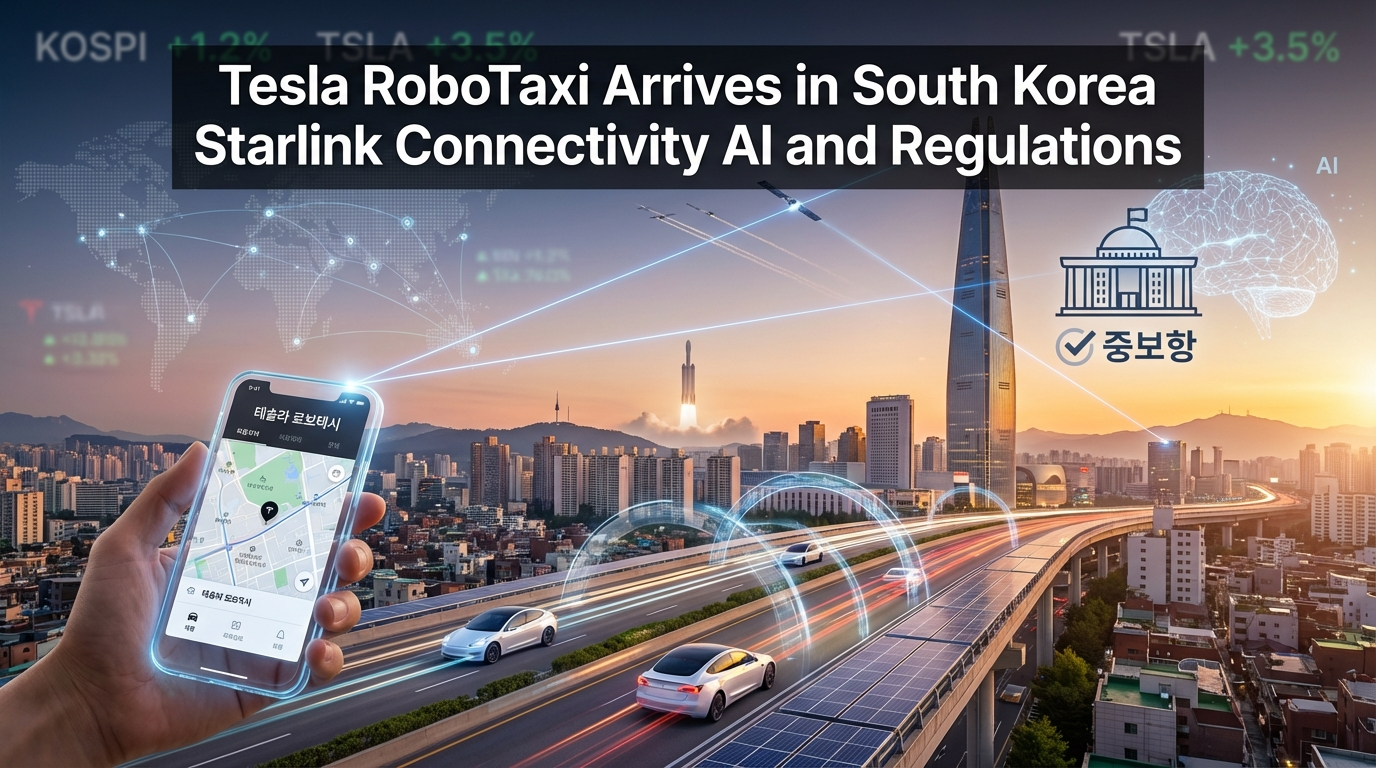
● Tesla RoboTaxi Invasion, Korea First
Tesla RoboTaxi App, The Real Meaning Behind Its Appearance on the Korean App Store and the Background of a Korea-First Strategy
It first states that with the news of the robo-taxi app appearing on the Korean App Store, it covers why Korea was prioritized, how to overcome the practical barriers of regulations, insurance, mapping, and payment, and even how interest rates and the financial market environment will affect the speed of robo-taxi commercialization.
It summarizes the current situation and rumors presented in the original text, and outlines at once the “unique variables of the Korean market” as well as the “revenue model and policy roadmap” that the industry seldom discusses.
It realistically presents the timeline of Korean robo-taxis from the perspectives of global economic trends, AI trends, and the Fourth Industrial Revolution.
1) News at a Glance: Summary of the Original Text and Key Points
According to the original text, the official Tesla RoboTaxi app has appeared on the Korean App Store.
In the United States, community news mentioned that a paid robo-taxi service is underway in Austin, with references to the introduction of a fare system and limited regional operations in the initial phase.
In FSD v14.2.1, a test video was released showing that text input is allowed depending on the situation, indicating the contextual application of driver monitoring.
There is word that AutoBild, Germany’s largest automotive media, tested the FSD in downtown Berlin and evaluated it as having a level of perfection that even threatens human capability.
It is reported that Elon Musk emphasized the official announcement of Starlink in Korea through X, and there were reports of major domestic airlines announcing the adoption of Starlink for onboard use.
Rumors are circulating about the possibility of SpaceX’s IPO in 2026, and the matter of preferential treatment for Tesla shareholders has been introduced as still undetermined.
For reference, the above information includes both the original text and industry community-based rumors, so it should be verified concurrently with official disclosures and domestic regulations.
2) Why Korea?: The Reason Tesla Sees Korea as a Strategic Hub
Korea ranks among the top in the world in terms of 5G penetration and urban density, resulting in an extremely fast pace of data collection and service diffusion.
High usage rates of Tesla FSD and high content consumption create favorable conditions for acquiring learning data, and the responsiveness of OTA-based feature expansion is outstanding.
If Starlink initially opens B2B channels in areas such as aviation and maritime, it will enhance the reliability of connectivity for moving vehicles and create a virtuous cycle that reduces communication risks for robo-taxis.
In conclusion, Korea is a market that has the optimal combination for “learning, launch, and diffusion” in terms of technological readiness, network quality, and consumer responsiveness.
3) The Unseen Hurdles for the Korean Launch: The Four Key Checkpoints of Regulation, Insurance, Mapping, and Payment
- Transportation Business Legislation
Under the Passenger Transport Business Act, a licensing framework for robo-taxis and a clear definition of the operating entity are necessary.
The key issue is how to classify unmanned or semi-autonomous operations within the framework of “platform-based transportation services.” - Liability and Insurance
Determining accident liability, insurance rates, and the design of coverage for the vehicle, individuals, and property based on SAE levels (L2 vs L3/L4) is a prerequisite.
It is also necessary to establish regulations for the utilization of autonomous driving data and for managing evidence (access to black box data and logs) in dispute situations. - Personal Information and Data Transfer
The overseas transfer of video and driving logs, along with pseudonymization, retention periods, and the scope of consent, must be designed in a manner that does not conflict with the Personal Information Protection Act. - Mapping and Positioning
Since Korea has special regulations such as restrictions on the export of precise maps, even vision-based driving requires a rational alignment between local regulations and high-precision positioning.
4) Observations on FSD v14: The Balance between Technology and Safety Indicated by “Allowing Text Input”
According to the original text and the test video, FSD is observed to adjust the strictness of driver monitoring based on contextual factors such as traffic density.
While it is ergonomically reasonable to be lenient in low-density areas and strict in high-density areas, legal responsibility remains with the driver.
The key point is that this marks the beginning of a transition to a state where “people drive less,” which in turn leads to a redefinition of passenger-centric UX and the interior space of vehicles.
5) The European Variable: EU Approval as a Catalyst for Global Expansion
The original text mentions the possibility of applying for a regulatory exemption in the Netherlands and the potential for a software update in February 2026.
If approval cases appear in major EU countries, they will serve as standard references, exerting pressure on and providing learning opportunities for Korean regulatory authorities.
Ensuring conformity with European safety standards and data regulation can be directly referenced in Korean design approaches.
6) Starlink-Airline Synergy: Connectivity Builds RoboTaxi Trust
News of Korean airlines adopting Starlink can be interpreted as a signal of building national-level B2B trust.
As coverage becomes denser in urban, suburban, mountainous, and coastal areas, the operating rate and service reliability of robo-taxis will increase.
In the context of the Fourth Industrial Revolution, hyper-connectivity in transportation is both a safety net for autonomous driving and a key infrastructure for cost reduction.
7) Realizing the Business Model: Unit Cost, Utilization Rate, and Regulatory Expenses Determine Profitability
The unit economics of robo-taxis are determined by the cost per kilometer, daily operating hours, maintenance, insurance, communication costs, and battery cycle life.
Although urban fare elasticity in Korea is high, initial margins may be low when platform fees, insurance premiums, and regulatory compliance costs are added.
During periods of rising interest rates, higher capital costs can delay vehicle procurement and infrastructure investments, while inflation-driven increases in maintenance and insurance costs place pressure on profitability.
Conversely, if the financial markets stabilize and interest rates decline, vehicle CAPEX and leasing costs will decrease, accelerating the pace of expansion.
This aspect is directly influenced by the global economic cycle, recession risks, and financial market liquidity.
8) The Korean-Style RoboTaxi Roadmap: Realistic Scenarios and Milestones
- Short Term (Pilot)
Test limited, paid operations under restricted zones, times, and speeds within a regulatory sandbox.
Collaborate with domestic insurance companies to design dedicated products and test protocols for accident investigations and data disclosure. - Mid Term (Partial Commercialization)
Increase the operating rate by deploying specific models or vehicle types within urban areas, while concurrently running route-based or point-based robo-taxi services in conjunction with local governments.
Reduce user friction by integrating public transportation-linked payments with T-Money, credit cards, and simple payment systems. - Long Term (Expansion)
Optimize in-vehicle work and entertainment, diversify revenue through advertising and subscription models, and enhance efficiency through V2X and C-ITS integration.
9) Risk Map: External Variables Beyond Technology – “People, Systems, and Society”
Support measures for transition and employment restructuring are necessary to mitigate conflicts of interest with the taxi industry.
Early safety incidents and cybersecurity issues could trigger tighter regulations, making proactive measures critically important.
Gaining public trust in the handling of personal data and the overseas transfer of such data will determine the pace of commercialization.
10) Key Insights from an Investment and Policy Perspective
The trajectory of interest rates and inflation directly affects vehicle procurement costs and insurance premiums.
As financial market volatility subsides, robo-taxi CAPEX and network expansion accelerate and unit economics improve.
If the rumors of a SpaceX IPO become reality, the narrative surrounding connectivity, space, and autonomous driving will be re-evaluated and may favor higher multiples.
However, regulatory uncertainties and societal acceptance will continue to act as discount factors on valuation.
11) Checklist for Korean Users
- Regulations
Since using a mobile phone while driving is illegal at this time, domestic laws must be prioritized regardless of any changes in FSD functionality. - Data
Be sure to check the scope of consent, storage, and whether location and video data collected by the app or vehicle will be transferred to third countries. - Insurance
Review the special clauses related to autonomous driving, including deductibles and liability provisions in case of an accident. - Infrastructure
Identify in advance the accessibility of parking and charging facilities, communication dead zones, and how GPS multipath issues are handled in areas densely populated with tall buildings.
Most Important Points That Are Not Frequently Mentioned Elsewhere
- Payment and Fee Structure
If robo-taxi fares are combined with in-app payments, app market fees and the scope of domestic electronic finance laws become significant variables affecting profitability.
Direct integration with the domestic simple payment and transportation card ecosystem offers a shortcut to reducing customer acquisition costs. - Combination of Map Regulations and Vision-based Driving
In an environment with restrictions on the export of precise maps, Tesla’s vision-centric approach is an advantage; however, verifying legal conformity in construction zones and with temporary signage is essential. - Redefining Data Sovereignty and Recalls
Software recalls, in which OTA updates fix functionality issues, will influence discussions on the Korean-style recall system and data sovereignty. - Timing of Social Consensus
Technology advances quickly, but systems move slowly.
Without a “comprehensive agreement” on citizen safety, employment transition, and data governance, commercialization will be delayed. - Sensitivity to Macroeconomic Conditions
As interest rates and recession risks increase, vehicle CAPEX, insurance costs, and maintenance expenses will be pressed, slowing down expansion.
When financial market stability and policy signals align, the door to large-scale expansion will open.
The key hurdles are transportation legislation, liability and insurance, the transfer of personal data, and the conformity of mapping and positioning.
The contextual driver monitoring in FSD signals a shift in UX from “driving to being a passenger,” though adherence to domestic laws remains paramount.
Interest rates, inflation, and financial market stability determine the unit economics and expansion rate of robo-taxis.
Connectivity infrastructure (Starlink) and EU approval are likely to serve as catalysts for the commercialization of robo-taxis in Korea.
[Related Posts…]RoboTaxi Regulatory Roadmap: 5 Issues Korea Must Resolve
The Impact of Starlink Onboard Internet Commercialization on Airline Revenues
*Source: [ 오늘의 테슬라 뉴스 ]
– 한국 앱스토어에 ‘로보택시 앱’ 등장… 머스크는 왜 한국을 먼저 열었을까?
● SpaceX IPO Bonanza Looms, Tesla Loyal Holder Windfall, Grok-FSD Profit Engine
[Tesla·SpaceX] WSJ ‘SpaceX IPO Rumor’ Core Points, Tesla Long-Term Shareholder Benefit Checklist, Grok-FSD Vertical Integration Revenue Model’s True Point
Today’s article covers the credibility of the SpaceX IPO rumor and its valuation range, the possibility of Tesla long-term shareholder priority, the revenue leverage created by the integration of Grok and FSD, Europe’s FSD ride-along experience as a turning point signal, and a scenario for a performance jump resulting from the release of deferred FSD revenue.
In particular, we have separately summarized the “practical issues of priority allocation for Tesla holders at the time of IPO,” “the structure of the data and revenue engine created by Grok-FSD integration,” and “the economic effect of the Supercharger prediction system,” which are rarely addressed by other media.
WSJ SpaceX IPO Rumor and Valuation Update
WSJ published a report suggesting that SpaceX is considering an IPO around 2026, causing a stir in the market.
So far, neither SpaceX nor Elon Musk has officially confirmed this, so it is reasonable to view it as still in the rumor stage.
Based on private and secondary market transactions, many market reports have discussed a valuation band for SpaceX of roughly $150 billion to $200 billion.
There are also reports of ongoing discussions to expand the size of secondary transactions (stock sales), but the terms and price remain fluid until eventually finalized.
The enterprise value and fundraising structure can also differ depending on whether the IPO is for SpaceX itself or a spin-off listing of Starlink.
From a cash flow perspective, there is increasing praise that Starlink’s subscriber growth and the enhancement of launch reusability have stabilized, which has raised the likelihood of an IPO within three years.
Depending on the global economic environment, stock market volatility, interest rate levels, and the path of inflation, the IPO window might be advanced or delayed.
Tesla Long-Term Shareholder Priority Possibility: Record and Checklist
Musk has repeatedly expressed the message of “rewarding long-term shareholders” in the past and has mentioned the possibility of giving Tesla long-term shareholders priority in the event of a Starlink IPO.
An actual example of this was when early delivery eligibility for the Cybertruck Foundation Series in 2024 was granted, with a concrete definition provided for “long-term holding.”
This criterion combined several conditions, such as the holding as of a specific past reference date, maintaining a minimum quantity up to the present, and restrictions on intermediate sales.
Even if the listing becomes a reality, there is an expectation that similar principles may be applied.
However, it must be designed so as not to conflict with securities regulations in each country, brokerage execution, and public offering/allocation rules.
Practical Perspective Checklist (Unofficial Guide)
First, a reference date for long-term holding and the amount held may be defined.
Second, there may be an allowable range for intermediate sales (e.g., maintaining at least 50% of the past holdings).
Third, account verification and allocation channels (by securities firms and by country) may be required.
Fourth, differences by taxation, currency conversion, and trading markets (US/non-US) must be considered.
All of these, independent of Musk’s intentions, are subject to legal and regulatory constraints, so until an official announcement is made, they should only be regarded as a possibility.
Grok x FSD Vertical Integration: Beyond Simple Voice Commands to a ‘Driving-Conversation-Recommendation’ Revenue Engine
In the Holiday Update, Tesla showcased how the in-vehicle Grok, navigation, and FSD are organically connected.
The core of this integration is not just entering a destination but also includes “adjusting driving style,” “understanding contextual situations,” and “conversational recommendations and execution.”
For example, commands like “drive a bit more smoothly” can be modified during driving, and natural language requests such as “I want spicy ramen; is there one nearby?” can immediately lead to navigation.
This not only changes the driving UX, but also opens a commerce revenue model that connects to maps, advertising, payment, and subscription services.
If the Grok 4.x series models are optimized for in-vehicle and edge inference, the loop of data-model-service will be further strengthened into a robust “data moat.”
Data Scale: The Meaning of “North America Collecting Petabyte-Level Data Daily”
Tesla emphasized that it collects petabyte-level autonomous driving data in North America alone on a daily basis.
This is equivalent to “watching a feature film continuously for 390 years every day” in terms of volume, and it is critical for compressing and refining meaningful samples to capture high-density rare events and enhance learning.
A pipeline that compresses and refines meaningful samples during training is essential to the fundamental competitive strength of FSD performance.
European FSD Ride-Along Experience: The Initial Intersection of Regulation and Demand
The ongoing FSD ride-along experience in Europe has received high praise as it demonstrates natural responses even in challenging environments such as narrow alleyways.
On-site feedback that ride-along experiences are increasing pre-purchase conversion is seen as a precursor to European commercialization.
Depending on UNECE regulations and certification procedures in various countries, there is a possibility that the level and scope of functionalities will be expanded step by step.
Supercharger ‘Prediction’ Update: The Economics of Network Efficiency
The new visualization doesn’t simply show the ‘remaining number of devices’ but predicts available charging bays at the time of arrival.
It directs optimal parking by considering the remaining time during charging, rotation rates, and the position of the bay.
This functionality leads to a reduction in waiting queues, shortened dwell times, and more kWh sales, thereby improving the network’s profitability.
Grok’s Investment Contest Performance Rumor: Implications and Cautions
Elon Musk mentioned that the unreleased Grok 4.2 achieved a revenue rate more than three times higher than competitive models at the AI investment contest “Alpha Arena.”
While the factual accuracy and evaluation methodology need public verification, it does indicate the quantitative potential for managing financial data, news, and market conditions with a large-scale language model.
If the in-vehicle Grok expands to include personalized financial advice, payments, and subscriptions, Tesla could secure a new market in “in-motion finance.”
Potential Release of $3.8 Billion in Deferred FSD Revenue
According to Tesla’s public filings, there was an estimated $3.8 billion of deferred revenue related to FSD, and revenue recognition is gradually advancing as the functionality improves.
Once unsupervised autonomous driving is officially launched, the significant release of this deferred revenue could act as a lever for a quarterly performance jump.
If the remaining balance of deferred revenue is large relative to the previous quarter’s net income, there is a possibility that a noticeable performance jump may occur in certain quarters.
Macro and Market Perspectives: Growth Momentum and Risks
In the stock market, the IPO momentum of SpaceX/Starlink, FSD commercialization, and Grok commercialization are being discussed as variables that could drive a “tech stock premium.”
However, if interest rates remain high, inflation re-accelerates, or regulatory risks emerge, the repricing pace might slow down.
In a global economic slowdown, funds are likely to be directed toward players in autonomous driving and satellite communications where a real cash flow transformation has been confirmed.
Key Points Other Media Rarely Mention
The first is the legal and practical obstacles to priority allocation.
Simply being a Tesla shareholder does not automatically grant access to SpaceX or Starlink IPO shares.
Pre-arranged allocation pipelines by securities firms, country-specific subscription rules, and whether the public offering and secondary market are separated must be pre-designed.
Grok-FSD is not merely a voice assistant but an integrated revenue engine where “data-model-driving-commerce” forms a closed loop.
Once map search, local advertising, and payment partners are attached, the ARPU will structurally increase.
The Supercharger prediction system is an innovation in facility productivity, increasing the network’s “turnover rate” to generate more revenue from the same asset.
This directly affects the profit and loss of the charging network and the pace of regional expansion.
Investor Action Plan (Unofficial)
Maintain a record of long-term holdings.
Organize your account statements to certify the past reference date and the current number of shares held.
Understand the subscription procedures by country.
Check your overseas brokerage accounts and the channels for accessing public offerings and secondary markets.
Monitor the FSD product roadmap.
Respond sensitively to version updates, regional expansions, and changes in pricing/subscription policies.
Stay alert for signals of Grok commercialization.
The key is whether in-vehicle payment, partnership, and advertising/recommendation features are incorporated.
Risks and Checkpoints
Regulatory delays.
The pace of commercialization will be influenced by the allowable range in various European and US states.
The difficulty of technological realization.
For widespread unsupervised autonomous driving, handling exceptions and proving safety are essential.
Market conditions.
In cases of rising interest rates or inflation, the volatility of high-valuation tech stocks can increase.
IPO timing.
Keep in mind that rumors are just rumors and the schedule may change at any time.
Timeline Observation (Not a Guide, but a Scenario)
0~12 months: Expansion of the European FSD ride-along experience, enhancement of the North American FSD version, and extension of in-vehicle Grok functionalities.
12~36 months: Possibility of initiating serious reviews of the IPO window for Starlink/SpaceX, acceleration of deferred FSD revenue release, and the advancement of Supercharger network prediction optimization.
Keyword Memo (SEO)
Global economy, stock market, interest rates, inflation, tech stocks
Disclaimer
This article summarizes opinions based on public materials and market rumors and does not constitute investment advice.
Please make your final decisions based on official announcements and your own judgment and responsibility.
< Summary >
The WSJ report on the SpaceX IPO remains at the rumor stage, but the possibility within three years has increased.
Considering Musk’s philosophy of “rewarding long-term shareholders,” there is a possibility of attempting priority allocation for Tesla long-term holders, but it must overcome legal and practical obstacles.
The integration of Grok-FSD goes beyond simple voice input to build a revenue engine that transitions from “driving to conversation to recommendations to payments,” significantly strengthening the data moat.
The European FSD ride-along experience signals early purchase conversion, and the Supercharger prediction system enhances network profitability.
Due to the large scale of deferred FSD revenue, a “function enhancement → revenue recognition” scenario for a performance jump is valid.
[Related Articles…]
SpaceX IPO Scenario and Reassessment of the Satellite Communication Revenue Model
Release of Deferred FSD Revenue and the Critical Point of Tesla’s Software Margin
*Source: [ 허니잼의 테슬라와 일론 ]
– [테슬라] WSJ 스페이스X 상장한다! 장기투자자 혜택은? 자율주행과 더 통합된 그록의 놀라운 투자 실적!
● Aritzia IPO Frenzy, DTC Sparks Middle Luxury Rebellion
Aritzia, Imminent Entry to the US Stock Market and the Counterattack of ‘Middle Luxury DTC’
Key Preview: Missing This Part in the Article Would Be a Loss
It outlines the background behind the imminent US listing rumor and explains how the dual-listed (Canada/US) structure is transforming valuations.
It explains how the acceleration of DTC (direct-to-consumer) is changing the margin and cash flow structure, as well as the revenue model shift where offline stores become ‘media’.
Amid macro factors such as inflation, interest rates, and weakening consumer sentiment, it details, including on-site observations, why Aritzia avoided negative growth in a news-style format.
It separately presents a checklist from the perspective of ‘AI-driven demand sensing, inventory turnover, LTV/CAC’, which other YouTube channels or news outlets rarely cover.
It offers actionable points and a risk map for managing price, quality, and brand momentum simultaneously in an intensifying competitive phase.
Performance in Numbers: Countertrend in a Downturn
For Q4 of FY2025, total revenue reached approximately $895 million, a 31% increase over the previous year.
US sales surged to $548 million, growing by 48.5% and serving as the engine of growth.
Net profit was $99.62 million, and earnings per share (EPS) were $0.84.
These figures, achieved amid weakening US consumer sentiment and a general downturn in retail, highlight the brand’s resilience.
The key driver was a DTC strategy that reduced dependency on department stores and strengthened its own online and company-owned stores.
Why It Worked in the US: A Triangular Formation of Product, Price, and Experience
Tailored office and semi-formal lines focused on well-fitted slacks, jackets, and coats created a distinct differentiation.
The use of muted colors and various material options increased suitability for different body types and occasions, encouraging repeat purchases.
Positioning as an ‘accessible middle luxury’ was secured with coats priced in the $300–$400 range.
The spread of TikTok and Instagram haul content generated efficient organic inflow compared to paid advertising.
The Manhattan flagship store functioned as an omni-channel hub, connecting experiences with orders.
On-Site Observation Points: Turnover, Assortment, and Crowd Effect
The store is bustling, and the rapid SKU turnover reduces ‘new product fatigue’ while increasing visit frequency.
Displaying color chips and fabric boards prominently reduces the cost of decision-making for customers.
Retailtainment elements like photo zones and seasonal setups conducive to ‘snap and share’ further drive virality.
Black Friday discounts of 20–50% are advantageous for explosive traffic growth and attracting new customers.
The Power of DTC: The Formula of Margin and Velocity
By reducing wholesale and growing its own channels, both the gross margin and SG&A efficiency improve.
Direct acquisition of demand data accelerates decision-making in production and inventory management.
Stores are redefined as media, serving not only as sales points but also as platforms for experiences, content, and membership acquisition.
Rumors of US Stock Market Listing: Why the Market Is Expecting It
As the share of US sales increases, the investor base expands across North America, boosting the demand for retail stocks.
Dual listings or direct listings enhance liquidity, research coverage, and the potential for multiple re-rating.
However, the timing, structure, and scale are subject to interest rates, volatility in the US stock market, and the mood in the IPO market.
Since the official announcement is not confirmed, event-driven risk management is necessary.
Macro Environment Check: Interest Rates, Inflation, and Consumer Sentiment
In periods of high interest rates, clothing consumption can weaken due to concerns of an economic slowdown.
If inflation persists, consumers will prefer discounts more intensely, putting pressure on margins.
When consumer sentiment weakens, middle luxury demand may be suppressed at the top, leading to polarization between low-priced and high-end products.
Weather variables, such as a warm winter or abnormal climate, can amplify the volatility in coat and outerwear sales.
Competitive Landscape: Brands Competing for the Same Customer
Premium women’s casual brands like Reformation, Abercrombie & Fitch, Banana Republic, and J.Crew are direct competitors.
Brands like Zara and H&M exert pressure through price competition, while Lululemon applies indirect pressure with its premium customer experience.
The differentiation points lie in ‘fit, material, and tone-on-tone styling’ as well as ‘the completeness of in-store experience’.
Key Points to Check Exclusively Here: The Intersection of Data, Capital, and Brand
Shortening the demand sensing cycle improves inventory turnover and cash conversion cycle (CCC), enabling resilience even under interest rate pressures.
Stores generate not only sales but also ‘media KPIs’ such as traffic, dwell time, and fitting data.
TikTok virality lowers CAC (customer acquisition cost), but an increased discount mix can harm LTV.
The strength of the USD and CAD volatility affect cost, pricing, and the conversion of offshore profits.
Quality and after-sales service issues can directly impact repurchase rates and brand reputation scores, thus necessitating an early warning system.
From an AI and Fashion Tech Perspective: Execution Levers to Evaluate Now
Using AI for demand forecasting to fine-tune purchase quantities per SKU in response to weather, events, and social trends.
Employing vision AI to analyze fitting room turnover, color touch frequency, and movement heat maps to optimize displays.
Utilizing generative AI to automate PDP copy, lookbooks, and styling recommendations to boost conversion rates.
Segmenting using RFM and LTV models and executing retention campaigns differently at each funnel stage.
Implementing a return prediction model to preemptively adjust penalties for material and size combinations, reducing both costs and customer complaints.
Risk Map: 6 Items to Keep in Check
Seasonal and weather risks could alter the mix centered on outerwear products.
An economic slowdown and weakening consumer sentiment might diminish overall demand.
Variations in quality and after-sales service experiences could trigger a decline in the brand’s NPS.
Excessive reliance on promotions could simultaneously damage both margins and brand equity.
The uncertainty of a US stock market event presents risks linked to potential dilution and volatility.
An intensifying competition in the premium women’s fashion sector could lead to increased customer acquisition costs.
Investment Checklist: Evaluating Execution Through Data
Monitor the trend in DTC proportion alongside gross margin performance.
Review the sales per sq.ft and recovery speed of new or relocated stores in the US.
Track whether inventory turnover days (DIO) and discount rate mix are normalizing.
Monitor improvements in the conversion rate relative to social mention volume and the CAC/LTV ratio.
Check whether return rates and the proportion of quality complaints are decreasing.
Sensible Approaches: Strategies by Scenario
If listing momentum strengthens, manage increased trading volumes and expanded coverage as short-term events.
Anticipate potential multiple re-rating should interest rates fall or inflation ease.
Prioritize checking inventory and margin damage in the event of weakened consumer sentiment or unusual weather.
< Summary >
Aritzia has achieved countertrend growth amid a downturn by strengthening its middle luxury DTC model with ‘fit, tone, and experience’ that resonate in the US market.
The performance remains solid, and rumors of a US listing suggest upside potential in terms of liquidity and multiples.
However, key risks include interest rates, inflation, consumer sentiment, weather variables, intensified competition, and quality/after-sales issues.
Advancing AI-based demand sensing, inventory, and retention strategies along with a ‘store=media’ approach will be the key to the next rally.
Data Calendar: What to Check Next
In the next quarter’s performance, monitor the proportion of US DTC, normalization of inventory and discount rates, and store sales density.
Keep an eye on official disclosures related to the listing and whether North American coverage expands.
Track the direction of social trends as well as return and quality indicators on a monthly basis.
[Related Articles…]
US Stock Market Listing, A Battle of Dual-Listing Strategies
Between Consumer Sentiment and Interest Rates, a Turning Point for Retail Stocks
*Source: [ Maeil Business Newspaper ]
– [어바웃 뉴욕] 슬렉스 맛집 이곳, 미국 증시 입성 임박? | 길금희 특파원