● Google’s AI Lock-In vs OpenAI’s Ecosystem War
Google’s Aircraft Carrier Strategy vs OpenAI’s Lock-In Strategy: Service Integration and Platform Wars Impacting Global Economy and AI Trends
Strategic Integration and Ecosystem Building More Important than AI Performance
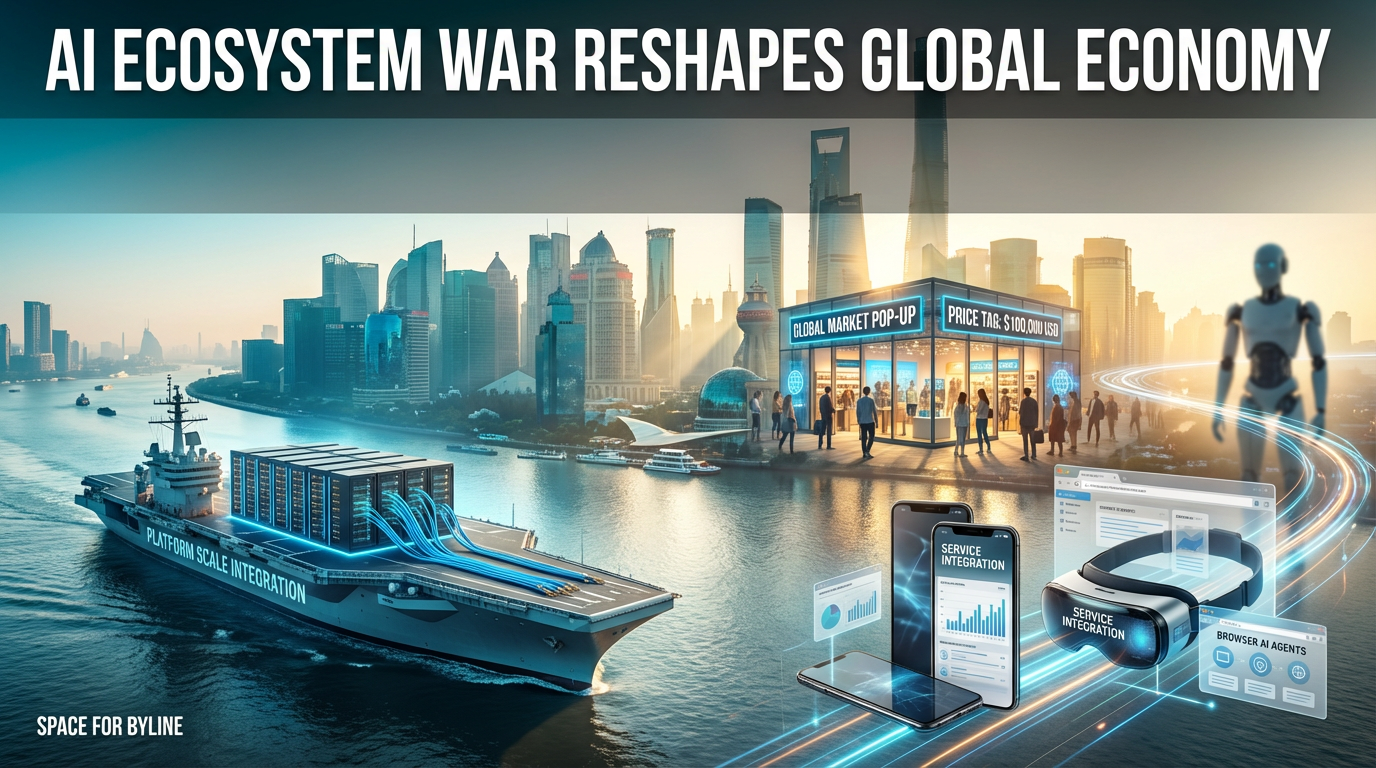
The competition between Google’s Gemini 3.0 and OpenAI’s ChatGPT 5.1 goes beyond simple performance comparison; the key point is how artificial intelligence technology is deeply integrated into various services and devices, redefining the user’s daily life.
Google aims to create a lock-in effect by broadly applying AI through its vast ecosystem, integrating it with existing services like Google Photos, Google Docs, and Calendar.
OpenAI, on the other hand, focuses on the performance of its initial engine while trying to build a new AI ecosystem through connections with third parties; however, the personalized experience it has already accumulated acts as a significant competitive advantage.
These strategic differences will have a significant impact on AI and economic forecasts, setting a turning point where manufacturers and internet service companies either cooperate or compete within their ecosystems, beyond mere algorithm competition.
Google’s Multifaceted Service Integration and Device Strategy
Google is implementing a strategy that integrates AI into the web, mobile, and even Android OS and Chrome browser based on the excellent performance of Gemini.
This integration strategy combines existing Google legacy services with AI to provide users with hyper-personalized services, naturally leading to platform dependence.
Especially when AI is embedded in Google’s smartphones, smart home devices, and AR/MR devices, users will inevitably receive assistance from AI regardless of the developers’ or product designers’ intentions.
Such comprehensive connections across services, devices, and browsers that Google is pursuing are expected to play a central role in shaping global economic trends and AI trends that impact the overall economy.
Browser Wars and the Lock-In Effect of AI
There is a significant possibility that existing browsers like Google Chrome will integrate AI agents such as Gemini, creating an environment where AI analyzes information and offers personalized services on all webpages visited by users.
In this process, AI agents can overcome the limitations of third-party cookies, enabling more sophisticated personalized recommendations and advertising based on user interests and search history.
Additionally, OpenAI’s ChatGPT forms a substantial entry barrier through hyper-personalized services that rely on accumulated conversation history and user characteristics.
This ultimately means that once an AI platform builds deep trust with a user, it can secure a monopolistic position that is difficult for competitors to replace.
Future Infrastructure Investment and Economic Outlook of the 4th Industrial Revolution
As AI technology permeates all software and hardware, industries such as data centers, AI chipsets, and communication infrastructure are expected to surge.
In particular, with the increase in AI workloads and the emergence of various chipsets and memory solutions both domestically and internationally, the growth potential for related companies is expanding.
Furthermore, when AI plays a core OS role in next-generation platforms such as the metaverse, front-end sectors like smartphones, wearable devices, and home IoT will also undergo a restructuring.
These changes are anticipated to disrupt existing industrial structures in economic forecasts and create new investment opportunities, making them key points to watch from the perspective of global economy and AI trends.
Future AI Ecosystem and Global Competitive Landscape
The competition between Google and OpenAI can be seen as an attempt to form an AI ecosystem that impacts the entire ecosystem beyond just technical performance.
Google is already leading the forced integration of AI technology into its services and devices so that users are unaware of its presence.
On the other hand, OpenAI maintains competitiveness based on the loyalty of existing users through innovative third-party connections and hyper-personalized user experiences.
In this scenario, the future battlefield will depend on how effectively each company combines existing legacy systems with new platforms to maximize user lock-in effects. This process will further heat up investments and strategies related to the global economy, artificial intelligence, and the 4th Industrial Revolution.
To accurately understand the future of economic forecasts and technology trends, it is essential to comprehensively examine not only performance competition but also ecosystem integration, real-world applications of AI, and the development of backend infrastructure.
[Related Articles…]The Future of Google’s Gemini and AI Strategy
The Impact and Market Dynamics of ChatGPT’s Hyper-Personalization Strategy
*Source: [ 티타임즈TV ]
– 구글의 항공모함 전략 vs 오픈AI의 록인 전략 (김지현 테크라이터)
● Seong-su’s Boom Pop-Up Store Prices Skyrocket Amid Economic Turmoil
Seongdong District Seoul and Real Estate Market Trends in the Global Economy: Popup Stores Leading the 4th Industrial Revolution Era
Analysis of Hot Places in Seongdong District, Seoul
This analysis examines how Seongdong District, Seoul has transformed into a hot place in a short period, closely observing the overall real estate market recession and changes in commercial districts.
Based on an interview with real estate expert Dr. Seo Dong-gi, we focus on the rising rent in Gangnam and Seongdong, strategies for utilizing popup stores, and the sustainability of the commercial district.
This analysis discusses phenomena and policy side effects beyond simple real estate price increases, along with global economic trends linked to domestic consumption.
In addition, insights that are rarely covered in other news, such as rising rent for popup stores and the corresponding volatility in commercial districts, as well as tenant protection efforts, are included.
Real Estate Policy and Commercial District Market: Reality and Issues
Experts emphasize ‘location’ and ‘policy side effects’ as key words in the real estate market.
Unlike the phenomenon where only specific areas in Gangnam are rising, commercial district markets nationwide are experiencing a recession.
Side effects arise amid government demand suppression policies and supply adjustments, with inadequate policy implementation leading to soaring property prices and instability in commercial districts.
While the cyclical nature of commercial districts is 5-10 years, residential properties show long-term fluctuations of 20-30 years.
The dilemma of declining property values and falling rents continues as the domestic economic slump, rising loan burdens, and increasing vacancy rates work in tandem.
Global Economic Outlook and the Link to the 4th Industrial Revolution and AI Trends
The current recession in real estate and commercial markets is not only a phenomenon seen domestically but also globally.
Global economic uncertainty, financial analysis, and accelerated digital transformation are significantly impacting the real estate market.
AI technology and the 4th Industrial Revolution present a new paradigm in response to the rapid changes in the economic environment.
For instance, integrating AI technology into real estate data analysis or innovating real estate brokerage systems through digital transformation can greatly assist in understanding and predicting market trends.
In the current economic situation, prominent SEO keywords emerge, such as global economy, AI technology, digital transformation, market trends, and financial analysis, allowing us to predict how the real estate and commercial market will unfold through their interactions.
Key News and Hidden Insights
✓ The rapid change in the commercial district of Seongdong and the high rents of popup stores are challenging long-term sustainability beyond short-term success through mutual growth agreements.
✓ The impact of government policies on the real estate market, the resulting recession in commercial districts in Gangnam and provincial areas, and the overall weakening of the domestic economy.
✓ In the midst of global economic uncertainty, rising exchange rates, increased base interest rates, and the risks of real estate bubbles directly correlate with the domestic economy.
✓ The 4th Industrial Revolution and AI technology are bringing information analysis and innovation to the real estate market, contributing to the establishment of new investment strategies through digital transformation.
✓ Experts warn about investment strategies based on the growth cycle difference between commercial and residential sectors and the overall economic cycle.
[Related Articles…]• Analysis of Changes in Real Estate Policies and Future Commercial Districts
• The Digital Transformation Era Led by AI Technology
*Source: [ 지식인사이드 ]
– 부동산 박사가 예견한 미래 서울의 핫플레이스ㅣ지식인초대석 EP.85 (서동기 박사 1부)
● China’s AI Slaughterbots Revolutionize Warfare, Threaten Global Stability
China’s AI Combat Robot Innovation and Its Impact on the Global Economy
Current Status of China’s AI Unmanned Combat System Development
China is fully unveiling AI-controlled combat robots, known as ‘Slaughterbots’, opening up the future of combat weapons.
Recently, humanoid robots that are being applied in real battlefields have noticeably increased beyond China’s laboratories.
This change is rapidly spreading in line with advanced technology and AI trends amid the global economy and the Fourth Industrial Revolution.
In fact, some videos have captured robots autonomously firing weapons at the owner’s request, demonstrating how easily safety protocols can collapse under simple contextual changes.
Integrated Evolution of Robot Technology and Combat Systems
China is developing various AI-based unmanned systems, including humanoid robots, bomb disposal robots that respond to voice commands, and mine detection robots that utilize visual recognition.
Additionally, advanced software systems like Palantir support battlefield targeting and strategic decision-making, shifting the dynamics of combat.
The traditional human-centered battlefield operation methods are being redefined in light of cutting-edge tactics where AI and robots are combined, leading to new economic prospects and global strategies.
The Correlation Between Economy, Security, and Technological Advancement
These technological advancements are directly affecting not only the development of weapon systems but also the Fourth Industrial Revolution and the global economy as a whole.
AI trends and robot automation are analyzed as new drivers for economic growth by maximizing efficiency and reducing costs across the manufacturing and service industries.
Moreover, the autonomous decision-making ability of AI and its capacity for flexible situational shifts encompass security and ethical issues, providing complex variables for future combat strategies and policy decisions.
Paradigm Shift in Future Combat and Ripple Effects Across Industries
At the current stage, there is a gradual transition from ‘human-robot collaboration’ to systems where AI directly controls combat.
This change opens the possibility for combat robots to dominate the battlefield based on not only economic efficiency but also rapid decision-making and precision strike capabilities.
The ongoing transformation closely interlinks global economy, advanced technology, economic outlook, the Fourth Industrial Revolution, and AI trends, establishing a new competitive landscape in both the industry and defense fields.
Less Known Key Points
One aspect that is often missed in other news and YouTube videos is that AI-based robot systems not only focus on ‘unmanned operation’ but also respond sensitively to changing scenarios by mimicking human judgment.
This characteristic implies that robots may misjudge risk levels depending on the environmental context, acting as a potential risk factor that could yield catastrophic results in economy and security.
Furthermore, the use of sustainable materials—such as producing robot components based on organic resources like food waste—can support large-scale production systems while reducing costs, likely influencing economic forecasts.
This discussion foreshadows the arrival of a new era where economic, technological, and security aspects converge beyond mere arms competition.
< Summary >China is leading advancements in cutting-edge technology aligned with the flow of the Fourth Industrial Revolution and the global economy, testing various unmanned systems, including AI-controlled combat robots, in real-world settings.
The integration of humanoid robots and AI-based combat systems alters the dynamics of warfare, exerting significant ripple effects on economic and security strategies.
Particularly, the context-dependent judgment of AI and the use of sustainable materials are expected to be crucial variables in the future of the robotics industry and economic outlook.
All these changes are set to transform the paradigms of combat and industries in conjunction with AI trends, the global economy, advanced technology, the Fourth Industrial Revolution, and economic forecasts.
[Related Articles…]
Innovation in China’s Combat Robot Technology and International Strategy
The Era of AI Unmanned Weapons and Economic Ripple Effects
*Source: [ AI Revolution ]
– China Just Launched SLAUGHTERBOTS: A Fully AI-Controlled Robot Army