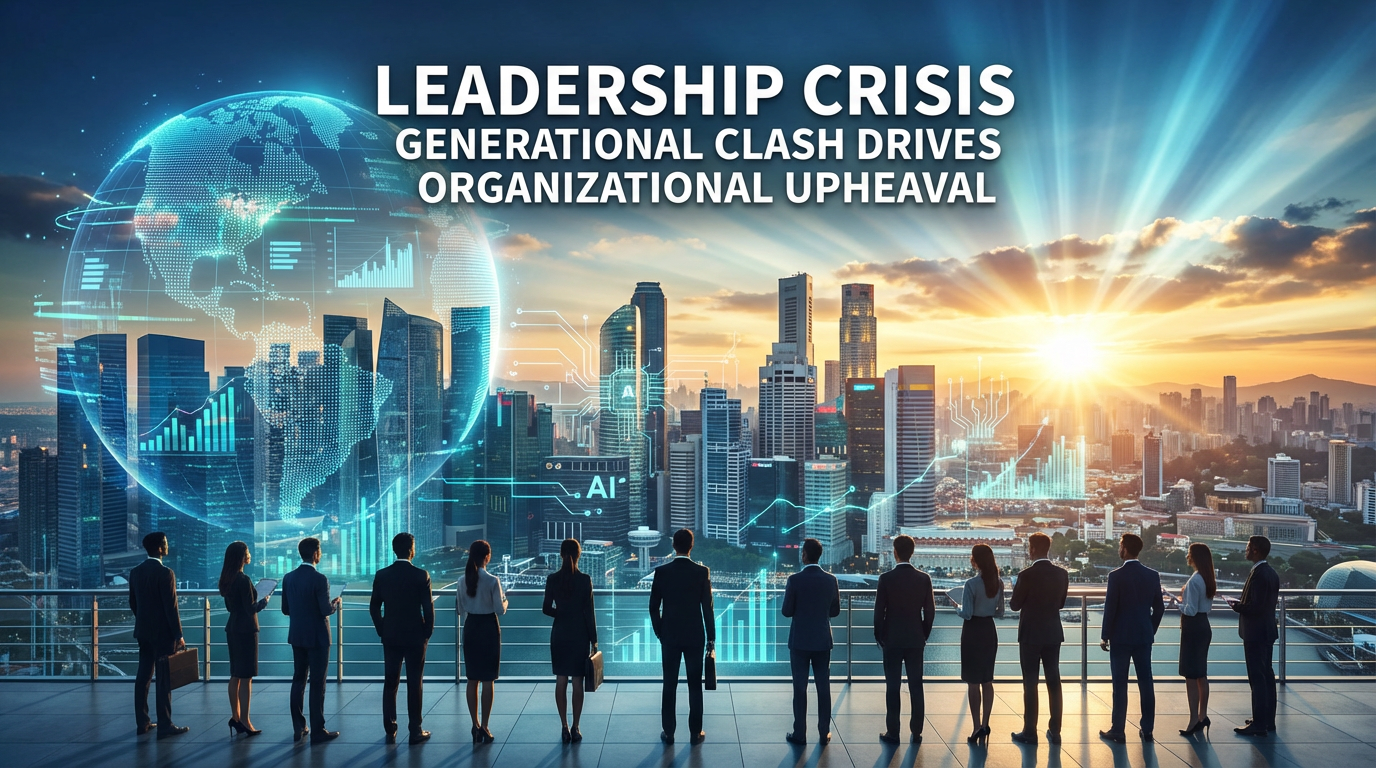
● Leadership Crisis Generational Clash Drives Organizational Upheaval
The Concerns and Solutions of New-Generation Leaders: Organizational Culture Innovation Viewed through Global Economic Prospects and AI Utilization
The Dilemma of Inter-Generational Change and Middle Managers
Recently, as “young people” from the older generation are advancing to mid-level management positions in corporate settings, messages of consolation are increasing instead of congratulations for promotions.
In discussions surrounding global economic prospects, this phenomenon reveals not just generational differences, but also psychological pressures and varying expectations between generations within the organization.
Middle managers feel the burden and anxiety of leadership as they are simultaneously subject to the scrutiny of both their seniors and juniors.
This phenomenon of leader phobia demands significant changes in organizational operation methods, especially in the context of rapidly advancing innovative technologies such as artificial intelligence, the Fourth Industrial Revolution, and digital transformation.
Challenges and Solutions for New-Generation Leaders
As millennials and late millennials emerge as key leaders, they are seeking new forms of autonomy and collaboration, moving away from traditional hierarchies and authority-based leadership styles.
They value work-life balance while also desiring an environment where they can maximize their capabilities.
Active communication strategies, such as peer feedback and reverse mentoring, along with an increase in talent density within the organization, can be seen as vital solutions to overcoming the limitations of existing leadership systems.
Furthermore, changes that emphasize performance management systems, strengthening followership, and recognizing the expertise of talent have emerged as essential transformations.
Artificial Intelligence (AI) and Digital Transformation: The Introduction of a New Leadership Model
AI and digital transformation have sparked innovation across the entire economic system, profoundly impacting leadership as well.
Training programs that utilize the latest technologies, such as AI leadership courses, encourage data analysis and digital collaboration, moving away from the traditional process-expert-centered leadership.
As keywords like artificial intelligence, global economic prospects, and the Fourth Industrial Revolution come to the forefront, leaders must utilize technological tools not merely as job support measures but as strategic decision-making partners.
This will enable all organization members to respond agilely to changes and lay the groundwork for creating new business models.
Performance Management and Followership: Redesigning Hierarchical Relationships
The existing promotion and evaluation systems reveal issues of emotional disparity and imbalances in authority delegation among generations.
Middle managers are demanding systematic feedback systems for responsibility regarding their roles, as well as for the actual development of their capabilities and cooperation among colleagues.
Both evaluators and those being evaluated must enhance individual growth and overall organizational efficiency through systematic training and feedback based on fairness.
These changes align with the key challenges of modern management that relate to talent density, economic prospects, digital transformation, artificial intelligence, and global economic expectations.
Leadership Success Strategies Reflecting Reality
Today’s leaders must go beyond exercising authority based on titles, strengthening followership to grow alongside their team members.
Enhancing the overall competitiveness of the organization by combining individual expertise with colleagues’ capabilities is crucial.
In this process, leaders should share clear visions and goals, helping team members find their own roles.
The use of AI and digital tools is a key to further enhancing the flexibility of organizational culture.
Summary of Key Points Often Overlooked by Other News
Mainstream news tends to focus solely on generational conflict and leadership changes, but what deserves attention here is the ‘transition of leadership and followership.’
In particular, it has analyzed in detail how rigid evaluation systems and promotion cultures negatively affect individual motivation and talent development.
Additionally, it revisits the mechanisms through which artificial intelligence and digital transformation innovate not just job tools, but the entire organizational structure and collaboration modes.
Thus, the conflicts faced by new-generation leaders and their solutions resonate with the latest trends emphasized in global economic forecasts and outlooks, offering important insights for future organizational operations.
Conclusion and
[Related Articles…]Innovative Changes in Corporate Promotion Culture
Analysis of New-Generation Leadership Strategies
*Source: [ 티타임즈TV ]
– 승진자 교육을 하면 ‘축하’보다 ‘위로’하는 시대 (이찬 서울대 교수)
● Soaring real estate crisis
Seoul Apartments, Global Real Estate Outlook and a New Paradigm of Reconstruction – Key Points You Must Know Now
1. The Value of Seoul Apartments Compared to the Global Economy
Seoul apartments are currently inflated to more than double the level compared to major global cities such as New York and LA in terms of price-to-income ratio (P Ratio).
The period required to save without spending even a penny is about 23 years, with the Gangnam area showing even more extreme figures.
This situation has a significant impact on economic outlook, the global economy, and the real estate market as a whole.
From the perspective of the global economy and economic forecasts, the high price level indicates a structural supply-demand imbalance issue rather than just a real estate bubble.
2. Changes in the Reconstruction Market and Hidden Risks
In the past, reconstruction could expect high returns with low burdens of contributions, but now, in the case of high-rise apartment reconstruction, construction costs and contribution burdens have significantly increased.
Amid stagnating economic growth and changes in demographic structure such as low birth rates, the past reconstruction myth is collapsing.
In the future, even attempts at reconstruction after 40 years may become difficult, which ultimately poses a risk of high-rise super high-rise apartments becoming unsustainable.
This situation is an important factor in redefining economic forecasts along with real estate and reconstruction in the global economy.
3. Government Policies and Directions for Real Estate Stabilization Measures
The government is trying to stabilize the real estate market through strong demand suppression and supply measures, but the effects are often limited to the short term.
In particular, regulations on land trading zones, holding tax, and capital gains tax have emerged as core points, and there are growing voices calling for improvements in the property tax system similar to the American-style holding tax implementation.
The impact of policy changes on the market is subtle, but it will play a crucial role in addressing economic forecasts and the polarization of real estate issues.
4. Changes in the Housing Market, Polarization, and Future Housing Trends
The soaring apartment prices in Seoul and the metropolitan area deepen the problem of real estate polarization compared to the sluggishness in some local and mid-sized cities.
Rising monthly rents and changes in the jeonse system emphasize the gap between investors and actual demand.
As the real estate market polarizes, the stability of housing for actual demand becomes an important issue within the economic outlook, real estate policies, and the global economy.
Moreover, these changes raise the need to redesign the future of the real estate market in conjunction with AI trends and the Fourth Industrial Revolution.
5. The Impact of the Global Economy and AI Trends on the Real Estate Market
Recent global economic trends and AI trends are providing new variables for the real estate markets of various countries.
In particular, international investors are paying attention to exchange rate fluctuations and currency value declines, leading to the phenomenon of high-priced apartments in Gangnam, Seoul being perceived as relatively inexpensive.
AI technology is expected to play a significant role in real estate analysis, price prediction, and policy decision-making, contributing to data-driven economic forecasts and real estate stabilization measures.
In this way, the intertwining of the global economy, economic outlook, real estate, reconstruction, and AI trends will be key factors shaping future market movements.
[Related Articles…]Future Outlook for Seoul Real Estate
Risks and Measures in the Reconstruction Market
*Source: [ 지식인사이드 ]
– 지금 서울 아파트가 뉴욕보다 사기 어려운 이유ㅣ지식인초대석 EP.86 (서동기 박사 2부)
● AI Revolution Ignites Economic Shift
Latest AI Trends and Global Economic Outlook: A Comprehensive Look at Deepseek, Nova, and Google’s Memory Innovations!
1. AI Innovation News and Technological Advancements
Recently, notable news has emerged in the AI market.
Deepseek’s open-source AI achieved a gold medal in the International Mathematical and Informatics Olympiad, demonstrating competitiveness in creative problem-solving and algorithm design beyond just text problem resolution.
Anthropic’s Opus 4.5 benchmark has shown exceptional performance in coding, signaling an intensifying AI benchmark competition.
Mistral 3 is Europe’s first open-source AI model, receiving positive feedback for its differentiation from Chinese and U.S. models and user interface.
Notably, Google is showcasing the potential of AI world models through Nano Banana Pro, implementing functions similar to human intuitive thinking, such as image, video, and 3D recognition.
Additionally, Amazon introduced the Nova 2 model family, an all-in-one multimodal AI model capable of processing text, images, video, and audio, indicating a trend toward the commoditization of AI models.
2. Trends in the Global Economy and the AI Industry
The impact of technological advancements on the economy is becoming increasingly pronounced.
Countries around the world are seeking to invest in AI technology and ease legal regulations as a strategy to secure competitiveness in the wave of the Fourth Industrial Revolution.
The EU is looking to facilitate the use of personalized data by relaxing some provisions of the GDPR and delaying the AI Act, while trying to strike a balance with strict regulations on high-risk AI systems.
Meanwhile, OpenAI is hinting at significant changes in its user data processing methods following an internal model update and recent privacy disputes, potentially causing ripples throughout the AI industry.
3. Future Industry Outlook and Key Issues
This month’s AI news provides crucial clues for predicting the future of various industries, beyond mere technological advancements.
Open-source AI models like Deepseek are expected to play an innovative role in the democratization of technology and personal data protection.
The introduction of multimodal AI models, such as Amazon’s Nova 2 series, is likely to enhance AI competitiveness and contribute to overall productivity improvements across the economy.
Furthermore, Google’s Titan and MRAZ technologies are seen as breakthroughs in solving the long-term memory system issues of AI, indicating the possibility of future AI replicating human learning and memory processes.
Additionally, the emergence of robots with an extremely high level of realism and mobility is generating both expectations and concerns regarding industrial automation and changes in everyday life.
Particularly, as the performance gap among AI models narrows, a new economic paradigm of ‘commoditization of models’ is expected to take shape.
4. Important Points Not Covered in Other News
Key contents often overlooked by many news outlets include the following.
First, the privacy and data sovereignty issues brought about by open-source AI technology.
Open AI models like Deepseek can be executed locally, reducing the risk of data exposure through the cloud and contributing to the protection of sensitive information.
Second, advancements in AI model memory and world model technologies could pave the way for implementing AI that closely resembles actual human learning and memory systems, beyond just improving benchmark scores.
Third, from a global economic outlook perspective, the rapid advancement of AI technology is predicted to bring major changes to the software and labor markets, with experts estimating that changes could exceed 90% by 2026.
Lastly, along with the easing of EU regulations, the competition in AI technology among major countries, including the U.S. and China, may expand into a new global hegemonic competition structure, warranting close observation of its impacts on the economy and industry as a whole.
< Summary >
Recent news of various AI innovations, including Deepseek’s gold medal AI, Anthropic’s Opus 4.5, Mistral 3, Amazon Nova 2, Google Titan, and MRAZ technologies, has been reported.
Alongside this, global AI industry and economic trends, such as the easing of EU regulations and OpenAI’s privacy disputes, are noteworthy.
Future advancements in open-source AI, the implementation of AI world models, and radical developments in robotics are expected to significantly impact the Fourth Industrial Revolution and the global economy.
[Related Articles…]
News on Deepseek’s Open-Source AI Innovations
OpenAI’s Privacy Dispute and Future Outlook
*Source: [ TheAIGRID ]
– AI News : Deepseek Returns, Amazons Secret AI Models, Googles Breakthrough , Veo 3 Beaten and More