● Economic Turmoil, Job Crisis, Urgent Reforms
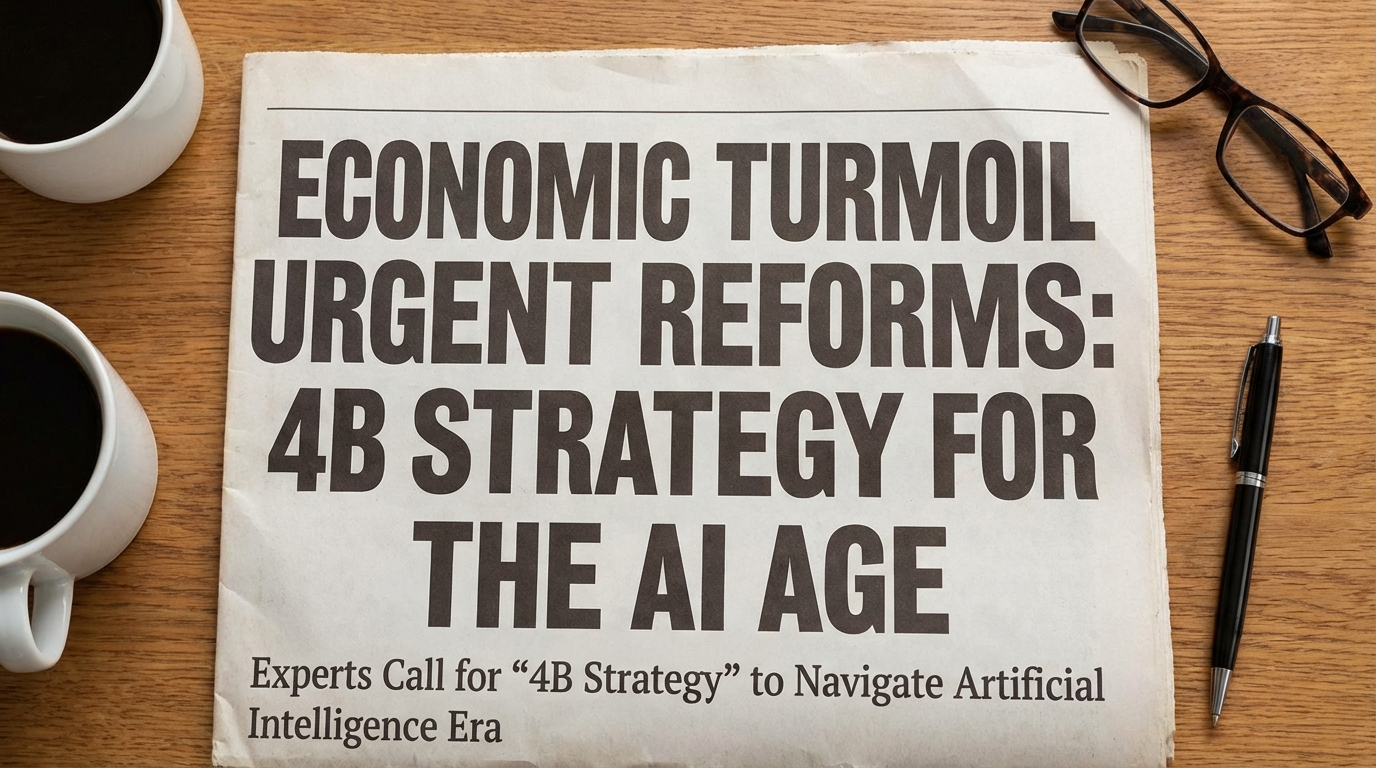
4B Strategy: Internal Development, External Recruitment, Consulting, AI Agents – The Golden Ratio for Organizational Innovation in the AI Era
Essential Strategies for the Global Economy and Digital Transformation Era – 4B Strategy
As companies grapple with how to restructure human resources in the face of AI innovation and digital transformation, the 4B strategy, composed of Internal Development (Build), External Recruitment (Buy), Consulting (Buy), and AI Agents (Bot), has garnered attention as the key solution.
This article elaborates on how to redefine workforce automation and business strategy through the processes of human resource restructuring and the adoption of AI.
In particular, it addresses the hidden secrets to driving global growth and leading digital transformation.
Components of the 4B Strategy
Internal Development (Build)
∙ This strategy involves operating training and capability enhancement programs utilizing existing personnel.
∙ Concentrated training in a short time enables employees to perform innovative tasks using AI tools.
∙ In the global economic context, talent development is a core aspect of corporate competitiveness.
External Recruitment (Buy)
∙ This strategy involves recruiting future talent from outside to align with the rapidly changing technological environment.
∙ By quickly hiring experts with experience and the latest skills related to AI, organizations can foster innovation.
∙ This approach contributes to rapid digital transformation and global growth.
Consulting (Buy)
∙ This approach utilizes temporary project teams or professional consulting firms to leverage external expertise and know-how.
∙ This helps solve problems that are challenging to address with internal capabilities alone, and supports AI implementation and workflow automation.
AI Agents (Bot)
∙ This strategy involves automating organizational workflows through software bots and agents.
∙ Utilizing agents for repetitive tasks and claims management maximizes operational efficiency.
∙ This plays a crucial role in AI innovation and workforce automation.
Challenges and Changes in Organizational Innovation in the AI Era
Historically, organizational innovation was focused on introducing single solutions such as ERP and CRM, but now, the restructuring of human resources based on AI technology has become a core challenge.
Leaders must reallocate existing personnel and establish technology-based training programs and systematic performance management strategies.
Simultaneously, in the global business environment, it is essential to pursue digital transformation and business strategy in tandem to secure a competitive advantage.
Real-World Cases and Practical Application of the 4B Strategy
∙ Nestlé Case
- With a global network, Nestlé quickly responded to the changing market through concentrated internal development and external talent acquisition.
- They implemented a strategy to swiftly reallocate internal personnel using a skills matrix.
∙ Philip Morris Case
- They substantially restructured existing production and distribution systems to transition to the e-cigarette market.
- By introducing AI agents, they automated customer claims processing and distribution processes, achieving workforce automation.
∙ The Hartford Case
- In insurance and investment sectors, The Hartford maximized overall operational efficiency from the outset of AI adoption through the allocation of agent roles.
- Their strategy, which utilized actual claims data analysis and automated personnel assignment, stands out.
Execution Steps and Implementation of the 4B Strategy
Implementing the 4B strategy typically involves six steps.
- Establishing a business strategy – Business units and leaders develop strategies reflecting future scenarios.
- Creating a skills matrix of current human resources – Evaluating internal capabilities using AI tools.
- Long-term scenario planning – Formulating future scenarios that reflect changing global economy and technological trends is essential.
- Mapping the optimal 4B combination – Combining elements of the 4B strategy according to scenarios, such as internal development and external recruitment.
- Developing an execution plan – Clearly defining roadmaps and responsibilities for each stage.
- Measuring KPIs and feedback – Evaluating the effects of agent adoption and workflow automation through specific indicators.
The Importance of Leadership and Education in Preparing for the Future
In the AI era, it is essential for not only leaders but all employees to effectively understand and utilize AI technologies and automation tools.
∙ Moving beyond traditional educational methods, AI education, leadership training, and practical coding education are becoming essential.
∙ Collaboration between HR and IT departments to establish a human-AI collaboration framework is key.
∙ These educational programs will greatly contribute to enhancing a company’s digital transformation capabilities and global growth.
Summary
∙ The 4B strategy consists of Internal Development (Build), External Recruitment (Buy), Consulting (Buy), and AI Agents (Bot), striking an optimal balance in the introduction of human resources and technology in the AI era.
∙ Companies must secure global economic and digital transformation competitiveness through AI innovation, workforce automation, and business strategy.
∙ As seen in cases like Nestlé, Philip Morris, and The Hartford, various companies are achieving organizational innovation through the 4B strategy.
∙ By simultaneously pursuing leadership, education, and KPI measurement through a structured six-step execution process, strategic organizational restructuring for the future is being accomplished.
[Related Articles…] Practical Application of the 4B Strategy | Restructuring Human Resources in the AI Era
*Source: [ 티타임즈TV ]
– 내부육성, 외부영입, 컨설팅, 에이전트의 황금비율은? (김덕중 퍼브 AI연구소장)● AI Revolution, Economic Surge
Galaxy AI Innovation Leads the Economy and Digital Transformation in the Era of the Fourth Industrial Revolution
Utilizing AI Through Key Features and Device Integration
The fun AI function built into the Samsung Galaxy goes beyond simple voice recognition or translation.
It has emerged as a tool that dramatically enhances workplace productivity, offering real-time recording, text conversion, image creation and editing, as well as video and meeting summaries.
This function plays a significant role in the digital transformation through integration with various Google services,
keeping pace with the economy and global economic trends, and establishing itself as a core component of the Fourth Industrial Revolution.
Real-World Applications: From Meeting Summaries to Image Editing
As mentioned in the examples during conversations, the fun AI provides the ability to convert recorded speech into real-time text during meetings and automatically summarizes key sentences.
This functionality reduces the time required for compiling meeting notes, allowing professionals to focus on more critical tasks.
Additionally, the image generation and editing functionalities greatly assist in the creative production of digital content, such as altering the gender of persons in photos or switching filming styles.
Distinctive AI Features and Changes in the Global Economy
The fun AI features not only simple text conversion but also real-time information search through the Circle Search function,
as well as providing interactive services via Galaxy AI Live, highlighted by enhanced data privacy through the integration of Google-based services and on-device AI technology.
In particular, these features demonstrate that AI technology is a driving force in the global economic transition and the Fourth Industrial Revolution, attracting significant interest from economic experts and investors.
As digital transformation and AI utilization accelerate across the economy, such innovations have even been evidenced by investment legend Warren Buffett’s purchase of Alphabet stocks.
Unique Tips for Utilization and AI Trend Forecast
Compared to traditional typing, the voice-based recording of memos and the AI’s automatic text modification and summarization feature offer high efficiency for busy professionals and students during lectures.
For example, with a single touch, the contents of a meeting are structured and summarized for record-keeping.
This functionality is an essential tool for enhancing productivity in the era of the Fourth Industrial Revolution.
Moreover, while being cautious of the fears and potential misuse of AI functionalities,
the direct experiences in everyday work and learning environments allow more individuals to engage in digital transformation through AI,
marking an important message amidst today’s economic and global economic trends.
[Related Articles…]Practical Tips for Using Galaxy AIThe Future of Global Economic Trends and AI Innovation
*Source: [ 지식인사이드 ]
– 상위 1% 고수들은 다 쓴다는 갤럭시에만 있는 놀라운 AI 기능ㅣ상국열차 EP.10 (김덕진 소장)
● AI Revolution Cost-Saving Giants Transform Global Economy
Summary of AI Innovations: OpenAI’s Garlic, Apple’s Clara, Microsoft’s Vibe Voice, and Their Impact on the Global Economy!
1. OpenAI’s Garlic AI – Innovation and Cost Efficiency Beyond Competition
Recently, economic experts both domestically and internationally are focusing on the latest AI trend news. This news provides a detailed analysis of OpenAI’s Garlic AI, which has triggered an internal race. This model has shown superior performance in high-level reasoning and coding tests compared to Gemini 3 and Anthropic’s Claude, indicating it will bring innovative changes to large enterprises and the global economy. OpenAI has significantly modified its previous approach of learning detailed nuances all at once, creating a turning point by first focusing on a macroscopic network and then supplementing the details. As a result, despite being a smaller model, it has been able to reduce costs and increase speed, which is a critical factor affecting digital transformation and economic outlook. Such innovations are expected to have a significant ripple effect on global economic and technological trends, digital innovation, global economy, AI trends, economic forecasts, and digital transformation.
2. Apple’s Clara – A Revolution in Large Document Compression Technology
Apple has unveiled the CLaRa system aimed at resolving unnecessary delays occurring in existing chatbots or document search systems by extremely compressing documents. This system allows for the summarization of long documents into a minimal amount of memory tokens, enabling fast and accurate document search and generation. Apple has applied an innovative methodology that trains memory and generation units together, ensuring core information is reliably communicated while compressing the entire document. This makes it more efficient than traditional AI search systems and is expected to play a crucial role in the digital transformation and innovation across the economy. Readers interested in information retrieval, AI technology, and economic forecasts related to innovation should take note.
3. Microsoft’s Vibe Voice – A New Standard in Real-Time Voice AI
Microsoft has introduced Vibe Voice Realtime 0.5B, a real-time AI voice model that perfectly resolves AI voice lag issues. By shortening the latency experienced with existing AI assistant services to within 300 milliseconds, it supports user experience and the overall digital transformation of the global economy. This model is optimized to operate simultaneously with large language models (LLMs), enabling essential real-time data processing for economic and digital innovation. It is important to pay attention to its impact on major issues related to the global economy, AI trends, innovation, economic outlook, and digital transformation.
4. Alibaba’s Live Avatar – Infinite Real-Time Video Streaming Technology
The Live Avatar system, publicly released in collaboration with major universities in China, utilizes a diffusion model with 1.4 billion parameters, bringing innovation to real-time video streaming. This technology maintains identity without degradation of quality even after 10,000 seconds of stable frame rates above 20fps. It showcases superior technical advantages over competitors in the field of video generation and streaming, heralding innovation in the media industry and the digital economy within the global economy. Such technological advancements will become significant keywords in artificial intelligence technology, AI innovation, and global economic forecasts.
5. Tencent’s Hunyuan Video 1.5 – Accessibility and Fast Video Generation
Tencent’s Hunyuan Video 1.5, despite being a smaller model with 830 million parameters, boasts high-quality video and rapid generation speed. This model is capable of generating 480p video in 8 to 12 steps, maximizing efficiency in terms of computational resources. Its immediate video output and stable performance are expected to provide innovative momentum for digital transformation and the global economy. Furthermore, this technological upgrade aligns with key topics such as AI trends, economic forecasts, e-commerce innovation, artificial intelligence technology, and the global economy, drawing attention in terms of investment and economic activity.
Summary of Key Points and Points for Readers to Note
• OpenAI’s Garlic AI is a high-performance AI model surpassing existing models while achieving intensified competition and cost efficiency.
• Apple’s Clara overcomes the limitations of existing systems by processing large documents with extreme token compression.
• Microsoft’s Vibe Voice offers real-time AI voice responses with latencies under 300 milliseconds.
• Alibaba’s Live Avatar rewrites the history of video creation with its unlimited streaming technology.
• Tencent’s Hunyuan Video 1.5, while being a smaller model, achieves fast and stable video generation, gaining attention as a technology accessible to the public.
All these technological innovations are analyzed as having a huge impact on the global economy, AI trends, economic forecasts, digital transformation, and innovation, which are key focal points in respective industries.
Significance in the Context of the Economy and the Fourth Industrial Revolution
The latest AI trends presented by each company are transforming not just technology but also the business models and overall economic outlook across the economy. Currently, the global economy is seeking new growth drivers through digital transformation and innovation, with various AI solutions at the forefront. In particular, cost reduction, speed enhancement, and real-time data processing technologies are set to become essential elements in any industry going forward. Thus, this technological trend news offers an opportunity to understand deeply about the economy, artificial intelligence, global economic outlooks, and digital transformation, enabling proactive responses to future market changes.
Through the recent innovative AI technologies released by OpenAI’s Garlic, Apple’s Clara, Microsoft’s Vibe Voice, Alibaba’s Live Avatar, and Tencent’s Hunyuan Video 1.5, we analyzed the ripple effects on the global economy and digital transformation. The technological innovations of each company transcend the limitations of existing systems in areas such as cost efficiency, real-time processing, and unlimited streaming, significantly impacting AI trends and economic outlooks. These changes are expected to serve as major drivers of digital transformation and economic innovation worldwide.
[Related articles…] OpenAI Garlic Strengthens Competitiveness | Alibaba Live Avatar Innovative Technology
*Source: [ AI Revolution ]
– OpenAI’s New GARLIC AI, Apple’s Clara, Live Avatar and More Intense AI News