● AI Job Apocalypse, Amazon vs Walmart
AI Transformation in the Retail Industry, Job Innovation, and Future Economic Strategies: An Analysis of Amazon and Walmart Cases
1. Background of AI Adoption and Industrial Transition
As AI and automation technologies rapidly spread across the economy, key terms of the Fourth Industrial Revolution such as AI, robotics, and automation are driving industrial transformation. There are concerns about job displacement, and each time we hear news of workforce reductions in big tech companies, the impact on the economy and the retail industry as a whole receives significant attention. The arrival of AI adoption in the retail industry, as well as in manufacturing and information technology sectors, has made job changes inevitable.
2. Amazon’s Automation Strategy through AI and Robotics
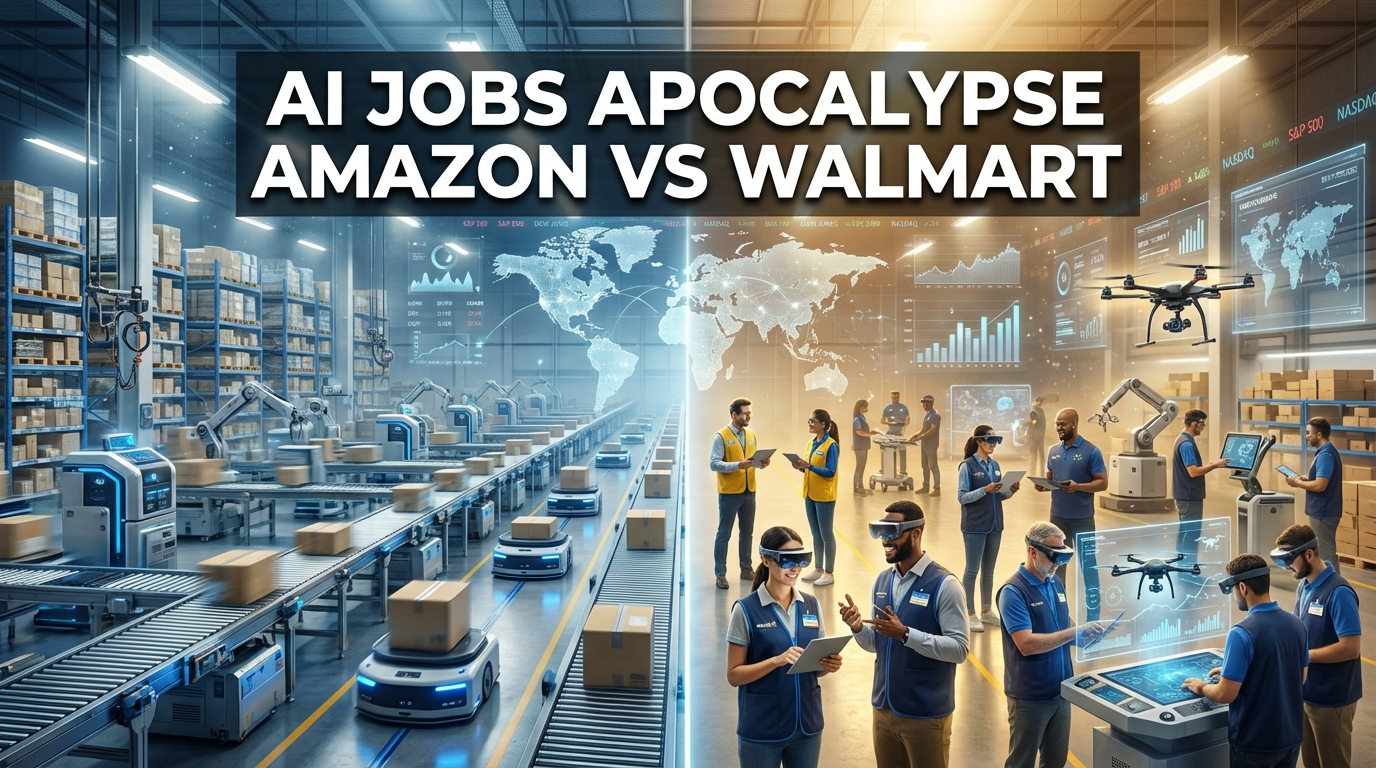
Amazon has actively pursued automation with a plan to replace a total of 600,000 workers with robots and AI systems by 2033. They have already deployed 1,000 robots at their Shreveport, Louisiana, distribution center, reducing the existing workforce by 25% and setting a goal to cut it by up to 50% in the future. Such a drastic automation strategy, aiming for a 75% reduction in the total workforce, raises concerns about mass layoffs and expected impacts on the economy and job market. While Amazon mentions “new robot managers” as future jobs, an automation-centered approach signifies the rapid disappearance of traditional jobs.
3. Walmart’s AI Adoption and Workforce Retraining Strategy
Despite adopting AI technology, Walmart has maintained its stance of not significantly reducing its workforce. The CEO of Walmart U.S. stated, “We plan to keep our employee level at current levels for the next three years,” interpreting the changes brought by AI as an “evolution of jobs.” Walmart has implemented the ‘A2T (Associate To Technician)’ program for existing employees performing simple tasks, establishing a training system to transition them into skilled workers such as drone technicians and robot managers. The company covers all costs and time associated with this training process, helping employees adapt to the AI era and increase their added value.
4. Walmart’s Innovative Technology Adoption and Productivity Enhancement
To maximize operational efficiency, Walmart has showcased various innovative cases incorporating AI, AR, and RFID technologies.
- They have added real-time translation functionality to their mobile app, allowing immediate translation of voice and text in 44 languages to facilitate communication between frontline employees and customers.
- The generative AI assistant “Ask Sam” provides employees with quick answers to work-related questions, enhancing work efficiency.
- With an innovative inventory management system, they introduced the AR-based app ‘VizPick,’ enabling rapid identification and replenishment of millions of inventory items.
- The introduction of AI interview coaches has integrated new AI technologies into the employee promotion and hiring processes, leading the way in talent development.
5. Key Points Not Previously Highlighted and Economic Implications
The cases of Amazon and Walmart suggest the economic potential that the adoption of AI and automation can lead to the evolution of jobs rather than mere job displacement. Walmart’s strategy shows that the AI era’s job restructuring does not necessarily correlate with mass layoffs, but rather promotes retraining and job transitions. This transformation reflects the trends of automation and AI in the context of the Fourth Industrial Revolution and the economy as a whole, hinting that ‘talent leveraging AI’ will become a key competitive advantage for companies in the long run. Notably, Walmart’s initiatives for AI training and redeployment programs are receiving attention as innovative attempts that simultaneously consider economic and job stability, illustrating how new job creation and productivity enhancement can drive balanced economic development.
< Summary >Amazon presents a model of mass reduction of traditional jobs through automation strategies involving AI and robotics, foreshadowing a significant impact on the overall economy. In contrast, Walmart aims to protect its existing workforce while promoting job evolution through retraining and job transitions despite the introduction of AI. The contrasting strategies of the two companies demonstrate that advancements in AI and the Fourth Industrial Revolution can lead to a reorganization of the economy and job market through changes in technology and work methods rather than simply resulting in mass layoffs. This article analyzes the latest trends and future strategies in the retail industry based on key SEO keywords such as AI, automation, jobs, economy, and robotics.
[Related articles…]AI Industry Outlook
Walmart Innovation Strategy
*Source: [ 티타임즈TV ]
– AI 때문에 해고하는 아마존, 가르쳐서 고용하는 월마트
● Wipes Addiction Sparks Health Crisis, Smart Laundry Revolutionizes Hygiene
The Economic Impact of Hygiene Management and Laundry Technology Innovations Seen Through the Obsession with Wet Wipes – Innovations in Daily Life Where Global Economy Meets Fourth Industrial Revolution and Artificial Intelligence
This article explores the hidden issues surrounding the use of wet wipes and laundry habits that many people overlook, and examines how our hygiene management methods in daily life are influencing the economy and the Fourth Industrial Revolution in an era of digital transformation and advancements in artificial intelligence.
Focusing on key themes such as global economy, digital transformation, artificial intelligence, technological innovation, and the Fourth Industrial Revolution, we will systematically analyze the changes manifested in household laundry practices.
The following sections will convey important insights from experts and chemists regarding the latest laundry trends, the importance of detergent expiration dates, the efficiency decline of drum washing machines, and the incorrect usage of wet wipes that are not covered by other news outlets.
1. Problems and Status of Laundry and Hygiene Habits
Experts warn that the obsession with wet wipes can lead to health issues such as dermatitis and bacterial growth, going beyond simple hygiene management.
Incorrect laundry habits, such as using excessive detergent or insufficient water in drum washing machines leading to weakened cleaning power, often occur in daily life.
Moreover, it is noteworthy that expired detergents can lose their chemical stability, diminishing their washing effectiveness and exacerbating issues related to microplastics and environmental pollution.
2. Innovations in Laundry Technology Utilizing Digital Transformation and AI
Recently, washing machine manufacturers have introduced smart washing machines that integrate artificial intelligence (AI) and IoT technology, which automatically adjust the optimal amount of detergent, temperature, and drying conditions.
These technological innovations maximize washing efficiency and help resolve the issues related to detergent residues caused by overuse, thus contributing to healthier hygiene management.
As we enter the digital transformation era, consumers are increasingly focusing on ‘smart laundry’ solutions that consider both environmental protection and cost-effectiveness, going beyond simple washing functions.
3. The Connection Between Global Economy and Changes in Lifestyle
The growing interest in hygiene management in daily life aligns with the changes in consumer patterns across the global economy.
Modern individuals, who prioritize eco-friendly consumption and cost savings, are transitioning to rational detergent usage and smart washing machines, contributing to the increased economic value resulting from technological innovations.
Additionally, as key technologies of the Fourth Industrial Revolution are directly applied to solving everyday problems, this presents an opportunity to reassess and improve outdated habits.
4. Core Facts Not Mentioned in Other News
One important fact that many news outlets do not mention is the significance of detergent expiration dates and appropriate usage amounts.
Expired detergents undergo chemical separation, leading to not only reduced cleaning power but also promoting bacterial growth on fabrics due to leftover detergent residues.
Furthermore, physical washing effectiveness can decrease with drum washing machines, making adherence to the prescribed amount of detergent and washing temperature essential for health and environmental protection.
Lastly, insufficient cleaning and drying management inside washing machines can lead to microbial growth and the emission of microplastics from unseen areas, necessitating thorough management.
Such changes and innovations in laundry management are significantly contributing to sustainable consumption and technological advancements in the global economy, increasingly becoming entrenched in our lives alongside the waves of artificial intelligence and digital transformation.
[Related Articles…]
• Latest Global Economic Outlook
• Analysis of AI Innovation Trends
*Source: [ 지식인사이드 ]
– 유독 물티슈에 집착하는 사람들에게 나타나는 공통적인 현상ㅣ의사들의 수다 EP.41
● AI Revolution Sparks Global Economic Disruption
How Google’s and OpenAGI’s Sudden AI Innovations Are Leading the Global Economy and the Fourth Industrial Revolution?
1. Google Titans and MIRAS: The Future of Large Context and Continuous Learning
The Titans system announced by Google to overcome the limitations of AI is an innovative approach that can have a significant impact on economic prospects and corporate digital transformation beyond a simple technological upgrade.
This system utilizes both short-term and long-term memory simultaneously to handle large-scale context with millions of tokens, and it has the ability to learn while in use.
In particular, it has shown dramatic performance in long sequence benchmarks, surpassing existing models such as GPT-4, Gemeni, and Llama.
These technological advancements are expected to serve as key competitive advantages in the latest technology and AI trends, global economy, and the Fourth Industrial Revolution.
2. Lux: The Practicality and Economic Impact of AI Demonstrated in Real Computer Usage Environments
The Lux model launched by the OpenAGI Foundation goes beyond simply understanding text; it recognizes the UI in real desktop environments and can handle clicks, scrolling, and keystrokes as a capable agent.
In the online Mind 2 web benchmark, Lux demonstrated performance that exceeded competing models, showcasing efficiency in real usage environments.
This represents an innovation that can achieve both operational automation and cost reduction for companies, potentially playing a significant role in the global economy.
In particular, it is expected to establish itself as a key technology in the Fourth Industrial Revolution and lead AI trends.
3. Nano Banana 2 Flash: Strategic Evolution of Cost Efficiency and Mass Image Generation
Google’s Nano Banana 2 Flash is a model that provides high-performance images while significantly lowering operational costs.
It offers performance similar to premium professional models while being suitable for users who need to generate images at high frequency.
From an economic perspective, this type of low-cost, high-efficiency model will assist many companies in adopting AI technology on a large scale, accelerating the commercialization of sustainable technology.
It is likely to be recognized as one of the key keywords in the global economy and AI trends.
4. AI-Based Headline Rewriting Experiment: The Impact on News Credibility and the Digital Economy
Google’s ongoing AI-based headline rewriting experiment has raised concerns about undermining the credibility of newsrooms and has sparked new debates in the digital new media ecosystem.
Cases of headline changes that contradict the actual article content have been reported, raising concerns about the potential distortion of information received by users.
These changes could have direct impacts on advertisers and content creators, emerging as complex social issues following global economic and technology trends.
5. The Explosive Growth of Gemini and OpenAI’s ‘Code Red’ Strategy
Recent data shows that Gemini is experiencing significant increases in monthly active users and time spent compared to ChatGPT.
In particular, the explosive growth in the Android environment and the increase in global downloads will play a crucial role in securing important market share in AI trends and the global economy.
Amid this competitive landscape, OpenAI’s development of the ‘Garlic’ model is expected to intensify competition in AI-related technologies.
This allows us to glimpse the evolving landscape of the AI ecosystem that is continuously changing in line with global technology competition and economic forecasts related to the Fourth Industrial Revolution.
6. Conclusion: The Future of Economy and Industry Brought by AI Innovations
Recent AI innovation cases such as Google’s Titans and MIRAS, OpenAGI’s Lux, and Nano Banana 2 Flash demonstrate the far-reaching effects on the global economy and the Fourth Industrial Revolution beyond mere technology upgrades.
Meeting the core SEO keywords of economic prospects, AI trends, global economy, latest technology, and the Fourth Industrial Revolution allows for an in-depth analysis of the technological advancements that will significantly impact both businesses and individuals moving forward.
The competition in AI technology and the rapid changes in the market will serve as critical variables for future business strategies and the economy as a whole, requiring ongoing attention and analysis.
[Related Articles…] The Connection Between Global Economic Outlook and AI Innovations | Reading the Latest Trends in the Fourth Industrial Revolution and AI
*Source: [ AI Revolution ]
– Google’s Titans Just Solved AI’s Biggest Weakness, But…