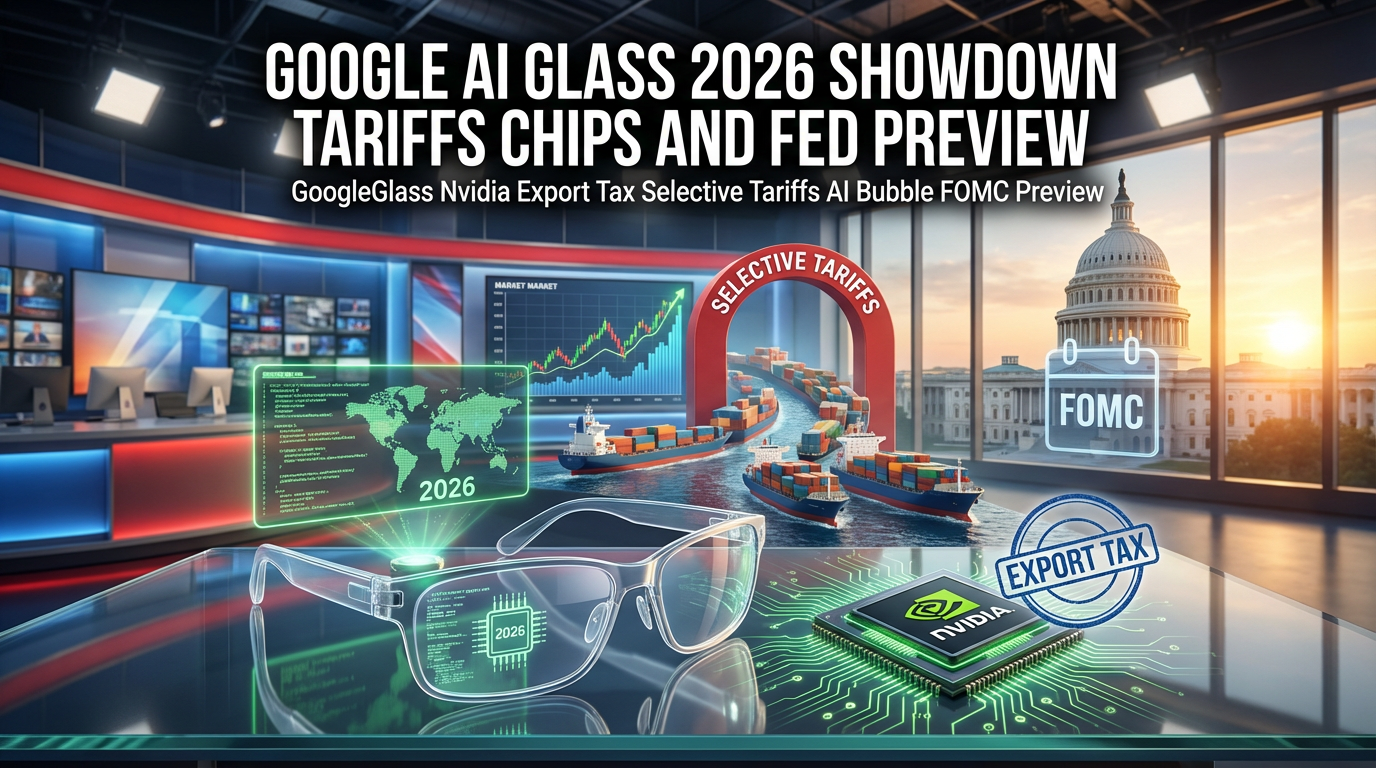
● Tariff Twist, Nvidia 25 percent Export Tax, AI Glass War Ignite Tech Shock
Today’s Checkpoint: Outline of Google’s AI Glasses Launch in 2026, Trump’s ‘Selective Tariff Reduction’ Signal, Nvidia’s Resealing of Export to China for Premium GPUs with a 25% Export Tax, Apple’s ‘AI Bubble Safe Haven’ Logic on the Rise, and a Wait-and-See Attitude Ahead of the FOMC
Market key points summarized for immediate use.
- Google officially prepares to launch lightweight AI glasses in 2026, entering a head-to-head battle with Meta.
- President Trump signals the possibility of selective tariff reductions on certain items, hinting at a recalibration of US–China supply chains and Big Tech earnings trajectories.
- Amid discussions of conditional resumption of sales for premium GPUs like Nvidia’s H200 to China, an unprecedented export tax structure—requiring 25% of sales revenue to be paid to the US—is being considered, potentially reshaping profitability and pricing strategies.
- Despite trailing in the race for large-scale AI investments, Apple’s role as an ‘AI bubble safe haven’ strengthens its defensive logic.
- With the FOMC (local time 12/10) imminent and data such as the JOLTS, dot plot, and guidance influencing the timing of rate cuts, the market is taking a wait-and-see approach.
- Bitcoin maintains its rebound momentum following reports of resumed institutional buying. This summary bundles the keywords: global economy, US equities, rate cuts, Big Tech, and cryptocurrencies.
Early Trading on the New York Stock Exchange: Mixed Performance Amid Caution, Regaining Composure Ahead of the FOMC
Indices started with mixed performance, later trading between slight decreases and increases.
Following the previous day’s decline in all three major indices and a rebound in Treasury yields that dampened investor sentiment, a wait-and-see mood prevails ahead of the FOMC, with more focus on the dot plot and Powell’s remarks than on confirmed rate cuts.
Key points.
- Themes are limited to individual material rotations.
- With positions being reduced and hedging demands increasing ahead of events, excessive directional bets are restrained.
Big Tech/Semiconductors: Nvidia—Double Signal with Conditional Resumption of Exports to China and a 25% Export Tax
According to reports, while limited sales of premium GPUs to China are expected to be allowed, a structure requiring 25% of sales revenue to be paid to the US is being discussed.
This is interpreted as a hybrid trade policy combining “conditional opening plus tax revenue recovery,” potentially seen as a compromise between technology control and inflation management.
Stock reactions remain muted, as the conservative stance and concerns over margin dilution and ASP adjustments are reflected simultaneously.
Key Implications.
- Margin impact: downward pressure on overall margins. However, some price pass-through may be attempted (toward data centers and AI services in China).
- Demand realignment: If legal channels open, the economics of smuggling or circumvention procurement diminish, thereby improving order visibility.
- Industry ripple effects: The precedent of a ‘strategic export tax’ may risk being established. If it expands to other advanced sectors (for example, advanced equipment and materials), pricing within the industry value chain may need to be restructured.
Investment Checklist.
- Nvidia: Monitor guidance language regarding the Chinese sales mix, unit prices, and margins.
- Taiwan/Korea supply chain: Check if legalization and transparency of order cycles lead to improved turnover.
- US stock market semiconductor indices: Reappraise premiums/discounts in light of policy volatility.
Apple: The Rise of the ‘AI Bubble Safe Haven’ Logic and the Solid Service Cash Cow
Market assessments are polarized.
- Critics argue that Apple is trailing in its in-house LLM/edge AI and that early XR evaluations were lukewarm.
- Conversely, the counterargument is that by lagging behind in the excessive AI CapEx competition, Apple is well-positioned to defend against a bubble burst, supported by strong iPhone sales, ecosystem integration, and service revenues generating robust cash flow.
Data Points (compiled from reports/analyst comments).
- CapEx for fiscal year 2025 is expected to increase only within a limited range, reducing the risk of overinvestment.
- The iPhone 16 series is showing solid sales, and service revenues are experiencing double-digit growth. The service segment, with higher margins compared to hardware, justifies a valuation premium.
- Concerns over personnel turnover are also being reinterpreted from a ‘generational shift’ perspective; during the AI transition, roles might be realigned to enhance speed and execution.
Investment Perspective.
- Positioned as a ‘quality defensive’ holding with visible cash flows and margins amid increased volatility in the AI bubble correction phase.
- Future triggers include on-device AI on iOS, service bundling, and enhanced cross-selling between hardware and services.
Google: Outline of the 2026 AI Glasses Launch—A Full-Blown Battle in Wearable AI with Meta
Through SEC filings and partner disclosures, Google’s roadmap for commercializing lightweight smart glasses in 2026 has been revealed.
Collaborations with hardware and design partners such as Wabi Parker and Gentle Monster aim to fuse ‘fashion + computing.’
A dual track appears likely, featuring both voice/visual recognition without a screen and a design incorporating a micro display within the screen.
Why it matters.
- The platform succeeding the smartphone: A ‘gaze-voice’ interface could redefine search, maps, translation, and shopping. Real-time conversion rates in advertising and commerce will change.
- Ecosystem competition: Google (with Android, Knowledge Graph, and ads) versus Meta (with its creators, social channels, and Ray-Ban collaborations) face off in terms of network effects.
- Supply chain opportunities: New investment cycles in optics (waveguides, microLEDs), ultra-low-power chips, frame manufacturing, battery and thermal management, among others.
Checkpoints.
- Price range, battery life, and privacy policies.
- The extent of openness regarding Google Apps and third-party SDKs.
- US/European regulatory guidelines on cameras and facial recognition.
Trade/Policy: Trump’s ‘Selective Tariff Reduction’ Flexibility—Balancing Supply Chain, Prices, and Growth
President Trump has mentioned the possibility of tariff adjustments on certain items to stabilize prices.
This is not a full-scale removal but a selective adjustment, maintaining public pressure while responding promptly to manage inflation and growth.
Market Impact.
- Inflation: Easing price pressures on certain intermediate and consumer goods could contribute to lower headline inflation.
- Growth: Reduced import costs may improve manufacturing and distribution margins and accelerate inventory turnover, positively impacting growth.
- Exchange rates/US equities: Expectations of moderated dollar strength could help revive appetite for risk assets, though this remains in a ‘waiting for news’ phase until specific items and timelines are confirmed.
FOMC Preview: High Rate Cut Expectations—The Key Lies in ‘Pace and Path’
Expectations of a slight rate cut at this meeting have been priced in, with the dot plot and Powell’s upcoming press conference on the future path serving as key focal points.
Powell is expected to reaffirm his “data-dependent” approach while emphasizing the balance among unemployment, growth, and service inflation.
Checklist.
- Dot plot: Whether the neutral rate (r*) is adjusted upward by the end of 2026.
- Tone of remarks: Frequency of terms like ‘patience’ and ‘confidence’ as well as mentions of the pace of QT.
- Short-term and long-term rates: Whether the term premium in the long segment widens, which directly influences US equity valuations.
Crypto: Resumption of Institutional Buying Reports—Improved Bitcoin Supply Dynamics
Reports indicate that some institutions have resumed buying with additional purchases worth $1 billion, reigniting price momentum.
Coupled with signals of easing by the Federal Reserve and the inflow of stable supply, the top-cap coins may see their duration premiums re-evaluated.
Note: A structural rally will depend on the entry of a spot ETF and the speed of on-chain liquidity recovery. A segmented approach emphasizing volatility management is advisable.
US Consumer Trivia: ‘Beverage Refill’ Policy Changes—Reshaping Profit Models Across Chains
Some major fast-food chains are adjusting their refill policies as they seek to optimize the balance between driving traffic and managing costs, theft, and congestion.
Refills have historically contributed to gross profit by increasing set meal selection, dwell times, and cross-selling rather than just boosting per-unit revenue.
These policy changes are connected to shifts in order mixes, turnover rates, and labor productivity, gradually impacting financial metrics such as margins and average customer spending.
Today’s Numbers & Calendar Briefing
- The October JOLTS release serves as a barometer for cooling labor demand. A slowdown in job postings is interpreted as easing wage pressures and a justification for rate cuts.
- FOMC (local time 12/10): Expect increased volatility in sequence with the issuance of the statement, the dot plot, and Powell’s Q&A. Post-event sector rebalancing should be anticipated.
Most Important Core Points Often Missed by Other YouTube/News Outlets
- Precedent Risk of Export Tax: The Nvidia case may set the stage for a ‘strategic export tax’ model. If it expands to semiconductors, equipment, batteries, and materials, the price-setting power in the global value chain might increasingly shift to governments and policymakers, with the period being re-evaluated not in terms of corporate margins but as a phase of ‘policy premium/discount.’
- AI Glasses and Real-Time Advertising ROI: The eye (gaze) + voice interface allows search queries to be tracked based on intent, enabling advertising and commerce conversion rates to be calculated on a visual field basis, as Google and Meta reconfigure revenue models to integrate multimodal real-space data. The focus should be on SDK and partner ecosystem lock-in rather than initial sales volume.
- Apple’s ‘Defensive Franchise’: As the risks of excessive AI investment grow, Apple’s robust service margins and lock-in effect serve as a relative safety net. In a bubble correction phase, strong cash generation and potential increases in subscription ARPU can function as defensive growth.
- Selective Tariff Reduction as an Inflation-Targeting Tool: By fine-tuning tariffs on categories with high CPI sensitivity, monetary policy (rate cuts) could be partly alleviated. This signals a transition to an era of ‘three-axis price management’ that combines monetary, fiscal, and trade policies.
Portfolio Execution Guide
- Core: High-quality cash flow (Big Tech with strong service margins), fractional allocation in US equity indices, and duration neutrality.
- Satellite: AI infrastructure (semiconductors, optics, low-power chips, micro-displays), supply chain for wearable AI, and policy beneficiaries (direct recipients of selective tariff cuts).
- Risk Management: Prepare for increased volatility immediately after the FOMC. For event-driven positions, reduce delta and increase cash exposure before re-entry.
- Crypto: Focus on spot exposure, prioritize stablecoins/Bitcoin, and avoid excessive leverage. An event-confirmation approach based on ETF inflows and on-chain liquidity is recommended.
< Summary >
- Key takeaway amid cautious sentiment: Until the FOMC, the variables of ‘pace and path’ remain crucial.
- Nvidia: The scenario of resuming exports to China along with a 25% export tax could reset margins, pricing, and demand trajectories.
- Apple: By taking a less aggressive role in the overblown AI race, its defensive growth and strong service margins justify a premium valuation.
- Google: The 2026 AI Glasses signal the start of the post-smartphone platform battle, ushering in a new cycle for the entire supply chain.
- Policy: Trump’s selective tariff reductions serve as an inflation-targeting tool, signaling the onset of an era combining monetary and trade policy measures.
- Crypto: Institutional buying reports and easing expectations are driving improved supply dynamics, although volatility management remains paramount.
[Related Articles…]
*Source: [ Maeil Business Newspaper ]
– 구글, 26년 AI글라스 출시 예고ㅣ트럼프 “일부 품목 관세 추가 인하 가능”ㅣ스트래티지, 비트코인 $10억 추가 매입ㅣ홍키자의 매일뉴욕