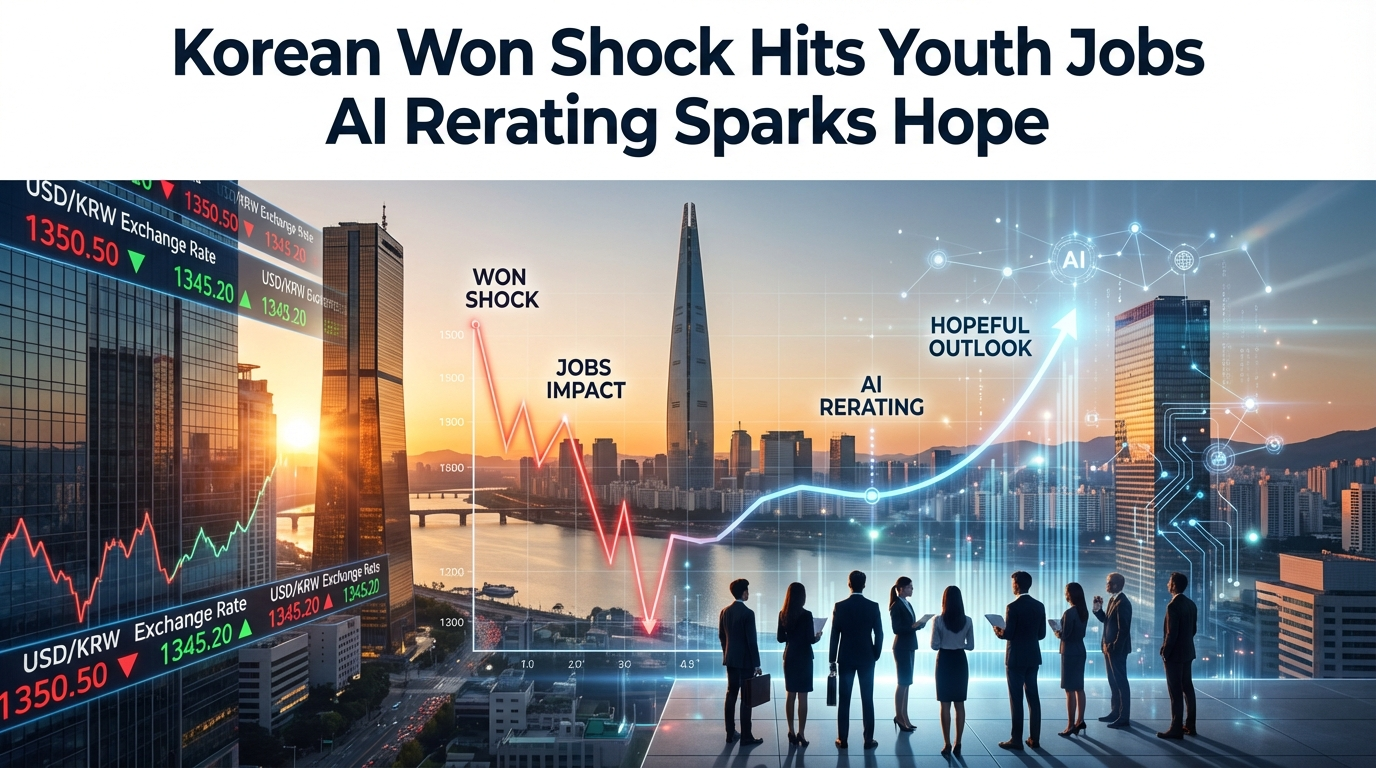
● Currency Shock, Youth Job Apocalypse, AI Destroys Career Ladder
The Most Dangerous Fault Line of High Exchange Rates: The Double Shock of Youth Employment Collapse and AI Acceleration
Key Points to Check Out in Today’s Article
The persistence of high exchange rates is leading to an investment slowdown → employment reduction → a sharp decline in youth recruitment, which has been organized into numbers and pathways.
It includes a point interpreting the surge in “not in labor force” youth labeled as “inactive” not as short-term unemployment but as a structural labor market exit.
It explains with examples how AI adoption initially destroys the career ladder for newcomers and why it benefits experienced workers.
Instead of lowering expectations, it specifically proposes a policy package that elevates job quality (wages, career trajectories, and investment in training).
It also compares the impact on the youth employment market under scenarios of a stabilized exchange rate at 1,350 KRW versus a rebound to 1,600 KRW.
It provides a checklist of survival strategies for businesses and youth from the perspective of key economic indicators: high exchange rates, economic downturn, inflation, interest rates, and the employment market.
Breaking News Summary
The USD/KRW exchange rate has stabilized in the 1,450 KRW range, while simultaneous declines in capital investment and recruitment are underway.
The number of youth “inactive” persons is at an all-time high, and the decline in employed youth is outpacing the decrease in the youth population.
The proportion of older and prime-aged workers in overall employment is increasing, while only the youth proportion is markedly shrinking.
The spread of AI adoption is replacing entry-level and supporting roles first, preventing the formation of a first career experience for new recruits.
The policy should shift from “lowering the bar” to “improving job quality” and “restoring the career ladder.”
The Essence of Worsening Youth Employment as Revealed by Data
Although the youth population (aged 15–29) is structurally declining, the drop in the proportion of employed youth is happening at a faster rate.
This indicates that the employment rate itself is weakening beyond just a population effect.
Statistics show an increase in the youth classified as “not in labor force” (as opposed to employed or unemployed), with a rapid rise in the “inactive” label among them.
While unemployment assumes active job seeking, the increase in “inactive” status is interpreted as a resignation from job searching and a withdrawal from the labor market.
The employment share of older and prime-aged workers is expanding, further intensifying the intergenerational employment imbalance where only the youth share is significantly shrinking.
The Ripple Effect of High Exchange Rates: Investment → Employment → Youth Recruitment
High exchange rates raise the cost of imported inputs and capital goods, thereby increasing equipment investment expenses.
At the same time, global inflation pressures and a high-interest-rate environment boost the borrowing costs for companies.
The subsequent investment slowdown leads to delays in new projects, with the first to be cut being the recruitment of new hires, interns, and juniors.
Exporters might see short-term performance improvements through exchange gains, but rising import costs for parts and raw materials, as well as a domestic economic downturn, put pressure on small and domestic companies.
As a result, the job market becomes bifurcated, systematically reducing youth recruitment opportunities.
AI Trends and Youth Employment: The Collapse of the Career Ladder
Generative AI and automation tools are replacing entry-level tasks such as research assistance, drafting, simple analysis, and test code writing first.
Skilled workers can leverage AI to boost productivity, experiencing a “leverage effect,” while young talent loses even the opportunity for initial work experience.
The reduction in new recruitments distorts the career ladder from intern → junior → mid-level → senior, leaving behind hysteresis (scarring of one’s career).
This structure is further intensified during periods of high exchange rates and economic downturns, reducing the rebound capacity of the youth employment market.
Policy Alternatives: Instead of Lowering Expectations, Let’s Enhance Job Quality
Linking recruitment with wage gap compensation: Provide temporary subsidies for 12–24 months to young workers in small to mid-sized companies to cushion the wage gap with large corporations.
Learning-investment employment incentives: If a company provides training in AI, data, and automation to new recruits, offer a package including a 50% subsidy of training costs plus reductions in social insurance contributions.
Restoring the career ladder: Increase conversion rates from internship → probation → permanent employment by offering phased tax credits and bonus points in public procurement.
Capital equipment investment credit: Apply accelerated depreciation and tax credits for hedge costs on exchange rate risks for the surge in costs of imported equipment and software due to high exchange rates.
Youth “Re-Entry” Program for the Inactive: Operate a 90-day track combining mentoring, on-the-job training, and short-term projects for those re-entering the job market after giving up on job seeking.
Cooperation in policies for exchange rate and interest rate stabilization: Accompany measures to reduce won volatility with liquidity backstops, expansion of currency swap lines, and fine-tuning of macroprudential rules.
Survival Strategies for Businesses and Youth
For companies: Expedite hedging against exchange rate risks, inventory optimization, and renegotiation of dollar-denominated payment terms to defend short-term cash flow.
Prioritize investment not in replacing labor costs, but in an “AI stack that leverages juniors.”
Standardize an onboarding process that includes AI toolkit and data governance training for new hires to ensure early productivity.
For youth: Focus on building skills rather than just securing positions.
Develop a T-shaped competency by combining AI prompt engineering, data analysis, and automation scripting with your major domain.
Build evidence of your first career through global remote projects with an English CV, GitHub, and Notion portfolio.
Exchange Rate Scenarios: Stabilization at 1,350 KRW vs. a Rebound to 1,600 KRW
Scenario at 1,350 KRW: If import prices ease and interest rates stabilize downward, recovery in equipment investment and recruitment will quickly follow.
Youth recruitment will resume first, centered on interns and contract workers, with conversion rates being highly sensitive to policy incentives.
Scenario at 1,600 KRW: The shock to domestic margins and expanding risks of sequential restructuring will essentially freeze new youth recruitment.
The increase in “inactive” status will spread to older age groups, delaying both entry into society for those in their early 30s and their decisions regarding marriage, childbirth, and housing.
Key Points Not Found Elsewhere
The surge in “inactive” status should be seen not as a short-term economic variable but as a signal of “career hysteresis.”
A gap in practical experience during the first one to two years has long-term negative effects on wage trajectories and employment stability.
AI reduces the gateway to entry-level jobs more than the total number of jobs.
Therefore, even if overall employment statistics hold, the youth may experience even greater deterioration.
The true cost of high exchange rates is not just “delayed investment” but the cumulative decline in potential growth resulting from the collapse of the career ladder.
The collapse of youth employment not only directly impacts social insurance finances, such as national pension and health insurance, but also does so with a lag.
Risk Checklist (Quick Check)
Check if the growth rate of youth not in labor force (“inactive”) has risen for three consecutive months.
Confirm whether the job opening ratio and conversion rate (from intern to permanent) for ages 15–29 are deteriorating simultaneously.
Monitor the trends in capital goods import volumes and ICT equipment investments.
Observe the gap between the real effective exchange rate (REER) and the SME business activity index.
Watch changes in the number of job postings for edutech and recruitment platforms, and the share of junior recruitment.
Market Impact and Positioning
For large export companies, high exchange rates can be a short-term positive, but worsening domestic and SME employment indicators increase the beta for economic downturns.
Companies benefiting from AI automation, as well as those involved in reskilling and edutech, face structural demand, and HR tech firms are potential beneficiaries of conversion rate incentive policies.
From a bond market perspective, signals of easing inflation and the timing of interest rate pivots can serve as leading indicators of recovery in equipment investment.
Conclusion: Exchange Rate Stability + Job Quality Improvement + Restoration of the Career Ladder is the Answer
If high exchange rates persist, the most vulnerable part of the youth employment market will pay the price.
The solution lies in reducing exchange rate and interest rate volatility along with designing incentives that economically rationalize companies’ recruitment of new hires.
AI should not be a tool for exclusion, but rather one that multiplies the productivity of junior staff.
A combination of policies is needed that provides youth with evidence of their first career, companies with a return on new hire investment, and the nation with restored potential growth.
< Summary >
High exchange rates lead to reduced recruitment for new hires and juniors through a slowdown in equipment investment, resulting in a surge in the “inactive” youth population.
AI adoption replaces beginner roles first, thereby collapsing the career ladder, and youth may feel the negative effects even more despite overall employment numbers holding steady.
Policies should focus on enhancing job quality rather than lowering expectations, with key measures such as wage protection linked to recruitment, learning-investment incentives, and conversion rate rewards.
Under a 1,350 KRW stabilization scenario, recovery is driven by interns and conversion, whereas under a rebound to 1,600 KRW, new youth recruitment freezes and delays in social entry worsen.
Both companies and youth must secure AI capabilities and evidence of their initial career achievements as part of their strategies.
[Related Articles…]
The Impact of a Weak Won on Youth Employment: Latest Analysis
AI Automation and the Future of Jobs: 2026 Outlook
*Source: [ 경제 읽어주는 남자(김광석TV) ]
– “쉬었음 인구 역대 최대” 청년 일자리가 사라진다. 고환율이 만든 가장 위험한 단층선 | 클로즈업 – 고환율 장기화의 무서움 4편
● Land Gold Rush, PBR Shock
The Prelude to Asset Stock Re-Rating in 2026: Cheonil Express, Seoul Express Terminal, and the Moment of PBR Reversal
Key Points at a Glance: What You Should Capture from This Article
It breaks down, using numbers and structure, why the assets held by Cheonil Express, recorded at 30 billion KRW on the books, are re-evaluated by the market at over 2 trillion KRW.
It outlines how asset stocks’ share re-rating is triggered through the interplay of PBR, fair value accounting, and official land prices.
It estimates the valuation of the Seoul Express Terminal mixed-use development under conservative, base, and aggressive scenarios.
It realistically presents the accounting and tax triggers that the government could use when aiming for a KOSPI re-rating.
It organizes an investment checklist that captures investment opportunities where asset stocks and the AI trend meet in an environment of interest rates, exchange rates, and inflation.
Today’s News Briefing: Cheonil Express Soars 10-Fold—What Changed?
Let’s start with a summary of the event.
Following the news that the Seoul Metropolitan Government is pushing for the mixed-use development of the Seoul Express Terminal site, Cheonil Express’s share price surged nearly 10-fold in about two weeks.
Cheonil Express has held a stake of over 16% in the Seoul Express Terminal, and the book value of this stake was around 30 billion KRW.
Market participants re-evaluated the stake’s value, anticipating that the market value of the land and buildings after development could be dozens of times higher than the book value.
The key is that the gap between the book value (acquisition cost) and the market value (including the development potential) was wide, and the news served as a trigger to reflect this all at once.
The Pitfall of PBR and Book Value: Why 30 Billion KRW Looks Like 2 Trillion KRW
PBR is the ratio of market capitalization to book value.
Under the Korean International Financial Reporting Standards (K-IFRS), companies can choose between the cost model (acquisition cost) and the revaluation model (fair value) for land and buildings, but most companies opt for the cost model to avoid volatility and tax issues.
As a result, the book value of high-quality sites held for a long time becomes extremely low, and when a development catalyst emerges, the PBR drops sharply and the share price soars, triggering a ‘re-rating’.
The officially announced land price is an administrative price for tax purposes and is significantly different from the actual trading price; for companies using the cost model, the market price is not reflected in the books.
In asset stock investment, the PBR becomes effective when a ‘market price reflecting event’ becomes visible.
The Value of the Seoul Express Terminal: Organizing Numbers with Scenarios
Let’s break it down by steps based on the site, location, floor area ratio, and revenue model.
-
Assumption 1: Approximately 26,351 pyeong of the Gyeongbu Terminal side site.
-
Assumption 2: A mixed-use development including office, retail, hotel, and residential components, with a 60-story skyline.
Land price scenarios.
-
Conservative: Assuming 100 million KRW per pyeong → Land value of approximately 2.6 trillion KRW.
-
Base: Assuming 200 million KRW per pyeong → Land value of approximately 5.3 trillion KRW.
-
Aggressive: Assuming 300 million KRW per pyeong → Land value of approximately 7.9 to 8.0 trillion KRW.
Estimation after completion of assets and liabilities.
-
Total Asset Value (GDV): Approximately 15 to 20 trillion KRW range, reflecting premium for the hotel and office, and top-tier department store retail sales power.
-
Total Project Cost: About 6 to 8 trillion KRW range, including construction cost, financing cost, and development cost.
-
Post-completion Net Asset Value (NAV): Approximately 7 to 13 trillion KRW range.
Implications of equity value distribution.
Depending on the equity structure, NAV portions for shareholders such as Shinsegae and Cheonil Express become larger, and the logic of ‘re-rating by dozens of times over the book value’ holds.
Importantly, the smaller the market capitalization of a stock, the greater the impact of a similar NAV re-evaluation on the share price.
Policy Trigger: Accounting and Tax “Switches” that Can Drive a KOSPI Re-Rating
When extended to the entire market, there are two policy variables.
-
Expansion of fair value accounting: If the application of fair value to land and investment properties is encouraged, many companies’ PBRs would decline, and new funds would flow into the ‘low-PBR basket’ in the stock market.
-
Improvement and shortening of the official land price update cycle: As the official price becomes more reflective of reality, the conservative calculation of asset values naturally increases.
There are side effects and conflicts of interest.
Issues such as inheritance and gift taxes for major shareholders, double taxation, increased earnings volatility leading to changes in dividend policies must be managed.
Nonetheless, if the policy will is strong, these become significant cards to leverage a KOSPI re-rating.
Asset Stock Selection Checklist: An Investment Framework You Can Use Immediately
Summarized with seven practical questions.
-
Market-to-book gap: How large is the gap between the estimated actual trading value of held land and buildings and their book value?
-
Ownership structure: Whether directly holding vs. using the equity method or related companies, and details such as the shareholding ratio, preferred shares, and conversion rights.
-
Development visibility: Urban planning changes, the stages of obtaining permits, public-private partnerships, and the developer’s execution capability.
-
Financial soundness: Debt ratio, sensitivity to interest rates, interest coverage ratio, and risks from foreign currency debt in the event of exchange rate fluctuations.
-
Cash flow: The stability of current NOI and operating cash flow, dividend policy, and the sustainability of dividends.
-
Event calendar: The schedule of catalysts such as asset sales, joint developments (JV), REIT inclusion, divisions, or listings.
-
Governance: The speed of decision-making by owners/the board, conflicts of interest, and consistency in shareholder return policies.
Risk Check: Interest Rates, Exchange Rates, Inflation, and the Cycle
Interest Rates: High interest rates worsen the development economics and lower the NAV due to a higher discount rate.
Exchange Rates: A weakening won influences the inflow and outflow of foreign funds and may lead to increased costs for imported materials.
Inflation: Rising construction and labor costs pressure the GMP, but these can be partially offset by increased rates in the retail and hotel segments.
Regulation: Permitting risks such as floor area ratio, transportation impact assessments, environmental, and cultural heritage issues always result in certain delays.
Demand: Long-term profitability is determined by office vacancy rates, hotel RevPAR, and retail sales density.
Case Comparisons: What the Past Tells Us
Lotte Chilsung experienced a large-scale re-rating in the mid-2000s when asset and new business expectations converged.
Jungang Express previously confirmed trading prices dozens of times higher than book values when selling a portion of the Seoul Express Terminal stake.
The common point is that an ‘event’ allowed the price to be re-discovered by market value rather than book value, and the leverage of asset value relative to market capitalization was significant.
Connection with the AI Trend: The New Engine for Asset Stocks
Data Center Demand: The spread of AI increases the strategic value of sites in urban and metropolitan areas equipped with power, cooling, and network infrastructure.
Smart Buildings and Digital Twins: AI reduces energy and maintenance costs during design, construction, and operation stages, thereby improving NOI.
PropTech Value Chain: GIS, satellite, computer vision, and generative design tools accelerate the speed of development feasibility analysis.
REITs and Alternative Investments: In an environment of normalized interest rates, there is potential for global pension funds and insurance companies’ core-plus funds to flow into Korean commercial real estate.
In short, AI is not just a theme but a real driver that changes the revenue structure and valuation multiples of commercial real estate.
The Overlooked Key: The ‘Cash Generation Engine’ of the Terminal Mixed-Use Development
The hotel can price its rarity with a premium, as it offers a “Han River-Namsan double view”, providing high cycle resilience with elevated RevPAR.
The retail component, based on top-tier department store sales density nationwide, features a structure of base rent plus sales-linked fees that result in lower NOI volatility.
The office segment has a high probability of attaining prime rents as it supplies a 60-story new A-grade alternative in Gangnam’s core.
The residential section is sensitive to regulatory variables such as the cap on sales prices, but the multi-transfer hub at Gangnam Station (Lines 3, 7, and 9) and the view premium create scarce value.
Traffic congestion and demand absorption issues can be mitigated with phased development and public contribution packages, which are directly related to the negotiating power in obtaining permits.
Portfolio Strategy: An Action Plan to Prepare for 2026
Avoid thematic concentration and build a basket that is robust against the three variables of interest rates, exchange rates, and inflation.
-
Core: 40% asset stocks with stable dividends — companies with low PBR, low debt, and strong cash flows.
-
Option: 30% development re-rating — stocks with catalysts in the permitting stage.
-
Hedge: 20% AI infrastructure (data centers, power, cooling) — linked to real demand.
-
Risk Management: 10% cash and short-term bonds — in response to fluctuations in interest rates and exchange rates.
The key is to approach with an event-driven mindset while structuring a portfolio that absorbs cyclic fluctuations.
It is recommended to design with multiple small probabilities accumulating rather than a single all-in bet in the stock market.
Investment Checklist: Finishing with the Numbers
Screen asset stocks in the PBR range of 0.3 to 0.7 first, and then extract candidates with an estimated market-to-book gap of at least five times.
Set safety criteria with a debt ratio of 100~150% or less, an interest coverage ratio of 3 times or more, and a dividend yield of 3% or higher.
Prioritize checking whether a catalyst (sale, JV, permit, division) is expected within one year.
Reflect sensitivities to exchange rate and interest rate re-pricing timing in stress tests.
< Summary >
The surge in Cheonil Express is a typical re-rating case where the gap between book value and market value was resolved instantly by development news.
The land and development value of the Seoul Express Terminal can be estimated at 2.6 to 8 trillion KRW for the land and 7 to 13 trillion KRW for NAV depending on the scenario, and equity holders have significant potential for re-evaluation accompanied by a falling PBR.
The expansion of fair value accounting and the modernization of official land prices could act as policy triggers to drive a KOSPI re-rating.
In an environment of interest rates, exchange rates, and inflation, asset stocks can simultaneously aim for dividend/cash flow defense and event-driven excess returns.
The spread of AI enhances real estate income through increased demand for data centers and smart buildings, thereby driving a structural increase in the valuation multiples of asset stocks.
[Related Articles…]
KOSPI Re-Rating and Asset Stocks: Changes Triggered by Fair Value Accounting
AI Data Centers and Commercial Real Estate: Scenarios After Interest Rate Normalization
*Source: [ Jun’s economy lab ]
– 서울고속터미널 2조원 땅을 300억으로 속일 수 있었던 이유(ft.천일고속)
● Won Crashes, Gold Booms, Cash Reigns
KRW Weakness, Gold Price Rally, and a ‘Cash Reserve Strategy’ You Can Use Right Now: A Guide to Reading the Flows of Exchange Rates, Interest Rates, and the Dollar
The current article covers the true trigger of KRW weakness, an alternative asset that could potentially have a better yield than gold, specific methods to profit when cash is king, fact-checking on central banks’ gold purchases and debates over fiat currencies, and even how AI trends might alter exchange rates and inflation. Although the video was recorded as of December 4th, focus on the core framework that remains unchanged despite any timing differences.
Today’s Key Headlines
The structural background of KRW weakness is a result of the combination of interest rate spreads, dollar liquidity, the semiconductor cycle, and the effect linked to Japan’s low-yen policy.Central banks will continue to buy gold, but in an environment of low real interest rates and a strong dollar, volatility increases.In the short term, a cash reserve strategy is effective, and ultra-short-term bond roll-downs and currency-hedged dollar MMFs are cost-effective.The primary drivers for gold are real interest rates and the dollar.In the momentum phase after breaking the previous high, scaling into positions gradually is statistically superior.Expansion of AI data centers could reignite inflationary pressures as demand for electricity, copper, and silver rises.This in turn could disrupt the trajectories of exchange rates and interest rates, creating an asymmetric risk of economic recession.
Exchange Rate Alert: The Structural Background of KRW Weakness
Large interest rate spreads increase the pressure of foreign investors pulling funds from bonds, leading to a rise in exchange rates.The stronger the US real interest rates and the dollar index, the weaker the KRW becomes.Even if Korea’s trade balance improves, continuous low-yen in Japan slows the pace of KRW recovery due to competitive pricing pressures.The semiconductor industry’s performance determines the beta for the KRW.KRW strengthens when both shipment cycles and average selling prices improve.During seasons when dividend remittances surge, short-term demand for dollars in the forex market expands.Middle Eastern risks, shipping freight, and raw material prices add further weakness pressure through import-induced inflation.The key watching point is whether the trends in exchange rates, interest rates, and the dollar reverse simultaneously.
Gold Price Outlook and Alternative Ideas
Central banks have steadily bought gold to diversify their foreign exchange reserves and avoid sanction risks.This structural demand supports the gold price from the bottom.However, gold’s trajectory is most robust when falling real interest rates are accompanied by a weakening dollar.If gold ETF inflows resume, momentum chasing by both individuals and institutions can increase volatility.There are also tactical ideas that might outperform gold.Silver, benefiting from industrial demand and expanded power infrastructure for AI data centers, has a higher beta compared to gold.Copper is undergoing structural tightening due to the expansion of power grid and cooling infrastructure.Gold royalty and streaming companies combine the leverage of rising gold prices with cost defense.TIPS provide protection in phases of reaccelerating inflation.Ultra-short-duration US Treasury bonds are advantageous for minimizing losses on reserve funds.The entry timing can be simplified to three points:Purchase in installments when signals of a falling real interest rate emerge.Increase momentum-based exposure when a declining dollar index coincides with gold retesting previous highs.After short-term surges, re-enter positions in a 38.2% to 50% retracement.The main risks include prolonged tightening, a sudden strong dollar rally, large-scale redemptions of gold ETFs, and weakening physical demand from China.
When Cash is King: How to Profit
Reserve funds are conservatively managed using money market instruments and ultra-short-term bond roll-down strategies.Roll-down leverages the natural improvement in yield as the remaining maturity decreases.For KRW investors, currency-hedged dollar MMFs are a useful option.When hedge costs are high, using shorter maturity hedges reduces expenses.When the exchange rate remains above the 200-day moving average and volatility is high, increase the cash proportion to 30–50%.When chasing after breaking previous highs, execute purchases only gradually, and establish stop-loss and take-profit rules in advance.Rebalancing is carried out by shifting back risk assets when the dollar’s strength weakens.
Central Banks and Fiat Currencies: Exaggeration and Fact-Checking
The narrative of “the end of fiat currencies” is exaggerated.In reality, diversification of reserve assets is underway, involving adjustments in the proportions of gold, dollars, and some yuan and euros.While CBDCs are being introduced by more countries, their focus is on improving payment efficiency rather than replacing bank deposits.Gold reinforces its role as a trusted asset and means of evading sanctions, but it does not immediately replace fiat currencies.The key is that inflation, fiscal deficits, and geopolitical factors are re-evaluating the trust premium.Thus, maintaining a balanced portfolio of dollars, gold, high-grade bonds, and real assets is crucial.
Key Points Not Often Mentioned by Other YouTube Channels
The real key for the KRW lies in semiconductor performance and electricity rates.If the competition for attracting AI data centers intensifies, investments in power grids and semiconductor capital expenditures could strengthen the fundamentals of the KRW.The often-overlooked demand for gold stems from emerging market gold import restrictions and diversified regional payment settlements.As oil transactions using the yuan increase, oil-producing countries may increase their gold purchases, stimulating hedging demand.A secondary effect of a rapid rise in exchange rates is the re-ignition of import-induced inflation and the dilemma in monetary policy.If prices rise, the delay in cutting interest rates increases, thickening the tail risk of a recession.Tactical trading tips include recognizing that exchange rate volatility tends to surge for 1–2 weeks right after the Fed’s dot plot release and during the Korean options expiry week.The gold–silver spread can also serve as a leading indicator for the interest rate path, making regular monitoring effective.
Checklist by the Numbers
Gold’s alpha increases when the DXY falls below its 200-day moving average and the US 10-year real interest rate drops by more than 0.5 percentage points.If the USD/KRW is more than 3% above its 120-day line and the 20-day historical volatility exceeds 10%, enter risk management mode.If Korea’s export YoY turns positive for three consecutive months, predominantly driven by semiconductors, a KRW strength bet is favorable.When an increase in the semiconductor weight in the KOSPI accompanies a decline in exchange rates, it signals simultaneous foreign inflows into both cash and futures.During periods when the CFTC’s net long positions on gold are overheated, refrain from chasing and wait for a retracement.
Scenarios and Portfolio Guide
In the event of a prolonged dollar rally, consider a defensive allocation such as 40% cash, 15% gold and silver, 25% short-term bonds, and 20% equities.In a scenario of gradual dollar weakness, an allocation of 20% gold and silver, 10% copper and energy, 45% equities, 15% short-term bonds, and 10% cash is reasonable.In the event of a volatility shock, reduce positions rapidly with over 50% in cash for hedging purposes, around 20% in gold, and 30% in ultra-short-term bonds.Each allocation can be adjusted by about 10 percentage points according to individual risk tolerance and investment horizon.
AI Trends Shaking up the Macro Environment
The expansion of AI data centers is expected to precipitate a surge in power demand, which can spread to increased demand for copper, silver, and cooling equipment, thereby triggering inflation.Rising electricity rates will increase manufacturing costs, enhancing sensitivity to exchange rates.Ultimately, this mechanism slows the pace of interest rate cuts and heightens dollar volatility.Investment ideas include power grids, transformers, copper and silver, high-efficiency cooling systems, AI semiconductor supply chains, and uranium and gas infrastructure.Practical tips for forecasting exchange rates and gold using AI involve combining alternative data and LLM-based news sentiment scores to generate real-time signals.A mix of GPUs, high-frequency data, and open-source time series models can be used to manage short-term volatility.Tokenized gold improves payment and storage efficiency, but it is essential to verify custodial risks and on-chain/off-chain matching.
Practical Preparation Checklist
Ensure liquidity in both KRW and USD in your trading accounts, and set up currency hedging measures in advance.Diversify your gold holdings across physical, trust, ETF, and royalty companies.Establish discipline for cash reserves through staggered maturities and automatic transfers.Set stop-loss and take-profit rules based on both percentages and time criteria.Use an economic calendar along with Fed events and Korean options expiries to adjust position sizing.Do not exceed 1.5 times the average volatility when using leverage.
Risk Notice and References
The contents provided here are for educational purposes, and individual investors are responsible for their own decisions.Be sure to consider transaction costs, taxes, and hedging expenses.As the video was recorded on December 4th, note that prices and indicators may vary with updated data.
< Summary >
KRW weakness is the result of a convergence of interest rate spreads, a strong dollar, the semiconductor cycle, and Japan’s low-yen policy.Gold is structurally supported by central bank purchases and its role as a trusted asset, though its direction is driven by real interest rates and the dollar.In the short term, cash reserve strategies and ultra-short-term bonds/currency-hedged MMFs are effective.Silver and copper, gold royalty companies, and TIPS, with a higher beta than gold, can serve as tactical alternatives.The expansion of AI data centers boosts demand for electricity and raw materials, altering the paths of inflation, exchange rates, and interest rates.Prepare for volatility by employing incremental approaches and adhering to risk management rules.
[Related Articles…]
- The Hidden Correlation Between Korean Exchange Rate Fluctuations and the Semiconductor Cycle
- The Impact of AI Data Centers on Interest Rates, Electricity, and Commodity Markets
*Source: [ 달란트투자 ]
– “환율 초비상” 원화가 녹아내린다. 당장 금 이만큼만 사라 | 조규원 대표 2부