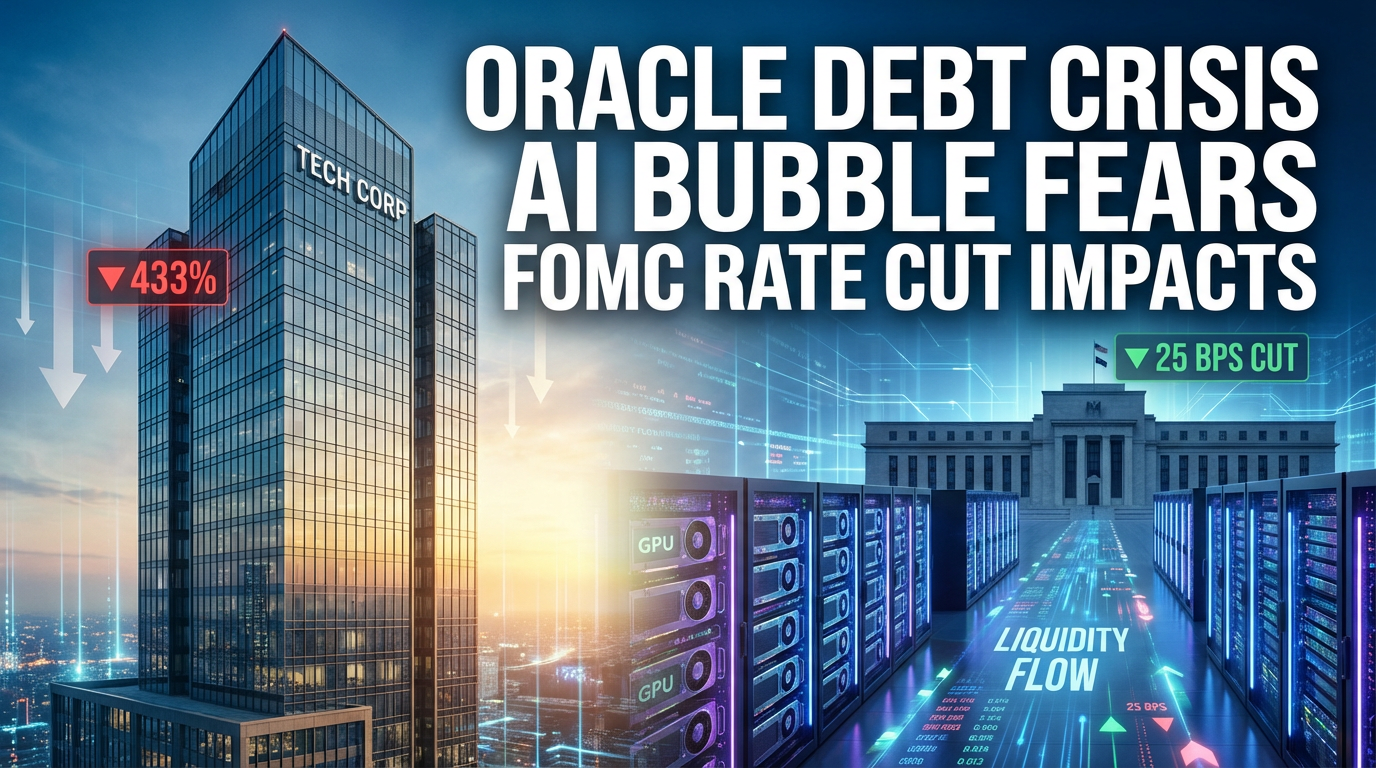
● Oracle’s Debt Crisis, AI Bubble Fears, FOMC Rate Cut Impacts
Digging into Oracle’s Poor Performance, FOMC Policies, and the Huge Debt Problem Faced in the AI Investment Era
[Summary of Key News]
This very important article deeply analyzes Oracle’s recent poor performance, excessive debt ratio (433%), concerns regarding AI investments, and the impact of the FOMC’s interest rate cuts and quantitative easing policies on the market. The best SEO keywords related to economy, AI, investment, data centers, and debt are naturally embedded. This article discusses a specific analysis of Oracle’s performance, the market’s concerns about the potential AI bubble, the expansion of data center infrastructure, and future investment strategies. Through the contents below, you can discover hidden truths and key points that are not well covered by other media.
Oracle’s Performance Analysis – Revenue, Earnings Per Share, and One-Time Revenues
Revenue was $16.1 billion, falling short of Wall Street’s estimate of $16.3 billion, with poor performance in the cloud, infrastructure, and software sectors. In particular, the software sector underperformed expectations, and cloud revenue also came in slightly lower. Earnings per share exceeded the estimated $1.64, reaching $2.26; however, a significant portion of this profit was attributable to one-time events such as the sale of Ampere, highlighting that these were not revenues generated from normal operations. As a result of these outcomes, the stock plummeted, and concerns about the AI bubble have resurfaced in the market.
Excessive Debt and Leverage as an Investment Tool
Oracle’s debt ratio is at 433%, indicating a dangerous level where liabilities approach six times assets. Following the recent issuance of $18 billion in bonds, a plan was announced to issue an additional $20 billion to $30 billion in bonds annually for the next three years. Investor anxiety has increased during this process, with the risk premium (similar to insurance premiums) rising to 120 basis points, prompting caution among investors. However, thanks to the strong leadership of CEO and founder Larry Ellison, Oracle aims to generate long-term profits in the AI and data center sectors through aggressive leverage and investment strategies. Economic and investment experts analyze that this leverage strategy, despite its short-term risks, could open up long-term growth potential through AI and data center infrastructure expansion.
AI Investment and Data Center Expansion – The Key to Future Infrastructure
The data center and AI sectors are currently very hot investment areas, backed by a global shortage of GPUs and rapidly increasing demand for computing power. Oracle’s GPU rental business and its hybrid strategy of on-premises and cloud services are seen as strong differentiators from competitors. In particular, Oracle’s push for private AI and multi-cloud strategies provides unique merits in terms of technological competition and security. Additionally, the Federal Reserve’s quantitative easing, 25 basis point interest rate cut, and large-scale Treasury purchases are expected to provide more liquidity for data center and AI investments, positively contributing to long-term market stabilization and economic activation.
FOMC Policies and Interest Rate Cuts – A Turning Point for Investment Strategies
The FOMC implemented a 25 basis point cut, simultaneously displaying a dovish stance despite hawkish rhetoric. Ending quantitative tightening and embarking on Treasury purchases for quantitative easing is expected to inject cash into the economy at a scale of KRW 50 trillion per month, indicating the need to devise investment strategies focusing on small-cap stocks and stability. Investors should be cautious about excessive debt and short-term volatility while simultaneously seizing long-term opportunities in data center and AI infrastructure expansion. Economic and investment experts believe that these changes in monetary policy will have positive ripple effects throughout the future economy.
Future Outlook – Between Risks and Opportunities
In the case of Oracle, there is substantial growth potential through advancements in AI technology and the expansion of data center infrastructure, but concerns regarding debt risks and the potential for an AI bubble persist. Amid increasing competition and volatility in the global financial market, investors need to manage risks carefully through incremental buying strategies and maintaining a high cash position (at least 20%). From a long-term perspective, infrastructure investments from governments and major corporations, along with support from the Federal Reserve’s policies, will create new opportunities in the AI and data center sectors, highlighting that appropriate investment strategies will be a crucial keyword in this market situation.
< Summary >
Oracle’s performance is falling short of market expectations due to poor revenue and one-time earnings per share improvements. Excessive debt (433%) and planned future bond issuances pose investment risks, alongside significant concerns about the AI bubble and increasing competition. At the same time, the expansion of data center infrastructure and cloud/private AI strategies are expected to serve as long-term growth drivers. The FOMC’s 25 basis point interest rate cut and quantitative easing policies signal positive support for liquidity, as well as opportunities in small-cap investing across the financial market. Economy, AI, investment, data centers, and debt are analyzed as key themes, requiring investors to focus on risk management and long-term strategy development.
[Related articles…]Trends and Key Issues in AI InvestmentGlobal Economic Outlook and Investment Strategy Analysis
*Source: [ 월텍남 – 월스트리트 테크남 ]
– 폭락하는 AI.. 부채비율 400%속 숨겨진 진실..● AI Revolution, Career Overhaul, Project-Based Future
Organizational Innovation and Project-Based Career Strategies in the AI Era – Key Analysis of Economic Outlook, AI Trends, Global Economy, and Innovation in the 4th Industrial Revolution
1. A New Paradigm of AI and Humans, and Task Segmentation
In the age of AI, innovation is needed to reposition the roles of humans and AI not by traditional job units, but by each task.
Particularly, considering economic outlook and global economic trends, it is evident that AI trends are redefining organizational and individual career design beyond merely being simple tools.
Experts say that we must distinguish between repetitive, data-driven tasks that AI can handle and creative problem-solving, face-to-face interactions, and emotional elements that only humans can perform.
This is emerging as a key strategy to achieve innovation in the wave of the 4th Industrial Revolution.
2. Redesigning Project-Based Careers and Experiences
For fresh graduates and those in the early stages of their careers, accumulating project-based experience has become more important than traditional job roles or organizational affiliations.
Recent AI trends suggest that career structures, which were previously bound to single job roles, should be flexibly and diverse, thereby simultaneously enhancing the individual’s brand and expertise.
Economic outlook experts recommend that both companies and individuals should build problem-solving narratives through systematic project experiences to expand their competencies in line with changing market environments.
The career narratives created through projects will serve as unique competitive strengths that AI cannot simply replace.
3. Human Perspective and Taste – The Power to Overcome AI’s Limitations
As AI rapidly processes information and reproduces knowledge and data, the human ‘taste’ and judgment are becoming increasingly important competitive elements.
In the context of economic outlook and the flow of the 4th Industrial Revolution, choosing among the numerous options provided by AI, pausing to reflect, and establishing one’s own standards are key.
This goes beyond mere technology utilization and connects to innovative thinking and creativity, directly correlating to cultivating a good questioning culture within organizations.
Ultimately, the competitiveness in economies and the global economy stems not from the instrumental use of AI but from the inherent human senses and creativity.
4. Redefining Organizational Culture Innovation and the Role of Middle Managers
While the introduction of AI technology has significantly improved work efficiency, the role of middle managers within organizations must be redefined compared to the past.
Companies need to implement AI to facilitate quick task completion while enhancing the storytelling narrative regarding why and with what purpose employees are working.
Economic outlook experts analyze that along with structural changes in organizations, the role of middle managers in managing human employees to recognize AI not merely as a support tool but as a collaborative partner has become increasingly important.
Improving internal communication methods and questioning culture within organizations is emerging as a new innovation factor beyond existing hierarchical orders.
5. AI Literacy and Personal Strategies for Preparing for the Future
In an era of living alongside AI, individuals must cultivate AI literacy and strategically organize their careers and projects.
Fresh graduates should focus on developing the ability to create new values through problem-solving experiences rather than simply filling job roles.
In an environment where global economies and innovations are rapidly changing, redesigning one’s career in line with AI trends is key to survival and progress.
Such strategies will play a significant role in balancing innovation and economic outlook, which are the core driving forces of the 4th Industrial Revolution, while shaping individuals’ differentiated competitiveness.
In the AI era, innovations are underway to reposition tasks into segmented units rather than traditional job roles.
Fresh graduates must reassess their careers through project-based experiences, while unique human perspectives and creativity emerge as core competencies beyond the instrumental use of AI.
Additionally, redefining organizational culture and the role of middle managers alleviates anxieties related to the introduction of AI, and through AI literacy and strategic career planning, we must drive innovation in the global economy and the era of the 4th Industrial Revolution.
[Related Articles…] • AI and Organizational Innovation: New Paradigms of Future Organizations | • Global Economic Outlook: Changes in the Era of the 4th Industrial Revolution
*Source: [ 티타임즈TV ]
– “사회 초년생, 뭐부터 해야 하죠?” AI시대 커리어 전략은? (성소라 교수)
● Broadcom and Nvidia Battle for AI Semiconductor Supremacy
Broadcom’s UA Link vs. NVIDIA’s MV Fusion: Innovations and Economic Outlook in AI Semiconductor Connectivity Technology
Key News Summary
Today’s article provides a detailed analysis of how Broadcom’s UA Link technology and NVIDIA’s MV Fusion and Spectrum X technologies are changing industry trends through ultra-fast data communication between AI semiconductors.
The copper cable connectivity technology within data centers is opening a new chapter in AI model computations, and as big tech companies adopt this, AI innovation is accelerating.
The competition between NVIDIA and Broadcom will impact economic forecasts and the technological advancements of the Fourth Industrial Revolution, providing significant insights into GDP and global economic trends.
Ultra-Fast AI Semiconductor Connectivity Technology in Data Centers
Thanks to communication technology that rapidly exchanges data computed by each semiconductor via copper cables, multiple AI semiconductors can operate like a single massive entity.
This capability makes it possible to perform efficient computations even amid a surge in AI model parameters, leading to a dramatic increase in the overall computational capacity of data centers.
In the future economic environment hinted at by key SEO keywords such as GDP, economic outlook, industry trends, AI innovation, and technological advancement, this technology will play a particularly important role.
Broadcom’s UA Link Technology
Broadcom’s UA Link technology supports connectivity between its own AI semiconductors and those from other manufacturers, providing scalability.
Big tech companies like AWS, Google, and Meta are benefiting significantly as they reduce their reliance on NVIDIA and develop their own AI semiconductors.
Even if the performance of individual AI semiconductors is lower, this strategy allows overall performance to be supplemented through efficient communication technology, presenting new directions for global economic outlook and Fourth Industrial Revolution innovation.
NVIDIA’s MV Fusion and Spectrum X Technology
In response to Broadcom’s advances, NVIDIA has unveiled its MV Fusion communication technology to enhance compatibility with third-party AI semiconductors.
Additionally, the launch of Spectrum X technology allows different data centers to be interconnected, enabling AI model computations.
This shift towards a more open AI semiconductor ecosystem, previously closed, is expected to accelerate the pace of technological advancement and positively impact economic outlooks.
The Impact of Technological Innovation on the Economy and Industry
The innovation of communication technology connecting AI semiconductors will lead to significant changes not only in technological advancements but also in the global economy and GDP growth.
The moves of big tech companies to establish independent AI semiconductor ecosystems will introduce new variables to industry trends,
and influence investment strategies in economic outlooks and technological advancements.
As the Fourth Industrial Revolution and AI innovation become more sophisticated, this technological competition will create significant economic news across industries.
[Related Articles…]
Analysis of Broadcom’s Micro Strategy
NVIDIA’s Future Technology Outlook
*Source: [ 티타임즈TV ]
– 엔비디아 위협하는 브로드컴의 전략 #shorts