● Oracle Shock Triggers AI Panic, Capex Collapse Looms
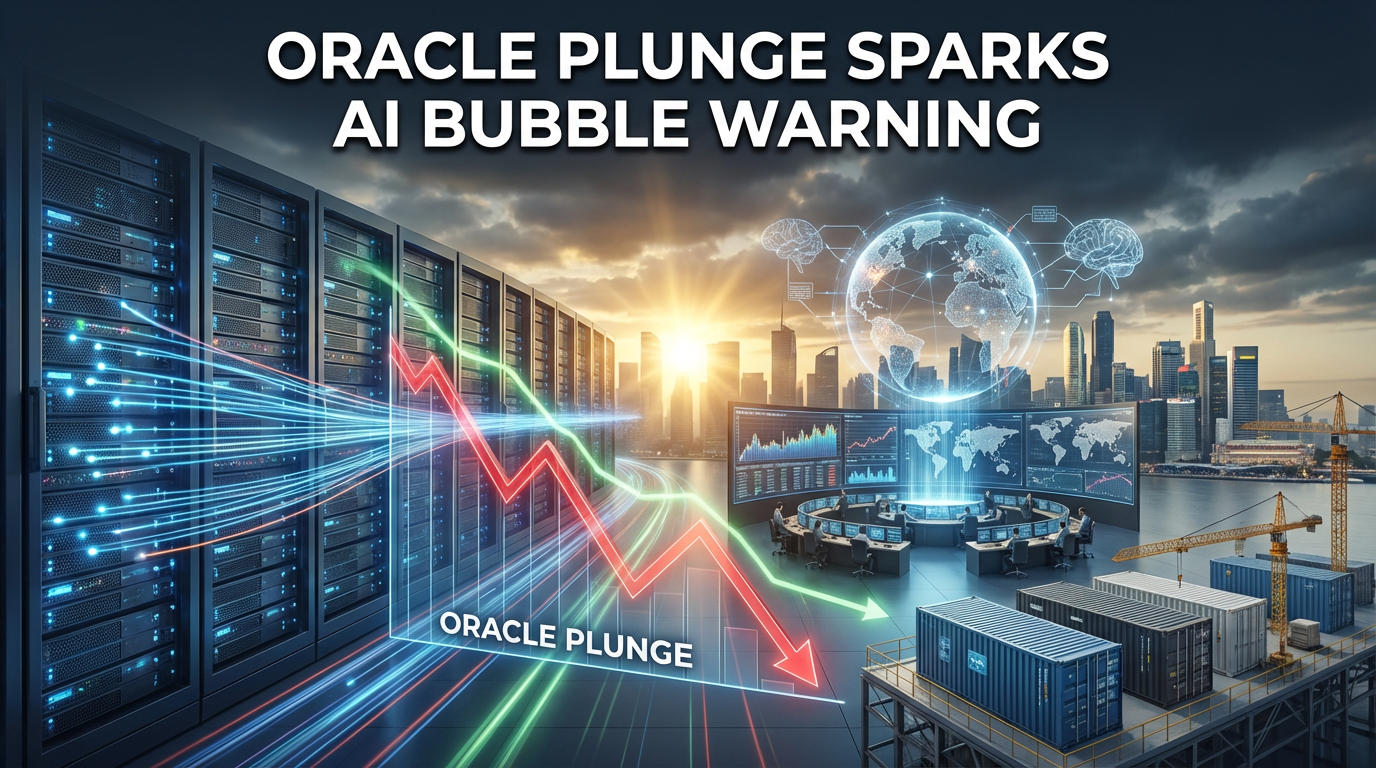
After the Oracle Shock, an AI Bubble? 5 “Real Signals” to Watch Right Now and the Reality of Space Data Centers
Today’s article covers 1) whether Oracle’s earnings shock signals the collapse of the AI bubble, 2) how to interpret the CDS surge in numbers, 3) to what extent the risk of OpenAI contract fulfillment is transmitted, 4) why the deceleration of big tech Capex is a “real systemic risk,” and 5) the structural changes that Google’s and Planet Labs’ space data centers will bring.
It summarizes the volatility of tech stocks in the context of global economic trends, interest rates, inflation, and recession risks—all on one screen.
Quickly understand with a news summary format, and we separately highlight key points that are rarely covered elsewhere.
Today’s Briefing: AI Flagship Stocks Weaken Together, Oracle’s Plunge Shakes Sentiment
The Nasdaq index declined slightly, but the impact felt much larger.
AI flagship stocks such as Nvidia, Broadcom, AMD, and Micron fell together, and Oracle experienced a double-digit plunge due to disappointing earnings.
Oracle’s performance report released right after the FOMC fell short of expectations, psychologically heightening fears over an overheated AI cycle.
Key Point of Oracle’s Earnings: The Cost Structure of ‘AI-Specialized Cloud’ is Revealed
Oracle has transitioned from a traditional database company to an AI-specialized cloud (dubbed Neocloud), but its cost structure has a heavy burden of depreciation due to high proportions of expensive equipment like GPUs, high-performance servers, and storage.
Instead of owning land (property), it purchases or leases equipment, software, and network assets directly within data centers, which increases initial capital efficiency but inevitably puts pressure on margins in accounting.
Revenues and earnings fell short of expectations, exposing the “growth vs. profitability” tradeoff, and the period appears to be a typical valuation readjustment phase where the stock, which had surged due to a large order backlog in the previous quarter, is giving back its gains.
The Market’s Real Concern: The Risk of OpenAI Contract Fulfillment
With OpenAI estimated to be one of Oracle’s major clients, the market is concerned about the ability of companies with sustained deficits to fulfill large-scale Capex commitments.
In the cloud industry, risk mitigation measures such as capacity reservations, advance payments, and phased inspections are typically used, but the details of each contract are confidential, which unsettles sentiment.
The key point is that rather than short-term earnings misses, “the ability and timeline of major customers to fulfill obligations” are the factors that determine the multiple.
CDS Spike, How It Reads in Numbers
At first glance, headlines about Oracle’s 5-year CDS premium spiking sound alarming, but the indicator implies an implicit default probability over 5 years of roughly in the low single digits to early teens (estimated at about 2–3%).
The absolute level itself is exaggerated as an “immediate systemic risk” signal, and the stock price is more reactive to earnings and guidance sensitivity.
In conclusion, while the CDS surge is a warning sign, it is currently difficult to definitively conclude an AI bubble collapse based solely on these numbers.
The Real Systemic Risk Is the “Deceleration of Big Tech Capex”
When the growth rates of AI Capex among hyperscalers such as MS, Google, Amazon, and Meta slow down, it marks a turning point in the cycle.
If that happens, the effect could spread across the entire semiconductor chain from GPUs (Nvidia, AMD) to network/accelerators (Broadcom) and memory/storage (Micron).
If interest rates remain high, inflation becomes entrenched, and bottlenecks in power, land, and permits occur simultaneously, tech stock multiples may contract, and combined with recession fears, volatility could increase non-linearly.
Data Centers in Space: Planet Labs x Google, the ‘Possibility’ is Clear
Planet Labs surged along with an earnings surprise and the announcement of a massive AI computing R&D project in space in collaboration with Google.
The advantages are clear.
They can essentially always utilize solar power, benefit from overwhelming cooling efficiency due to the cold space environment, and reduce the impacts of terrestrial issues (noise, heat, regulations).
The limitations are also clear.
Due to launch costs, maintenance, ensuring hardware reliability in radiation/vacuum conditions, and latency issues, it will take time and technical validation before large-scale commercial deployment.
If reusable rockets (e.g., Starship) progress and unit costs drop become visible, it is likely to become economically feasible first for “specific workloads” (batch processing, large-scale pre-processing of video/observational data).
In short, rather than a theme, view it as a mid-to-long-term R&D pipeline, and it remains well worth tracking as an alternative to data center power and cooling bottlenecks.
Key Point Often Missing in the News: Distinguish Between Transmission Paths and the ‘Magnitude’ of Impact
- Oracle is not the main player in AI infrastructure.
The ecosystem is practically led by the hyperscalers’ equity, cash flow, and ability to secure power.
Oracle’s issues do not directly lead to a demand collapse across the sector. - The transmission paths are credit and Capex.
The real risk emerges when widening credit spreads tighten data center financing conditions, and when hyperscaler Capex growth decelerates. - Contract structures serve as a buffer more than expected.
Large cloud contracts typically feature phased inspections, advance payments, and penalties to spread out risk.
Thus, a “complete cancellation” is less likely than a scenario of “slowed pace.”
Investment Checklist: Key Points by Timeline
Short-term (2 weeks): Pay attention to inflation indicators such as CPI and PPI, the tone of FOMC statements, and whether U.S. Treasury yields and the dollar rebound, as these influence tech stock beta.
Mid-term (3–6 months): The key factors are each company’s Capex guidance, available power capacity, GPU lead times, and order backlog updates.
Long-term (1–2 years): Track changes in the training-to-inference mix, the price cycles of memory/storage, trends in power PPA and distributed power investments, and the commercialization pace of space, underwater, and modular data centers.
Risks and Scenarios
Base: Although sentiment weakens following the Oracle incident, leading to short-term volatility, hyperscaler Capex continues to grow without deceleration, and the sector reverts to a revaluation phase after adjustments.
Downside: If interest rates remain high, the dollar strengthens again, or power and permitting bottlenecks intensify causing Capex growth to fall short of expectations, valuation compression could worsen.
Upside: If bottlenecks in power/cooling and supply chains are alleviated and inference demand surges, spreads in the non-GPU chain (network, memory, storage) could widen.
Conclusion: It’s a Valuation Readjustment, Not a Bubble Collapse
While the CDS and the extent of the stock decline serve as warning signals, the current data suggest this is more of an earnings and Capex expectation adjustment phase than a systemic collapse.
The real signals are the Capex tracks and progress in securing power by the big tech companies.
The Oracle issue should be seen as an opportunity to verify, analyze, and learn, focusing on the figures and updates regarding power, land, and permits announced by the ecosystem’s main drivers.
Watchlist You Can Use Right Away
- Updates on hyperscaler Capex guidance and data center power allocation
- Nvidia and AMD GPU lead times, Broadcom CPO/network order flows, Micron HBM expansion plans
- Changes in major customer contract disclosures from Oracle, Microsoft, and Google
- 5-year CDS, corporate bond OAS, the Dollar Index, and the direction of the U.S. 10-year yield
- Signs of re-heating inflation and changes in policy interest rate paths
< Summary >
- Oracle’s earnings miss is an issue of cost/depreciation structure exposure and valuation readjustment, and by itself does not signal the collapse of the AI bubble.
- The CDS spike is a warning sign, yet the implicit default probability remains in a low range when interpreted numerically.
- The trigger for a systemic risk is not Oracle, but the deceleration of hyperscaler AI Capex.
- The risk associated with the OpenAI contract weighs more on the possibility of a “slowed pace” rather than a “cancellation,” as the contract structure can serve as a buffer.
- Space data centers are increasingly valuable as a mid-to-long-term option in addressing power and cooling bottlenecks, though their short-term commercialization is limited.
[Related Articles…]
Who Benefits from the AI Data Center Power Crisis?
Big Tech Capex Cycle Outlook and Semiconductor Benefits
*Source: [ 내일은 투자왕 – 김단테 ]
– 오라클 실적 폭망으로 AI 버블 붕괴하나?
● AI Crash, Credit Panic
Oracle Shock Shakes AI Investments, Eli Lilly Clinical Breakthrough, Trump ‘Gold Card’… December US Market Checkpoint Summary
Key Points to Grab from Today’s Article
It first highlights the real cause behind Oracle’s 14–16% plunge and what the tipping point in the AI investment cycle is.
It examines in detail how Eli Lilly’s next-generation obesity treatment clinical results could impact expectations for the healthcare value chain and easing inflation.
It outlines the structural effects of Trump’s $1 million “Green Card Gold Card” on the inflow of talent and capital, as well as on the US labor market, real estate, and US stocks.
It lays out the post-FOMC interest rate cut trajectory and December market strategy by sector using an actionable checklist.
In a separate box, it summarizes the most important aspect absent from the news: Oracle’s RPO concentration risk, soaring CDS premiums, power supply bottlenecks, and the mismatch between data center CapEx and cash flow are key risks for the global economy and AI investments.
Market Briefing: New York Stock Market Trends and Sector Temperatures
With Nasdaq down 0.69%, S&P 500 down 0.41%, Dow up 0.33%, and Russell 2000 up 0.13%, tech stocks were weak while cyclical and financial stocks were relatively strong.
The trigger that flipped the market mood negative was Oracle’s earnings shock.
In the wake of Oracle’s plunge, semiconductor and AI infrastructure stocks such as Nvidia, AMD, Intel, and Broadcom all showed weakness.
Although expectations for interest rate cuts remained post-FOMC, the change has already been largely priced into US stocks, resulting in increased short-term volatility.
Dissecting the Oracle Shock: Quality Issues Over the Numbers
Revenue reached approximately $16.1 billion, growing 14% year-over-year, but fell short of consensus, which was the first shock.
While EPS looked good, the key point was that one-off earnings of about $2.7 billion (related to the sale of Ampere Computing stake) significantly affected the broadcast summary.
The most critical point is that the CapEx guidance was raised from about $35 billion to $50 billion, a level that far exceeds Oracle’s annual free cash flow.
The CFO’s remark that “we can borrow enough” sent the message, and the actual surge in CDS premiums reflected the market’s heightened sensitivity to credit risk.
Although the RPO (remaining performance obligation) stands at $523 billion, if there is a high concentration of a few large customers such as OpenAI, it creates a concentration risk.
There is growing concern that if OpenAI experiences delays in monetization or setbacks in additional investments, Oracle’s future revenue visibility could be compromised.
As the fourth-largest cloud provider, to keep pace with investment competition from Microsoft, AWS, and Google, data center and AI infrastructure CapEx will have to increase exponentially, further widening the cash flow gap.
AI requires power, and with North American large data centers still facing bottlenecks in PPAs, transformers, and transmission networks, delays in revenue recognition relative to investments may occur.
In conclusion, this plunge has expanded beyond individual company issues to raise the market’s questions about the “quality of the AI investment cycle.”
The Most Important Points (As Overlooked by Other Media)
The longer the period of CapEx-cash flow mismatch, the sooner credit spreads will react, followed by an escalation in stock volatility.
In the “cyclic revenue” chain from Oracle to RPO to OpenAI to Nvidia, if even one link wavers, the leveraging effect can be amplified in reverse.
Power and grid bottlenecks, aside from GPU supply issues, delay the pace of revenue recognition, potentially decoupling the phases of the semiconductor cycle and the cloud cycle.
An increased reliance on lease and vendor finance may make the surface debt appear lower, but the schedule for cash outflows becomes stiffer, reducing defensive strength during a cycle downturn.
In this context, the key to “AI investment” is not the total volume but rather the conversion efficiency (revenue/cash realization speed per dollar invested), which is directly reflected in stock multiples.
Post-FOMC Interest Rate Cut Trajectory and Macro Signals
This FOMC featured a mix of dovish and hawkish sentiments, and the market has already largely priced in the interest rate cut trajectory.
The combination of the dot plot and statements is interpreted as signaling that “the downward path of inflation remains, but the pace is gradual.”
Short-term Treasury purchases and QT adjustments are positive from a liquidity perspective, but rotations into financials and small-cap stocks may intermittently occur during the normalization of the yield curve.
By sector, while some interest rate-sensitive industries may enjoy a tailwind, deep-cycle companies like AI investments with long-term CapEx cannot immediately translate lower capital costs into earnings.
Overall, the US stock market is being driven more by micro-level differentiation in industries and themes than by broad indices amid the tug-of-war between global economic slowdown concerns and upward revisions of corporate profits.
AI Infrastructure and Power Bottlenecks: It’s About Speed, Not Just Total Investment
Major power companies and data center operators in North America often indicate an 18–36 month lead time to secure new power capacity.
A combination of shortages in transformers and switchgear with delays in expanding transmission networks is lengthening the lag from GPU supply to service commercialization and revenue recognition.
This lag reduces the revenue conversion efficiency of AI investments, which could lead to a reevaluation of stock multiples.
Therefore, it is effective to change the basis for evaluating AI investments from “total CapEx” to “alignment with power, site, and order dynamics.”
Eli Lilly: The Significance of Surpassing Expectations in Next-Generation Obesity Treatment Clinical Trials
Results from the Triumph-4 trial showed a weight loss figure of 28.7%, conveying that the treatment is superior to existing options like Zebaound and Wegovy.
This stimulates a relisting of the healthcare sector and raises expectations for expanded insurance coverage, supporting the structural growth sector premium in US stocks.
The spread of obesity and diabetes treatments could, in the medium to long term, impact healthcare cost structures, retail, food and beverage demand, and labor productivity, potentially exerting slight downward pressure on the inflation trajectory.
The speed of ramping up supply and production facilities is key, and if competitor Novo Nordisk’s oral medication performance falls short of expectations, the market share gap may widen further.
Trump’s ‘Green Card Gold Card’ and Platinum Option: A Big Bang for Capital and Talent
The Gold Card, which grants legal permanent residency for an individual fee of $1 million (with a processing fee of $15,000), and the $5 million Platinum Option accelerate the relocation of high-net-worth individuals and key talent to the US.
Companies can sponsor employees at around $2 million per person, a policy that uses money to alleviate visa bottlenecks for Silicon Valley tech talent.
Tax exemptions on foreign income and residency benefits stimulate the tax-optimization demand of ultra-high-net-worth individuals, creating additional demand in the US dollar, US real estate, and private education markets.
From a US labor market perspective, the concentration of AI engineers, doctors, and biotech professionals could intensify, affecting rental and office demand in coastal metropolitan areas.
In terms of global capital flows, the pressure of capital inflows into the US is increasing, reinforcing the argument for the relative strength of US stocks even in a rate-cut phase.
Positioning Guide: Scenario-Based Checklist
Scenario A (Optimistic): If semiconductor results from companies like Broadcom hold up and FOMC comments reconfirm disinflation, a rebound is possible as core elements of the large platform and HPC supply chain recover.
Scenario B (Neutral): If the aftershocks from Oracle prolong the phase of scrutinizing AI investment efficiency, one can defend with software, security, and utility-based recurring models that have solid cash flows.
Scenario C (Risk): If credit spreads widen and power bottlenecks persist, concurrently review areas where tangible constraints are opportunities, such as data center REITs, power equipment, and fuel chains for power generation.
As a common principle, AI investment exposure should be evaluated not by “total CapEx” but by scoring “power, RPO quality, cash realization speed, and customer concentration.”
Since the benefits of interest rate cuts take time, gradually adjust positions by monitoring the pace of rotations among financials and small-cap stocks within the US market.
Short Policy & Consumer Corner: What American-Style Recycling Reveals
The US single-stream recycling model is centered on consumer convenience and corporate profitability; while actual recycling rates are low, the barriers to participation are minimal.
This structure is a facet of the American market mechanism that favors “scale, automation, and capital investment,” and it shows how ESG costs translate into consumer prices and corporate margins.
Understanding the indirect effects of policy on consumer behavior and corporate investment decisions helps interpret inflation trends.
Today’s Core Keywords Reminder
The direction of the US stock market is a tug-of-war between prepriced interest rate cuts and scrutiny over AI investment efficiency.
The structure of global capital flows is increasingly favoring the US.
Inflation is slow but maintains a downward trajectory, with greater differentiation by sector.
Calendar/Checkpoints
Check the quality of AI demand and the networking/ASIC pipeline in Broadcom’s earnings and guidance.
Monitor the strength of macro risk-on sentiment through weekly unemployment benefit claims and long-duration Treasury demand.
Watch for updates on the CapEx plans of major cloud companies and data center power contracts/lead times.
Investor Note
This article is based on publicly available broadcast summaries and market data, and the final responsibility for investment decisions rests with the reader.
It is essential to incorporate physical constraints such as power and site availability into the model, alongside cash flow and debt.
When it comes to AI investments, the focus is now on “efficiency” rather than sheer “volume.”
[Related Articles…]
Oracle Shock: Focusing on AI Investment and Cloud CapEx Tipping Points
Post-2025 FOMC: Interest Rate Cut Trajectory and US Market Strategy Checklist
*Source: [ Maeil Business Newspaper ]
– 오라클 실적발표 후 14% 급락ㅣ일라이릴리, NEW 비만치료제 첫 임상 ‘성공적’ㅣ트럼프 영주권 골드카드 판매개시ㅣ홍키자의 매일뉴욕