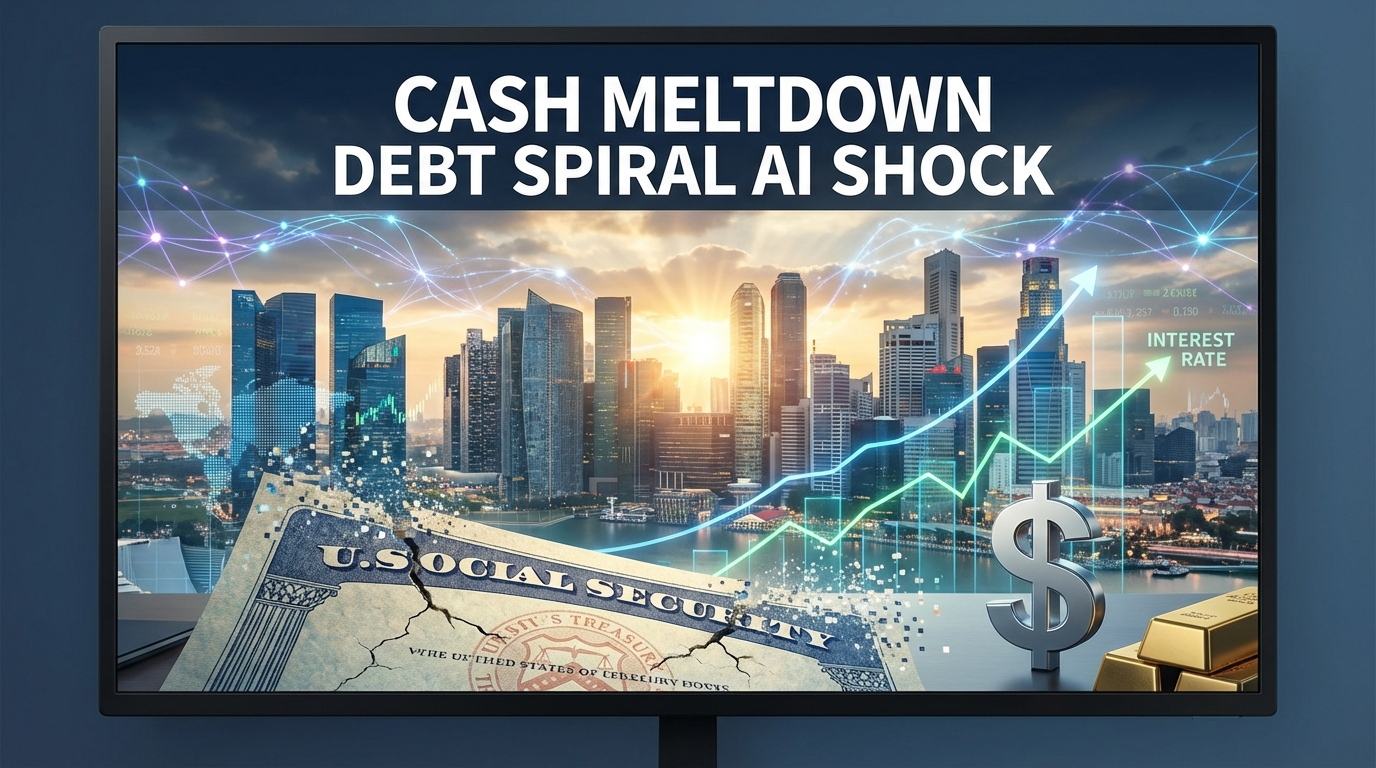

● Cash Meltdown Debt Spiral AI Shock
Ray Dalio’s “Big Cycle” Warning Summary: Within 5 Years, Money, Politics, and AI Will Shake at Once (Is Cash Really Safe?)
Today’s post contains exactly three things for sure.
First, what Ray Dalio means by the “collapse that’s coming soon” (not fear marketing, but a structural story).
Second, why debt, polarization, and the dollar system shake at the same time (from the Big Cycle perspective).
Third, the key point that AI can become either a “savior” or “fuel for civil conflict.”
Below, based on the Oxford lecture content (original text), I’ll lay it out cleanly like a news brief,
and at the end I’ll also pull out the “truly important parts” that other YouTube/news pieces often don’t talk about.
1) Today’s Headline: The Real Meaning Behind “Cash Can Become Trash”
The reason Dalio’s provocative line (cash becomes like toilet paper) matters is that
it’s not simply “buy gold,” but a structural warning that in the late stage of a national debt cycle, currency can lose its function as a ‘store of wealth.’
In particular, right now inflation, interest rates, recession, U.S. Treasuries, and a strong dollar aren’t moving separately;
they’re bundled into one mass and rolling into “cracks in the credit system”—that’s the point.
2) The “Five Forces That Move the World” Dalio Described (News-Style Summary)
Dalio believes that “major events that happen each year are created by five forces.”
When these five overlap at the same time, the felt “speed at which an era changes” accelerates sharply.
2-1. Force #1: Money · Credit · Debt (Late Stage of the Debt Cycle)
Money and credit are different.
Money settles transactions immediately,
and credit creates “purchasing power you don’t have right now” and keeps the economy moving (like blood).
The problem is that there comes a time when credit shifts from “good debt” that increases productivity
to “bad debt” where principal and interest squeeze out other spending.
In the original text, U.S. debt is mentioned as $38 trillion (continuing to rise).
The key isn’t the number itself,
but the mechanism that if debt keeps growing faster than income, trust in money gets shaken.
2-2. Force #2: Wealth Gap → Political Polarization → Risk of Internal Breakdown
Dalio says capitalism creates innovation but also creates a concentration of wealth at the same time.
As inequality widens and the economy worsens,
people stop wanting “compromise” and start wanting “a strong leader (populism) who will fight for them,”
and as a result, the center collapses and the democratic system itself can be shaken, in his view.
And there’s an extremely strong line as well.
“The probability of a civil war or quasi-civil-war-level breakdown is over 50%.”
2-3. Force #3: Reshaping of the World Order (Weakening Multilateralism, Strengthening Power Politics)
The post-1944–45 order (the UN, the World Bank, multilateral agreements) is weakening,
and we are moving into a period of “country-first” where “power” takes precedence over rules, from this perspective.
If, in this flow, financial sanctions (asset freezes) become a ‘weapon of war,’
trust in the reserve currency could shake along with it—this is the Dalio-style interpretation.
2-4. Force #4: “Uncontrollable Natural Variables” Like Climate and Pandemics
Dalio points out that what has toppled more civilizations than war was natural disasters and epidemics.
Citing figures like 7 million+ official COVID deaths,
he argues that climate risk has become a force that “additionally shakes” economic and political systems.
2-5. Force #5: Technology (Especially AI) — This Time It Can “Overwhelm” the Other Forces
Technology has also been a force that reverses crises, but
this AI, he says, is at the level of a “productivity revolution,” and can overwhelm the other variables.
Here, the important duality appears.
AI can create enough wealth to offset debt,
but at the same time, if job displacement explodes inequality, it can become fuel for internal breakdown—that point.
3) The Logic Behind “Cash Can Become Risky”: The Mechanism Dalio Described
Dalio’s logic can be summarized like this.
1) The “cash” you saved is, in effect, a bank/government “debt (liability).”
2) When national debt becomes unsustainable, the options shrink.
3) Eventually, the temptation grows to print more money (diluting currency value) to pay the debt.
4) In that process, if money loses its function as a ‘store of wealth,’ a trust crisis comes.
So Dalio believes the move toward “real assets that governments find hard to control, like gold” can increase.
In the original text, he strongly frames it as “it’s not that gold became amazing; it’s that money became weaker.”
4) The “Geopolitical Risk” of the Dollar/Treasuries: The Trust Crack Created by Asset Freezes
One of the most realistic parts of the original text is this.
From the standpoint of major bond-holding countries like China,
as conflict with the U.S. grows, “U.S. Treasuries” stop looking like a simple financial asset and start looking like
a political-risk asset that can be frozen by sanctions, he argues.
The key is that it’s not “only China’s problem,”
but a structural story: the more finance is weaponized in diplomacy/security, the more the whole world starts thinking similarly.
5) There Are Only Three Policy Fixes, and All Get Hated (So Politics Shakes)
Dalio organizes it as: when a country’s debt becomes unmanageable, there are only three choices.
1) Raise taxes
2) Cut spending (including sensitive areas like welfare/pensions)
3) Borrow more (expand deficits)
All three are political hell, so
phenomena like the U.K. constantly replacing leaders aren’t just “individual incompetence,” but arise because
it’s a structurally ‘unsolvable’ hard problem, he interprets.
Also, realistically, he says it’s not a “one-shot” solution but a mix is needed.
As an example, he mentions combinations like taxes +4% and spending -4%, explaining that
bringing the fiscal deficit down to around 3% of GDP is the sustainability threshold.
6) The Point of the “Fake Wealth Is 8.5x Real Money” Remark: The Essence of a Bubble
This is the most shocking number in the original text.
It’s the claim that book (valued) wealth (asset valuations) has grown excessively larger than real/ cash-like value.
What Dalio warns about here is a scene like this.
When “taxing the rich” is strengthened,
if especially unrealized gains (valuation gains not even sold yet) are taxed heavily,
asset owners/companies without cash must sell assets to pay taxes,
and if selling concentrates at the same time, it can lead to a sharp market drop → bubble collapse, in his logic.
In other words, setting aside the issue of distributive justice,
it’s closer to a technical warning that tax design can tear the market’s liquidity structure.
7) Is AI a “Debt Solver,” or a “Civil-Conflict Accelerator”?
Dalio’s conclusion, unexpectedly, converges on “AI as the key variable.”
If AI creates a productivity revolution,
growth rises, tax revenues increase, and corporate profits expand,
creating the possibility of reducing the debt burden in relative terms.
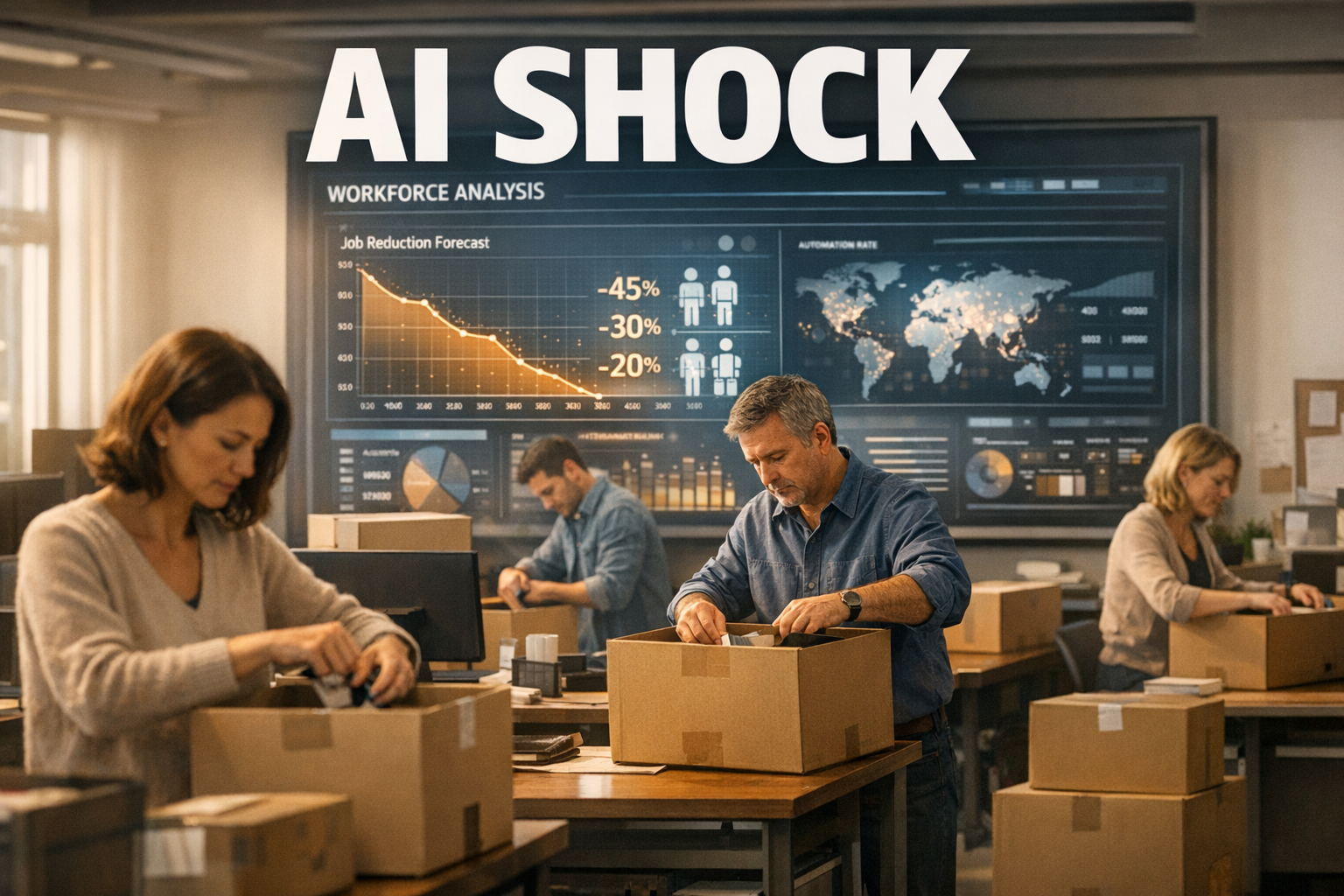
Conversely, if AI rapidly replaces jobs,
the income base collapses and class conflict intensifies,
which can further raise the “internal breakdown probability” mentioned earlier, he believes.
So the message Dalio throws out is actually two-pronged.
“Relying only on cash/bonds could be risky” + “AI requires a redesign of the social system.”
8) The “Most Important Points” Other News/YouTube Often Don’t Highlight (Reorganized in My View)
From here is the real point, but surprisingly it gets left out of a lot of content.
Point A. Dalio’s gold recommendation is not “investment advice” but a “diagnosis of the trust system.”
If you isolate the gold talk, it ends with “here we go again, telling us to buy gold,” but
the essence of the original text is “a phase where trust in currency, Treasuries, and institutions is damaged by politics/geopolitics.”
When trust shakes, it’s not that gold rises;
at the moment trust shakes, the benchmark for pricing all assets (discount rates/risk premia) changes.
That’s the truly scary part.
Point B. “Asset freeze risk” is a more realistic crack trigger than dollar weakness.
It’s not whether the dollar goes down or up;
if the experience accumulates that “my assets can be politically locked,”
holders will try to diversify even if they sacrifice some yield.
Even if this flow moves slowly, it’s hard to reverse.
Point C. The unrealized-gains tax debate blows up first in “liquidity,” not “justice.”
Public discourse fights as “tax the rich more / that’s absurd,” but
the market looks first at “who will dump to raise cash.”
The way policy shakes markets shows up not through “justification,” but through “cash flow.”
Point D. AI is a “political variable” before it is an economic variable.
If AI replaces jobs, it’s not just an unemployment problem;
voters move toward extremes and populism strengthens.
That is, AI can be a productivity revolution and at the same time a technology that raises the operating cost of democracy.
Point E. “The next 5 years are a time warp” refers to the speed of “institutional change,” not “asset prices.”
The five years Dalio talks about isn’t a stock-market prophecy;
it’s a warning that as debt/politics/war/climate/AI become entangled,
rules (regulation, taxation, monetary policy, capital controls) could change suddenly.
9) So What Should We Check (A Realistic Checklist)
I’ll summarize this more as a “dashboard” than as investment advice.
1) Fiscal: Major countries’ deficit/GDP trends and the share of interest costs in government spending (to gauge policy room)
2) Monetary policy: Rather than the rate direction, check whether “the structure forces money printing again in a crisis”
3) Geopolitics: Whether sanctions/asset freezes expand (degree of finance weaponization)
4) Society: Polarization indicators (real wages, housing-cost burden, youth unemployment/sentiment)
5) AI: Rather than productivity indicators, the “speed of job replacement” and execution capacity of “redistribution/retraining policy”
< Summary >
Dalio warned that in the late stage of the debt cycle, trust in currency can be shaken.
The world is seeing five forces collide at once: money/debt, polarization, reshaping world order, climate risk, and AI.
Risk in Treasuries/the dollar may grow less from interest rates and more from trust damage like “political sanctions and asset freezes.”
AI can become a productivity revolution that eases debt, or it can accelerate internal breakdown by enlarging inequality.
The 핵심 is not the gold recommendation, but “cracks in the trust system” and “a sudden acceleration in the speed of institutional change.”
[Related posts…]
- Dollar strength/weakness cycle, summarized into 5 variables through 2026
- Job reshaping created by AI: How to read the signals of white-collar restructuring
*Source: Science Adam