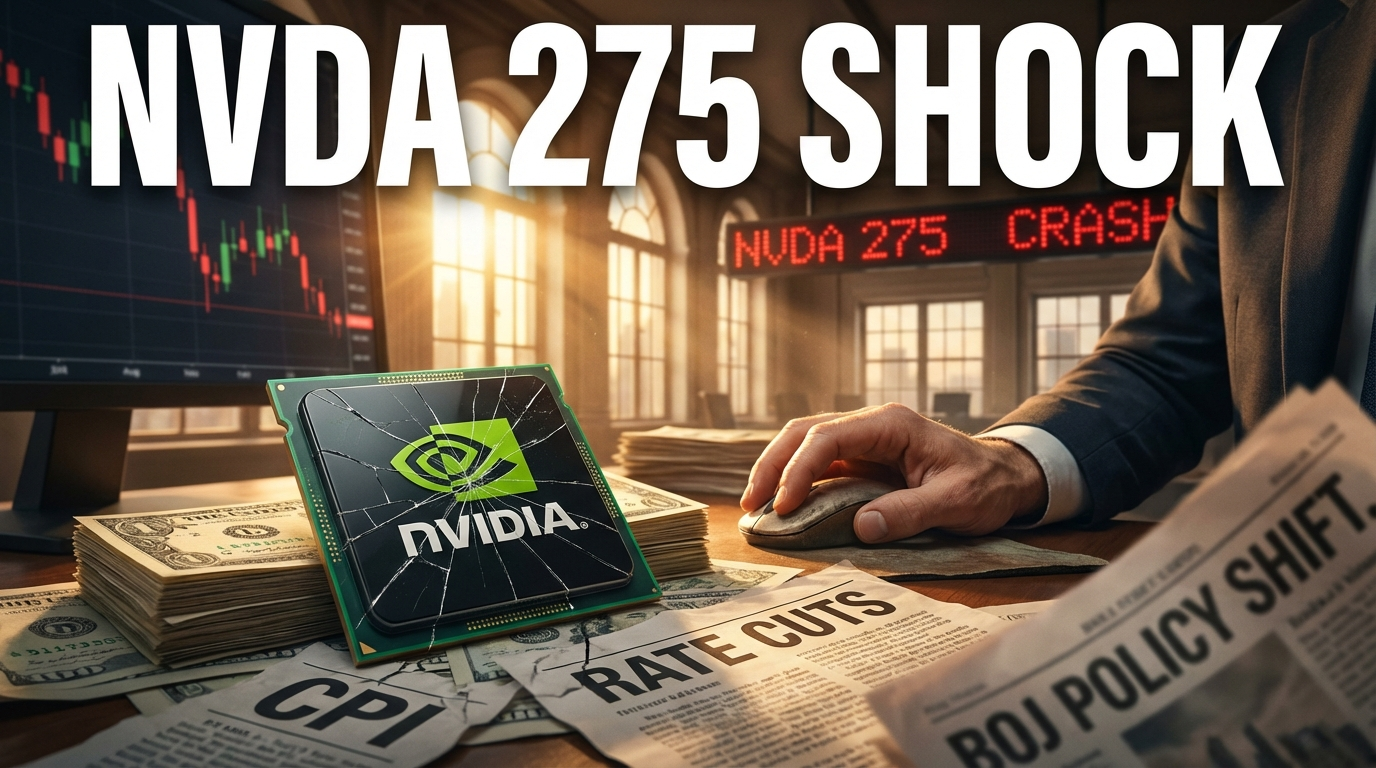
● AI Profit Panic, Nvidia 275 Target Stands, CPI Jobs BOJ Shockwave, Power HBM Depreciation Trap
Three Catalysts Likely to Move the “U.S. Equities + AI” Complex This Week: (1) The Real Implication of Maintaining a $275 NVIDIA Target (2) How November Jobs, CPI, and the BOJ Reshape “Rate-Cut Timing” (3) The AI Bubble Debate Shifting Toward Power, HBM, and Depreciation
This note focuses on:
- Why technology stocks are destabilizing (spillover from Broadcom’s margin commentary),
- Why Wall Street continues to anchor on NVIDIA (the substance behind the $275 target),
- How this week’s macro releases (jobs, CPI, BOJ) may transmit sequential shocks into risk assets.
1) U.S. Equity Headline: “Rate Cuts Are No Longer the Primary Catalyst; AI Profitability Is”
Last week, both the Nasdaq and the S&P 500 declined. Early this week saw a brief rebound followed by renewed volatility.
The key shift: the market is increasingly prioritizing whether AI is generating measurable profit over incremental FOMC expectations.
Broadcom’s implication that AI revenue margins are not superior to non-AI margins accelerated a reframing of the AI bubble debate from demand to profitability.
2) Catalyst for the AI Bubble Debate: Broadcom and Oracle Reinforce a “Margin/ROI” Framework
The debate is moving from “Are AI chips selling?” to “Is AI ROI thinner than expected?”
This matters disproportionately when the message comes from the custom silicon (ASIC) ecosystem because markets have treated GPU (NVIDIA) and ASIC (Broadcom / hyperscalers) as dual engines of AI infrastructure.
Two near-term questions dominate:1) Can NVIDIA revalidate the investment rationale?2) Can Micron’s results restore conviction in the memory cycle (including HBM)?
3) NVIDIA: What Bernstein’s “Outperform, $275 Target” Actually Signals
The headline reads as bullish, but the underlying message is more specific.
(1) NVIDIA as the “breakwater” for the AI infrastructure narrative
A sharp deceleration in AI infrastructure investment would undermine the hyperscaler CAPEX-led growth framework. The market is relying on NVIDIA’s Blackwell-to-Rubin roadmap to sustain confidence that demand durability remains intact.
(2) Why “Google TPU is strong” is not viewed as a decisive threat
The key moat is not only raw performance comparisons but ecosystem depth (software, tooling, developer adoption, and supply reliability).
(3) Clear risks: China (H200 licensing) and depreciation pressure (upgrade velocity)
Export restrictions can cap top-line potential. More structurally, hyperscalers face rising depreciation stress as GPU upgrade cycles compress. Even if AI CAPEX persists, procurement timing risk increases if buyers delay purchases to avoid premature write-downs.
4) Why This Week’s Macro Calendar Matters: Markets Re-anchor to Data
While not an FOMC week, the schedule is dense: employment indicators, PMI, CPI, and multiple Fed speaker events. This can materially shift rate-cut expectations.
Key checkpoints
- November employment data: evidence of weakening labor conditions would support renewed rate-cut pricing.
- November CPI: sticky inflation would likely keep Fed rhetoric hawkish.
- Fed speakers (including Waller): interpretation risk can reprice markets even with unchanged data.
JPMorgan’s mention of a possible January cut functions less as a forecast and more as narrative-setting: weaker jobs data can rapidly reattach the “January is plausible” framing.
As rate cuts approach, lower financing costs can partially ease AI CAPEX burdens, potentially moderating the intensity of the AI bubble debate.
5) Bank of Japan (BOJ) Risk: Yen Carry Trade as a Renewed Headline Volatility Source
The BOJ decision matters not only for Japan rates but for global liquidity and cross-asset positioning.
Consensus suggests a repeat of last summer’s sharp drawdown is less likely; however, crowded positioning can still produce outsized volatility even when the risk is widely recognized.
6) Semiconductors, Act II: Pair “HBM Growth” with “Upgrade-Delay Risk”
Two points matter simultaneously:
(1) HBM market growth remains steep
Forecasts implying >70% YoY growth through 2026 are supportive for the memory value chain.
(2) “Demand exists” is not equivalent to “timing is favorable”
If hyperscalers slow Blackwell Ultra-to-Rubin transitions or moderate deployment velocity, HBM4 adoption timing risk increases.
Micron’s earnings are therefore not just a results event, but a test of whether memory fundamentals are tracking the realized pace of AI infrastructure build-out.
7) Power Infrastructure (Electricity, Transmission, Distribution): Not the “Next Theme,” but a Binding Constraint
AI data centers are power-intensive. As bubble concerns rise, power infrastructure, utilities, and grid modernization can re-rate as more tangible beneficiaries.
This is not a short-lived theme: electricity is a persistent cost line item in AI infrastructure economics.
8) Trump “Marijuana Executive Action” Issue: Why Cannabis Equities Move Discontinuously
The focus is not full legalization but the potential federal rescheduling shift.
If Schedule I shifts to Schedule III, expectations cluster around:
- Improved tax and regulatory conditions,
- Greater institutionalization under medical and oversight frameworks.
Large single-day moves (e.g., Tilray up >40%) reflect policy-event trading dynamics rather than fundamentals-driven repricing.
9) “The U.S. as a Recall Economy”: Linkage to AI Investment Dynamics
A system optimized for post-launch remediation aligns with AI and software delivery models.
Tesla’s ability to address recalls via software updates illustrates a regime where speed of deployment and iteration can outweigh initial perfection.
This reinforces why U.S. large-cap tech can push AI products through beta-to-improvement-to-scale cycles rapidly.
10) Crypto Pullback (Bitcoin): More About Leverage and Expectations Than Structural Exhaustion
Bitcoin fell below $90,000 with broad altcoin weakness.
Two variables to monitor:
- Whether correlation with risk assets (Nasdaq) strengthens again,
- Whether recurring dip-buying entities (e.g., MSTR) continue to provide a psychological “floor narrative.”
Repeated MSTR accumulation functions less as near-term price signaling and more as sentiment stabilization.
11) This Week in One Line
The most effective antidote to the AI bubble debate is not revenue growth alone, but improved confidence in profitability and procurement timing.
This week’s likely sequence of market drivers:
- Jobs and CPI reshaping rate-cut expectations,
- Micron earnings revalidating (or challenging) semiconductor cycle realism,
- BOJ decisions influencing liquidity and FX-driven volatility.
Most Underpriced Takeaways (Condensed)
1) The AI bubble debate is shifting from “demand” to “depreciation and upgrade-cycle pressure.”
Faster hardware improvement increases customer balance-sheet stress; investment behavior may express as delays rather than cancellations.
2) NVIDIA’s primary competitor is not a single chip vendor, but customer timing decisions.
The largest risk is “pause one cycle,” not immediate substitution.
3) Rate cuts matter, but this cycle channels through CAPEX affordability.
Markets are less focused on P/E multiple expansion and more on whether AI infrastructure economics remain viable under funding costs.
4) Power infrastructure is a core component of AI cost structure.
As AI scales, electricity and grid capacity increasingly directly impact quarterly cost structures.
SEO-Aligned Keyword Set
To frame this week’s setup: U.S. equities, rate cuts, inflation, AI semiconductors, Bitcoin.
< Summary >
- Post Broadcom/Oracle commentary, the AI debate has shifted from demand to profitability.
- Bernstein’s $275 NVIDIA target functions less as optimism and more as an assertion that NVIDIA remains the structural anchor of the AI infrastructure narrative.
- Jobs and CPI can reprice rate-cut expectations, while the BOJ can add liquidity/FX-driven volatility risk.
- Micron earnings are a key validation point for semiconductor fundamentals, including HBM.
- Power infrastructure is not a secondary theme; it is a binding input cost for AI scale.
[Related Links…]
- NVIDIA Outlook: Signals from the Blackwell-to-Rubin Roadmap
- U.S. Rate-Cut Scenarios: Interpreting the Next Step Through Jobs and CPI
*Source: [ Maeil Business Newspaper ]
– 번스타인, 엔비디아 ‘아웃퍼폼’, 목표주가 $275ㅣ트럼프, 금일중 마리화나 행정명령ㅣ리콜 공화국 ‘미국‘ 출시후 재수정ㅣ홍키자의 매일뉴욕