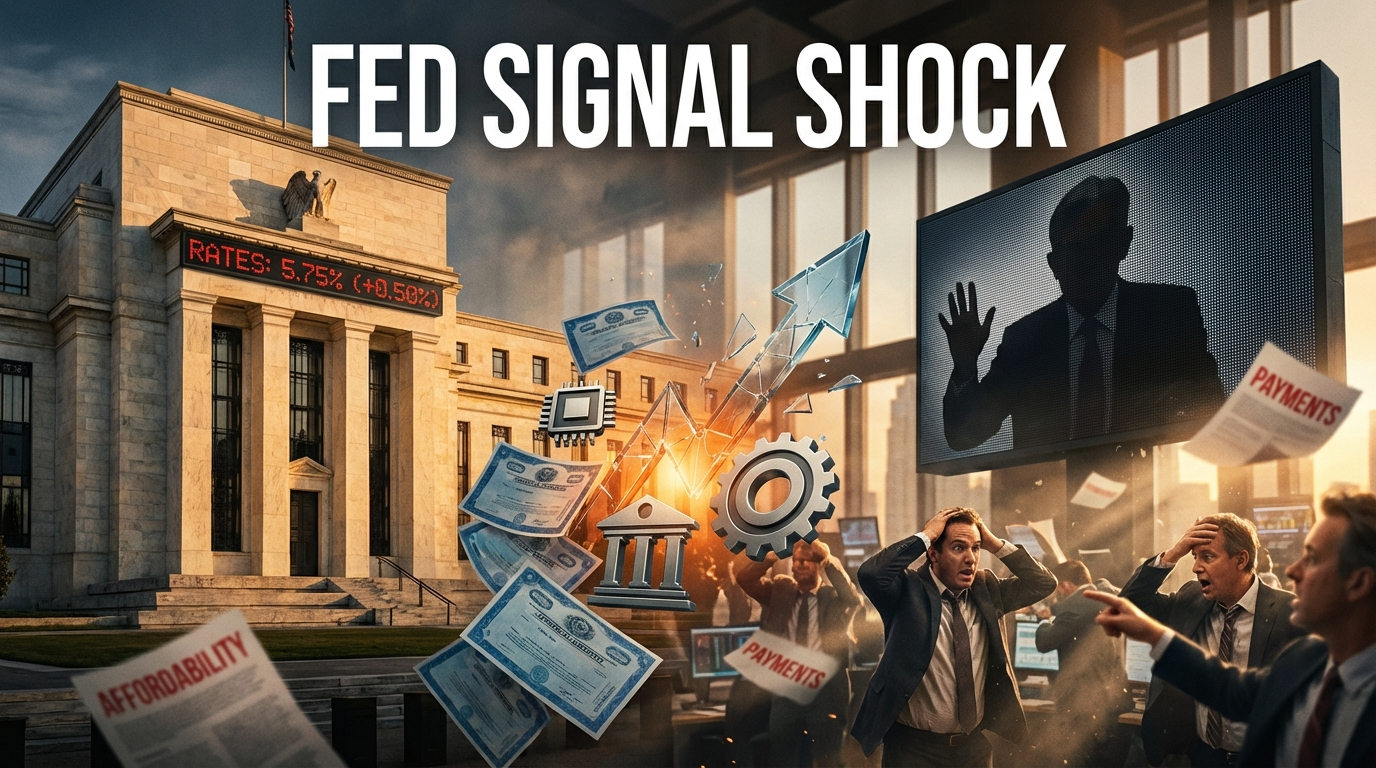
● Fed Trump Tag Team Sparks 2026 Rally Rotation into Beaten Down Consumer Travel Payments
1H26 “New Market Leaders” Signals: Converging Messages from Trump and the Fed, and Where Market Regime Shifts Quietly Begin
This report focuses on four points.
1) A Fed (FOMC and dot plot) framework that simultaneously supports “growth resilience + disinflation + shock insurance”
2) An election-cycle policy timetable focused on household affordability (energy, tax cuts, rebates, agricultural support)
3) Sector checkpoints for post-AI “breadth expansion” (consumer, travel, payments, transport, agriculture)
4) Key variables often underweighted in mainstream coverage (supply constraints, pricing power, policy timing)
1) [Federal Reserve] December FOMC: Formalizing a “Goldilocks” Baseline
Core message:
“Growth is holding up better than expected → inflation is likely to ease → liquidity tools remain available for adverse shocks.”
1-1. Dot plot and projections: investor-relevant interpretation
– Upward revisions to growth imply the Fed is weighting “moderate expansion” over recession risk.
– Even with softer employment, productivity (including AI-driven gains) can support growth; the narrative shifts toward “growth without proportional hiring.”
– Comments suggesting inflation could peak in Q1 and then moderate leave room for a less restrictive rate path than worst-case scenarios.
1-2. The market focus: not “Fed confidence,” but “Fed insurance”
Forecasts change; the investable signal is the simultaneous setup of shock-mitigation readiness (liquidity backstops).
This matters because:
– High-valuation AI-linked segments are rate/liquidity-sensitive.
– Cyclical and previously lagging sectors can re-rate materially if recession tail risk compresses, even without outsized earnings growth.
2) [Politics and Policy] Trump’s election-cycle priority: affordability
The organizing theme is “improving household finances,” implemented via direct channels: energy prices, tax cuts, rebates, and targeted support (including agriculture).
2-1. Three pillars: gasoline/oil + tax cuts + rebates
– The key statement is that “lower energy prices function like a large tax cut.” Gasoline prices transmit quickly to inflation expectations and consumer sentiment.
– From January 1, 2026: proposed relief related to tips/overtime/Social Security contributions, aimed at improving real disposable income.
– April 2026: a sizable tax rebate (frequently cited around ~$1,000 per household), potentially acting as a consumption catalyst.
2-2. Agricultural support as a timing instrument that can create market timing
Scheduling agricultural support payments for February–March reflects political calendar incentives as well as economic considerations.
Such measures can be priced into agriculture-related equities (agriculture, fertilizers, machinery, logistics) through expectations ahead of reported fundamentals.
3) [Markets] 2024–2025: AI concentration; 2026: potential for breadth expansion
The implication is not an end to AI leadership, but improved conditions for AI-driven liquidity and productivity expectations to broaden into other sectors.
After two to three years of U.S. equity concentration in mega-cap technology and semiconductors, many consumer and cyclical names remain materially below prior highs (often down ~50% to ~60% or more). In such setups, the key driver can be normalization and reduced pessimism rather than exceptional earnings upside.
4) [Sector Framework] 1H26 candidate areas by structural drivers
4-1. Core expression of consumer recovery: payment networks (cards) + retail (ETFs)
– A rebound in consumption tends to appear first in transaction volumes for payment networks such as Visa and Mastercard.
– For diversified exposure, retail ETFs (e.g., XRT-type structures) can capture breadth expansion without single-name concentration risk.
Key factor: not only incremental demand, but the higher consumption elasticity associated with discrete cash-flow events (tax cuts/rebates).
4-2. Travel (airlines): pricing power driven more by supply constraints than demand
The central variable is constrained aircraft supply. With limited capacity growth, modest demand resilience can support higher fares; if energy prices stabilize, unit costs may fall, reinforcing margin leverage.
Evidence consistent with pricing power: demand +2.3% alongside price +7%, implying willingness to pay and a favorable margin structure for carriers.
Key monitoring points
– Whether oil/gasoline remains stable (policy and geopolitics included)
– Whether aircraft delivery delays persist (supply constraints remain binding)
– Whether load factors hold despite elevated fares
4-3. Travel (cruises): repositioning as a value alternative
Post-pandemic hotel rates increased significantly, while cruise pricing has remained comparatively attractive, supporting demand broadening and a younger customer mix.
Royal Caribbean’s “higher dividends + buybacks” is best read as improving cash-flow visibility rather than a purely cyclical earnings signal. Longer lead-time bookings can reduce volatility and enable more aggressive capital-return policies.
4-4. Sports/apparel: event-driven demand can move sentiment ahead of fundamentals
A North America-hosted World Cup (referenced as June next year) can stimulate demand across sportswear, equipment, media, ticketing, and travel. These themes often reprice on expectations before earnings confirmation and can exhibit higher volatility.
4-5. China consumption support (indirect variable): embedded leverage for global consumer brands
Global brands such as Nike are exposed to China’s consumer sentiment as well as U.S. demand. If China strengthens domestic demand as a buffer against export uncertainty (including tariff risk), downside risk for global consumer franchises may be more limited than consensus assumes.
5) Underweighted but decision-relevant variables
1) The practical meaning of Fed–Trump directional alignment is not “policy coordination,” but potential compression in the risk premium.
When both emphasize downside protection and affordability, markets may assign less probability to tail-risk outcomes, supporting a gradual re-rating of lagging cyclicals.
2) For airlines/cruises, supply constraints and pricing power are the primary variables.
Travel demand is cyclical, but constrained supply can sustain pricing power even with only moderate macro resilience, strengthening the investment case beyond a generic recovery trade.
3) Tax cuts/rebates typically shift sentiment before they shift realized macro data.
Equities discount 3–6 months ahead; payments, retail, and travel can move before headline indicators visibly improve.
4) Even if AI remains strong, relative performance leadership can rotate.
High-performing segments carry elevated expectations, while depressed segments can rally sharply on “less negative” fundamentals. This is a common pattern when market breadth expands after prolonged concentration.
6) 1H26 monitoring checklist (portfolio review)
– Whether disinflation extends into services inflation
– Whether oil/gasoline stability is maintained through the election cycle
– Timing of tax cuts/rebates flowing into consumer indicators (card spending, retail sales)
– Whether travel prices (airfares/cruises) can rise without demand deterioration
– Whether AI risk shifts from earnings to valuation pressure (relative strength monitoring)
If these conditions persist, 2026 may feature more frequent cyclical rotations alongside a soft-landing narrative, rather than a single-theme market dominated solely by AI-linked leaders.
< Summary >
The Fed reinforces a Goldilocks baseline via higher growth expectations, easing inflation, and explicit shock-mitigation readiness. Trump’s agenda emphasizes affordability through energy-price management, tax cuts, rebates, and targeted agricultural support. The implication is not the end of AI leadership, but improved conditions for breadth expansion into consumer, travel, payments, and transport. Within travel, supply constraints and pricing power are the dominant variables.
[Related Links…]
- What Markets Actually Watch After the FOMC: Three Factors More Important Than the Policy Rate
- How Shifts in Trump Policy Could Affect U.S. Equity Sector Rotation
*Source: [ 소수몽키 ]
– 26년 새로운 주도주는 여기서 나온다? 트럼프와 연준이 동시에 준 강력한 신호들
● Surplus Yet Skyhigh Won, Dollar Drain, Liquidity Surge, Credibility Shock
Why the KRW-USD Exchange Rate Is Not Falling Despite a Current Account Surplus: The Convergence of “Structural USD Leakage,” “Liquidity Growth Velocity,” and a “Credibility Premium”
This report covers:
1) Structural mechanisms in which a current account surplus does not translate into sustained USD availability in the onshore FX market
2) How the growth rate of Korea’s money supply (M2) can lift the exchange-rate level
3) Real-economy impacts when FX pressure becomes persistent rather than a temporary spike
4) Why verbal guidance and direct intervention are losing effectiveness (credibility and policy consistency)
5) How non-current-account (non-trade) USD demand—such as tariffs and investment commitments—can reset the FX level
1) News Briefing: “Surplus, Yet FX Stress” — A Breakdown of Conventional Expectations
Key points
A current account surplus typically implies net foreign currency inflows, which should support KRW appreciation.
However, the KRW-USD rate remaining elevated is increasingly attributed to a structure in which USD inflows do not remain in the domestic FX market.
Market interpretation (discussion summary)
Treating FX as a direct function of export performance is insufficient in the current regime.
The exchange rate is increasingly priced as a function of liquidity conditions, policy mix, and credibility.
2) Structure (I): Why USD “Enters” but Does Not “Remain” in the Onshore Market
1) Inflows followed by immediate offshore re-outflows
Even when USD is earned via the current account, the exchange rate will not decline if that USD is not converted into KRW and does not accumulate as onshore supply.
A key observation is that USD exits quickly after being generated.
2) “Hoarding” behavior and a preference to hold USD
If corporates and households retain USD balances or shift into foreign assets rather than converting to KRW, onshore USD liquidity tightens.
In such conditions, FX can respond more to perceived USD scarcity than to macro fundamentals.
3) FX reserves can be perceived as insufficient despite headline size
Market participants focus less on total reserves and more on how much can be deployed quickly and credibly for stabilization.
If doubts rise, a large reserve stock may deliver limited stabilizing signal.
3) Structure (II): KRW Weakness Driven by Money-Supply Growth Velocity (Liquidity Trap)
Core logic
In phases when the USD weakens due to increased US liquidity provision, the KRW typically has room to strengthen on a relative basis.
However, if Korea’s M2 growth materially outpaces that of the US, the market can price a regime where the USD softens while the KRW weakens further.
Why “velocity” matters
Exchange rates reflect cumulative conditions, but in the short run they are highly sensitive to the pace of liquidity expansion.
Faster domestic liquidity growth increases relative KRW abundance, reduces perceived KRW scarcity, and can lift the exchange-rate level.
If fiscal expansion is added
Repeated expansionary fiscal policy (higher budgets and potential supplementary spending) can be interpreted as reinforcing a KRW-weak policy mix.
In that case, FX pricing shifts from event-driven moves to a structural repricing of the policy mix.
4) Why Persistence Is More Damaging Than a One-Off Spike
Past crisis pattern (spike)
During prior crisis episodes, sharp depreciation was often followed by stabilization and rapid mean reversion.
Current risk (persistence)
The primary risk is not a brief overshoot but an extended period of elevated exchange-rate levels.
Asymmetric impact on the real economy
Large exporters may benefit via translation and price competitiveness.
However, SMEs with USD-denominated input costs face rapid margin compression.
This can widen internal distributional gaps, including divergence between large-firm earnings and SME profitability.
Inflation pass-through
A weaker KRW increases import prices and can pass through into CPI.
This can intensify pressure for domestic support measures and contribute to a cycle of fiscal expansion and liquidity growth.
5) “Level” Drivers vs. “Volatility” Drivers in FX Pricing
1) Drivers of the exchange-rate level
Interest-rate differentials, the current account (goods and services), and cross-border capital flows.
2) Drivers of volatility
Political uncertainty, geopolitical risk, and abrupt shifts in policy signaling.
Political variables primarily amplify volatility
Political stress tends to generate spikes, with partial reversal when conditions stabilize.
Recent dynamics suggest level shifts beyond politics
If the exchange rate remains elevated despite reduced political noise, markets infer additional structural drivers resetting the level.
6) Why US-Korea Tariffs and Investment Commitments Can Shift the FX “Level” (Key Watchpoints)
Issue under market scrutiny
Large-scale US-directed investment commitments, defense-related outlays, and offshore USD expenditures are being assessed as either one-off shocks (volatility) or persistent structural USD demand (level).
If interpreted as persistent USD demand
Given Korea’s characteristics as a small open economy, structurally higher USD outflows can raise the perceived upper bound and equilibrium range of the exchange-rate level.
If interpreted as manageable and absorbable
Credible shock-absorption mechanisms—such as swap lines, FX stabilization frameworks, and moderated institutional outbound investment—can reclassify the impact as largely volatility-driven, supporting a lower level over time.
7) Why Intervention Is Less Effective: The Role of a Credibility Premium
Limits of verbal guidance
Markets discount statements that are not supported by sustainable policy and consistent follow-through.
Repeated verbal intervention without reinforcing instruments reduces marginal effectiveness.
Constraints on direct intervention
Spot intervention can dampen short-term moves, but if structural USD supply-demand imbalances and an accommodative policy mix persist, depreciation pressures can re-emerge.
Central requirement: coherent policy mix
FX stability, inflation control, growth support, and financial stability must be addressed simultaneously.
Markets therefore focus less on single actions and more on alignment between monetary and fiscal policy.
8) Scenario Framework Through 2026 (Investor-Oriented)
Scenario A: Persistent high FX level (upshifted range)
Structural USD leakage continues, monetary and fiscal expansion accumulates, and external investment/outlays become persistent USD demand.
Implications: sustained import-cost pressure, SME margin compression, and prolonged domestic-demand constraints.
Scenario B: Lower volatility with gradual normalization (downshifted range)
A clearer US easing cycle, slower domestic liquidity growth, and improved credibility of USD backstops (including swaps) support convergence toward fundamentals such as the current account.
Scenario C: Event-driven re-spike (crisis-type shock)
Renewed political, geopolitical, or financial stress, or a sharp rise in perceived USD funding risk.
Implications: rapid depreciation followed by outcomes dependent on policy response; stabilization or transition into persistence.
9) Underemphasized but Material Points
1) FX can be driven more by USD “holding time” than by the current account
Beyond surplus/deficit, the duration USD remains onshore and the degree of KRW conversion can dominate pricing in certain regimes.
2) The largest burden of a weaker KRW often falls on import-dependent SMEs, with spillovers to jobs and domestic demand
Exporter performance can mask margin erosion in upstream and downstream supply-chain segments, where employment and consumption are more sensitive.
3) More critical than “defending the FX rate” is the credibility cost when markets do not see a sustainable roadmap
A higher credibility premium can push the exchange-rate level higher even under similar fundamentals.
4) The key signal is not the M2 level but the direction of its growth rate
Markets react more to whether liquidity growth is turning up or down than to the absolute stock.
5) US-Korea issues should be treated as structural variables in the USD balance, not merely political headlines
Tariffs, investment, and defense-related payments can create sustained USD demand outside the current account and therefore influence the level.
< Summary >
The KRW-USD rate can remain elevated despite a current account surplus when USD inflows do not remain onshore and when Korea’s M2 growth outpaces external benchmarks.
If high FX levels persist rather than mean-revert after a spike, the burden becomes asymmetric—pressuring import-reliant SMEs, domestic demand, and inflation dynamics.
While political factors amplify volatility, recent pricing increasingly reflects level-setting structural drivers, including non-trade USD demand, the policy mix, and a credibility premium.
[Related …]
- https://NextGenInsight.net?s=exchange%20rate
- https://NextGenInsight.net?s=current%20account
*Source: [ 경제 읽어주는 남자(김광석TV) ]
– 환율 폭등, 구조적 붕괴인가? 달러 유출과 유동성의 덫 환율, 신뢰가 무너진 결과다 | 심층토론 – 김대호, 노영우 1편
● KOSPI 4000 Meltdown, Liquidity Crunch, AI Hype Fades, Japan Rate Shock, Trump Chaos
KOSPI 4,000 Breakdown (Sharp Decline): The Core Drivers Were Not “Charts,” but a Simultaneous Turn in Four Pillars: Liquidity, AI, Japan’s Rates, and Politics (Trump)
This report consolidates the following in one place:
1) Why breakouts become difficult after a double-top (behavioral and capital-structure dynamics).
2) Why the AI rally has entered a phase of limited incremental catalysts (end-stage rotation from first- to third-wave beneficiaries).
3) Where liquidity warning signals surfaced first (bond yields, Bitcoin, highly leveraged corporates).
4) Why Japan’s rate hikes can be structurally adverse to global equities, particularly growth/AI (yen carry, USD, rate sensitivity).
5) A prioritized checklist of key indicators that many media segments underweight, and how to use them to interpret near-term market direction.
1) One-Line Market Summary (News Briefing Style)
Global equities, including the KOSPI, moved into a regime where a confirmed double-top, a shortage of fresh catalysts, decelerating liquidity, and concerns over Japan rate hikes jointly shifted risk/reward toward faster fear-driven selling than greed-driven buying.
Even when technological progress (e.g., AI) continues, equity prices can weaken during a selection phase, where “good industries” and “good price action” often diverge.
2) Why a “Double-Top” Limits Breakouts: Not a Chart Pattern, but People and Capital
2-1. Two Failures at the High Convert Greed into Fear
After the first peak and pullback, investors often retain the expectation of a subsequent breakout.
A second failure materially reduces conviction.
At that point, the default posture becomes “buying here risks getting trapped again,” constraining incremental demand.
2-2. Breakouts Require Turnover (Capital)
Breaking to new highs typically requires sufficient buying power and turnover to absorb overhead supply.
When market psychology tilts toward risk-off, “breakout capital” tends not to engage.
The result is a capped market where relatively small negative catalysts can produce outsized drawdowns.
3) How AI Rally Catalysts Become Exhausted: Late-Stage Rotation from Wave 1 to Wave 3
3-1. Late 2022 to 2024: AI as an Unexpected Shock
A key driver of the broader market advance was upside surprise—expectations that exceeded consensus.
Generative AI (e.g., ChatGPT) served as the primary narrative and supported a multi-year re-rating.
“Freshness” in catalysts is defined by narratives that exceed prior expectations, not by already-known positives.
3-2. As AI Exposure Spreads from Wave 1 to Wave 3, “Hidden Value” Becomes Scarce
Wave 1: Core infrastructure/platform leaders (e.g., dominant GPU and AI infrastructure leaders).
Wave 2: Adjacent beneficiaries (e.g., semiconductor infrastructure, networking, servers).
Wave 3: Peripheral names marketed as “AI-related” with weaker linkage.
As the cycle reaches Wave 3, incremental entry points become less compelling; late-stage names typically exhibit higher downside due to prior price appreciation and thinner fundamentals.
3-3. What the Next AI Catalyst Must Look Like
To re-accelerate broader risk appetite, AI would likely require either a clear expansion narrative or monetization proof.
Examples include:
– A defined growth vector into physical AI (robotics, manufacturing, logistics automation).
– Demonstrated commercialization of autonomous driving/agents with measurable adoption and revenue.
– Earnings surprises that validate profitability (e.g., margin expansion or credible path to sustained profitability).
4) Liquidity Bottoming Signals: Stress Appeared First in “Tail-Risk” Assets
4-1. Bond Yield Volatility Is a Liquidity Alarm
When bond yields—particularly long-duration yields—become volatile, growth valuations are immediately pressured.
Yields function as the discount rate applied to future cash flows.
Rising rate volatility is often interpreted as a precursor to tighter liquidity conditions.
4-2. Assets That Typically Move First: Bitcoin, High-Risk Themes, Highly Leveraged Equities
A common sequence is:
– Tail-risk assets spike first in a short, high-intensity move (upside burst).
– The market then struggles to extend, followed by consolidation or reversal.
High-volatility assets such as Bitcoin often provide early signals of risk appetite exhaustion.
4-3. Why Highly Leveraged Companies Break First
As rates and liquidity tighten, issuers with high interest burden and refinancing risk are pressured first.
Equity pricing becomes more sensitive to solvency and funding access than to near-term operating performance.
Dispersion typically rises, with widening gaps between stronger and weaker balance sheets, even within favorable industries.
5) Why Concerns Over Japan Rate Hikes Pressure Global Equities
5-1. Less a One-Day Shock, More a Structural Liquidity Headwind
Japan rate hikes are less likely to be a single, immediate market-ending catalyst and more likely to operate as a gradual liquidity drain.
The impact is amplified when offsetting fresh growth narratives are absent.
5-2. Yen Carry, FX, the USD, and the Transmission to Growth Stocks
Japan’s rate regime influences the yen and, through FX dynamics, global risk appetite.
In such environments, growth equities—particularly AI with long-duration cash flows—tend to be more sensitive to shifts in rates, FX, and liquidity.
6) The Trump Variable: Markets Price the Probability of Equity-Supportive Messaging
If political communication indicates a strong preference to stabilize equities, negative catalysts may be partially offset by expectations of policy signaling, pressure, or rhetoric.
Markets incorporate not only macro data but also perceived policy intent and communication effects.
This channel remains probabilistic rather than policy-confirmed, implying elevated volatility.
7) Practical Checklist for This Drawdown (Next 1–4 Weeks)
7-1. Rate Volatility Matters Before Rate Direction
For growth/AI, instability in yields often drives price action more than the absolute level of rates.
Monitor whether U.S. Treasury yield volatility compresses.
7-2. AI Equity Drivers Shift from “Tech News” to Earnings and Margins
Market impact increasingly depends on fundamentals rather than product demos or model releases, including:
– Upward earnings guidance revisions
– Speed of revenue conversion relative to AI capex intensity
– Margin resilience, including power and data-center cost pressures
7-3. Relative Drawdowns: Leaders vs. Late-Stage (Wave 3) Themes
If leaders decline less while peripheral themes sell off more, the market may be transitioning into a de-risking and bubble-deflation phase rather than broad capitulation.
7-4. FX (USD Strength) Combined with Foreign Flow Positioning
Korean equities are highly sensitive to foreign flows.
USD strength can weaken risk-asset demand.
Track KRW stability and changes in foreign positioning across futures and cash equities.
8) The Most Material Point Often Underemphasized
The central issue is not the double-top or Japan rates in isolation, but the market entering a regime where the combined effect of catalyst freshness (new narrative) and liquidity is no longer net-positive.
Many commentaries treat drivers separately:
– “AI is positive/negative”
– “Rates are rising/falling”
– “Japan is hiking rates”
In practice, markets respond to the net impulse after aggregating catalysts and headwinds.
At present, many participants are unwilling to provide incremental demand at higher prices to force a breakout.
This is a core mechanism behind failed breakouts and rising sensitivity to marginal negative news.
9) Investor Framing (Risk-Control Oriented)
– Near-term price forecasting is low-confidence; volatility is structurally elevated in this zone.
– Rather than adding with high conviction at elevated prices, phased entry after risk is more fully priced can improve survivability.
– AI’s long-term industry growth can diverge from equity return paths; prioritize cash flow, leverage, and margins over headline-driven technology updates.
This phase reflects a typical regime where concerns around rate hikes and inflation coincide with higher FX volatility, and recession probabilities are re-priced into the equity market.
< Summary >
After a double-top, psychology shifts toward fear, limiting the turnover required for a breakout.
The AI rally has progressed from Wave 1 to Wave 3, reducing incremental “fresh catalyst” capacity.
Early liquidity slowdown signals often appear in bond yield volatility and in drawdowns across high-risk assets and highly leveraged corporates.
Japan rate hikes function more as a gradual liquidity headwind, with greater impact when fresh positives are scarce.
The key variable is the net impulse of catalysts minus headwinds; current conditions are not net-positive, and markets trade that aggregate.
[Related Articles…]
- How rate-hike regimes and bond-yield volatility transmit to equity markets
- AI investment cycle signals as leadership expands from Wave 1 (leaders) to Wave 3 (themes)
*Source: [ Jun’s economy lab ]
– 코스피 4000깨짐, 지금 증시가 하락하는 이유