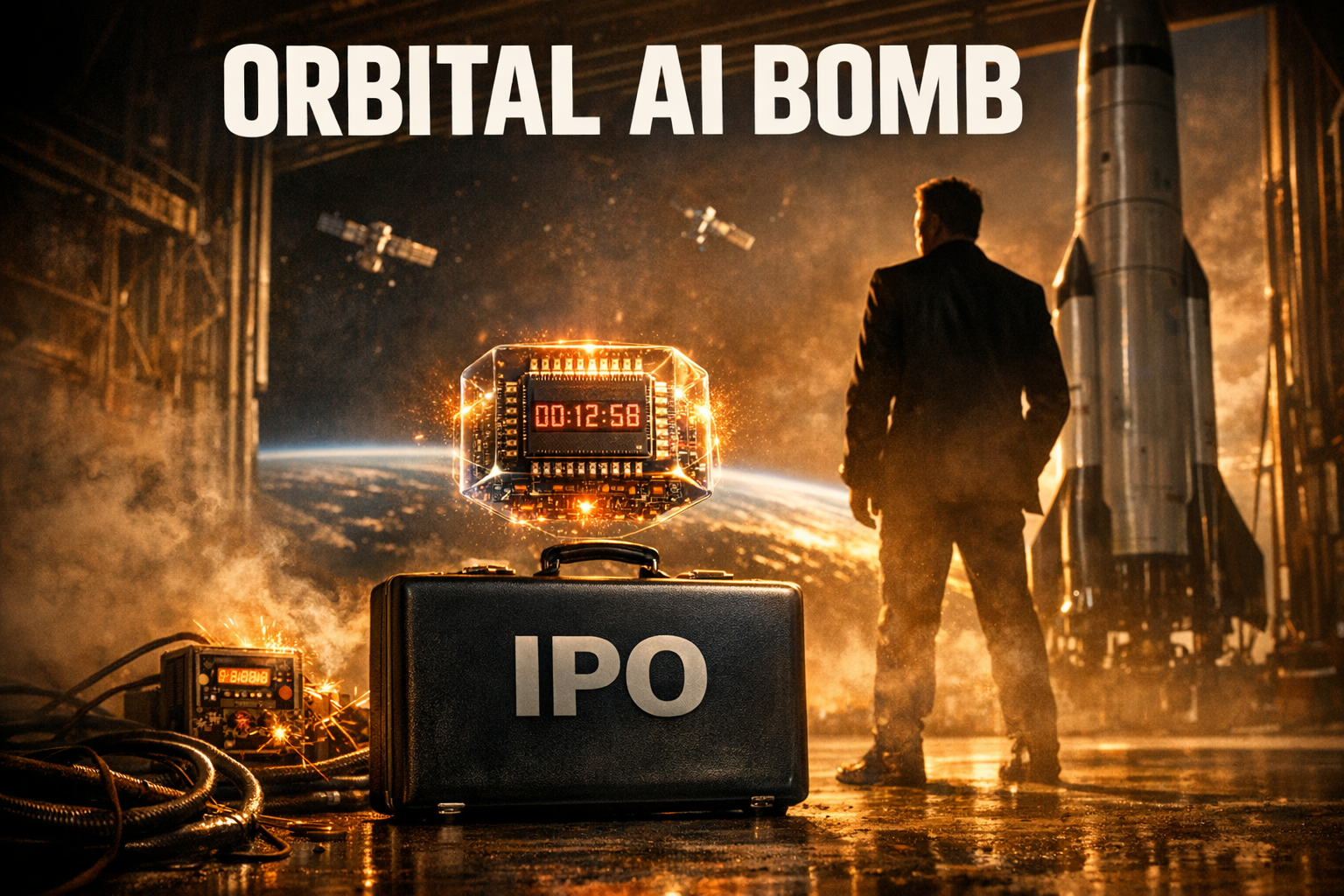
● SpaceX IPO sparks space-AI datacenter goldrush, power-crunch shockwave
What SpaceX’s IPO May Actually Target: “Orbital Data Centers” Could Reshape Global AI Leadership and the Power Constraint
The content centers on three points.
First, why Elon Musk’s claim that “AI run in space could become cheaper than on Earth within 4–5 years” may be economically plausible.
Second, why a SpaceX IPO could be more than capital raising and instead change the rules of AI infrastructure.
Third, how this trajectory could connect to inflation, interest rates, energy prices, supply chains, and AI semiconductor demand.
1) News Briefing: Core Claims Structured as Fact-Level Points
1) Musk’s framing: “The core cost of AI is electricity + cooling”
As models scale, the cost center shifts from GPU purchase price toward power consumption and cooling.
For hyperscale data centers, securing electricity (generation and transmission) and building cooling capacity are described as binding constraints.
2) Why AI could be cheaper in space: solar generation + radiative cooling + near-continuous output
The economic rationale is summarized in three points.
In space, solar power is not constrained by clouds or nighttime, enabling near-continuous generation.
Cooling could be simplified via radiative heat rejection rather than water-based cooling.
Compared with terrestrial builds, space-based systems may face fewer site, land, and local regulatory constraints.
3) Timeline: “Space-based AI compute could become the lowest-cost option within 4–5 years”
The stated timeframe is 4–5 years.
The implication is not only technical feasibility but a potential crossover in cost structure.
4) Link to a SpaceX IPO: capital to build a space-based AI network
A potential interpretation is that IPO proceeds could support further launch-cost reductions (via Starship cadence and logistics) and enable deployment of large-scale AI-capable satellites or compute payloads.
2) Macro Interpretation: Why This Could Affect Power Markets and Interest Rates
1) The next phase of the global energy contest: “AI consumes power”
Terrestrial AI scaling increases electricity demand, creating upward pressure on power prices.
Higher electricity costs can raise data center unit economics and flow through to AI service pricing and enterprise cost bases.
As a result, AI-related power costs can become an additional factor in inflation dynamics.
2) Rates and the cost of capital: data centers as infrastructure-like assets
Data centers increasingly resemble infrastructure projects, combining compute with generation, transmission access, and cooling systems.
Higher interest rates can slow CAPEX expansion, potentially extending periods of compute scarcity and sustaining higher pricing.
3) Supply-chain reconfiguration: AI demand extends beyond chips to power, thermal, and packaging
Competition is shifting toward total cost of ownership, including power efficiency, thermal performance, packaging, and power delivery/cooling solutions.
This broadens potential beneficiaries beyond leading GPU vendors to include power, cooling, and materials ecosystems.
These shifts may accelerate supply-chain reconfiguration.
3) Practical Barriers for “Orbital AI Data Centers”
1) Cooling reality: “Space is cold” does not mean cooling is easy
Despite low ambient temperatures, heat rejection in space relies primarily on radiation; radiator surface area is a major constraint.
Water cooling may be reduced, but thermal structures, area, and mass become key cost drivers.
2) Radiation and reliability: replacement and repair are difficult
Space environments increase exposure to radiation effects, including single-event upsets and material degradation.
Large-scale compute would require fault-tolerant architectures (redundancy and error correction), raising system cost and complexity.
3) Latency and bandwidth: not all workloads are suitable for space
Workload selection matters across training and inference.
Ultra-low-latency use cases (e.g., some real-time control) remain better suited to terrestrial or edge compute.
Latency-tolerant workloads (e.g., batch inference, scientific computing, climate or drug simulation) are more plausible candidates.
4) The core question: can “launch cost + operations + replacement cycle” beat terrestrial power economics?
The competitive benchmark is total cost of ownership (TCO), not electricity price alone.
A viable crossover likely requires materially lower launch cost, mass-manufactured space hardware, and an operational model that assumes replacement rather than repair.
4) The Strategic Meaning of a SpaceX IPO: Space Logistics as AI Infrastructure
1) IPO as a re-rating catalyst from “launch company” to “AI infrastructure platform”
If markets begin valuing SpaceX not only as transport/connectivity but as off-planet infrastructure that addresses AI-era power and cooling constraints, the valuation framework could shift.
2) If orbital data centers become viable, bargaining power for terrestrial data centers changes
Terrestrial expansion depends on negotiations with utilities, local governments, and regulators.
A credible “compute can move to orbit” option could shift bargaining dynamics, even without directly lowering terrestrial power prices.
3) National competition framework: “AI leadership = power + launch + orbit + communications”
AI competition may expand from model performance to a combined stack including energy access, launch capacity, orbital footprint, and communications networks (including laser links).
5) Key Considerations Often Underemphasized
Point A: The core value proposition is not “zero-cost electricity,” but avoidance of grid, permitting, and siting bottlenecks
The primary constraint for terrestrial data centers is often grid expansion, community opposition, water usage, environmental permitting, and land availability.
Shifting some workloads off-planet may provide an option to bypass these bottlenecks, potentially altering market structure.
Point B: If orbital AI scales, differentiation may shift toward power efficiency and radiation-tolerant packaging
Terrestrial deployments prioritize performance per dollar; orbital deployments prioritize performance per watt, reliability, error correction, and durability.
Potential beneficiaries could extend beyond GPU vendors to packaging, materials, power semiconductors, and communications silicon.
Point C: Combining robotics with space/terrestrial AI could affect service price structures before labor markets
Robotics adoption implies wage-structure impacts, but service unit economics may shift earlier.
If robots perform on-site tasks while AI provides centralized decision-making, costs in logistics, manufacturing, maintenance, support functions, and security could decline, changing margin structures.
Over time, this may act as a disinflationary force, while transition costs could remain material.
6) Monitoring Checklist (Investment and Industry Tracking)
- Whether SpaceX IPO disclosures emphasize space-based compute/data-center capabilities.
- Starship launch cadence, reuse turnaround time, and observed $/kg launch-cost trends.
- Effective bandwidth, latency, and cost structure of space communications (including laser links).
- Emergence of standardized space compute payloads (modular replacement, fault-tolerant design).
- Potential conflicts between national security/space regulation frameworks and data sovereignty.
This trajectory is a question of where AI infrastructure CAPEX migrates.
It also links data center expansion, semiconductor supply chains, and energy transition into a single investment theme.
AI is increasingly relevant to macroeconomic variables rather than remaining a purely technology-driven narrative.
< Summary >
Orbital AI is less about “free power” and more about bypassing terrestrial grid, permitting, and siting constraints via an alternative infrastructure option.
A SpaceX IPO could function as a catalyst for scaling a space-based AI network spanning compute, communications, and logistics.
Outcomes depend on TCO: launch economics, radiative thermal design, radiation-driven reliability engineering, communications bandwidth, and replacement-oriented operations.
The shift could influence energy transition dynamics, inflation sensitivity, interest-rate transmission, AI semiconductor demand, and supply-chain reconfiguration.
[Related]
SpaceX IPO and the shifting landscape of the space industry
Power constraints in data centers and AI infrastructure investment strategy
*Source: [ 오늘의 테슬라 뉴스 ]
– 일론 머스크의 미친 계획 드디어 현실화되나… AI를 우주로 보내겠다는 충격적 발언, 스페이스X IPO의 진짜 이유는?
● Tesla Robotaxi Crackdown Rumor, Waymo Milestone, xAI Shockwave, Short Squeeze Looms
Tesla, Waymo, and xAI in One Framework: Why “Rumors–Regulation–Robotaxis–Short Squeezes” Converge
This report consolidates five core points.
1) Why the “California sales ban” rumor emerged and why Tesla immediately rebutted it
2) The primary risk signals in robotaxi incident data (including UI-based trackers)
3) What a Korean lawmaker’s FSD ride implies for regulation and policy
4) Why Waymo surpassing 20 million rides can structurally benefit Tesla
5) Why short positioning and xAI/Optimus “distributed data center” comments point in the same direction
1) Update: The “Tesla sales suspension in California” rumor centers on advertising and terminology, not an outright ban
A Bloomberg-sourced narrative circulated suggesting Tesla vehicle sales were halted in California, creating short-term share-price volatility.
Tesla responded via an official account, stating the report was inaccurate.
The key issue is not a sales prohibition but a court-related request for consumer-protection remedies intended to prevent consumer misunderstanding.
This is primarily a constraint on marketing language and terminology (e.g., “Autopilot”), rather than a restriction on the product itself.
2) Parallel to the Delaware compensation ruling: “Protection” as rationale, “noise and cost” as outcome
A comparable pattern is highlighted: Delaware actions framed as “shareholder protection” that resulted in legal expense and operational distraction.
The California matter similarly emphasizes “protection,” while citing limited visibility of direct consumer harm cases.
Repeated regulatory/legal friction can increase incentives for companies to shift operations to jurisdictions perceived as more predictable (e.g., Texas).
This links the headline to a broader theme: migration in U.S. corporate governance and regulatory exposure, which can translate into risk premia and valuation impacts.
3) X as a rapid rebuttal channel: rumor → immediate response → faster market repricing
A practical market dynamic is the shortened cycle from headline risk to rebuttal and reassessment.
Unlike prior eras where large-media framing persisted, Tesla can now respond immediately on X, enabling quicker market repricing.
This functions as a volatility dampener via faster narrative correction.
Lower perceived volatility can reduce friction for institutional rebalancing and may affect the implied cost of capital at the margin.
4) Robotaxi incident UI disclosure: severity, causality, and reporting standards matter more than raw counts
A robotaxi tracker (UI format) is referenced, summarizing 8 incidents in Austin, Texas from July through October.
Key reported points include:
- Out of 8 incidents, 1 was classified as involving “meaningful injury,” described as minor
- Autonomous-driving incident reporting often includes any involvement regardless of fault attribution
- External factors (other vehicles, bicycles, motorcycles, animals) may be included in the same dataset
- Collisions with fixed objects can imply higher probability of system responsibility
For investors, the priority is incident causality, severity, and incident rate normalized by fleet size and miles driven, rather than absolute counts.
This framing also supports data-based regulatory engagement and disclosure strategy.
5) A Korean lawmaker’s FSD ride: the debate shifts from technology to policy design
A Korean National Assembly member publicly reported an FSD ride experience on X, stating it felt effectively complete.
The policy relevance is that deployment timelines are increasingly constrained by liability allocation, insurance frameworks, and data disclosure scope rather than core technical capability alone.
Public participation by policymakers can indicate a transition from generalized risk framing to implementation-oriented rulemaking (operating permits, incident responsibility, and data submission standards).
6) Waymo surpassing 20 million rides: demand validation that can still advantage Tesla
Waymo’s milestone supports the existence of real demand for robotaxi services and benefits the sector broadly.
6-1) Hardware cost trajectory: Waymo improves materially, but Tesla’s starting point is structurally lower
Waymo’s 5th-generation unit cost is cited at $150,000+ per vehicle, with the 6th generation expected to decline to approximately $60,000–$80,000.
Tesla’s Model Y manufacturing cost is referenced around $35,000 for potential robotaxi deployment, with additional claims that a dedicated “Cybercab” could move below $25,000 if scaled.
The implication is that Waymo is reducing cost, but Tesla’s baseline cost position is materially lower due to manufacturing scale and cost-down capability.
6-2) The primary gap is software (real-world AI); Alphabet’s potential stake sale is interpreted as capital discipline
Alphabet is cited as valuing Waymo at roughly $100 billion and considering the sale of approximately 15% (>$15 billion) to external investors.
This is framed not only as funding success but also as a signal that real-world autonomy remains capital-intensive with uncertain time-to-profitability, motivating partial risk transfer to outside capital.
7) Short interest and autonomy at scale: the condition for “short capitulation” is scaling, not demonstration
The key term emphasized is “scale.” The stated view is that short sellers who do not cover before Tesla achieves large-scale autonomy risk severe losses.
The thesis is that robotaxis shifting from pilot to scaled deployment can alter revenue, margin, and free-cash-flow narratives and reset long-duration growth assumptions embedded in valuation.
In rapid repricing phases, margin calls and forced covering can create a short squeeze, making a technology inflection a positioning catalyst.
8) xAI meeting leak (high-level): Optimus and space-based data centers as alternative compute infrastructure
Two points are highlighted:
- Optimus humanoid robots discussed as potential “distributed data center” capacity in the future
- Space-based data centers referenced, including implications extending beyond Earth orbit
The investable interpretation is not the literal timeline but the strategic direction: AI scaling is constrained by terrestrial power, cooling, siting, and local regulation.
Distributed or non-traditional infrastructure concepts indicate that AI is increasingly treated as an infrastructure competition, not only a software race.
9) A 12–13 year-old Musk email remains relevant: fundamentals over market timing
The cited points are:
- Public equities can move materially due to macro factors (rates, cycles) unrelated to company execution
- Price volatility can distract stakeholders from product and operational delivery
- Consistent market-timing outperformance is statistically uncommon
- For long-horizon conviction, maintaining necessary liquidity while holding the remainder can be a rational posture
This is positioned as relevant in environments where rates, liquidity, and cyclical uncertainty drive broad dispersion and correlated drawdowns.
10) Europe delivery data: the final two weeks can materially change quarterly totals
Aggregated weekly/daily trackable-country data indicates Tesla’s Europe deliveries remain slightly below the prior year’s Q4-to-date level but are closing the gap.
The final two weeks are described as seasonally strong and potentially decisive for the quarter’s outcome.
A separate dataset is cited indicating Tesla ranking first in brand sales in Europe on the referenced date (with limited country coverage). This is presented as a counterpoint to narratives of structural demand collapse or brand impairment, rather than as a standalone performance claim.
Key investor takeaway: real-world AI simultaneously impacts regulation, unit economics, and positioning
The central framework is not a simple “Tesla vs. Waymo” comparison, but the observation that real-world AI affects three interlocking dimensions: regulation, cost, and market positioning.
- Regulation
The California matter is characterized as a consumer-misunderstanding and terminology issue rather than a product ban.
Autonomous driving is increasingly a contest over liability and accountability design, not only technical approval. - Cost
Even with meaningful Waymo cost reductions, Tesla is presented as operating from a structurally lower manufacturing-cost base.
Competitive outcomes depend on the interaction of cost-down velocity and software scalability. - Positioning
Confirmation of scaled robotaxi deployment can shift expectations and prompt mechanical covering by short sellers.
In high-short-interest equities, technology catalysts can transmit rapidly into flows-driven price action.
In the current market, Tesla-related repricing is depicted as the intersection of macro (rates and liquidity), regulatory framing, autonomy scaling velocity, and short positioning structure.
< Summary >
The California “sales ban” rumor is framed as an advertising/terminology and consumer-misunderstanding issue, not a sales prohibition.
Tesla’s rapid rebuttal capability via X can reduce the duration of rumor-driven volatility.
Robotaxi incident evaluation should prioritize causality, severity, and normalization by exposure; reported meaningful injuries appear limited in the cited dataset.
A Korean lawmaker’s FSD ride suggests the debate is moving toward policy design (permits, liability, insurance, and data disclosure).
Waymo’s 20 million rides validate demand; however, cost structure, software scalability, and external capital dynamics are presented as reinforcing Tesla’s comparative positioning.
Scaled autonomy could catalyze short covering; xAI’s distributed-infrastructure discussion frames real-world AI as increasingly constrained by compute infrastructure.
[Related Links]
- Tesla robotaxi and FSD scaling: key watch points
- Waymo fundraising and robotaxi market structure changes
*Source: [ 허니잼의 테슬라와 일론 ]
– [테슬라] 일론 머스크가 선언한 ‘공매 세력 완전 파멸’! / 구글과 웨이모가 보여주는 테슬라 자율주행 기술의 함의 / 13년 전 일론 이메일에 담긴 투자의 정석
● Retirement Hell, Stuck Strong Dollar, Buy US ETFs Now
2026 Retirement, FX, and U.S. Equities: A Consolidated Framework for (1) Required Retirement Capital, (2) Structural Drivers of KRW Weakness, and (3) Why to Accumulate Overseas ETFs in IRP/DC
This report integrates three items:
First, a quantitative estimate of the capital required to generate KRW 3.2 million per month in retirement.
Second, a structural explanation of why USD/KRW remains elevated (beyond retail overseas equity holdings).
Third, the core rationale for accumulating overseas ETFs within retirement accounts (IRP/DC) from a tax-deferral and compounding perspective.
1) Key Items (Briefing Summary)
1-1. Retirement underfunding is quantifiable
Assuming monthly living expenses of KRW 3.2 million, approximately KRW 1.17 billion is required over 30 years.
This estimate does not fully incorporate medical costs, family support obligations, or inflation risk.
1-2. Household asset concentration in real estate is high by global standards
Korean households hold roughly 80% of assets in real estate.
In major developed markets (U.S., U.K., Germany, Japan), the typical range is ~30–50%.
A key constraint is that real estate often does not generate stable cash flow; leveraged apartments frequently rely on price appreciation rather than income, which can be disadvantageous post-retirement.
1-3. The U.S. 401(k) structure supports broad equity compounding
In the U.S., 70–80% of 401(k) assets are allocated to equities (including equity ETFs).
Multi-decade equity market appreciation, particularly in the S&P 500, has produced many cases where retirement accounts alone reached high asset levels.
In contrast, approximately 90% of Korean retirement plan assets tend to remain in principal-protected deposits, limiting long-term compounding.
1-4. Excess conservatism at younger ages can increase long-term risk
As retirement approaches, increasing principal-protected allocation is directionally appropriate.
However, for investors in their 20s–40s, overly conservative positioning can materially reduce compounding time, increasing retirement shortfall risk.
2) What “structurally elevated USD/KRW” implies
2-1. Retail overseas equity holdings matter, but are not the core driver
Retail overseas equity holdings of roughly KRW 330 trillion can contribute to FX pressure.
However, this factor alone is insufficient to explain persistent elevation.
2-2. Three structural sources of USD demand (simultaneous demand across sectors)
A central feature is concurrent USD utilization across the private and public sectors:
- Corporates: Profits (e.g., from semiconductor upcycles) are not fully repatriated and are increasingly redeployed into overseas capex and investment.
- Government: A higher intensity of U.S.-linked investment commitments and negotiation dynamics can increase USD-denominated spending.
- Households: Portfolio protection motives (FX and growth differentials) have increased allocations to overseas equities and ETFs.
When all three sectors require USD simultaneously, sustained downward pressure on the local currency becomes more likely.
2-3. Monetary conditions and liquidity can reinforce KRW weakness
In accommodative monetary environments, local liquidity (e.g., M2) can expand, creating medium-term pressure on currency value.
The focus is not short-term FX forecasting, but the structural risk that KRW-only portfolios may face reduced long-term purchasing power resilience.
3) Similarities vs. differences relative to Japan (mid-1980s to 1990s)
3-1. Similarities: Slowing growth, rising outbound investment, limited domestic opportunity set
Lower domestic growth and weaker local return expectations can drive capital outward, consistent with certain historical parallels.
3-2. Key difference: Japan invested abroad during JPY strength; Korea is investing abroad amid KRW weakness
Following the Plaza Accord, Japan operated under a stronger currency, lowering the effective cost of overseas assets.
Korea is allocating to overseas assets while the KRW is relatively weak, increasing the cost of USD assets, raising import-price sensitivity, and increasing the barrier to entry for overseas investment.
4) The core advantage of overseas ETFs within IRP/DC
4-1. Primary advantage: Tax deferral and compounding, not headline returns
In taxable accounts, realized gains taxation can reduce compounding efficiency.
In retirement accounts, taxes are generally deferred and may be recognized later under potentially lower effective rates when paid as pension income, increasing the value of long holding periods.
4-2. IRP tax credits function as an initial capital accelerator
Annual tax benefits (including references to a KRW 9 million annual limit) can increase investable principal early, improving long-term compounding.
4-3. Dividend-first is not necessarily optimal; reinvestment can be more efficient in growth regimes
A common “retirement equals dividends” framing is not universally optimal.
In growth-driven regimes, retaining earnings via reinvestment may outperform pulling forward cash distributions; if cash is required, partial sales of growth assets can be a more efficient mechanism than relying exclusively on dividend payouts.
Recent relative performance of dividend-focused ETFs has been cited as less competitive.
5) Practical translation of “accumulate these ETFs in retirement accounts”
The implied objective is to reduce exposure to domestic market range-bound risk and KRW concentration, while increasing exposure to U.S. innovation and USD-linked assets.
5-1. Core allocation: Broad U.S. index ETFs for long-term compounding
A broad U.S. market or S&P 500-type ETF is positioned as the retirement-account core holding.
Reference frameworks such as the Buffett-style split (equities plus U.S. Treasuries) are used to illustrate the strategic intent.
5-2. Satellite allocation (optional): U.S. innovation sectors with higher risk and higher growth exposure
The U.S. equity market features ongoing leadership rotation and innovation dynamics, with examples such as long-horizon value creation in semiconductor and compute-linked firms.
This supports a strategy to maintain long-duration exposure to an innovation premium.
5-3. Consistent contributions dominate timing considerations
Retirement accounts are structurally suited to rule-based accumulation and periodic rebalancing rather than tactical trading.
In elevated FX conditions, the primary decision variable is less the short-term exchange-rate peak and more the long-term purchasing-power hedge and global diversification achieved through sustained contributions.
6) Underemphasized but decision-relevant takeaways
6-1. FX is not driven solely by retail flows; multi-sector USD demand is critical
Attributing FX weakness only to retail “overseas investing” is incomplete.
The simultaneous USD demand from corporates, government, and households increases the probability that FX normalization may be slower than commonly assumed.
6-2. The dominant domestic risk is cash-flow structure, not only price-level returns
High real-estate concentration can inflate reported wealth during appreciation cycles, but may fail to generate sufficient retirement cash flow.
For retirement planning, sustainable cash flow is often more critical than nominal asset value.
6-3. Retirement accounts should be treated as compounding engines, not only tax-savings tools
Tax credits alone are insufficient as a strategy.
Tax deferral enables uninterrupted reinvestment and is a core driver of long-horizon outcomes, motivating a shift from deposit-heavy allocations toward global asset allocation.
6-4. Domestic bias framed as patriotism is not an investment criterion
Retirement outcomes are driven by growth, innovation capacity, currency exposure, and tax structure.
Portfolio decisions should be based on these variables rather than non-financial narratives.
7) Positioning the framework within a 2026 global view (macro + AI)
The recurring competitive advantage cited for U.S. markets is innovation.
Into 2026, the innovation center remains AI infrastructure (semiconductors, cloud, data centers) and productivity transformation.
A U.S. index-centered retirement core can be interpreted as exposure not to single-name outcomes, but to broader U.S. corporate margin and earnings dynamics influenced by the AI cycle.
Key macro variables to monitor (5):
- Potential transition toward rate cuts
- Re-acceleration risk in inflation
- Persistence of structurally elevated USD/KRW
- Global recession risk and corporate earnings resilience
- Long-term performance dispersion between domestic concentration and global diversification
< Summary >
To fund KRW 3.2 million per month over 30 years, approximately KRW 1.17 billion is required; heavy real-estate concentration (~80%) weakens retirement cash-flow capacity.
U.S. retirement plans are equity-ETF centered, enabling compounding; Korea’s retirement assets remain largely in deposits, limiting growth.
Elevated USD/KRW reflects not only retail overseas investing but concurrent USD demand from corporates, government, and households, alongside liquidity conditions.
Overseas ETFs are structurally more efficient in IRP/DC due to tax deferral and compounding; reinvestment-focused approaches may be more efficient than dividend-first positioning depending on regime.
A long-term shift away from KRW-only concentration toward U.S. broad indices and global diversification is the primary strategic implication.
[Related Links…]
Retirement pension IRP: How to compound overseas ETFs with taxes and rebalancing
https://NextGenInsight.net?s=retirement-pension
USD/KRW 1500-era framework: How to size USD assets
https://NextGenInsight.net?s=exchange-rate
*Source: [ Jun’s economy lab ]
– 한국에 투자하면 가난해집니다 퇴직연금으로 이 ETF 사 모으세요(ft.최만수 기자 1부)