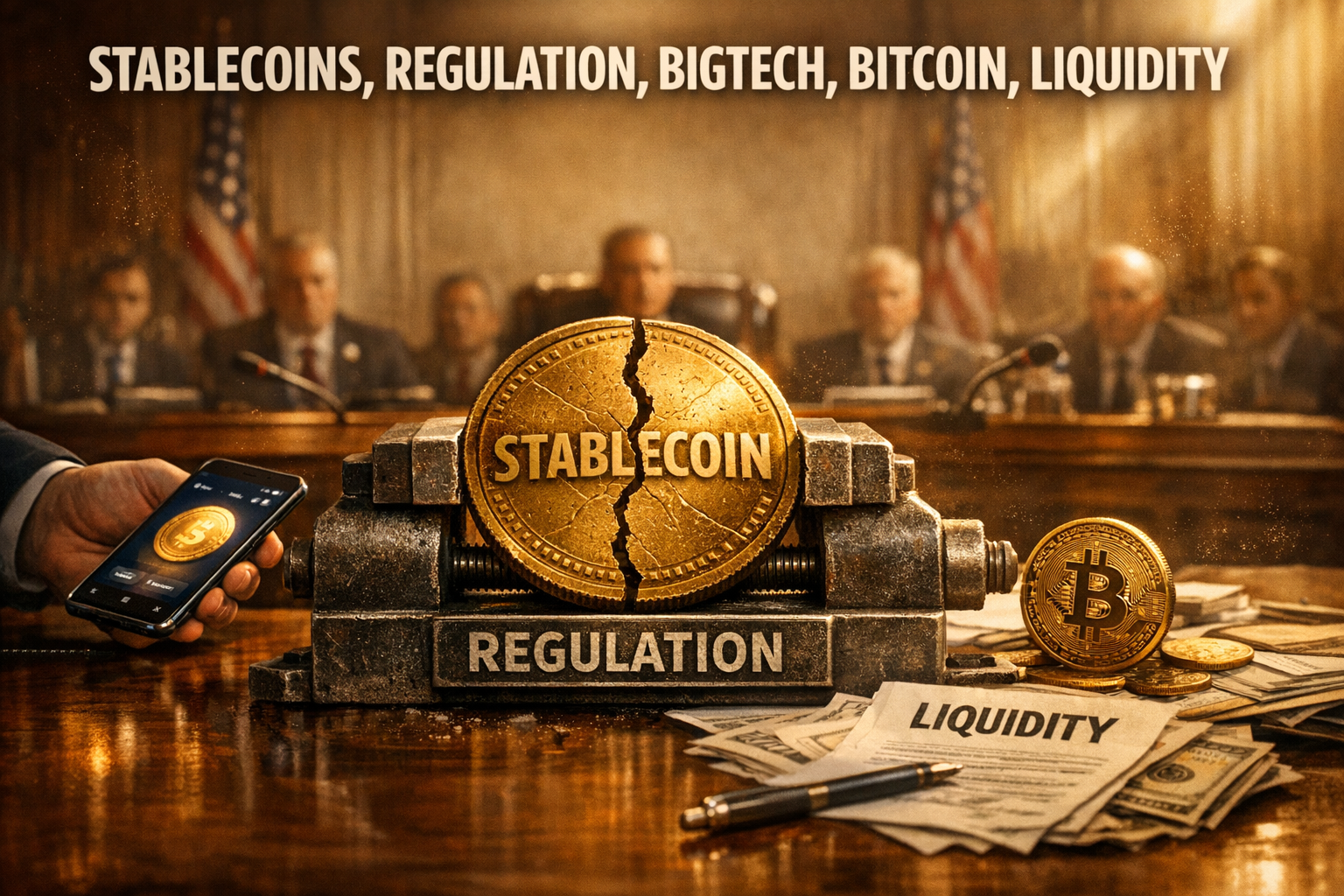
● 2026 Stablecoin War, Big Tech Coins vs Bank Cartels, Bitcoin Shock
The 2026 “Stablecoin War” Begins: GoogleCoin and TeslaCoin vs. Bank-Consortium Coins—and the Implications for Bitcoin
This report focuses on four points.
First, why stablecoins may enter a rapid expansion phase in 2026 (regulatory path and timeline).
Second, where Big Tech-issued coins (Google, Tesla, Meta) are structurally advantaged and disadvantaged (UI/UX vs. monetization).
Third, why Wall Street and major banks may prioritize B2B settlement and RWA over mass-market B2C coins (economic incentives).
Fourth, why stablecoins’ impact on Bitcoin is better understood as liquidity-driven correlation rather than direct causality.
1) News Briefing: Why the 2026 Stablecoin War Is Being Positioned Now
– The competitive landscape is a three-player dynamic: government, Big Tech, and Wall Street.
– While positioned as a payment instrument, the core battleground is reserve assets (Treasuries and cash equivalents) and user lock-in.
– As U.S. regulation (e.g., stablecoin legislation and supervisory guidance) becomes clearer, a 2026 sequence of “whitepaper disclosure → partner announcements → commercial launch” becomes more likely.
A key observation is the current lack of visible activity despite the scale of the opportunity.
Large market shifts often occur after periods of limited public signaling.
2) Three Participant Groups in the 2026 Stablecoin Market: Competitive Advantages by Segment
2-1) Big Tech (Google, Tesla, Meta, X, etc.): Differentiation Through UI/UX and Lower Payment Friction
Big Tech stablecoins are structurally constrained in offering interest in a bank-like manner.
However, their advantages are concentrated in distribution and product experience.
– Advantage 1: Superior UI/UX
Stablecoins are difficult to differentiate at the asset level given the 1 coin = 1 dollar construct; the primary competition shifts to interface, user journey, and settlement speed.
– Advantage 2: Lower unit economics of payments (reduced friction costs)
Big Tech often treats payments as a mechanism to reduce ecosystem friction rather than as a standalone profit center.
Reducing fees, settlement delays, and FX costs can support growth in commerce, advertising, and subscriptions.
– Likely implementation: Parallel preparation of proprietary networks and issuance on existing public chains
A dual-track approach preserves optionality and enables synchronized market entry.
2-2) Wall Street and Banks (including JP Morgan-scale institutions): Monetization Design and Regulatory Asset Access
A common assumption is that banks will compete head-on with Big Tech via B2C stablecoins. Economic incentives suggest a different path.
– Why banks may avoid large-scale B2C stablecoins: internal conflicts with deposit-based banking economics
Banks rely on deposits as a funding base and net interest margin through lending.
Broad B2C stablecoin issuance can accelerate migration from deposits to token balances, pressuring the deposit franchise and internal P&L alignment.
– Preferred path 1: B2B stablecoins for corporate payments and settlement
B2B settlement fees and operational costs are material.
Banks can preserve existing relationships while improving efficiency via blockchain-based rails.
– Preferred path 2: RWA (real-world asset tokenization) to control core collateral and compliant issuance
RWA requires AML/KYC compliance and fits the institutional regulatory perimeter where traditional finance has structural advantages.
Banks can enable the payment layer while capturing value via reserves, collateral, and tokenized asset infrastructure.
This aligns with broader institutional trends, including tokenized assets and digital bond issuance.
Reserve construction becomes a competitive variable as interest-rate and USD liquidity regimes shift.
2-3) Government and Politics (U.S.): Rulemaking and Treasury Demand
Government acts as the rule-setter and may also be an indirect beneficiary through Treasury demand.
Many stablecoin models hold short-dated Treasuries and cash equivalents as reserves; wider stablecoin adoption can broaden the buyer base for government securities.
Regulatory momentum is also linked to political cycles and administrative priorities.
Once policy uncertainty declines and rules are finalized, market participants typically accelerate execution.
This underpins the 2026 acceleration scenario.
3) In a Multi-Issuer Market, Is There a Single Winner?
A plausible market structure is analogous to multiple issuers distributing proprietary store-of-value instruments within their ecosystems.
Potential competitive sequence:
– Phase 1: Ecosystem payments and lock-in competition → rapid proliferation of coin types
– Phase 2: Interoperability, exchange, and settlement standards → consolidation into a limited set of dominant rails
– Phase 3: Collateral quality, trust, and regulatory compliance → increased probability that Wall Street controls the economic backbone
The most widely used coin and the entity that captures the majority of economics (reserves, settlement, RWA infrastructure) may diverge.
4) Stablecoins vs. Bitcoin: Competitive and Complementary Dynamics
4-1) Competitive pressure: stablecoins may dominate the payments narrative
If stablecoins become the default “on-chain dollar” for payments, Bitcoin’s original peer-to-peer payments narrative may weaken.
Developer and product momentum has generally favored programmable chains for payments and settlement expansion rather than Bitcoin as a payments platform.
4-2) Complementarity: increased on-chain liquidity can support Bitcoin as a store-of-value asset
Stablecoin growth increases on-chain USD liquidity.
In periods of currency debasement concerns or macro uncertainty, capital often reallocates toward perceived hedges such as gold, equities, real estate, and Bitcoin.
Summary framing:
– Payments utility: potentially unfavorable for Bitcoin
– Liquidity and store-of-value demand: potentially supportive for Bitcoin
This dynamic is consistent with macro observations: higher inflation pressure and shifts in USD liquidity often coincide with increased demand for alternative stores of value.
5) Key Points Often Underemphasized in Market Coverage
– Point 1: Large-scale bank B2C stablecoins can cannibalize the deposit base
Public narratives focus on “banks issuing coins,” but internal economic incentives and franchise protection frequently constrain B2C scale.
As a result, banks may prioritize B2B settlement and RWA-oriented strategies.
– Point 2: The decisive factor is reserve-asset constraints and redesign, not branding
As adoption grows, stakeholders may question whether reserves limited to USD cash and Treasuries remain sufficient under purchasing-power erosion concerns.
Pressure for reserve expansion (e.g., tokenized assets and on-chain collateral) would structurally favor institutional balance-sheet and market-infrastructure providers.
– Point 3: Big Tech can replicate “interest-like” value via benefits and experience rather than explicit yield
Examples: fee waivers, subscription bundles, commerce credits, membership benefits, and AI-driven payment optimization.
These can increase perceived consumer surplus without constituting regulated interest-bearing products.
6) Monitoring Checklist Through 2026
– How Big Tech integrates wallets into operating systems and core services
– Whether banks emphasize B2B settlement and RWA tokenization over B2C issuance in public disclosures
– The permissible scope of stablecoin reserve assets (cash/Treasuries vs. broader eligibility)
– The trajectory of USD liquidity and interest rates (directly linked to risk-asset appetite)
– The growth rate of stablecoin supply and co-movement with Bitcoin (correlation monitoring)
< Summary >
2026 may represent an inflection period in which regulatory clarity enables simultaneous acceleration by Big Tech, Wall Street, and government stakeholders, increasing the number and scale of stablecoin launches.
Big Tech’s advantage is product distribution, UI/UX, and payment-friction reduction; Wall Street’s advantage is B2B settlement economics and RWA infrastructure that controls collateral and compliant issuance.
Banks may avoid direct B2C competition due to deposit-franchise cannibalization risk and instead pursue B2B and RWA-led strategies.
Stablecoins may weaken Bitcoin’s payments narrative while potentially supporting Bitcoin via expanded on-chain USD liquidity and store-of-value demand.
[Related Articles…]
- Stablecoin War: 2026 Payment Power Scenarios (Comprehensive Overview)
- Bitcoin and USD Liquidity: The Core Mechanism Behind Price Dynamics
*Source: [ 경제 읽어주는 남자(김광석TV) ]
– 구글코인·테슬라코인 현실화? 2026년 스테이블코인 전쟁 시작 ‘춘추전국시대’ 온다. 빅테크 vs 월가, 승자는 누가 되나… | 경읽남과 토론합시다 | 김창익 작가 3편
● Geopolitical Shockwave, Rare-Earth Crunch, EV Price War, Busan Logistics Boom
2026 Investment Landscape: Why Claims Like “Sell Everything (e.g., Samsung Electronics, Doosan Enerbility)” Are Circulating — Geopolitical Risk, the Rare-Earth Supply War, EV Industrial Leadership, and the Busan–Ulsan–Gyeongnam Logistics Thesis in One Report
The primary risk in the current market is the assumption that “a good company can simply be held indefinitely.” This report consolidates four core themes:(1) Why volatility in 2026 could rise materially (geopolitics + elections + policy)
(2) How the rare-earth/supply-chain conflict transmits into semiconductors, batteries, and robotics
(3) The EV leadership contest: identifying where value and profits accrue beyond “batteries”
(4) The structural meaning of the Busan–Ulsan–Gyeongnam thesis (logistics, infrastructure spending, aerospace)
A final section highlights key points frequently underemphasized in mainstream coverage.
1) News Briefing: 2026 Investment Keyword = Volatility and Defense Under Geopolitical Risk
Key takeaway: “Provocations in the West Sea, the Senkaku/Diaoyu Islands, Taiwan-related risk… domestic local elections and the U.S. midterms… conclusion: elevated uncertainty and volatility.”
Market implication: periods where markets react more to headlines (events) than fundamentals (earnings) may lengthen. Equity outlooks based solely on earnings and interest rates may be less reliable.
Geopolitical risk can also transmit through inflation and rates. Rising commodity costs, logistics expenses, and insurance premiums can increase costs. Monetary policy may remain more hawkish to contain inflation. The chain is:global supply shock → higher costs → inflation/rate pressure → valuation compression
2) The Meaning Behind “50% Cash”: Cash as an Option on Entry Timing
Statement: “Maintain roughly 50% cash… deploy aggressively during sharp volatility.”
This should not be interpreted as a permanent cash allocation. The core principle is that cash is a tool to monetize volatility through disciplined entry.
Operational framework:
- Normal conditions: prioritize position and risk management over trend-chasing
- Sharp drawdowns: pre-defined, staged entries (notably in supply-chain/industrial enabling segments)
- Sharp rallies: accelerate profit-taking; volatility regimes tend to exhibit stronger mean reversion
3) Rare-Earth Conflict: A Supply Variable That Disrupts Semiconductors, Robotics, and Batteries
Point: “In a rare-earth conflict-driven volatility regime, timing matters more than trend.”
The investment-relevant question is: “Who can pass through higher input costs?”
When rare earths and critical minerals tighten, multiple chains are affected:
- EV drivetrains and motor efficiency (magnet/material constraints)
- Robotics and automation (motors, reducers, sensor supply chains)
- Defense, aviation, and space (specialty materials and component procurement risk)
In 2026, thematic alignment is insufficient; winners are more likely to be firms that can preserve delivery schedules and margins under supply disruptions.
4) EV Leadership Contest: Winners Are Where Structural Profit Pools Persist
Statement: “2026: the EV leadership contest… winners include batteries, space, and logistics.”
EV market growth does not imply broad, uniform upside across all battery-related equities. Dispersion may increase, with differentiation driven by margins, cash generation, and policy eligibility.
Structural checklist:
- Demand: in a slowdown, premium EVs may underperform; mix may shift toward mass-market and commercial fleets
- Supply: capacity expansion competition may evolve into pricing pressure
- Policy: U.S./EU subsidy rules (origin and supply-chain requirements) can directly impact reported results
Conclusion: “EV = buy batteries” is insufficient. Priority factors include policy-compliant supply chains, customer lock-in, and cost pass-through capability.
5) The Structural Meaning of the Busan–Ulsan–Gyeongnam Thesis: Policy- and Budget-Driven Growth in Logistics, Infrastructure, and Aerospace
Statement: “Relocation of the Ministry of Oceans and Fisheries… Busan as a logistics hub… leading logistics names…”
Rather than focusing on individual tickers, the relevant mechanism is structural:
- Ports/shipping/hinterland: potential beneficiary of rising throughput and supply-chain reconfiguration
- Infrastructure (rail/road/port): budget execution creates tangible demand and flows into adjacent industries
- Aerospace/defense: higher reliance on public procurement and R&D can produce a distinct cycle profile
Interpretation: the thesis is less about regional consumption and more about policy-driven capital allocation and logistics-network redesign.
6) Shipbuilding, Defense, and Semiconductor Equipment/Materials: What “Buy on Sharp Pullbacks” Typically Refers To
Statement: “Shipbuilding and defense… semiconductor equipment/materials should be bought on sharp drawdowns.”
This is not a generic “good sector” endorsement. It is a claim that purchase timing differs materially by sector in volatility regimes.
- Shipbuilding/defense: backlog can support downside resilience, but event risk (conflict, export policy, procurement) can drive sharp swings
- Semiconductor equipment/materials: sensitive to customer capex cycles and inventory corrections; deeper drawdowns can create asymmetric entry points
In 2026, returns may be driven more by “when/how to buy” than by “what to buy.”
7) Key Points Often Underemphasized in Mainstream Coverage
① Geopolitical risk is a filter for pricing power (margins), not merely a fear catalyst.
Even when revenue grows, firms with faster-rising input costs can see profits deteriorate. Differentiation increasingly depends on cost pass-through.
② In 2026, performance may depend less on cash levels than on re-entry rules.
The key distinction is whether an investor freezes during drawdowns or executes a pre-defined staged-buy plan.
③ “Busan–Ulsan–Gyeongnam logistics” may reflect an endpoint of supply-chain reconfiguration, not a short-lived theme.
If China risk, freight rates, insurance costs, and route risk converge, logistics hubs can shift, reshaping industrial demand patterns.
④ Extreme comments such as “sell mega-caps” should be read as regime warnings, not single-stock judgments.
The concern is that “wait for recovery” may underperform in volatility regimes where policy, FX, and export cycles are simultaneously unstable.
8) Checklist: Six Daily Indicators for a 2026 Volatility Regime
- During geopolitical events: whether energy, freight, and insurance metrics rise concurrently
- Rare earths/critical minerals: effective dates of export controls, quotas, and tariffs
- EVs: subsidy eligibility changes (origin/supply chain) and actual sales-mix shifts
- Logistics: port throughput, freight indices, and major route risk
- Semiconductors/equipment-materials: customer capex guidance and inventory indicators
- Domestic policy: pace of budget execution for regional infrastructure/industrial clusters/aerospace programs
< Summary >
The 2026 environment may be characterized by volatility driven by geopolitics and elections, with market sensitivity shifting from earnings to headline risk. The rare-earth conflict is not solely a resource story; it can disrupt supply chains and margins across semiconductors, batteries, robotics, and defense. In EVs, differentiation is likely to depend on policy eligibility, pricing power, and unit economics rather than headline growth. The Busan–Ulsan–Gyeongnam logistics/infrastructure/aerospace narrative is better framed as structural change driven by supply-chain reconfiguration and public spending. Ultimately, outcomes may depend less on static cash allocations and more on disciplined re-entry rules such as staged buying during drawdowns.
[Related Articles…]
- Rare-Earth Supply-Chain Conflict: Comprehensive Assessment of Implications for Korean Industry (https://NextGenInsight.net?s=rare%20earth)
- Global Logistics Regime Shift: Port Throughput, Freight, Supply-Chain Reconfiguration Investment Framework (https://NextGenInsight.net?s=logistics)
*Source: [ 달란트투자 ]
– “삼성전자 두산에너 싹다 정리” 곧 끔찍한 일 벌어진다 | 이승조 무극선생 풀버전