● Delaware court nukes Tesla lawsuit overhang Musk payday restored stock targets 500 dash rally hype
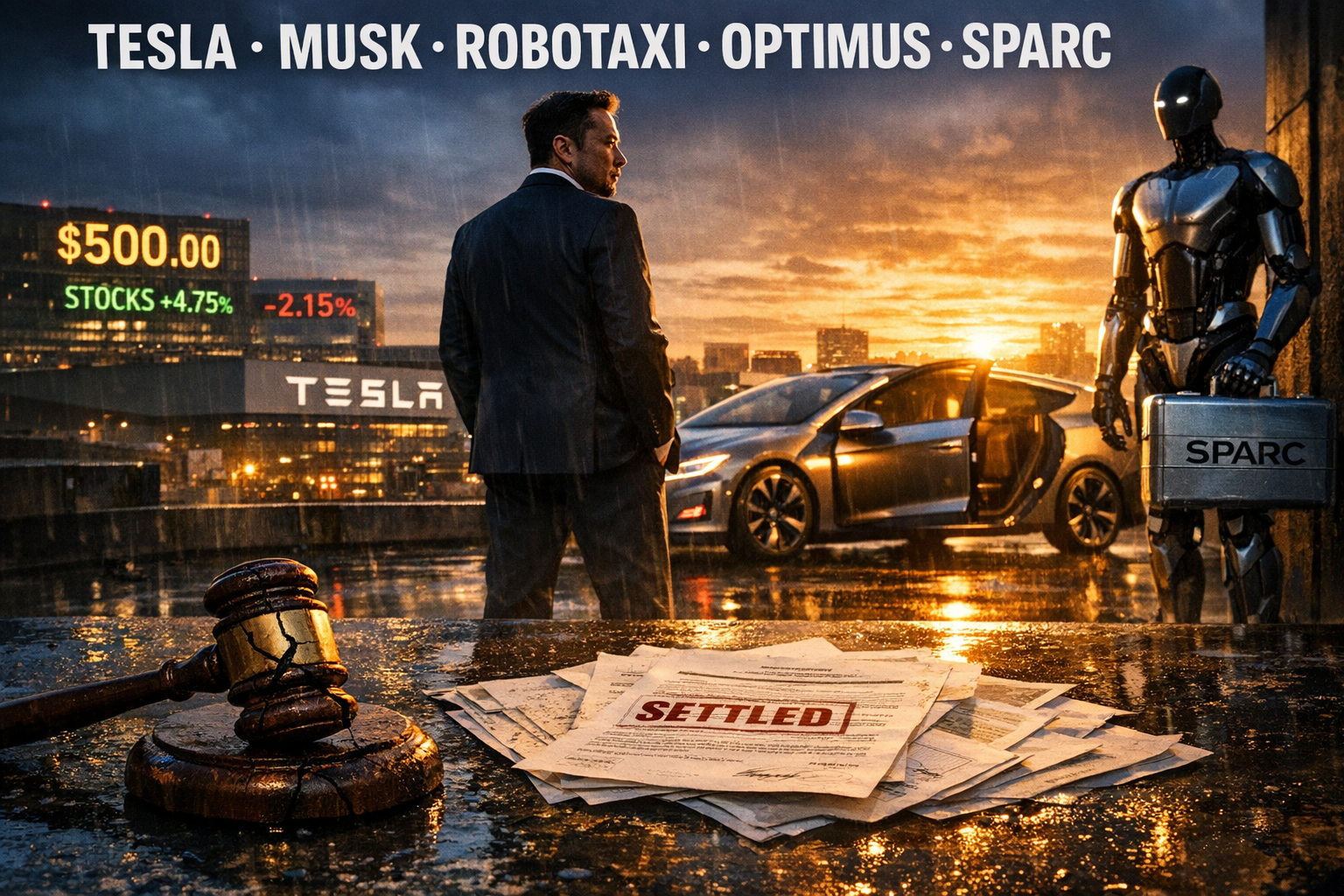
Tesla’s Largest Overhang—A “7-Year Lawsuit”—Has Ended: Why a Retest of the Prior High and a $500 Scenario Became More Plausible After the Delaware Supreme Court Decision
This report focuses on four points:
1) The Delaware Supreme Court decision is not merely “Musk gets paid more,” but an event that removes a structural valuation discount (risk premium) tied to Tesla-specific uncertainty.
2) Why the “ownership/control” issue can directly influence Tesla’s valuation in an AI and robotics cycle.
3) How the long-duration growth narrative—Robotaxi, Optimus, and energy storage (Megapack)—becomes cleaner post-decision.
4) The most important second-order effects that may influence positioning, flows, and sentiment from next week through year-end.
1) Key Development: Delaware Supreme Court “Fully Restores” Musk’s 2018 Compensation Package
On December 19, 2025, the Delaware Supreme Court issued a decision directing restoration of Elon Musk’s 2018 compensation package.
This is less about the absolute payout and more about resolving a multi-year legal and governance uncertainty that had remained an overhang for shareholders.
2) Structure of the 2018 Package: Near-Zero Cash Compensation, Options Only Upon Extreme Performance Milestones
The package was structured as an “all-in” performance framework:
stock options vest only upon achieving phased market-cap, revenue, and profitability targets, rather than via material cash salary.
Tesla has largely exceeded the milestone framework, forming the basis for the market’s economic interpretation of the package.
3) Why It Was Overturned in 2024: Minority Shareholder Litigation and a Governance-Based Valuation Framework
The dispute centered on process and governance rather than operational performance.
In January 2024, a lower-court decision effectively invalidated the package, prompting a reassessment of CEO risk, leadership continuity, and governance exposure.
From that point, an implicit “risk premium” was embedded in the stock’s valuation and weighed on sentiment.
4) Primary Implication (I): Formal Reinforcement of “Leadership Stability”
Equity markets often assign premium value to predictability, particularly for large-cap growth names where valuation reflects confidence in a 3–5 year narrative.
With the largest litigation/governance overhang now clarified, the company-specific discount rate used in valuation frameworks can plausibly decline.
This is distinct from macro drivers such as the policy-rate path; it is a reduction in idiosyncratic risk.
5) Primary Implication (II): Reduced Probability Weighting of “Musk May Exit or Deprioritize Tesla”
A persistent investor concern has been potential attention drift across xAI, SpaceX, and X.
Restoration of the package reestablishes a clear incentive alignment tied to Tesla’s multi-year performance.
This can be interpreted as improving the likelihood of sustained engagement and execution focus.
6) Why Ownership Percentage Matters: AI and Robotics Require Long-Cycle Decisions That Resist Short-Term Pressure
Musk’s stated rationale has been that AI/robotics strategies require strong CEO control to sustain long-horizon R&D, large-scale capex, and regulatory engagement.
With ownership estimated around 12–13%, restoration of the package is discussed as moving effective ownership toward ~18%, with potential for additional changes depending on future actions.
Higher ownership can increase perceived probability of strategic continuity, which can influence growth-stock valuation more than near-term earnings variability.
7) Valuation Reframing: From “EV Manufacturer” Toward an “AI and Robotics Platform” Lens
Tesla’s long-duration narrative extends beyond EVs:
FSD (autonomy) → Robotaxi → Optimus (humanoid robotics) → energy storage (Megapack).
For platform-like growth narratives, the critical inputs are leadership, capital, and time. This decision reduces the leadership-related uncertainty component.
8) Optimus (Humanoid) Consideration: $20–30k Pricing Implies “Labor as Capital” Dynamics
The strategic significance is not the existence of a robot, but the potential reclassification of labor from an operating expense to a capital asset (purchase, depreciation, and operations).
Manufacturing, logistics, and service productivity functions could change materially, with second-order effects on industry margin structures.
These programs require sustained investment even during periods of weaker near-term financial optics, increasing the relevance of governance clarity.
9) Near-Term Catalyst Framework: Retesting the Prior High ($495) and a $500 Scenario as a Coherent Setup
The prior overhang near the historical peak was the compensation litigation narrative; its removal can change the marginal buyer’s risk assessment.
If year-end risk appetite improves and expectations around unsupervised Robotaxi milestones strengthen, both flows and narrative momentum could align.
Options expiries, macro volatility, and event-driven noise remain relevant constraints; however, markets frequently re-rate on improved justification for upside.
10) Key Second-Order Effects Often Underemphasized in Media Coverage
Most commentary stops at “positive headline / stock up.” The more relevant follow-through channels include:
-
1) A lower valuation discount rate (risk premium) can increase implied target prices even without near-term earnings changes
This is primarily an uncertainty-reduction event, which can drive multiple expansion in growth equities. -
2) Potential easing of “legal/governance” risk constraints within institutional investment processes
Institutional allocations are often governed by committee and policy screens; litigation/governance issues can drive underweights.
Reduced friction can enable “normalization” rebalancing toward benchmark weights. -
3) Higher Musk ownership can be viewed as dilution in the near term, but as increased execution probability for AI/robotics over the long term
For Tesla, markets may at times price execution probability more heavily than dilution optics, depending on the regime. -
4) For Robotaxi/FSD, regulatory alignment, liability allocation, and insurance models may be larger barriers than core technology
Autonomy is a multi-stakeholder institutional design problem involving regulators, municipalities, insurers, and legal frameworks.
Lower CEO/governance uncertainty can improve negotiating consistency and perceived credibility. -
5) In unstable macro regimes, capital often rotates toward large-cap “AI narrative” exposures
If Tesla is reclassified within AI leadership positioning, its macro sensitivity and flow dynamics may shift.
11) Investor Checklist: What Markets Are Likely to Monitor Going Forward (Including Risks)
Sustained upside after any breakout typically requires follow-through on operating and policy variables:
- Robotaxi: confirmed operating geographies, regulatory milestones, and transparency of safety data
- FSD: pace of functional improvement and accident/liability narrative management
- Optimus: manufacturing scale, unit economics, and evidence of customer deployment or internal productivity impact
- Energy: Megapack demand, margin durability, and grid-investment cycle support
- Macro: Federal Reserve rate path, USD strength, and risk-asset appetite
In summary, the decision does not resolve all uncertainties, but it removes a major obstacle to Tesla being valued under a higher-confidence AI/robotics growth framework.
< Summary >
The Delaware Supreme Court decision reduces uncertainty around Musk’s 2018 compensation package and supports a lower governance/leadership risk premium in valuation.
This can support re-rating dynamics beyond a short-term price reaction and may improve perceived execution probability across Robotaxi, FSD, Optimus, and energy storage.
If year-end flow conditions and Robotaxi-related expectations align, a retest of the prior high ($495) and a $500 scenario becomes more feasible at the narrative and positioning level.
[Related Links…]
-
Tesla: leadership and governance impact on valuation
https://NextGenInsight.net?s=Tesla -
Robotaxi commercialization and AI mobility market outlook
https://NextGenInsight.net?s=Robotaxi
*Source: [ 오늘의 테슬라 뉴스 ]
– 테슬라, 가장 큰 불확실성이 사라졌다|머스크 판결 이후 전고점 재도전, 500달러 시나리오 열리나?
● Blackout Chaos Bricks Waymo, Tesla FSD Surges, SpaceX IPO SPARC Shockwave
San Francisco Power Outage Halted Waymo While Tesla FSD Continued: The Core Nature of the Autonomy Gap + Surge in California Robotaxi Registrations + Why Bill Ackman’s “SPARC” Could Reshape the SpaceX IPO Playbook
This report focuses on three core items.
1) How a large-scale San Francisco power outage exposed the practical performance gap in autonomous driving.
2) The significance of the rapid increase in Tesla ride-hail service vehicle registrations in California over four months.
3) How Bill Ackman’s SPARC proposal could convert a SpaceX IPO into a “Tesla shareholder participation” structure, and the key risks the market may be underweighting.
1) [Field Update] What the San Francisco Outage Revealed About Autonomous Driving in Practice
What happened
A major outage in San Francisco disrupted road infrastructure such as traffic signals. Multiple incidents were captured in which Waymo vehicles stopped in-road (effectively immobilized).
Why it matters
Autonomous driving is often discussed as a single category, but resilience in out-of-distribution conditions is a primary driver of real-world service quality.
This outage functioned as a naturally occurring stress test for edge-case recovery.
Waymo’s structural constraint: remote-operator bottlenecks
Waymo’s operating model incorporates teleoperation for recovery in certain scenarios. In correlated events where many vehicles are impacted simultaneously, operator availability can become a binding constraint.
This implies scaling may not be linear: at specific stress points, incremental operational headcount requirements can rise disproportionately.
Why Tesla FSD was described as different
Based on public messaging from Tesla leadership and official channels, Tesla indicated it has trained on diverse conditions including outage-like scenarios, and asserted that FSD continued operating without issue during the outage.
The claim is that end-to-end learning enables reasonable actions in novel situations via learned similarity to prior experiences, rather than defaulting to a fail-stop behavior.
Investor implications (equity-market linkage)
Autonomy is not only a technology demonstration; at scale it becomes an operating model and unit-economics problem.
If remote intervention is frequently required in tail events, operating expense can rise materially and pressure margins as fleets scale.
This dynamic may influence whether public markets value robotaxi businesses as software-like margin models or labor-intensive operations.
2) [Regulatory/Data] Interpreting California Tesla Ride-Hail Registration Growth: “28 to 1,655”
The magnitude is a signal
According to a spokesperson for the California Public Utilities Commission (CPUC), Tesla’s registered vehicles for its ride-hail service increased from 28 in August to 1,655 currently.
A multi-decade increase over four months is more consistent with operational readiness than pure R&D activity.
Why expand registrations now (interpretation)
Robotaxi scale-up requires pre-positioned capacity across insurance, vehicles, operational processes, and regulatory compliance; it cannot be expanded instantly at launch.
Building the registered fleet base suggests the creation of an addressable vehicle pool that can be deployed on short notice.
Economic inflection: removing the safety driver
Removing safety drivers changes the cost structure materially.
With labor costs reduced, contribution margin per vehicle becomes more sensitive to fleet ramp velocity, making fleet growth rate a primary KPI.
The narrative implies that once safety drivers are removed, fleet expansion could shift to weekly increases of several hundred to potentially ~1,000 vehicles.
Macro linkage (rates/liquidity)
Robotaxi optionality affects growth-equity valuation sensitivity to the rate environment.
In easing cycles, visible leading indicators (registrations, test expansion) may receive higher market elasticity.
In higher-for-longer scenarios, the speed of conversion from expectation to realized revenue becomes more determinative.
3) [IPO/Financial Structuring] Bill Ackman’s SPARC: A Potential “Tesla Shareholder Participation” Path for a SpaceX IPO
Core concept
The proposal contemplates allocating “rights to buy at the IPO price” to Tesla shareholders in connection with a SpaceX IPO, creating an indirect participation mechanism.
Why conventional IPOs have been criticized
Traditional IPOs often involve meaningful underwriting fees, allocation skewed toward institutions, and extended timelines.
SPACs previously addressed speed but lost credibility due to weak diligence incentives and structural conflicts.
SPAC vs. SPARC (high-level)
-
SPAC: a shell company lists first, then searches for a target; investors commit capital before the target is known.
-
SPARC: the target transaction is identified first; participation rights are distributed afterward.
What Tesla shareholders could receive (rights structure)
The structure described allocates IPO purchase rights (functionally call-option-like) pro rata to Tesla share ownership, without upfront payment.
Shareholders could either (i) exercise at the IPO price or (ii) sell the rights for cash.
Potential equity-price mechanics (ex-rights effect)
The value of the rights could be reflected as a premium in Tesla’s share price ahead of separation.
When the rights detach, an ex-rights adjustment could occur.
Ackman/Pershing Square capital signal
The proposal references a potential $4 billion investment on the same terms, intended as alignment and credibility signaling.
4) Key Issues Often Underemphasized in Coverage
Point A: The outage was an operational-risk event, not a product demo
Framing autonomy solely as a sensor-versus-vision debate misses the principal challenge: city-scale operations and incident recovery.
If outages and related disruptions require large-scale teleoperation, the model converges toward a control-center staffing business rather than a software-margin business.
This distinction is structurally relevant to long-term operating margin.
Point B: The registration surge may indicate scale preparation rather than regulatory breakthrough
Market attention often centers on permit approval, but accumulating registered vehicles suggests readiness to attach operations and the intent to scale testing and deployment.
Point C: SPARC’s key impact is demand conversion
If implemented, SPARC could partially substitute institutional IPO demand with Tesla’s shareholder base.
This could support a “shareholder benefit” narrative and strengthen long-duration holding incentives.
The implication is a capital-markets design shift rather than a one-off event.
Point D: Principal risks are jurisdictional and term design
Key uncertainties include corporate domicile/jurisdiction considerations and the precise eligibility rules for rights allocation (e.g., all holders vs. long-term holders).
Final terms could drive either short-term thematic inflows or disappointment-driven reversals.
5) Forward Monitoring Checklist
-
Additional disruption events in San Francisco/California: outage, communications failures, and road closures, and how each autonomy operator recovers.
-
Tesla safety-driver removal expansion: evidence via employee videos, official statements, and regulatory filings.
-
Further changes in CPUC registrations: whether 1,655 reflects registration-only or is accompanied by operational rollout.
-
Official SPARC responses: whether SpaceX/Elon Musk engages, and whether regulatory, exchange, and legal advisory pathways emerge.
-
Macro variables: Federal Reserve signaling and the rate path as support or headwind for autonomy and space-sector duration assets.
< Summary >
The San Francisco outage is interpreted as exposing differences between Waymo’s teleoperation-dependent recovery constraints and Tesla FSD’s asserted edge-case robustness.
Tesla’s California ride-hail service registrations rising from 28 to 1,655 may signal operational scale preparation.
Ackman’s SPARC could enable a Tesla-shareholder participation pathway for a SpaceX IPO, but execution depends on jurisdictional considerations and allocation terms, leaving material uncertainty.
[Related]
*Source: [ 허니잼의 테슬라와 일론 ]
– [테슬라] 빌 아크만, 테슬라 주주 모두가 참여가능한 스페이스X 상장 방법 제시! / 웨이모와 FSD의 격차 증명! 샌프란시스코 정전이 밝힌 자율주행의 현실!