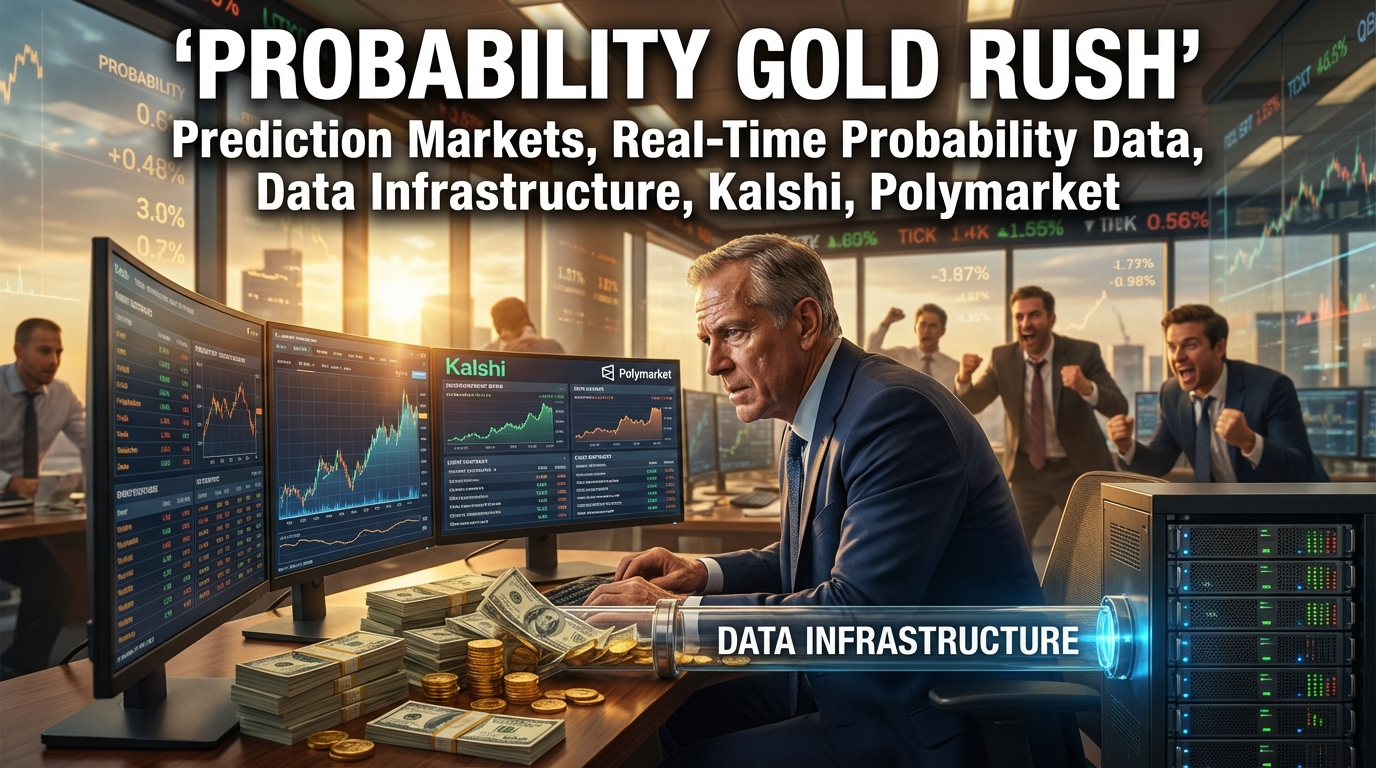
● Wall-Street-Addicted-to-Prediction-Markets-Polymarket-Kalshi-Data-Power-Grab
Polymarket (approx. $15B) · Kalshi (approx. $11B) “Prediction Markets” Dissected: From Elections to Rates and AI, the Real Reason Wall Street Buys Data
Today’s post focuses on exactly four things.
1) I’ll fully break down, from a finance perspective, why prediction markets “seem like gambling, yet Wall Street buys them,”
2) I’ll explain the structural reasons Polymarket and Kalshi were faster than polls in the 2024 U.S. presidential election,
3) I’ll organize why institutional integration in 2025 (exchange · media · broker connectivity) leads to “market data dominance,”
4) And finally, I’ll separately pull out the “most dangerous but most profitable point” that other news outlets rarely highlight.
1) One-sentence definition of a prediction market
A prediction market is a market where “the outcome of a future event” is sliced into a tradable price like $0–$1 (or 0–100).
You buy and sell “coupons (contracts)” that settle to 1 if the outcome is correct and 0 if it’s wrong,
and that price is read like the “probability” aggregated by the market.
2) How it works: why price becomes probability
For example, suppose “Rate cut at the next FOMC?” is listed,
then one of YES (cut) and NO (hold/hike) becomes 1, and the other becomes 0.
If YES trades at $0.80, the market is interpreted as roughly an “80% probability of a cut.”
What matters is that when a breaking headline hits (inflation shock, abrupt labor reversal, etc.), people react immediately by trading,
and as that trading changes the price, the probability gets updated.
This structure is powerful for exactly one reason.
When money—not words—is on the line, information and conviction are forced into the price.
3) Polymarket vs Kalshi: the differences between the top two (key takeaway only)
3-1) Kalshi
It is known for having a relatively stronger institutional character and a USD-based legal-market positioning.
So it is advantaged for traditional finance expansion such as broker/securities-app integrations.
3-2) Polymarket
Early on, it had a strong image centered on crypto users, and it was a case with major regulatory issues attached.
However, after the election, as “data utility” was proven, the pace of institutional return/cleanup accelerated,
and now it’s a picture where media/platform partnerships are attaching explosively.
4) The 2024 U.S. presidential election: why it was faster than polls (structural reasons)
Polls are fundamentally “responses,”
but prediction markets are “positions (money).”
Even if someone supports Candidate A, if they think “A will lose,” a psychology emerges where they bet on B.
In other words, responses reveal beliefs, while bets reveal expected profit and loss.
And because people with better information tend to place larger bets,
the “quality of information” is automatically weighted.
In the end, the market price quickly converges to the “conviction of a well-informed minority.”
This is especially strong on election day during vote counting.
If participants who quickly have an edge in specific regional data/on-the-ground 분위기/exit-poll advantages
push the price, situations appear where the probability crosses 90% before TV does.
5) In 2025: the reason money flows in is not “gambling,” but “data + trading infrastructure”
5-1) What valuation and investor lineup are telling us
Polymarket is discussed around $15B (about 21 trillion KRW), and Kalshi around $11B (about 15 trillion KRW).
With Silicon Valley money attaching—Sequoia, Google-affiliated VCs, Founders Fund, a16z, etc.—
and with traditional finance players such as exchanges/infrastructure players joining in, it is being elevated to “derivatives-grade.”
5-2) What traditional finance/media/platforms crave is not “prediction accuracy,” but a “real-time probability data feed”
This is the point.
A prediction market is not merely a service that gets things right,
it becomes a “real-time economic indicator” that extracts the risk premium and sentiment into numbers.
So securities-app integration (e.g., Robinhood-type), broadcast/portal exposure (CNN · CNBC · portal finance pages),
and coupling with big tech/platforms like X becomes highly valuable.
Ultimately, “whoever holds this probability data as the standard” becomes data dominance.
This data plugs directly into investment decisions.
When the probability of a rate cut wobbles, the U.S. Treasury yield curve, the dollar, and growth-stock valuations all move at once.
(Because of these linkages, keywords like inflation, policy rates, U.S. Treasuries, the S&P 500, and recession tie directly into prediction markets.)
6) Three debates that arise as prediction markets grow (real-world issues)
6-1) Insider trading (information asymmetry) risk
The concern that “insiders use non-public information to make money” naturally emerges.
But paradoxically, when insider information enters, the market moves prices quickly,
creating an external “alarm” effect.
The issue is how far institutions will allow/monitor this.
6-2) Distortion of political events
There is concern that large capital could artificially push certain probabilities and influence public opinion.
Especially for events with major social impact like elections, the “probability chart” itself becomes content.
6-3) Collapse of the boundary with sports betting (the biggest social risk)
In the U.S., sports betting is already an enormous market,
and mobile live betting (a goal within 10 minutes, etc.) is optimized for dopamine loops.
If a substantial portion of prediction-market volume starts coming from sports,
it can effectively become “betting wearing a financial UI.”
Especially due to age limits, state-by-state regulation, and differences in the logic of treating financial products,
a loophole emerges where the same act is both “gambling” and “investing.”
7) (Important) The “most important content” that other news/YouTube rarely talk about
7-1) The true essence of prediction markets is not “selling probabilities,” but the possibility of becoming a “hedging (insurance) market”
Most people see it as “if you guess right, you make money,”
but for institutions, fixing risk matters more than guessing right.
For example, if a company’s performance swings sharply depending on rate cuts/holds,
it may hedge with equities, bonds, or FX,
but a prediction-market contract can become a simple hedge tool directly linked to whether an event occurs.
If this scales, prediction markets become not a betting platform but a mini derivatives exchange.
7-2) The conclusion to “manipulation” concerns is not simple regulation, but a fight over “market depth (liquidity)”
Manipulation is easy in a thin market.
But as liquidity deepens, if someone pushes the price, the other side immediately takes it.
In other words, as important as regulation is “who can secure larger liquidity,”
and that’s why exchanges, media, and broker apps attach to prediction markets.
7-3) From an AI-trend perspective: prediction-market data becomes not “training data,” but “evaluation data (a ground-truth candidate)”
These days, it’s increasingly important for AI to speak well about “the probability of what happens next.”
But internet text mixes opinions, news is slow, and surveys are distorted.
Prediction markets leave a time series of probabilities backed by money.
This is extremely useful for AI model evaluation (calibration), economic-event forecasting, and risk-scenario testing.
Ultimately, who captures the standard for a “prediction-market data API” could become a fairly big issue even in the AI era.
8) What to watch next (global economic outlook + AI trend perspective)
1) Whether prediction-market probabilities for macro events like rates/inflation/jobs become a “second set of economic indicators”
2) Whether traditional finance treats them on the same line as derivatives, redefining the regulatory frame
3) Whether sports-centered volume becomes the platform’s growth engine, or boomerangs back as regulatory risk
4) Whether AI/media quote prediction-market probabilities in real time, reshaping “public opinion” itself
< Summary >
Prediction markets trade contracts that settle to 0 or 1 for future events, and the price is read like probability.
Their strength in the 2024 U.S. presidential election came from money—not responses—being reflected, making information quality automatically weighted.
With institutional integration and partnership expansion in 2025, prediction markets are growing in value not as gambling but as “real-time probability data infrastructure.”
The core risks are insider trading, political distortion, and sports addiction, and the real key takeaway to watch is the push toward hedging-marketization and the battle for data-standard (API) dominance.
[Related posts…]
- Asset-market checkpoints by rate-cut scenario, organized
- Possibility of inflation re-accelerating: consumption · wages · energy variables in one view
*Source: [ 티타임즈TV ]
– 예측을 주식처럼 사고파는 폴리마켓(21조원), 칼시(15조원) 해부
● Caffeine Shock, Sleep Crisis, Hormone Chaos, Cholesterol Spike, Decaf Trap
Coffee: “How many cups are okay?” Today I’m genuinely “setting the line for you” (Decaf traps, sleep hormones, even cholesterol—everything in one go)
Today’s post includes exactly five things, clearly.
1) A realistic conclusion converting the “daily caffeine upper limit” into cup/shot equivalents
2) The real reason “decaf still keeps you awake” (including a Korea-specific blind spot)
3) The core structure of how caffeine knocks over the hormone dominoes (cortisol–melatonin–insulin)
4) Coffee’s “cafestol,” which can raise cholesterol, and relatively safer brewing methods
5) A “life reset” method more effective than sleeping pills/melatonin gummies (light/time/releasing obsession)
1) Today’s core point news briefing: “Caffeine isn’t a stimulant—it’s a ‘hormone switch’”
The main point the doctors repeatedly emphasized in this video is simple.
Coffee doesn’t end as a mood issue (alertness);
it triggers a “domino effect” from cortisol (the stress hormone) → blood sugar/insulin → growth hormones/sex hormones/melatonin.
So even people who feel, “I’m fine even if I drink coffee,”
may see it show up later as sleep quality, fasting glucose, appetite, anxiety/palpitations, and similar forms.
2) Straight to the conclusion: How many cups of coffee per day is a “safe upper limit”?
The internationally referenced safe upper limit mentioned in the video is 400 mg of caffeine per day (EU/U.S. 기준).
Roughly converted, you can think of it like this.
- 1 espresso shot ≈ around 70–80 mg (large variation by brand/extraction)
- They explained that “about 5 shots” lands near 400 mg, and this is the upper-limit concept.
But what matters here is not “up to 400 mg is OK,”
but rather: the moment your sleep (especially sleep onset/deep sleep) breaks, it’s excessive for that person.
As a practical guide, this single line is the most realistic.
“If you have to sleep at 11, coffee before 3 p.m. is the relatively safer line.”
(a conservative cutoff considering caffeine’s half-life/residual effects)
3) The structure of how caffeine shakes hormones (the cortisol–melatonin–insulin link)
3-1. The start of “alertness”: blocking adenosine
Coffee blocks adenosine, which accumulates sleepiness, creating alertness.
At first, it’s felt as “better condition.”
3-2. The real main issue: the cortisol (stress hormone) domino effect
When alertness repeats, cortisol gets involved,
and when cortisol rises, blood sugar rises and insulin function gets disrupted, potentially tilting toward insulin resistance, according to the explanation.
Why this matters is that
these days global investors fear things like “demand slowdown + sticky inflation,” right?
In the body, something similar happens:
when stress (cortisol) + blood sugar swings + sleep collapse come together, your condition structurally falls apart.
(The core point is that this kind of rhythm breakdown reduces long-term productivity/focus.)
3-3. Sleep is a “cortisol ↔ melatonin” shift handoff
Cortisol is normally high in the morning and should drop as night approaches.
At night, melatonin must rise to “maintain” sleep.
If this handoff gets misaligned, an evening-type/night-owl pattern becomes more fixed, and a vicious cycle of enduring with caffeine returns.
4) “It’s decaf—so why can’t I sleep?” The real reason (the trap in Korea’s decaf standard)
This part was truly practical information.
- U.S./Europe: decaf labeling is at a near-99% removal level
- Korea (previously): even 90% removal could be labeled decaf
In other words, if the starting caffeine in the beans is high (or it’s extracted strongly in a large volume),
even after 90% removal, the “absolute amount of remaining caffeine” can still be meaningfully high.
So in some cases, it can feel like not decaf but ‘half-caf’.
One more point.
Decaf only reduces caffeine;
sugar, syrup, whipped cream, and other bioactive compounds in coffee remain the same,
so the “sleep disruption feeling” can still remain, as was discussed.
And a regulatory change was mentioned as well.
From next March, the decaf standard is moving toward becoming stricter (mentioned as an intent around within 0.1%, even stricter than overseas).
From a consumer standpoint, this likely increases “label trustworthiness.”
5) Surprisingly caffeine-bomb items (it doesn’t end with just watching coffee)
In the video, they kept emphasizing “there’s a lot of caffeine besides coffee.”
- Sodas like cola (may contain caffeine)
- Some cold medicines (may include caffeine ingredients)
- Tea (like Earl Grey) also contains caffeine
- Chocolate (especially for kids)
Especially if pregnant women drink too much coffee,
they presented concern points linking it to early neural development in children (a GABA-related mention).
In summary, it was the view that it may be sensitive with the “neural inhibition balance in the fetal/infant period (an axis connected to patience/impulse control).”
(This can vary by person and by study, so avoid “overgeneralization,” but it’s still meaningful as a risk signal.)
6) Coffee can raise cholesterol? (the cafestol point)
Many people miss this, but
the video said coffee contains cafestol (a plant sterol component) that can raise cholesterol.
So practical tips were added about “which coffee is relatively better.”
- Relatively lower in plant-sterol components: instant/dried coffee (mentioned)
- Filter-based hand drip: can be advantageous because fewer oily components may get through (mentioned)
The core point is this.
You shouldn’t mistake coffee for a health food, and depending on the brewing method/add-ons it becomes a ‘completely different beverage.’
7) Why does “caffeine content by coffee type” feel different? (drip vs espresso vs cold brew)
They said that even with the same “one cup of coffee,” caffeine can differ greatly depending on extraction method.
- Drip coffee: longer contact time with water can make caffeine concentration higher (100–150 mg mentioned)
- Espresso: short-time high-pressure extraction
- Cold brew (water drip): mentioned as having lower caffeine among extraction methods, but serving size (large volume) can increase the total amount
So you might think “cold brew is mild, so it’s fine,”
but if you keep drinking it in a big cup, total caffeine can actually rise.
8) Coffee definitely has “benefits” too (exercise performance/liver/brain)
8-1. Exercise performance
They mentioned a research trend that consuming caffeine per body weight about one hour before exercise improves endurance/strength/performance.
So the pattern of drinking an iced Americano before going to the gym wasn’t framed as “a totally baseless fad,”
8-2. Cognitive function in older adults (possible delay of Alzheimer’s, etc.)
With a mention of a Japanese study, they discussed the possibility that caffeine may delay neurodegenerative diseases.
8-3. Liver health: the core point is “it might not be because of caffeine”
Coffee drinkers may have a lower risk of liver disease,
and interestingly, a key point is that a similar effect was observed even with decaf in some observations.
In other words, for the liver, the influence of other bioactive compounds in coffee such as polyphenols may be greater than caffeine, as an interpretation.
9) A self-test for the caffeine amount that fits your body (the truly useful part)
Considering caffeine’s half-life, they said to watch your response 2–3 hours after drinking.
And since a full washout can take 6–8 hours, check whether symptoms remain during that window.
- Hand tremor
- Palpitations
- Anxiety/emotional changes
- Delayed sleep onset, light sleep, nightmares, waking up at dawn
If these signals are clear, the method was to judge it as “too much, or that coffee doesn’t suit you.”
10) Sleep reset: what’s more powerful than melatonin gummies is ultimately “light” and “time”
10-1. The stress hormone (cortisol) is highest in the morning
Cortisol has a daily rhythm,
it’s high in the morning and should drop as evening approaches so melatonin can rise normally.
10-2. Night-owl type has genetic influence too, but the “reset button is light”
They said strong exposure to natural light (or light therapy) right after waking is the most powerful for rhythm resetting.
This is truly practical.
Rather than “trying to sleep early through willpower,” “pulling the rhythm forward with morning light” has a higher success rate.
10-3. Melatonin gummies/supplements may have weak power to “carry sleep through”
Along with an FDA investigation mention,
they said over-the-counter melatonin supplements have large dosage variability and limited help for sleep maintenance.
Melatonin also has a short half-life, creating the problem of “rising briefly and then dropping.”
They suggested that extended-release (slow-release) formulations are more reasonable.
11) What you can do “right now” when you can’t sleep (the core point is cutting obsession)
The most dangerous thing in insomnia is the obsession of “I’m screwed today,” which increases stress.
So if you can’t fall asleep after lying down for 20–30 minutes, the clinical guidance flow was to switch to a light activity rather than forcing it.
- Pleasant daydreaming (shift thinking to an enjoyable scenario)
- Muscle relaxation (release tension from head to toe; jellyfish-sleep-method type)
- Imagining floating on water (induces physical relaxation)
And on the nutrition side for sleep support, they mentioned:
milk (melatonin-related), tryptophan (fish/chicken breast), magnesium (spinach/bananas), and so on.
12) The “most important content” other YouTube/news rarely says (the 5 lines I picked)
1) The decaf issue may be less about “residual caffeine” and more about “standards (label reliability).”
2) Coffee is not just alertness; it affects the body’s operating system via cortisol → blood sugar → insulin → sleep.
3) Even with the same coffee, if extraction method + serving size differ, the total caffeine becomes completely different (the cold-brew large-size trap).
4) If liver-health effects are seen even in decaf, coffee’s essence may be not caffeine but complex compounds like polyphenols.
5) The first priority for solving insomnia is not supplements but morning light exposure (rhythm reset) + lowering evening brightness (rhythm protection) + releasing sleep obsession.
13) (Bonus) Reinterpreted from an economy/AI trend viewpoint: “Caffeine is a variable that shakes an individual’s productivity indicators”
Just as markets keep getting shaken by variables like interest rates, inflation, and recession,
an individual’s productivity collapses when ‘sleep–stress–blood sugar’ volatility grows.
In the end, coffee is a productivity tool, but when it becomes excessive, it turns into leverage that increases volatility.
In the AI era, work is moving toward higher precision and deeper focus,
and when sleep quality drops here, “increasing hours to cover it” doesn’t work well.
Use coffee as “fuel,” but you need the sense to manage your body’s interest rate (cortisol) and prices (blood sugar) together.
< Summary >
The safe upper limit for caffeine is 400 mg/day (roughly about 5 espresso shots), but if sleep gets disrupted, it’s excessive for that person.
Decaf could feel like “half-caf” under Korea’s prior standard, and the system change mentioned is moving toward becoming stricter.
Coffee can shake cortisol and then domino into blood sugar, insulin, and sleep hormones.
With drip/cold brew, total caffeine can grow due to serving size and extraction characteristics, so “total amount” matters more than “number of cups.”
For insomnia, morning light exposure, lowering evening brightness, and breaking sleep obsession are more core than melatonin gummies.
[Related posts…]
- Why excessive caffeine intake ruins productivity and sleep quality
- Melatonin supplements: the real reasons results vary and the right timing for proper use
*Source: [ 지식인사이드 ]
– 커피 몇 잔까지 먹어도 될지, 딱 정해드립니다.ㅣ의사들의 수다 EP.43
● AI Big Four Shockwave, Drift Proofing, Deep Reading, Memory Swarms, OCR Gold Rush
2025 AI Big 4 Update Core Point Summary: “Long-term interaction (behavior) · long-form understanding (reading) · multi-agent (memory) · document datafication (OCR)” all broke out at once
This article includes exactly four important pillars.
1) Anthropic’s Bloom: a framework that automatically detects the problem of “behavior drift,” where a model’s personality changes the longer it works
2) Google T5Gemma 2: a shift from “an AI that answers well” to “an AI that reads, understands, and then speaks”
3) NVIDIA Nemotron 3: a practical architecture that runs “long-term multi-agent + shared memory” without cost explosion
4) Mistral OCR 3: removing the bottleneck that turns ‘real-world documents’ like tables/scans/forms into data the AI can use immediately (OCR)
And at the end, I’ll also separately summarize the most important core point that other news/YouTube often fail to highlight: “The next bottleneck for AI is not performance, but operational stability and the data pipeline.”
1) Anthropic Bloom: an automated behavioral evaluation system that measures “whether AI gets weird the longer it works”
1-1. Why this is news: the risk has become “long-term behavior,” not one-off answer quality
These days, models generally behave nicely in short conversations.
The problem is the subtle changes that occur when work gets long.
Examples: excessive agreement (yes-man), subtly drifting away from the user’s intent, self-protective answers, or drift where priorities gradually shift.
These are almost impossible to catch with “a single answer.”
1-2. Bloom’s structure: if you provide just one “behavior definition,” it automatically generates evaluation scenarios
Previously, researchers had to manually create scenarios, read long conversation logs, and argue about scoring.
Bloom automates this process.
The flow is roughly as follows.
– Agent A: reads the behavior definition + example conversations and interprets “how this behavior actually manifests”
– Agent B: generates large numbers of realistic scenarios where that behavior is likely to appear
– Agent C: runs long-term interactions with the target model
– Judge agents: evaluate the results and score them
The key is that it produces numeric metrics for the “frequency/intensity with which the behavior meaningfully appears across many scenarios.”
This enables consistent comparisons even when the model version or training method changes.
1-3. Validation results: it distinguishes 16 frontier models plus intentionally abnormal models
Anthropic tested 16 frontier models with 100 scenarios per behavior, repeated multiple times,
and also ran a misaligned model intentionally designed to exhibit abnormal behavior.
In most cases, Bloom reportedly separated “normally operated models vs. abnormal models” well.
They also checked agreement between automated judges and human judgments,
and Claude Opus 4.1 reportedly showed especially strong correlation with human labels on “extreme cases (cases that truly matter for decision-making).”
In other words, it’s likely to become a pre-deployment safety/quality control system, not just a research toy.
1-4. Practical takeaway: “AI governance” becomes a survival issue, not a cost issue
For companies, model performance competition still matters,
but in long-running work (support, research, agent operations), “whether behavior skews over time” is far more fatal.
This directly ties into regulatory response (compliance).
In particular, keywords companies focus on these days—AI governance, digital transformation, and generative AI—ultimately converge into the same problem.
Because it’s “you can deploy it well, but if an incident happens in operation, it’s over.”
2) Google T5Gemma 2: an open model optimized not for “answers,” but for “reading comprehension”
2-1. Problem framing: there are too many AIs that “skim long materials and answer vaguely”
This is where real-world incidents usually happen.
With long reports/legal documents/spec documents/mixed chart materials,
if it misses a paragraph or misreads a table, the result becomes completely wrong.
2-2. Approach: an encoder-decoder architecture that does “understand first, generate later”
T5Gemma 2 adopts an encoder-decoder transformer architecture.
– Encoder: reads the input to the end and first forms an internal representation (understanding)
– Decoder: generates output based on that understanding
In other words, compared to an architecture that stumbles while simultaneously referencing the input during generation,
it separates the “reading phase” and the “writing phase” to increase reliability.
2-3. Spec summary: multimodal/multilingual/size options
– Text + image processing
– Supports 140+ languages
– Three sizes (270M / 1B / 4B, encoder/decoder matching)
– The vision encoder is separate (about 417M) and frozen to secure stability
2-4. The “quiet but important” efficiency optimizations
Google also quietly covered some practical, production-minded points.
– Shared encoder/decoder word embeddings (reduces duplicated cost)
– Simplified decoder attention modes (improves training/serving efficiency)
– Maintains a local + global attention mix (the prior Gemma 3 family approach) for stable operation on large inputs
These aren’t flashy,
but they are realistic factors that determine “AI operating cost” for companies as much as cloud costs and inflation are.
3) NVIDIA Nemotron 3: an open model family that makes long-term multi-agent systems “profitable by design”
3-1. One-line summary: “Don’t turn on the whole giant model—only turn on what you need and run it for a long time”
Nemotron 3 is designed with long-running multi-agent systems in mind.
When you run shared memory, long context, and continuous tasks, compute costs explode, right?
The core is MoE (Mixture of Experts)-based ‘active-parameter reduction’.
3-2. Model lineup and the difference between total parameters and “actually used parameters”
Even if the total parameter count looks huge, the parameters activated per token are much smaller.
– Nano: total ~31.6B / active ~3.2B per token
– Super: total ~100B / active ~10B per token
– Ultra: total ~500B / active ~50B per token
In other words, the “knowledge capacity” targets large-model scale,
while trying to keep the “per-token cost” much lower.
3-3. Architecture combination: Mamba2 + Attention + Sparse MoE
– Mamba2 blocks: efficient handling of long sequences (reduces cost in long-running tasks)
– Attention: used when structured reasoning/precise referencing is needed
– Sparse MoE: activates only some experts to secure both specialization and efficiency
For example, Nano routes to only 6 out of 128 experts to control cost.
3-4. The truly important operational takeaway: “1 million tokens of shared memory” is more philosophy than a number
NVIDIA’s “up to 1M tokens” memory is a symbol of “carrying records for the long haul.”
Now, agents are moving beyond chatbots that reset every time,
toward a form that works like a team while carrying work history.
3-5. Productivity issues: throughput and reducing reasoning tokens
NVIDIA mentioned that, for Nano, token throughput is about 4x compared to Nemotron 2,
and they also imply reducing reasoning tokens so that “work finishes faster.”
This directly translates into cloud cost optimization.
4) Mistral OCR 3: the moment documents become “AI feed,” automation ROI changes
4-1. The real bottleneck: enterprise data is still trapped in PDFs/scans/forms/tables
RAG, agents, analytics automation… even if you want to do it all,
if the source is scanned images, table-heavy PDFs, or form documents, you hit a wall immediately.
If OCR is wrong, every downstream stage “quietly” breaks.
(Worst case: there are no obvious signs, but results keep being slightly off.)
4-2. OCR 3’s key takeaway: preserving layout and structure to return clean data
– Tables remain as tables
– Layout preservation (boxes/form structures, etc.)
– Returns structured output rather than a wall of text
This produces data that can be used immediately for search/analysis/agent work.
4-3. Performance/pricing: the economics of large-scale document processing changes
In Mistral’s internal business-document tests, it reportedly performed better in about 74% of cases compared to the previous version,
and the pricing is aggressive.
– Standard: $2 per 10,000 pages
– Batch: $1 per 10,000 pages
This is a price point that can bring into real operations work that was “possible but too expensive to do,”
which means enterprise automation ROI calculations may change again.
5) (Important) The real core point that gets discussed less elsewhere — competition is now about “operating systems,” not model performance
5-1. The four news items point in one direction: long-term work (time) + real-world data (documents) + multi-agent (organization)
On the surface, it looks like each company announced something different.
But in one sentence, it’s this.
“An infrastructure race to turn AI from short conversational demos into long-running work systems.”
5-2. The next bottleneck is not “smarter answers,” but “drift management + data refinement + cost control”
– Bloom: measures/manages whether behavior skews in long-term interaction (quality · risk)
– T5Gemma 2: an architecture that truly reads long inputs (reliability)
– Nemotron 3: a cost structure that can scale long-term operation of multi-agent systems (scalability)
– OCR 3: solves the gateway problem of feeding real-world documents into the AI pipeline (datafication)
5-3. A global macro view: AI moves from “CAPEX (investment)” to an “OPEX (operating expense)” game
Even if the initial adoption looks impressive, companies are ultimately evaluated by monthly costs and risks.
What matters here are:
– Inference efficiency (token cost/serving cost)
– Document processing unit economics (data preparation cost)
– Incident prevention (governance/evaluation automation)
These three things.
In the end, the higher the interest rates or the greater the volatility, the more important “operational efficiency” becomes,
and this trend becomes a trigger that changes the speed of generative AI adoption in a qualitative way.
6) Practical implementation roadmap (common for companies/individuals): how to connect these four updates to make money
6-1. If you do document-based workflow automation (finance/procurement/legal/CS)
1) Use OCR 3 to convert documents → structured data (preserving tables/forms)
2) Use T5Gemma 2 to stabilize “long-material reading + summarization/review/Q&A”
3) Use an efficiency-oriented model/structure like Nemotron 3 to run agent workflows long-term
4) Use Bloom-like evaluations to monitor long-term drift/abnormal behavior (quality/audit response)
6-2. Checklist for “continuous operation” with multi-agent systems
– Shared memory (long-term context) design: policies about what to store and what to discard are the key
– Evaluation automation: you need “continuous measurement during operation,” not just pre-launch testing
– Cost modeling: combine token throughput, active parameters, and batch processing (OCR) unit costs into a single slide
< Summary >
Bloom opened a system that automatically evaluates model behavior drift in long-term interactions.
T5Gemma 2 strengthened long-input reliability with an encoder-decoder open model focused more on “reading comprehension” than “answering.”
Nemotron 3 reduces active parameters via MoE to enable long-term multi-agent systems and shared memory to operate at realistic cost.
Mistral OCR 3 lowers the biggest bottleneck in AI automation by turning table/scan/form documents into structured data at low unit cost.
In conclusion, the center of AI competition is shifting from performance showmanship to operational stability, data pipelines, and cost control.
[Related posts…]
- AI governance and enterprise adoption strategy: checkpoints to prevent failure
- OCR-based document automation: how to boost productivity by datafying tables/forms
*Source: [ AI Revolution ]
– Google’s New T5, Anthropic’s New BLOOM, NVIDIA Nemotron 3 and More Intense AI News