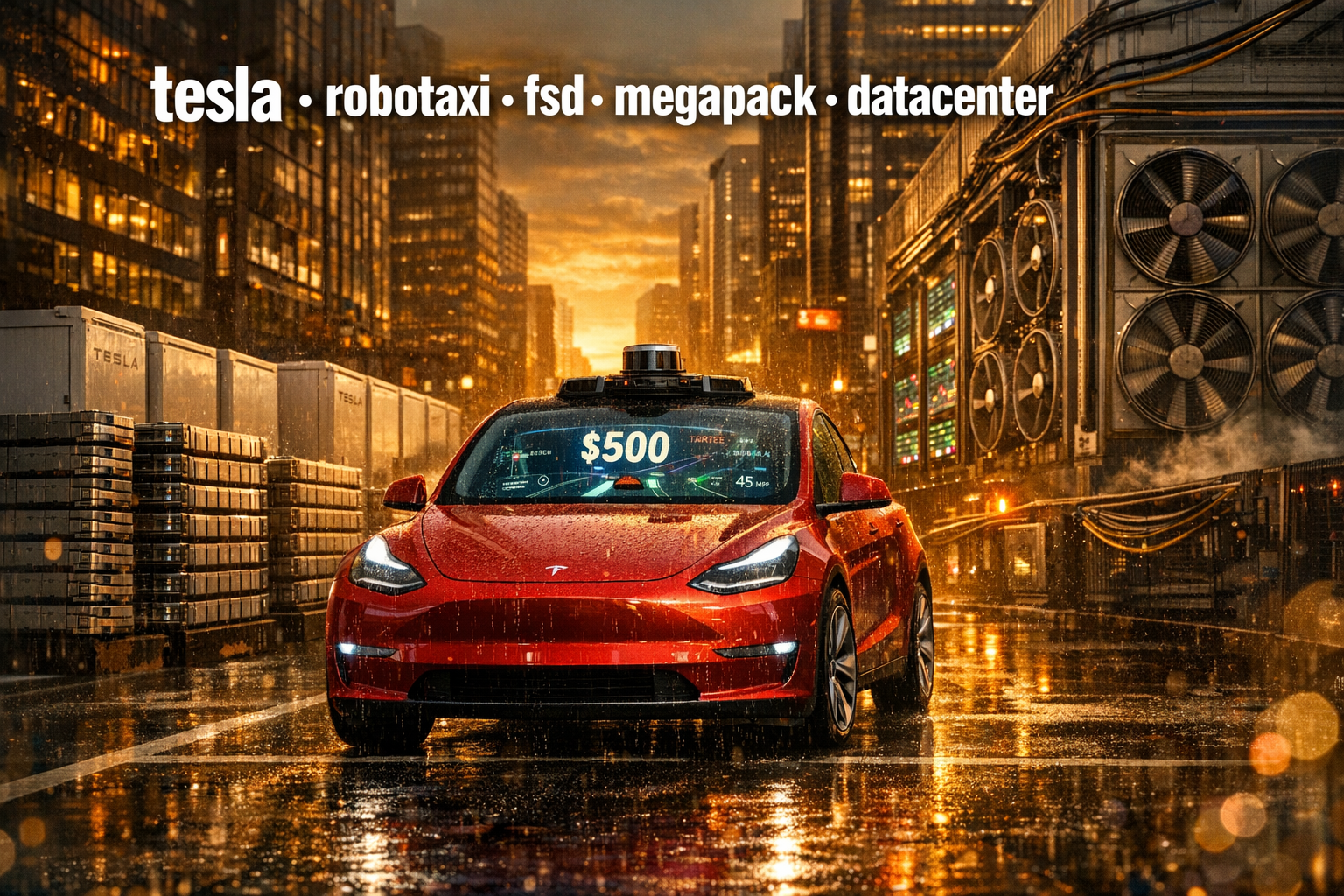
● Tesla 500 Wall Street War UBS 247 vs Canaccord 551 Gamma Trap Robotaxi Infrastructure Shift
Tesla at the $500 “Wall”: Wall Street Splits Between $247 (UBS) and $551 (Canaccord) — The Market Is Pricing “Infrastructure,” Not Quarterly Results
This report focuses on three points:
1) Why Tesla is laying the policy, UX, and settlement foundations that signal a transition from robotaxi “demo” to “operational service.”
2) Where Wall Street’s valuation frameworks diverge: $247 (auto-style valuation) vs. $551 (AI/energy/robotics platform valuation).
3) Why $500 is not merely a psychological level but an options-driven “gamma zone,” and what may occur if the level is breached.
1) Key News Briefing: What the “Silence Before $500” Represents
Situation summary
- Tesla has paused near $500 after reaching record highs.
- High-profile selling (including statements of full liquidation and partial sales by ARK) has amplified noise.
- Price targets across Wall Street range from $247 to $551, implying a 2x dispersion.
Why the stock stalls near $500
- The focal point is an options open-interest concentration creating a gamma-sensitive zone.
- A break above $500 may force option sellers (including institutions) to buy shares for delta hedging, potentially fueling a short-term rally (gamma-squeeze-like mechanics).
- As a result, $500 becomes a tactical defense level where buying and selling pressure often collide, increasing the likelihood of near-term stagnation.
2) Two Signals Tesla Is Shifting Robotaxi Toward a Real Service
The relevant question is not whether robotaxi is feasible in theory, but whether Tesla is completing the operational checklist required for scaled deployment.
(1) Introduction of a robotaxi cleaning-fee policy = core operating infrastructure
- $50 for minor soiling; $150 for severe contamination (e.g., smoking or biological contamination).
- Post-ride review; clearly displayed in the robotaxi app usage record.
- The importance is not the fee level, but the introduction of rules, accountability, and settlement—markers of a service moving from demonstration to operations.
- In platform businesses, post-transaction settlement, dispute handling, and penalties typically precede full monetization as foundational layers.
(2) Key message in the latest robotaxi video = practical usability over technical showcase
- Emphasizes real usage scenarios (e.g., wheelchair loading space) rather than distance or difficulty.
- Messaging shifts from “how intelligent it is” to “how reliably it works in daily use.”
- The communications cadence remains consistent with a 2026 target and an intent to scale toward city-level infrastructure deployment.
3) FSD 14.2.1: Accumulating “Operational Details,” Not a “Autonomy Showcase”
Notable improvements in this release
- Vision encoder neural-network upgrade based on higher-resolution processing.
- Enhanced recognition of emergency vehicles, obstacles, and pedestrian gestures.
- More granular arrival-point control: parking lot, roadside, driveway, curbside drop-off options, plus automatic navigation pin adjustments.
- Improved behaviors for emergency-vehicle approach (yield/stop), debris avoidance, and gate traversal.
Interpretation
- Emphasis is shifting from adding headline features to building exception handling, precise arrival UX, and safety scenarios required for service-grade autonomy.
- These elements are increasingly treated by the market as practical indicators of commercialization progress.
4) Why Wall Street Is Split: Different Definitions of What Tesla Is
The price-target dispersion is primarily a framework divergence, not a numerical debate.
- Under an auto-company framework, $247 becomes defensible.
- Under an AI/energy/robotics platform framework, $551 can be modeled.
Macro factors influence which framework dominates at a given time:
- Shifting rate-cut expectations and inflation paths tend to increase volatility in growth and mega-cap equities.
- U.S. economic outlook and global supply-chain risks, including China-led pricing pressure, can directly affect Tesla’s valuation framing.
5) Conservative Case (UBS): “High-Growth Automaker, Not AI” → $247 Target
Starting point: quarterly deliveries and margins
- UBS argues the stock remains primarily driven by whether quarterly deliveries beat or miss consensus.
- Example: 2025 Q4 deliveries reduced to 415,000 units, reflecting a peak-demand framework.
Core risk 1: demand deceleration can re-rate valuation quickly
- A single material miss may trigger disproportionate multiple compression.
Core risk 2: China-driven price competition structurally pressures margins
- Ongoing competition from domestic players such as BYD.
- Price cuts are viewed as defensive rather than strategic.
Conclusion
- Robotaxi, Optimus, and software revenue contributions are considered too distant to be materially reflected in near-term financials; therefore, $247 is aligned with current fundamentals.
6) Aggressive Case (Canaccord): “Energy and Robotics Can Rebase the Story” → $521–$551 Target
Rationale 1: energy (Megapack) growth
- Energy may stabilize results and profitability when auto demand softens.
- The thesis highlights a trend where energy margins increasingly rival or exceed auto margins.
Rationale 2: regulatory and policy momentum
- A shift in autonomy standards toward Tesla could be a structural catalyst.
Rationale 3: Optimus not adequately reflected in valuation
- Pilots targeted for 2026; current pricing is viewed as incorporating less than 10% of potential value.
- Under this framing, $500 may represent a base for a new leg rather than a cycle peak.
7) Headline Debate: “Narrative Premium” vs. “AI Cycle Still Early”
Bear case (Barclays, Dan Levy)
- Recent appreciation is attributed more to narrative than fundamentals.
- Elevated valuation versus earnings is emphasized; Europe sales declines and subsidy reductions cited as risk factors.
Bull case (Wedbush, Dan Ives)
- AI adoption is framed as early-cycle (“third inning”).
- Tesla is positioned as an AI and robotics platform rather than an automaker.
- A 2026 scenario includes robotaxi expansion across 30 U.S. cities.
- Tesla is discussed alongside Nvidia as a “physical AI” beneficiary.
- Robotics value is framed in the range of $1 trillion under conservative assumptions.
8) Five Under-Discussed Points That Matter
(1) The $50/$150 “cleaning fee” is a disclosure of operating governance
- Robotaxi scaling is constrained more by operations than technology.
- Without dispute resolution, liability assignment, penalties, and post-settlement, losses can increase with scale.
- The policy suggests Tesla is designing a scalable operating model ahead of full rollout.
(2) The strategic value of FSD updates is concentrated in arrival UX (curbside/driveway, etc.)
- Service satisfaction is often determined by drop-off precision and reliability rather than cruising performance.
- Greater granularity can reduce early-stage complaint intensity and associated operational costs.
(3) $500 is an options-driven tactical battleground, not a round-number effect
- The relevant mechanism is gamma exposure and open-interest positioning.
- A clean breach may alter short-term supply/demand dynamics.
(4) The $247 vs. $551 split is fundamentally about revenue recognition timing
- The key variable is when robotaxi becomes recognizable as revenue and margin, not merely technical feasibility.
- Robotaxi monetization requires integration of regulation, insurance, accident liability, vehicle depreciation, utilization, and cleaning/maintenance processes.
- UBS assumes slower recognition; Canaccord assumes earlier recognition, producing a 2x valuation gap.
(5) Implications extend to Korean OEMs (Hyundai and Kia)
- EV transition progress does not resolve the next phase: autonomy, robotaxi, and software platforms.
- OEMs may face a forced choice between in-house development and partnering with leading platforms, with speed and survivability outweighing brand pride.
9) Monitoring Checklist (News and Market Structure; Not Investment Advice)
Near term (flow/price action)
- Options positioning around $500: open-interest shifts and expiration-related flows.
- Institutional buy/sell disclosures: symbolic price levels often trigger portfolio rebalancing.
Medium term (earnings/business mix)
- Degree to which energy (Megapack) revenue and margin offset auto softness.
- Impact of China pricing competition on ASP and margins.
Long term (platform readiness)
- Further refinement of robotaxi operating policies (insurance, accident handling, customer disputes, maintenance/wash SLAs).
- Pace of accumulating service-grade exception handling within FSD.
< Summary >
- Tesla’s $500 level functions as an options-driven gamma zone, making it a high-friction area for flows and short-term price formation.
- Cleaning-fee policy, practical-use messaging, and service-grade FSD refinements indicate a shift from demo to operational readiness in robotaxi.
- UBS frames Tesla as an automaker driven by deliveries and margins, supporting a $247 target; Canaccord emphasizes energy, regulatory momentum, and Optimus optionality, supporting $521–$551.
- The core debate centers on the timing of operational infrastructure reaching a stage where revenues and margins become financially recognizable.
[Related Articles…]
- Tesla robotaxi and FSD commercialization reshaping the global mobility investment map (https://NextGenInsight.net?s=Tesla)
- Autonomous driving deregulation and the AI platform war: the next strategic question for OEMs (https://NextGenInsight.net?s=Autonomous%20Driving)
*Source: [ 오늘의 테슬라 뉴스 ]
– 테슬라 500달러 앞에서 갈라진 월가의 판단, 247달러 vs 551달러 어디로 갈까?
● Rate Cut Liquidity Surge Sparks Wild Market Whiplash
Why a “Liquidity-Driven Market” in 2026 May Still Be More Volatile: Deconstructing Sharp Rallies and Sell-Offs Through Soros’ Reflexivity
This report covers four points:1) Why real-economy expectations and equity-market expectations can diverge
2) The meaning of Soros’ view that “prices reflect reality while simultaneously distorting it”
3) The bubble-to-collapse-to-stabilization mechanism using the AB–HI framework from The Alchemy of Finance
4) The 2026 linkage among volatility, liquidity, interest rates, and AI
1) News Briefing: “In 2026, liquidity increases, but volatility may rise”
Core message:
2026 is widely expected to coincide with an interest-rate cutting phase (post-pivot), which typically increases the ease with which liquidity enters risk assets.
However, higher liquidity does not necessarily imply price stability. Equity volatility can increase because the speed at which expectations (narratives) are capitalized into prices accelerates.
In summary:
- Real-economy indicators adjust gradually,
- Asset prices move ahead based on expectations (narratives),
- When expectations reverse, prices can overreact in the same direction.
2) A Common Misinterpretation: Treating “Real Economy” and “Equity Market” as the Same Forecast
A key analytical point is that macroeconomic forecasts (e.g., GDP growth) and equity-market forecasts are structurally different.
Real-economy frameworks typically focus on:
- Employment, inflation, household leverage, trade, fiscal policy, industrial productivity
- The question: “How much will GDP grow next year?”
Capital-market (equity) frameworks typically focus on:
- Discount rates (interest rates), liquidity, risk appetite, valuation multiples, positioning
- The question: “Where will capital flow?”
This divergence allows scenarios such as:
- Weak or sluggish real activity (low growth), while
- Equities rise on rate cuts and liquidity expansion.
A typical precedent was the 2020–2021 period, when real activity was impaired while asset prices appreciated materially.
3) Interpreting Soros’ Core Claim: “Equities Are Part of Reality, and Reality Is Part of Equities”
This implies equities are not merely a mirror of fundamentals.
Market expectations can move prices first, and those prices can then influence corporate behavior, consumer sentiment, investment decisions, and financing conditions, creating a feedback loop that can alter real outcomes.
Soros describes this as reflexivity:
- Not only “prices reflect fundamentals,” but also
- “prices can shape fundamentals.”
4) Structure of Rallies and Drawdowns via AB–HI: From Self-Reinforcement to Self-Reversal
As a simplified representation, consider two lines:1) Fundamentals (e.g., earnings per share trend)
2) Price (valuation incorporating expectations)
4-1) AB: Prices Rise Ahead of Fundamentals as Expectations Lead
Fundamentals remain stable or improve gradually.
As expectations strengthen, prices re-rate in advance of realized results, moving ahead of fundamentals.
4-2) BC: Trend Reinforcement (Self-Reinforcing Upside)
Participants increasingly treat the trend as validated.
Capital inflows and strengthening narratives steepen the rally. Higher liquidity compresses the time spent in this phase.
4-3) CD: Recurring Pullbacks and Re-Accelerations
Intermittent corrections emerge:
- Slowing growth rates, ambiguous guidance, or valuation constraints
These pullbacks do not necessarily end the trend; they can be followed by rebounds that re-ignite expectations.
A key implication:
- Price volatility can be triggered not by deteriorating results, but by deceleration in improvement (slower growth), which can drive valuation compression even if absolute earnings remain strong.
4-4) D: Belief Phase (Price Anchored More to Conviction Than to Results)
Market learning reinforces the assumption that “pullbacks recover.”
Narratives (e.g., broad AI transformation) can become dominant drivers of pricing.
4-5) EF: Core Bubble Phase (Expectations Exceed Feasible Delivery)
Even strong results may fail to satisfy expectations.
With pricing far ahead of fundamentals, small disappointments can trigger outsized reactions.
Comparative framing:
- In many historical episodes, prices overheated without corresponding fundamentals.
- In the AI cycle, certain bellwether firms have delivered material fundamental growth, complicating a binary “bubble vs. not bubble” classification.
The relevant variable becomes the speed of realized results relative to embedded expectations.
4-6) FG: Recognition of Bias and Expectation Reset
Participants begin to recognize overextension.
Without earnings deterioration, a shift in any one factor (valuation limits, growth-rate deceleration, policy variables such as rates or regulation) can rapidly cool expectations.
4-7) G: Support Breakdown and Sell-Off Trigger (Structural Deleveraging)
Downside acceleration can become structural rather than purely sentiment-driven:
- Stop-loss cascades, margin calls, risk-parity and systematic de-risking, ETF redemptions
This can produce continuous price slippage.
4-8) GH: Downtrend Reinforcement (Fear Becomes Self-Reinforcing)
The dominant regime flips:
- In uptrends: “pullback = buy”
- In downtrends: “rally = exit”
Self-reinforcing upside dynamics invert into self-reinforcing downside dynamics.
4-9) HI: Stabilization and Re-Equilibration
When prices overshoot below fundamentals, incremental negative news has diminishing marginal impact.
Markets then move toward a new equilibrium.
5) Why This Framework Matters More in 2026: Liquidity Amplifies Reflexivity
If 2026 is characterized as liquidity-driven, higher volatility can be interpreted through reflexivity as follows:
1) Rate cuts raise the present value of long-duration expectations
Lower discount rates increase the valuation of distant cash flows, typically benefiting narratives, growth equities, and thematic exposure.
2) Liquidity does not provide “truth”; it provides “speed”
More liquidity does not exclusively reward quality; it often flows first to assets with the strongest expectations.
This accelerates both upside repricing and downside repricing when expectations fracture.
3) The AI theme combines fundamentals and narrative, increasing complexity
Because parts of the theme exhibit measurable earnings expansion, the regime is less analogous to episodes characterized by weak fundamentals.
Assessment should focus on expectation levels versus the pace of delivery, rather than binary labels.
6) Under-Emphasized High-Impact Points
Point A: Sell-offs often reflect changes in the slope of expectations, not earnings contraction
Even with rising earnings, a slowdown in growth can trigger rapid multiple compression.
Point B: “Weak real economy implies weak equities” can remain incorrect
Low growth can coincide with equity strength if monetary conditions ease.
A wider gap between macro narratives and market pricing can increase debate and, by extension, volatility.
Point C: Under reflexivity, price is a signal
Causality can run both directions:
- “Data to price,” and
- “Price to corporate actions, investment, financing, and eventually data”
Therefore, sharp price appreciation can function as an input into subsequent fundamentals.
7) Practical Checklist for Investment and Research Use
1) Where is the market within AB–HI?
Identify whether the regime is early uptrend, belief phase (D), expectation overshoot (EF), or post-breakdown.
2) Prioritize the direction of growth rates over absolute levels
Deceleration is often priced quickly.
3) The stronger the narrative, the larger the impact of a support break (G)
High-conviction markets are more prone to disappointment translating into systematic selling.
< Summary >
2026 may support upward asset prices through rate cuts and liquidity expansion, while reflexive dynamics can increase volatility as expectations move prices faster than fundamentals. Real-economy forecasts and equity-market pricing can diverge; prices both reflect and distort fundamentals through feedback loops. The AB–HI framework formalizes the sequence from expectation-driven appreciation to overheating, breakdown, and stabilization. In 2026, corrections may be triggered more by decelerating growth expectations than by outright earnings deterioration.
[Related Articles…]
- Signals to Monitor in a Liquidity-Driven Market: https://NextGenInsight.net?s=liquidity
- Three Patterns Observed in Rate-Cut Regimes: https://NextGenInsight.net?s=rates
*Source: [ 경제 읽어주는 남자(김광석TV) ]
– 급등·급락의 정체. 기대가 가격을 움직이는 방식 | 북리뷰 – ‘ 금융의 연금술’ 3편
● AI Power Crunch, US Grid Shock, VPP Surge, Data Center Energy War
2026 AI Inflection Point Shifts from “GPUs” to “Power”: U.S. Power Shock, VPPs, and Data Center Energy Management Reshape Equity and Industry Landscapes
This report focuses on four core points:
1) Why “power scarcity” may become a more material AI bottleneck than “GPU scarcity” from 2026 onward
2) How to interpret early signals of pricing shock in the U.S. power market (PJM capacity auction)
3) Where hyperscalers are reallocating focus: VPPs (Virtual Power Plants) and data center energy management solutions
4) Why a Korea-style “energy superhighway” (HVDC + smart grid) can become a strategic asset in AI infrastructure competition
1) News Briefing: The Next Chapter After the 2023–2025 AI Rally Is Power Infrastructure
From 2023 through 2025, U.S. equity performance was largely driven by AI exposure, with clear dispersion between AI-adjacent and non-AI companies. The theme expanded in phases:
① Phase 1 Rally: NVIDIA (GPU-centric)
GPU concentration in AI training/inference drove outsized market capitalization gains.
② Phase 2 Rally: Data centers (servers, racks, networking, cooling)
As AI data center build-outs accelerated, companies constructing facilities and supplying critical equipment materially outperformed.
③ Phase 3 Rally: Power (generation, transmission, distribution, storage)
AI data centers consume significantly more electricity than conventional data centers, shifting the 2026 debate toward whether the U.S. can meet incremental power demand.
2) Quantifying the Constraint: AI Data Center Power Demand Is a Physical, Not Software, Problem
Key figures:
U.S. AI data center power demand
- 2024: ~4 GW
- 2035: ~123 GW (projected)
The magnitude implies that grid, generation, substations, and transmission build-out timelines risk lagging AI-driven demand growth. AI expansion is increasingly constrained by physical factors such as land, permitting, interconnection, and local acceptance.
Observed market frictions include community opposition, and cases where facilities are completed but cannot ramp due to delayed grid interconnection.
3) U.S. Power Pricing as an Early Warning: PJM Capacity Auction Signals the Start of “AI-Driven Inflation”
Recent PJM capacity auction results indicated a sharp increase in clearing prices versus prior periods.
Key implication:
Power is shifting from a cost input to a competitive differentiator.
As model performance competition drives higher compute requirements, operators bifurcate into:
- entities able to procure sufficient power to scale operations, and
- entities that achieve higher output per unit of energy through efficiency.
From 2026, the second group may gain advantage because power constraints are not resolved by price alone; transmission, substation capacity, permitting, and local constraints impose time-based bottlenecks.
4) Hyperscaler Response (I): AI-Optimized Cooling as a Material Cost Lever (Up to ~40% Electricity Reduction)
A cited case highlights AI-managed cooling systems reducing electricity consumption by ~40%.
Relevance:
In data center economics, power and cooling are recurring operating costs.
Hardware is largely upfront capex; electricity is a continuous opex line item.
This creates structural divergence:
- high-efficiency data centers: stronger margin resilience
- low-efficiency data centers: elevated margin compression risk
Sustained advantage increasingly depends on operational energy optimization capabilities, not solely algorithms.
5) Hyperscaler Response (II): Why VPPs Are Gaining Momentum
Core thesis:
Reducing wasted electricity is increasingly valued on par with adding new supply.
A Virtual Power Plant aggregates distributed energy resources (solar, wind, ESS, demand response) via software to deliver dispatchable, power-plant-like capacity at the right time and location.
VPPs address:
- mismatch between steady generation and volatile demand
- intermittency of solar and wind output
- rising costs of balancing via storage
- system inefficiencies where produced energy is not utilized optimally
As AI data centers expand, the value of flexible aggregation and dispatch is likely to rise.
6) Data Center Energy Management Systems (EMS): The Emergence of “Autonomous Power Operations”
A data center EMS applies AI to monitor, decide, and optimize operations across electrical systems, cooling, and load.
The directional shift is from monitoring to:
forecast → control → optimization
Capabilities include:
- forecasting GPU load spikes
- proactive cooling adjustment
- avoiding high-tariff time blocks where feasible
- peak shaving via on-site ESS and distributed resources
With these controls, data centers can transition from grid stressors to active grid-support assets.
7) Hanwha Qcells: From Solar Manufacturing Toward Energy Services
Positioning extends beyond cell/module manufacturing into distributed energy solutions, with disclosure of AI-applied energy management software and commercialization trajectory.
Investment interpretation:
Solar is a hardware business; energy management can become recurring services revenue.
In large markets with accelerating AI data center demand, software and operating capabilities can move suppliers up the value chain beyond equipment delivery.
8) Korea: Rising Data Center Build-Out Implies Higher Power Price Pressure
In Korea, increasing data center density is expected to raise electricity demand. Since power is a foundational input cost, higher system costs can flow through to electricity tariffs, industrial competitiveness, and broader inflation dynamics.
A policy response under consideration is an “energy superhighway”:
Core components
- bulk transfer from renewable generation regions to major load centers (capital region/industrial corridors)
- HVDC for long-distance, high-capacity transmission
- AI-enabled smart grid for forecasting and real-time matching of supply and demand
This framework targets simultaneous progress in decarbonization, AI infrastructure readiness, and power supply stability.
9) Six Under-Discussed Points With High Strategic Relevance
① From 2026, power access may become a primary driver of AI valuation dispersion.
As model performance converges, power prices, power contracts, and utilization rates become direct profit drivers.
② Power scarcity can cap AI supply.
GPUs without adequate electricity cannot deliver output, potentially slowing AI service scaling.
③ Grid infrastructure (transmission/substations/interconnection) may be a larger bottleneck than generation.
Interconnection queues and constrained corridors can prevent load from coming online.
④ 24/7 power quality requirements elevate the importance of renewable-integration technologies.
Intermittent renewables require ESS, demand response, VPPs, and EMS to meet data center reliability requirements.
⑤ AI is expanding from software into industrial and infrastructure domains.
Semiconductors (compute) → data centers (facilities) → power (physical infrastructure).
⑥ In higher-rate environments, efficiency investments can be comparatively defensive.
While capex is rate-sensitive, efficiency initiatives reduce opex with clearer payback logic, supporting adoption.
10) Investor/Industry Checklist: Sector Map for “AI + Energy” Into 2026
① Power infrastructure
- transmission/substation/distribution capex beneficiaries
- HVDC value chain
② Data center efficiency
- cooling optimization (including liquid cooling)
- power distribution, UPS, high-efficiency power semiconductors
③ VPP / demand response (DR)
- platforms that convert demand into controllable grid resources
④ ESS + renewable integration
- mitigating renewable intermittency to deliver data-center-grade power quality
⑤ AI-enabled smart grid
- generation and demand forecasting
- real-time optimization and grid operations software
AI infrastructure investment can drive broader capex cycles, while grid investments are long-duration projects with macro sensitivity. FX, USD liquidity, and rate trajectories may influence deployment timing.
Summary
The AI rally began with GPUs, but AI data center power constraints are increasingly positioned as a core bottleneck from 2026. U.S. power market pricing signals are strengthening, and hyperscalers are prioritizing efficiency measures such as AI-driven cooling. VPPs and data center energy management can deliver “negawatt”-equivalent impact by reducing waste and smoothing demand, supporting grid reliability. Korea’s HVDC + smart grid “energy superhighway” can improve renewable delivery and strengthen AI infrastructure competitiveness.
Related Links
- https://NextGenInsight.net?s=AI
- https://NextGenInsight.net?s=datacenter
*Source: [ Jun’s economy lab ]
– AI 산업에 이제 이것이 반드시 필요합니다.