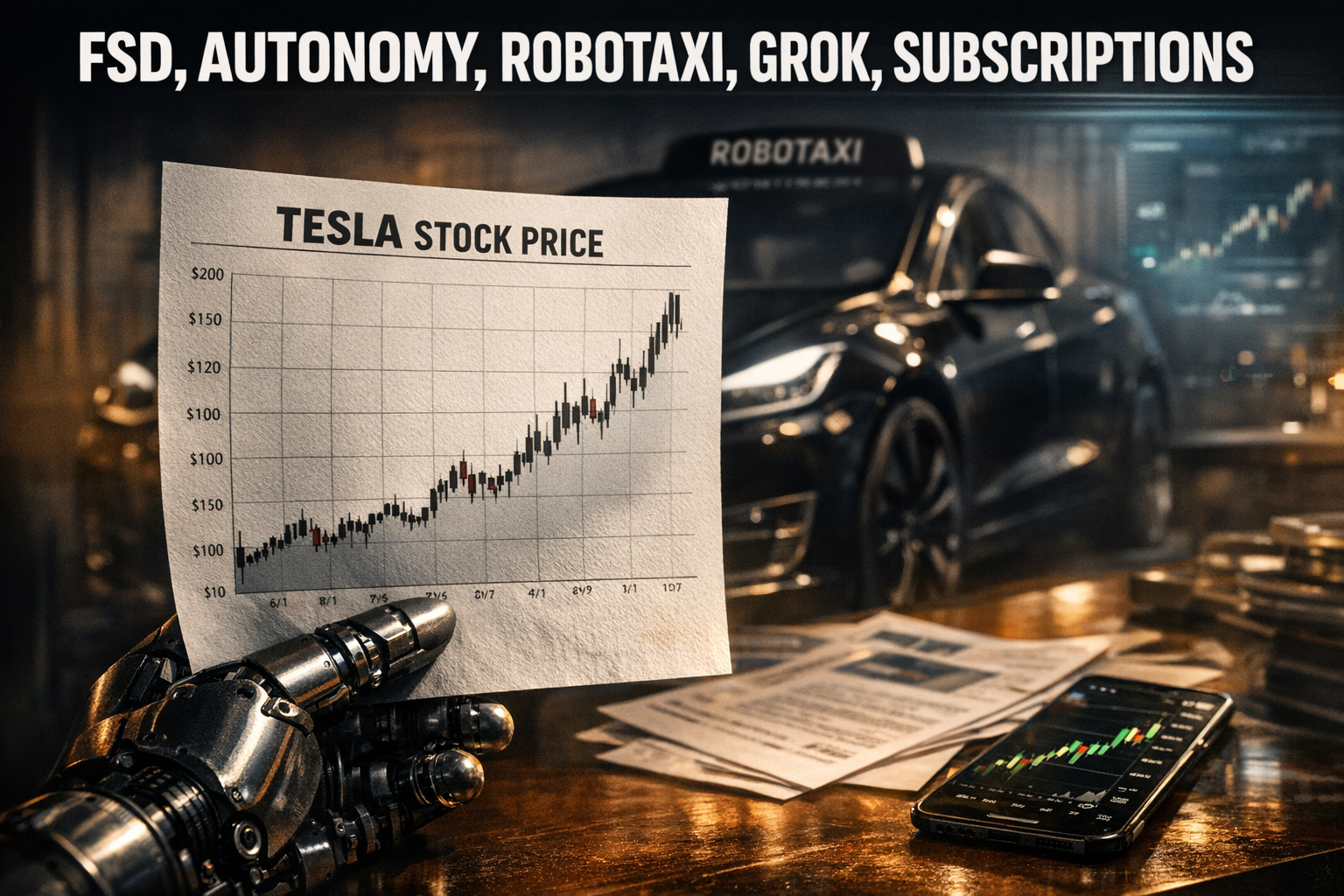
● Bad-News Proof Tesla FSD Repricing Signal
Despite a Wave of Negative Headlines, Tesla Did Not Sell Off: The Market Is “Genuinely” Pricing an FSD (Autonomy) Inflection Signal
This report covers:
1) The market mechanism behind Tesla’s resilience despite NHTSA scrutiny, Model 3 safety concerns, and year-end demand variables
2) An investor-oriented interpretation of NVIDIA Robotics Director Jim Fan’s comments on FSD v14
3) Why the “physical Turing test” framing can shift the valuation framework for autonomy
4) Three investor checkpoints that connect to metrics still underappreciated by Wall Street (subscriptions, lock-in, robotaxi optionality)
5) The key takeaway: the price action suggests not “insensitivity to bad news,” but an early signal of a shifting valuation axis
1) One-line market summary: the negatives were not “new information,” and pricing began to emphasize a different variable
Despite multiple negative headlines, Tesla closed essentially flat.
This more likely reflects that the market treated the news as within an already-known risk set, rather than ignoring it.
Equities typically react more to surprise versus expectations than to headline intensity.
Regulatory risk, recall-type issues, and demand incentives recur for Tesla; absent material novelty, incremental downside is often limited.
The more relevant question is what the market is prioritizing.
The observable implication is a potential shift in the valuation axis from vehicle delivery cycles toward an AI software transition.
As this narrative gains weight, short-term negatives may pressure the stock less than expected and support the downside.
2) Issue map: separating today’s Tesla headlines by category
2-1) Regulation and safety (downside pressure): NHTSA scrutiny, Model 3-related safety concerns
This category typically increases the risk premium.
For autonomy, regulation can directly slow product rollout and adoption, effectively increasing the discount rate (cost of capital).
If the stock did not decline meaningfully, the market may be discounting these items as non-fatal to the core medium-to-long-term scenario (autonomy/robotaxi/subscription revenue).
2-2) Earnings and demand (near-term variables): year-end sales outlook, incentives, margin risk
This is the traditional framework most analysts prioritize.
Deliveries, ASP, margins, inventory, promotions: inputs that map directly into conventional manufacturing valuation models.
However, as software and services increase as a share of value, near-term delivery volatility becomes one factor rather than the primary driver.
At that point, the stock can increasingly trade on platform-style growth narratives alongside interest-rate sensitivity.
2-3) Technology and perception (upside optionality): Jim Fan’s experience with FSD v14
A key signal is that a senior figure in physical AI/robotics outside the Tesla ecosystem characterized FSD v14 as moving from novelty toward everyday usability.
This can be interpreted less as praise and more as an early indicator that the product may be entering a phase where it alters user behavior.
If behavior changes, recurring revenue potential (subscriptions) becomes more resilient to macro variables, and subscription economics generally support higher valuation multiples than one-time hardware sales.
3) The central implication of Jim Fan’s remarks: the critical shift is “normalization,” not “performance”
Technologies are initially consumed as novelty.
From an investment perspective, the key inflection occurs when the product becomes a functional dependency.
The comment that losing FSD would be inconvenient is consistent with an early-stage shift toward necessity and lock-in.
If this shift materializes, the unit economics can change: retention becomes measurable, and cumulative retention can begin to reshape reported results over time.
4) Why the “physical Turing test” framing is consequential
The Turing test originally focused on whether humans can distinguish machine output in conversation.
Applying the concept to the physical world implies a reframing of autonomy evaluation.
The evaluation standard could shift from engineering metrics (e.g., distance between interventions) to experiential metrics: whether behavior is natural, predictable, and human-comparable in real-world contexts.
Experiential trust can directly affect willingness to pay, referrals, and regulatory acceptance, thereby serving as a practical proxy for product-market fit (PMF) beyond specification-level performance.
5) Why positive signals may not immediately translate into a sharp rally: markets validate “technology” through “reported metrics” with a lag
A portion of the market continues to value Tesla primarily as an automotive company.
Consequently, a muted near-term price response is consistent with the typical sequence: technology perception → user adoption → revenue model shift → financial metric confirmation → multiple re-rating.
Where the lag persists, downside behavior can change: the stock may become less sensitive to near-term earnings noise if investors begin to price the next framework.
6) Three core metrics to monitor from here (“evidence the market is waiting for”)
6-1) FSD adoption velocity: subscription conversion and active usage growth
Product quality alone is insufficient if usage remains confined to a small cohort.
Key indicators include subscription take-rate, post-trial re-subscription, and regional usage intensity.
If these build, Tesla gains a growth driver less correlated with the vehicle sales cycle.
6-2) Dependency (lock-in): the point at which “inconvenient without it” becomes mainstream
Lock-in reduces price elasticity and can support higher ARPU over time.
Once dependency is established, competitors may find replication of isolated features insufficient to displace the ecosystem.
6-3) Translation into revenue mix: a measurable increase in high-margin software contribution
The primary trigger for sustained re-rating is financial evidence.
If FSD subscription revenue begins to change the revenue mix, and robotaxi services add service-layer revenue, the market’s classification of the company can shift.
Valuation discussions may migrate from auto-style P/E framing toward AI platform and subscription-based multiples.
US Treasury rate trends remain relevant given their direct impact on growth equity discounting.
7) The most material point: the signal may be an early valuation-axis shift rather than “bad-news immunity”
The central question is not a simple bullish-versus-bearish headline contest.
It is whether market participants are beginning to interpret Tesla through a different valuation lens.
If the stock is resilient amid negative news, it may indicate that part of the market is positioning for optionality tied to AI software and physical AI platforms, beyond near-term operating noise.
This also has macro relevance: manufacturing earnings are typically more cyclical, while subscription-style revenue can be more defensive through slowdowns and FX volatility.
A credible transition toward that structure can, over time, reduce the strength of traditional downside arguments.
< Summary >
A flat close despite multiple negatives suggests the market treated the headlines as non-novel and may be beginning to price a shift from automotive-cycle valuation toward an FSD-led AI software transition.
Jim Fan’s characterization of FSD v14 as moving from “magic” to everyday usability is consistent with early lock-in dynamics rather than a one-time performance milestone.
For a broader re-rating, investors should monitor FSD adoption velocity, evidence of lock-in, and measurable revenue-mix change toward subscriptions and robotaxi services.
[Related…]
Key briefing: the AI platform competition reshaped by Tesla FSD and robotaxi
How NHTSA-related regulatory risk affects markets and key investor checkpoints
*Source: [ 오늘의 테슬라 뉴스 ]
– 악재가 쏟아졌는데도 테슬라는 왜 안 빠졌을까? 주가가 말해주는 진짜 이유는?
● AI Companions Spark Loneliness Spiral, Labor Crash, Capital Boom
AI Increases Loneliness? By 2026, the Landscape of Relationships, Labor, and Capital Will Shift Materially
This report covers:
- Structural reasons why Companion AI may not “solve” loneliness but can entrench it chronically.
- Why the UK and Japan created government functions focused on loneliness, and where Korea remains structurally underprepared.
- Why declining labor value accelerates a capital (investment) regime, and which roles can still command premium compensation.
- Under-discussed next-stage scenarios for the Companion AI market (Guardian AI, mandated offline community infrastructure).
1) One-line issue summary: “AI may reduce loneliness short term, but ‘non-rejecting relationships’ can make real-world relationships harder to sustain”
Conversational AI and Companion AI generally do not reject users.
However, interpersonal maturity is built through calibrated friction (rejection, conflict, negotiation).
As reliance on AI intimacy increases, real-world relationships may be avoided not due to inconvenience, but due to higher perceived risk, discomfort, and lower expected return.
2) News-style brief: Loneliness has become a policy agenda, not a purely individual issue
2-1. Overseas: The UK and Japan moved earlier
The UK elevated loneliness as a social issue and strengthened policy responses, including rebuilding community spaces.
Japan also established a cabinet-level function around 2021 to address social isolation.
These initiatives are linked not only to welfare, but to macro risks including social cohesion, political polarization, and misinformation dynamics.
2-2. Korea: Socially isolated youth have reached meaningful scale
Korea’s socially isolated youth population is estimated in the hundreds of thousands. A core gap is the structural shortage of accessible opportunities and places to gather.
Post-pandemic defaults—remote work, delivery services, OTT streaming, and mobile-first consumption—reduced the necessity of in-person interaction.
Personalized AI further increases the share of “low-friction relationships” that do not impose discomfort on users.
3) Trend 1: Why “companionship” evolved from animals to plants to stones to AI
Growth in the companion pet market reflects rising demand for emotional targets amid chronic loneliness.
Subsequent categories (plants, stones) lowered caregiving burden.
Companion AI adds dialogue, empathy simulation, and interaction, increasing adoption potential and societal impact.
3-1. Companion AI introduces a distinct “loss risk”
Service discontinuation or company bankruptcy can terminate the relationship abruptly.
Human relationships often include a dissolution process; AI relationships can end instantly via system shutdown.
This can intensify perceived loss and increase dependency dynamics.
4) Trend 2: “AI risk is driven less by intelligence than by the absence of rejection”
Real-world relationships require adjustment and conflict resolution.
Companion AI is typically designed to remain available and align with the user.
Risks are higher for adolescents and young adults with limited social experience.
Deep immersion can blur real/virtual boundaries and may reinforce harmful interaction patterns.
4-1. The next stage: Humanoids and physical interaction
When conversational AI integrates with robotics, physical companionship becomes feasible (e.g., hand-holding, daily accompaniment).
At that point, the product can shift from a service to lifestyle infrastructure.
Demand could scale, while regulatory, ethical, and safety debates intensify.
5) Trend 3: Offline gatherings are resurging, but formats have changed
Book clubs, running crews, and interest-based groups are growing, reflecting the limits of sustained isolation.
Unlike legacy clubs with extended social bonding, many modern communities optimize for short, efficient meetups and rapid dissolution.
This reflects a new community UX under personalization.
5-1. Policy candidate: Mandating “places to gather”
A notable concept is institutional expansion of safe spaces where children can gather and practice social interaction, similar to residential community facilities.
This is better framed as long-term human-capital investment (social skills, collaboration capacity) than as welfare spending.
6) Economic and investment lens: Declining labor value increases capital value, but demand-side constraints matter
As AI raises productivity, unit labor costs in repetitive office and service work face downward pressure.
This supports the “investment era” narrative, but introduces a constraint: reduced labor income can weaken consumption; weaker consumption can pressure corporate revenues.
Redistribution mechanisms, including variants of basic income, persist as a policy discussion partly to address this demand gap.
At the global level, if AI productivity rises while middle-class purchasing power erodes, the cycle can face persistent demand insufficiency.
Consequently, distribution structures may warrant greater attention alongside inflation, rates, and growth.
7) “In-person capability” may become scarce and command higher pay
Korea’s labor force is heavily concentrated in services; paradoxically, strong in-person communication is becoming scarcer.
In an AI-intensive environment, empathy, negotiation, conflict resolution, and leadership may become premium capabilities.
Roles in healthcare, education, and management are harder to decompose due to emotional and relational labor, potentially widening wage dispersion.
7-1. Leader avoidance: Compensation alone is insufficient
Avoidance of leadership roles reflects higher perceived costs (time, stress, accountability) relative to authority.
Potential responses include time autonomy, job redesign, and leadership models emphasizing operational participation.
Organizations may need to redesign “how people lead people” in an AI-enabled context.
8) Under-covered but material points
8-1. “Guardian AI” could emerge as a necessary category
A monitoring layer may be required to prevent boundary violations, block risky dialogue, and help balance real-life routines (sleep, study, social interaction).
Monetization has historically favored “engagement-maximizing AI,” but the next phase may elevate “harm-minimizing AI” at the intersection of market demand and regulation.
8-2. Offline community infrastructure as a macro risk hedge
Loneliness creates long-duration costs via reduced productivity (depression, burnout), higher healthcare spending, increased conflict-related costs, and declining social trust.
Community spaces, social-skills education, and youth isolation responses can be framed as national competitiveness investments.
8-3. Humanoids are not primarily “appliances,” but “relationship-based consumer goods”
Replacement cycles and subscription models may be driven more by attachment and continuity than by performance.
A smartphone-like model (hardware + content + subscription) is plausible; regulatory framing may shift from product safety toward relational and emotional safety.
9) Immediate usage principles
Maintain the principle that AI is a tool.
AI-generated comfort, advice, and judgments can be fast, but humans must evaluate fitness to purpose.
Statements that blur boundaries (e.g., urging withdrawal from real life) should be treated as risk signals and independently verified.
< Summary >
Companion AI can reduce loneliness, but non-rejecting relationships may increase avoidance of real-world relationships.
The UK and Japan elevated loneliness as a policy agenda and are rebuilding community infrastructure; Korea’s isolated youth population is already material in scale.
Companionship markets evolved from animals to plants to stones to AI, introducing a new discontinuity risk when services end.
Humanoid integration may sharply increase immersion and amplify regulatory, ethical, and safety issues.
Falling labor value can accelerate a capital-driven regime, while demand-side constraints strengthen redistribution debates.
In-person communication, empathy, and leadership may become scarce and command wage premiums.
Key under-discussed trends include Guardian AI and offline community infrastructure as potential next-stage themes.
[Related Articles…]
- AI regulation and industrial competitiveness: 2026 investment themes overview (https://NextGenInsight.net?s=AI)
- Global asset allocation strategy as interest-rate direction shifts (https://NextGenInsight.net?s=interest%20rates)
*Source: [ Jun’s economy lab ]
– AI 때문에 더 외로워질 겁니다(ft.윤덕환 작가 2부)
● Nvidia 20B Groq Grab, Santa-Rally Heat, 2026 AI Shakeout
NVIDIA’s $20B Acquisition of “Grok,” Santa Rally Statistics, and Key Inflection Points Through 2026
This report consolidates three core topics:1) The strategic rationale behind NVIDIA’s $20 billion acquisition of the “Google TPU” engineering team (implications for the post-GPU roadmap).
2) The statistical basis for the “Santa Rally” and potential inflection points into next year.
3) Evidence that broad-based AI beta is fading, with dispersion increasing within AI-linked equities.
1) US Equities Today: Year-End Support Persists; Leadership Broadens Toward Memory/Storage
Trading conditions were subdued due to an early holiday close, but overall tone remained constructive.
The S&P 500 held near highs, and year-end “Santa Rally” expectations continued to support risk appetite.
1-1. Semiconductor Focus: Micron + SanDisk
Strength was more pronounced in memory semiconductors, with SanDisk also performing well.
This matters because the AI investment cycle is increasingly extending beyond compute into data storage, movement, and training infrastructure.
Market attention appears to be broadening from GPUs to memory/storage, and further toward power efficiency and inference optimization.
2) Santa Rally: A Repeated Pattern with Statistical Support
Tom Lee’s central claim is that the Santa Rally is not merely anecdotal.
Historically elevated returns during the final week of the year and the first few sessions of the new year were attributed to two recurring flows.
2-1. Two Structural Drivers Behind the Santa Rally
- Window Dressing: Year-end positioning to improve the appearance of portfolio holdings
- New-Year Rebalancing: Early-year inflows and renewed allocation to risk assets
When these flows overlap, US equities have often experienced incremental upside over a short horizon.
2-2. Lee’s Medium-Term Framework (Including a 2026 Lens): Easing Rate Pressure + Expansion Scenario
The proposed sequence is: a more accommodative Federal Reserve stance, increased expectations for rate cuts, easing valuation pressure, improving corporate sentiment, ISM recovering above 50, and a transition toward expansion.
Political events and potential policy stimulus could further reduce the dominance of “sharp slowdown” positioning.
3) The Most Important Shift Next Year: “AI Can No Longer Be Treated as One Basket”
A key change is declining correlation among hyperscalers (Amazon, Google, Meta, Microsoft, Oracle, etc.), with performance increasingly driven by company-specific fundamentals.
3-1. Why This Matters for Investors
Broad allocation across “tech/AI” may fail to match index performance in a higher-dispersion regime.
Within AI, outcomes are increasingly likely to diverge based on earnings quality, bookings, and margin structure.
3-2. Next Potential Areas of Diffusion: Traditional Cyclicals + Financials
Under an expansion assumption (ISM > 50), Lee highlighted cyclical sectors such as industrials, energy, and materials.
He also emphasized financials as a primary beneficiary.
3-3. The Case for Financials Re-Rating “Like Tech”
The logic is summarized as follows:
AI and blockchain adoption → reduced labor dependence → cost reduction and margin improvement → potential multiple expansion for large banks.
This framework supports the view that firms such as JPMorgan and Goldman Sachs could be reconsidered as structurally advantaged large-cap leaders.
If regulatory easing materializes, benefits could extend to regional banks.
4) Major Headline: NVIDIA to Acquire Semiconductor Startup “Grok” for $20B
NVIDIA announced a $20 billion acquisition of “Grok,” described as one of the company’s largest transactions, with the CEO and key executives joining NVIDIA.
4-1. Why “Grok” Commands a Premium: “Built by Google TPU Engineers”
The strategic value is concentrated in the team’s TPU lineage, effectively internalizing capabilities associated with a key alternative compute paradigm.
4-2. Core Thesis: After Training Comes Inference; Power Efficiency Becomes Central
While GPUs remain dominant in training, industry focus is shifting toward inference.
In inference, total cost and power efficiency increasingly determine competitiveness.
This elevates ASICs (custom silicon) as a competitive axis, with TPU as a representative benchmark.
A common bear thesis on NVIDIA has been that inference/ASIC migration could compress the GPU premium.
4-3. Jensen Huang’s Response: Address the Concern via Acquisition
The transaction can be interpreted as a direct response to ASIC/TPU and inference-transition risk through M&A.
NVIDIA’s cash and equivalents were cited at approximately $60 billion, implying financial capacity to execute a $20 billion deal.
4-4. Residual Variable: Antitrust/Regulatory Risk
Large transactions inherently carry regulatory review risk.
Market attention is likely to monitor antitrust dynamics, with outcomes dependent on policy stance and enforcement priorities.
5) Brief Item: Tim Cook’s Nike Purchase Filing
A filing indicated Tim Cook purchased 50,000 shares of Nike at $58.97 per share (approximately $3 million).
Such insider/high-profile purchases can provide short-term sentiment support, while durability depends on subsequent earnings and guidance.
6) Key Points Often Underemphasized
6-1. NVIDIA’s Acquisition: Not Portfolio Expansion, but Control Over AI Power Economics
The primary issue is not only “GPU vs TPU,” but the cost structure of power and data center operations.
As AI demand scales, constraints increasingly shift from raw performance to power, thermals, and operating expense.
NVIDIA’s move can be interpreted as securing inference-optimization talent to defend positioning in a power-constrained environment.
6-2. Falling Correlations: Not Necessarily a Bubble Signal, but Evidence of Industrialization
When tech moves in unison, theme-driven beta dominates.
As correlations break down, investors increasingly price company-level attributes such as monetization model, CAPEX efficiency, and customer lock-in.
This can coincide with late-cycle excesses unwinding, but also marks an environment where durable winners are differentiated.
6-3. Financials’ AI Upside: Back-Office Automation, Not Consumer Chatbots
Economic value in financial-services AI is more concentrated in risk management, underwriting, compliance, payments/settlement, and fraud detection.
Productivity gains in these functions can structurally alter cost bases, supporting the multiple-expansion argument.
< Summary >
US equities retained year-end support, with notable leadership from memory/storage.
The Santa Rally has statistical backing via window dressing and early-year rebalancing flows.
Next year may feature increased dispersion within AI as correlations decline and fundamental selection becomes more important.
Lee’s expansion framework (ISM > 50) favors cyclicals and highlights financials as a potential re-rating candidate.
NVIDIA’s $20 billion Grok acquisition positions the firm for the inference/ASIC transition and intensifying competition around power efficiency.
[Related Links…]
- https://NextGenInsight.net?s=NVIDIA
- https://NextGenInsight.net?s=Financials
*Source: [ Maeil Business Newspaper ]
– [홍장원의 불앤베어] 엔비디아 숏친 마이클 버리 응징하는 젠슨황의 초대형 인수합병