
● Samsung Shocks Tesla, Grabs ZF ADAS Data Goldmine
In this article, I will go beyond the simple news that Samsung Electronics bought a German parts company and dig into the reality of the ‘Data War’ hidden behind it.
I will cover in great depth why this deal makes Tesla nervous, what the real meaning of vertical integration drawn by Samsung in the SDV (Software Defined Vehicle) era is, and the future of the autonomous driving data economy that will unfold. If you read to the end, you will definitely understand how the global market landscape is currently flipping.
1. December 2025, Samsung’s Quiet Winning Move: Acquiring German ZF ADAS
Outwardly expanding parts business, inwardly securing a ‘Data Pipeline’
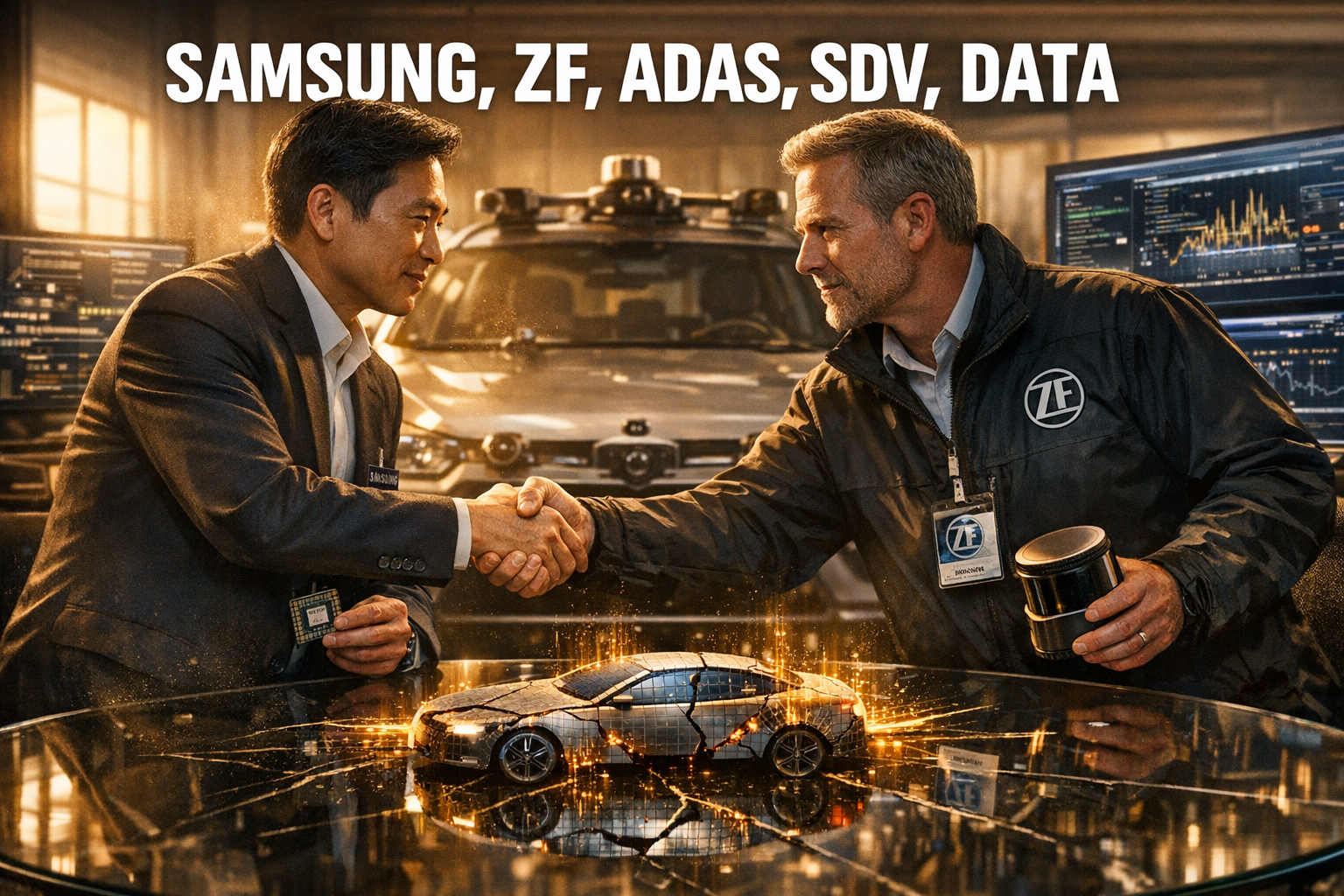
In December 2025, Samsung Electronics acquired the ADAS (Advanced Driver Assistance Systems) division of ZF (Friedrichshafen), a German automotive parts giant. The media briefly covered it as Samsung strengthening its electronics business, but industry experts were shocked. In Silicon Valley, comments even emerged saying, “Samsung has finally entered the real game; Tesla needs to be nervous.”
It is not just about making one more part. ZF is the world’s second-largest company supplying parts to premium brands like Mercedes-Benz, BMW, and Audi. The ADAS technology they possess is installed in over 5 million vehicles worldwide. With this acquisition, Samsung has instantly secured ‘time’ and ‘actual driving data’ that money cannot buy.
2. Paradigm Shift in the Automotive Industry: From Hardware to Software
Computers on Wheels, the Arrival of the SDV Era
Cars are no longer machines that run on gasoline. As Tesla proved, they are ‘computers on wheels.’ The latest cars contain over 100 million lines of code, which is more than a fighter jet. In the past, the engine and transmission were important, but now the integration capability of software is the core competitiveness.
This is why existing automakers find it hard to catch up with Tesla. It is almost impossible to integrate parts that are all different—Engine from Company A, Brakes from Company B, Infotainment from Company C—into a single software system. That is why giant companies like Volkswagen suffered from software errors. However, the transition to SDV (Software Defined Vehicle) has become an essential task for survival.
3. The Core Secret of AI Autonomous Driving: More Important than Algorithms
Data is the Only Resource Money Can’t Buy
There are three elements that make autonomous driving AI smart: Algorithms, Computing Power, and Data. The first two can be obtained from Google or Nvidia if you have money. But data is different.
As Professor Andrew Ng said, “The winner of autonomous driving is not the one with the smartest algorithm, but the one with the most data.” The tens of thousands of variables experienced on actual roads (unexpected situations, bad weather, etc.) cannot be created in a laboratory. The reason Tesla is scary is that over 3 million vehicles worldwide are pouring out driving data equivalent to circling the earth 250,000 times every day. It would take 10 years to catch up to this, but Samsung has closed that 10-year gap in an instant with the ZF acquisition.
4. Samsung’s Big Picture: Perfect ‘Vertical Integration of Data Collection’
Samsung’s Unique Full-Package Strategy Even Tesla Can’t Do
The real core point of this acquisition is that Samsung has become the only company capable of handling the entire process ‘from data generation to analysis’ on its own. Let me summarize step-by-step how amazing this is.
- Step 1 (Collection): ZF ADAS cameras film road conditions. The image sensors used here are made by Samsung Electronics (World No. 2).
- Step 2 (Transmission): The 5G modules that send the vast collected data to the server? Samsung Electronics is in the lead group.
- Step 3 (Storage): The SSD and DRAM to store data inside the car even if communication is cut? Samsung Electronics is World No. 1.
- Step 4 (Processing): The Exynos Auto Processor (NPU) that performs AI calculations within the vehicle is also Samsung’s.
- Step 5 (Analysis): The HBM (High Bandwidth Memory) needed when training data piled up in the server? Samsung has a tight grip on it.
- Step 6 (Platform): Even Harman’s infotainment system that integrates all this and displays it to the user.
Do you see it? Tesla uses chips from Nvidia and batteries from Panasonic, but Samsung has vertically integrated this entire hardware and software value chain. This is something neither Apple nor Tesla has accomplished.
5. Future Economic Outlook: A World Making Money with Data
New Rulers of the Subscription Economy and Smart Cities
Samsung is no longer a simple manufacturer. It can create enormous new businesses with the secured data.
- Autonomous Driving Subscription Service: Like Tesla FSD, they can receive a monthly subscription fee. Even capturing just 10% of the global market generates over 10 trillion KRW in annual revenue.
- Insurance and Financial Products: They can sell driver habits and accident risk data to insurance companies or create their own insurance products.
- Smart City Solutions: B2G businesses providing road damage, traffic congestion, and floating population data to local governments or cities are also possible.
Now, the central axis of the automotive industry is moving from Detroit to Silicon Valley and Seoul. If oil dominated the 20th century, the 21st century will be dominated by those who hold Mobility Data. And Korea, equipped with capabilities in semiconductors, batteries, displays, communications, and finished cars, occupies the most advantageous high ground in this war.
< Summary >
- Event: Samsung Electronics acquired the German ZF ADAS division, ascending as a ‘Hidden Champion’ in the autonomous driving market.
- Core Point: The essence is not simple parts manufacturing, but securing high-quality driving data accumulated over 10 years from over 5 million vehicles.
- Strategy: Completed perfect vertical integration leading from Image Sensor (Collection) -> 5G (Transmission) -> Memory (Storage) -> AI Chip (Analysis) -> Platform (Harman).
- Competitiveness: Possesses the only hardware + software + data integration capability that can threaten Tesla’s monopoly system.
- Future: Expansion of the industrial ecosystem through new data-based business models such as autonomous driving subscriptions and insurance data sales.
[Related Posts…]
- New Paradigm and Future Outlook of the Data Economy
- Autonomous Driving Revolution, Survival Strategies for Korean Companies
*Source: 위대한스토리