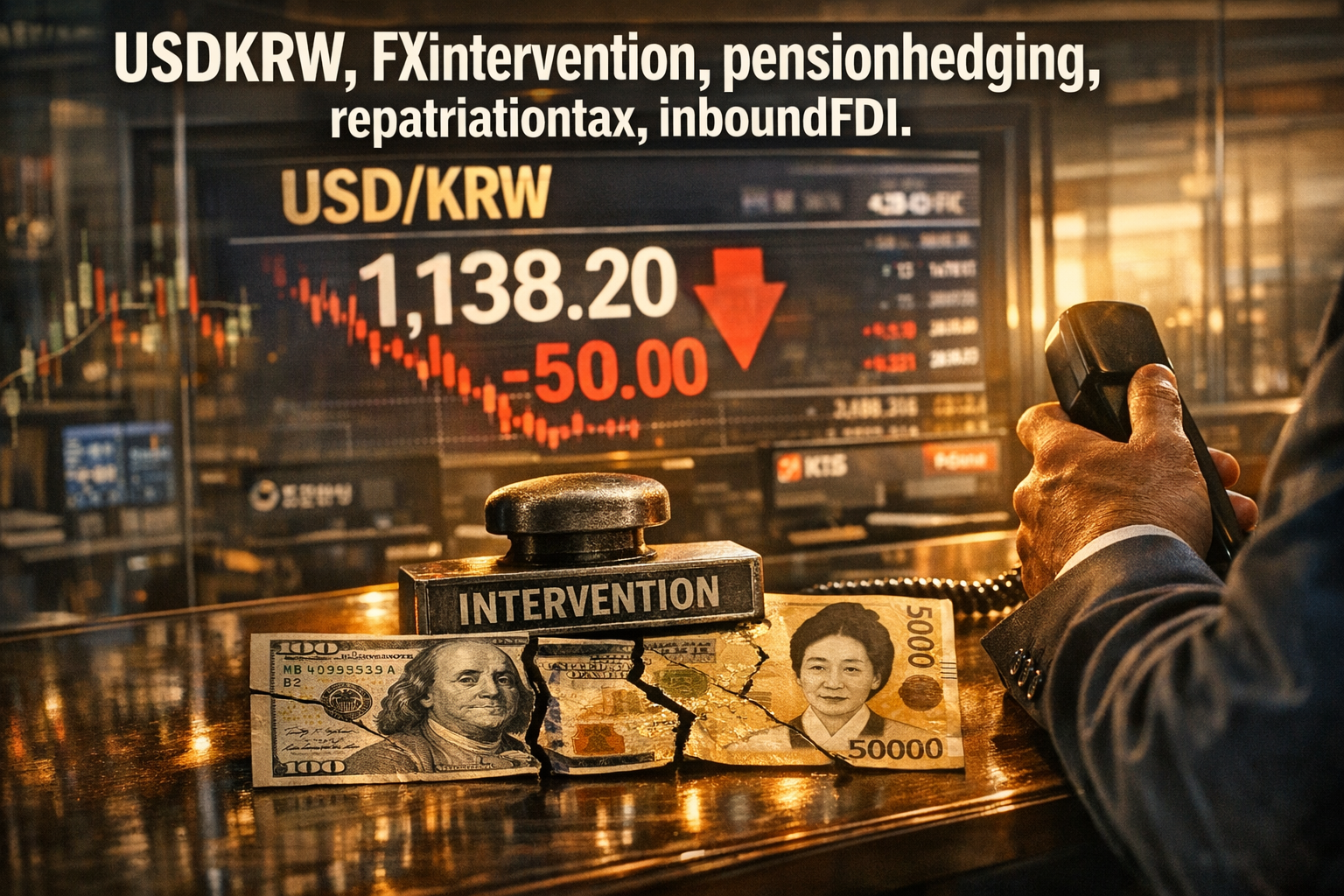
● Dollar-KRW Shock, Government Crackdown, Pension Hedge, Tax-Bait Repatriation, 1500 Rebound Bets
USD/KRW Down 50 Won: The Real Test Starts Now — FX Authorities’ Intervention, National Pension FX Hedging, and RIA (Overseas Equity Tax Incentives) in One Brief
This note consolidates three topics in a news-style format:
1) Why authorities pressed USD/KRW so aggressively (verbal intervention vs. direct intervention)
2) How the three-part policy package (RIA tax incentives, National Pension “strategic FX hedging,” and corporate USD repatriation) can alter FX supply-demand dynamics
3) Why markets still price a “return to 1,500” scenario and what structural solutions (fundamentals) would be required
1) Headline: “USD/KRW Down 50 Won” — Signals Beyond Verbal Intervention Toward Possible Direct Action
USD/KRW declined sharply over a short period, prompting a notable market reaction.
The key takeaway is that the move was interpreted not only as stronger messaging, but also as a potential indication that USD liquidity may have been supplied to the market.
1-1. Verbal Intervention: Messaging Intensity Increased
A coordinated, high-intensity message from the Ministry of Economy and Finance and the Bank of Korea—stating that excessive KRW weakness is undesirable—was read as a signal of tighter level management.
Such verbal intervention typically influences short-term positioning more than medium-term FX expectations.
1-2. Direct Intervention: A 50-Won Move Is Difficult to Explain by Sentiment Alone
A large intraday decline generally implies a meaningful shift in flow dynamics (substantial USD selling).
If the decline persists across holidays, markets tend to infer either actual intervention or a stronger belief in authorities’ willingness and capacity to intervene.
Intervention size can only be confirmed after relevant statistics are published; at present, the appropriate framing is an elevated likelihood of intervention-consistent flows.
1-3. Why “Buy-the-Dip” Reappears: Markets Do Not Yet Price a Structural Shift
Repeated episodes of USD buying on declines indicate a prevailing base case:
“Authorities can suppress the market in the short run; absent a change in fundamentals, USD/KRW can re-rise.”
The current phase is therefore a contest between near-term flow management and the market’s assessment of longer-term equilibrium levels.
2) Authorities’ Working Frame on the Drivers of FX Stress: “Overseas Equity Demand Increased USD Demand”
The policy package is broadly designed to reduce USD demand (capital outflows) and increase USD supply (inflows), i.e., a flow-focused approach.
2-1. Flow Factors (Where Short-Term Measures Can Be Effective)
Rising retail buying of overseas equities → increased USD buying
Expansion of the National Pension’s overseas allocation → persistent structural USD demand
Delayed conversion of export proceeds / higher offshore USD retention by corporates → reduced USD supply
2-2. Structural Factors (Determinants of the FX Level)
Prolonged US–Korea rate differential
Domestic liquidity growth / expansionary fiscal stance
Net outward FDI structure
If these structural factors remain unchanged, flow suppression alone may lead to a repeat pattern of temporary declines followed by renewed upward pressure.
3) The Three-Part Policy Package: Mechanisms to Shift USD Supply-Demand
3-1. (1) RIA: Capital Gains Tax Relief for Repatriation from Overseas Equities
Policy intent:
Sell overseas equities → convert USD to KRW → reallocate into domestic equities or equity funds
If realized at scale, this could reduce USD demand and/or increase USD supply, supporting FX stabilization.
Key design features typically include larger benefits for earlier participation (quarterly tiering) and per-person caps (e.g., KRW 50 million).
RIA: Practical Considerations (Risks and Constraints)
Fairness concerns: preferential tax benefits for overseas equity holders versus domestic-only investors
Distributional concerns: benefits may skew toward higher-wealth cohorts with greater access to overseas assets
Limited durability: capped, event-driven incentives may not shift the FX level on a sustained basis
3-2. (2) National Pension “Strategic FX Hedging” Task Force: Potential Shift from Spot to Forwards/FX Swaps
The National Pension is a major participant given its sizable overseas asset exposure.
Expanding overseas equity and bond allocations structurally increases USD demand.
The policy objective is primarily to reduce the visibility and immediate impact of the National Pension’s USD buying on the spot market.
How Strategic FX Hedging Affects the FX Market (Simplified)
Buying USD via spot → immediate increase in spot USD demand and direct upward pressure on USD/KRW
Shifting part of the activity to forwards → reduces immediate spot-market shock
Using FX swaps → operationally similar to “borrowing” USD, smoothing spot-market demand over time
Key Constraint: Hedging Is Not a Permanent FX-Level Tool
FX hedging is fundamentally a risk-management instrument, not a mechanism to permanently lower USD/KRW.
If hedging costs (rate differentials / swap points) rise, sustainability can weaken.
3-3. (3) Incentivizing Corporate USD Repatriation: Tax Measures for Dividends and Profit Remittances
If corporates bring export proceeds or overseas subsidiary cash flows back onshore, USD supply increases and can support FX stability.
Authorities may adjust double-taxation treatment on overseas subsidiary dividends to provide incentives for repatriation.
The approach relies on incentives rather than coercive controls.
4) Risk Point Often Underweighted: “Year-End Closing Level Management” Can Raise Policy Intensity
For authorities, the year-end USD/KRW level can function as a de facto scorecard.
Accordingly, intervention intensity and policy messaging may strengthen into year-end windows.
If volatility rises, corporate FX risk management and investor USD allocation discipline become more important.
5) Higher-Importance Points Often Underemphasized in Media Commentary
5-1. Flow Measures Primarily Reduce Volatility and Buy Time
RIA, National Pension hedging, and corporate repatriation incentives all target FX flows.
They can be effective near term, but absent improvements in fundamentals, markets can revert to a 1,500-type scenario.
5-2. A Structural Path to Lower USD/KRW Requires Stronger Inbound FDI (USD Inflows to Korea)
Restricting outward investment is difficult and can create significant side effects.
A more durable approach is to increase inbound FDI through a comprehensive package spanning regulation, labor, taxation, quality-of-life factors, and R&D infrastructure to strengthen the investment case for operating in Korea.
5-3. AI Infrastructure as a Potential Fundamental Support Channel
Global capital allocation is increasingly directed toward AI data centers, GPU infrastructure, and semiconductor supply chains.
Korea’s relative strengths in HBM and manufacturing value chains could support AI-related inbound FDI if policy design is effective.
This can be viewed not only as industrial policy but also as a potential medium-term channel for FX stabilization via sustained USD inflows.
6) Forward Checklist: Six Signals for Investors and Corporates
1) Frequency and intensity of FX authorities’ actions (verbal to direct-intervention patterns)
2) Implementation details of National Pension hedging (share and pace of forwards/FX swaps)
3) Actual RIA participation and realized inflows (announcements vs. observed fund flows)
4) Changes in corporate dividend/remittance data (evidence of increased USD onshore inflows)
5) US–Korea rate differential and the global USD trend
6) Policy developments tied to inbound FDI (deregulation, AI/data-center zones, tax incentives)
< Summary >
USD/KRW declined sharply amid stronger official messaging and market perceptions of elevated intervention likelihood; however, markets continue to emphasize unresolved structural drivers that could reassert upward pressure.
Authorities are pursuing flow-based stabilization via RIA tax incentives for repatriation from overseas equities, National Pension “strategic FX hedging” through forwards/FX swaps, and incentives for corporate USD inflows.
A sustained downward shift in the FX level would likely require complementary structural measures, including stronger inbound FDI and AI-infrastructure-driven investment attraction.
[Related Articles…]
- USD/KRW Volatility: What Individual Investors and Corporates Should Monitor Now
- Understanding FX Hedging (Forwards and FX Swaps) to Manage USD Risk
*Source: [ 경제 읽어주는 남자(김광석TV) ]
– 외환당국의 고강도 개입으로 원달러 환율 50원 급락. (1)해외주식 매각시 양도소득세 감면, (2) 국민연금 ‘전략적 환헤지’, (3) 기업의 달러 국내 수취 [즉시분석]
● Japan Drills in Cambodia, China Bleeds Cash in Southeast Asia Power Clash
Signals from Japan Self-Defense Forces Training Observed in Cambodia: Why Southeast Asia’s Military and Economic Landscape Is Shifting Simultaneously (China’s Most Material Vulnerability)
This report covers four areas:
1) Why the Japan Self-Defense Forces training observed in Cambodia is not symbolic but potentially a structural inflection point
2) How confidence in Chinese-made weapons can deteriorate rapidly in the Thailand–Cambodia context, with spillovers into exports, diplomacy, and finance
3) How intensifying competition in Southeast Asia can transmit into supply chains, FX, and inflation from the perspective of Korean corporates and investors
4) A focused framework on where China may incur non-obvious financial damage
1) News Briefing: What Happened
-
Reports indicated that Japan Self-Defense Forces training activities were observed within Cambodia.
-
Japan has expanded its influence in Southeast Asia over an extended period.
-
As regional competition intensifies, analysis suggests China is the most strategically constrained party.
-
A parallel vector involves Thailand:
-
Alongside a narrative of declining confidence in Chinese-made weapons, certain Thailand-based “zones” (interpretable as development/industrial/real-estate projects) are linked to Chinese capital.
-
The central implication is that the visible military storyline may mask a mechanism through which China absorbs financial losses indirectly.
2) Why the Cambodia–Japan Vector Matters Now: How a Single Military Image Transmits into Markets
Visible military cooperation in Southeast Asia (training, basing, port access) functions as a signal of who shapes regional order, not as an isolated event.
Cambodia’s position connects the Mekong subregion (Indochina) with maritime logistics routes (Gulf of Thailand–South China Sea). As Japan’s presence becomes more explicit, multiple channels can move concurrently:
- Supply-chain reconfiguration: accelerated “China+1” relocation toward Cambodia/Vietnam/Thailand corridors
- Geopolitical risk repricing: increased sensitivity in insurance, ocean freight, and component lead times
- Higher FX volatility: moves in local currencies (THB/VND/KHR) translate into import/export pricing
- Diplomacy–finance bundling: security cooperation paired with ODA, infrastructure finance, and technical standards
In effect, the “training image” is a defense signal, while the primary transmission is via trade, investment, logistics, and funding costs.
3) Why Thailand Is Part of the Same Story: “Weapons Credibility” as a Sovereign Trust Variable
A key claim is a sharp deterioration in perceived performance/reliability of Chinese-made weapons. Regardless of the degree of exaggeration, if the narrative gains traction in Southeast Asia, the economic spillovers can include:
- Reduced defense-export competitiveness → tighter payment terms (higher prepayment requirements, greater vendor-financing burden)
- Higher country-brand risk → weaker pricing power and credibility across infrastructure/energy/telecom equipment (quality and after-sales support)
- Elite-network rebalancing → impacts on long-cycle project pipelines (ports/rail/industrial estates)
This is not limited to marginal defense sales; it can force a repricing of China’s bundled model (finance + technology + equipment + labor), creating non-obvious but compounding financial pressure.
4) Key Point Often Underweighted: China’s Primary Pain Point Is Capital Recovery, Not Military Optics
The reference to Thailand “zones” linked to Chinese capital is financially material.
China-linked projects in Southeast Asia (real estate development, industrial estates, resorts, special zones, distribution hubs) are structurally sensitive to:
- cash-flow stability, and
- policy/regulatory risk.
As geopolitical tension rises, capital markets typically react faster than security outcomes. Plausible pathways include:
- Reassessment of permits/tax incentives: favorable terms weaken as political sensitivity increases
- Local sentiment and labor risk: higher frequency of regulatory actions, audits, and compliance scrutiny
- Higher funding costs: wider risk premia raise refinancing difficulty
- Slower capital recovery: weaker presales/leases/utilization prolong payback periods
The core loss is not reputational; it is lower ROI and slower repatriation of invested capital.
5) Japan’s Strategic Objective: Supply-Chain Standards Rather Than Pure Security Signaling
Japan’s expansion in Southeast Asia extends beyond defense visibility toward:
- manufacturing clusters,
- port/logistics systems,
- energy efficiency, and
- digital infrastructure,
with a focus on expanding standards, interoperability, and partner ecosystems.
In global supply-chain terms, this supports diversification and risk dispersion. Southeast Asia shifts from a perceived neutral arena to a contested one.
6) Investor/Business Checklist: Variables Most Likely to Move
- Trade: higher Southeast Asia transit volume increases sensitivity to ocean freight and insurance pricing
- Energy/commodities: elevated geopolitical risk raises volatility → manufacturing cost pressure → inflation pass-through risk
- FX/rates: risk-off conditions typically support USD strength and local-currency depreciation → higher import prices
- Corporate strategy: accelerated footprint diversification increases local CAPEX for select sectors; others may reinforce reshoring/nearshoring
- Policy: security and industrial policy may be bundled into incentive packages, increasing “alignment” pressure on corporate choices
7) Link to AI and Advanced-Industry Themes: Competition Converges on Data, Surveillance, Drones, and Satellites
The linkage to AI is operational: defense, policing, borders, ports, and logistics are increasingly managed via sensors, data, and AI.
- Port/logistics optimization: AI-driven vessel scheduling, container stacking, and automated customs risk scoring
- Enhanced surveillance/reconnaissance: drones, SAR satellites, and computer vision for border and maritime monitoring
- Cybersecurity and communications infrastructure: intensified competition across 5G, subsea cables, and data centers
- Supply-chain risk management: AI-enabled real-time optimization of lead times, alternate suppliers, and inventory (cost competitiveness)
Influence is increasingly determined not only by platforms and maritime assets, but by control over data pipelines.
8) Conclusion: The Central Shift Is the Re-Routing of Capital Flows in Southeast Asia
Headline conflict framing can obscure the financial mechanism. The more relevant signal is a concurrent reallocation of security, diplomacy, and capital toward greater Japanese presence and higher Chinese cost of capital.
A practical inflection point would be a tangible repricing of cash flows for China-linked projects via higher discount rates and delayed capital recovery. Financial variables move before overt political outcomes.
9) Key Points Typically Underreported
-
(1) Weapons-performance narratives first impair bundled-deal financing rather than defense sales alone
(Trust deterioration → worse payment terms → higher financing burden → spillover into infrastructure bidding) -
(2) China’s “non-obvious” damage in Southeast Asia is more likely to occur via delayed capital recovery than through direct military confrontation
(Permits, public sentiment, audits, and tax terms compress ROI) -
(3) Japan’s expansion tends to culminate in supply-chain standardization and data-infrastructure control
(Ports/logistics/communications/data centers as long-duration strategic assets) -
(4) For corporates and investors, the actionable variables are cost inputs such as freight, insurance, and FX rather than headlines
(Ultimately reflected in P&L via costs and funding rates)
< Summary >
Japan Self-Defense Forces training observed in Cambodia signals a more explicit phase of influence competition in Southeast Asia. Combined with Thailand-related dynamics, narratives around declining confidence in Chinese-made weapons can extend beyond defense into country brand, bundled financing, and infrastructure project pipelines. The most financially consequential mechanism is potential ROI compression and delayed capital recovery for China-linked projects in the region, rather than loss of military prestige. These dynamics can transmit into supply-chain restructuring, FX volatility, freight/insurance costs, and inflation channels, while the AI dimension centers on ports, logistics, surveillance, and communications/data infrastructure competition.
[Related Posts…]
-
Southeast Asia Supply-Chain Reconfiguration: A New Investment Map Shaped by Japan–China–US Competition
https://NextGenInsight.net?s=Southeast%20Asia -
How Geopolitical Risk Transmits into FX and Inflation (2026 Outlook)
https://NextGenInsight.net?s=Geopolitics
*Source: [ 달란트투자 ]
– 캄보디아 내 일본 자위대 발칵 동아시아에 곧 피바람이 분다 | 조한범 박사 2부
● Fed Wordplay, QE-Style Liquidity Pump, 2025 Melt-Up Risk
The Mechanism by Which Wall Street Lifts Markets Through “Semantic Framing”: Where We Are Now on Reserves, Liquidity, QE-Like Optics, and the 2025 Investment Roadmap
This report consolidates four items.
1) The core mechanism behind “not QE” messaging while markets respond as if it were QE
2) Why near-floor bank reserves can coincide with simultaneous false rallies, concentration, and higher volatility
3) The linkage across three 2025 triggers (rate cuts, Treasury buybacks, energy/inflation management)
4) A practical checklist for validating the true direction of liquidity using S&P 500/Nasdaq futures (/ES, /NQ)
1) News Briefing: One-sentence definition of the “semantic framing”
Key takeaway
Even when the Federal Reserve states it is not conducting traditional quantitative easing (QE) via direct asset purchases, replenishing reserves within the banking system can still create conditions in which institutions are more able to purchase Treasuries and equities, producing QE-like market behavior.
Critical point
The emphasis is less on immediate real-economy stimulus and more on asset-price-driven easing that improves financial conditions and supports the perception of economic strength.
In this framing, the issue is not definitional debate over QE, but the use of equity strength as an indirect policy transmission channel.
2) Why Bank Reserves Matter: When Reserves Are at the Floor, Market Behavior Distorts
(1) Three common outcomes when reserves are near the floor
1) Higher volatility: thinner liquidity increases sensitivity to marginal flows
2) False rallies (concentrated rallies): gains driven by a narrow set of names rather than broad participation
3) Preference for defensive/alternative assets: greater tendency for flows into gold, silver, and other alternatives
(2) Why concentrated rallies emerge
When reserves are constrained, institutions often have limited capacity to buy broadly across the market.
Flows can therefore concentrate into a small number of themes or large-cap leaders, creating the appearance of strength while underlying market breadth remains fragile.
(3) The recurring misconception in this regime
“Liquidity provision automatically and immediately translates into equity inflows” is only partially accurate.
When reserves are already extremely low, policy actions may first be priced through expectations rather than through immediate, durable balance-sheet expansion.
3) Indirect QE-Like Pathway: Reserves → Institutional Risk Capacity → Asset Prices
(1) A three-step structure
– Step 1: Federal Reserve/Treasury measures increase reserves in the banking system
– Step 2: Banks and institutions gain incremental operating capacity while remaining constrained by regulation and stress-testing considerations
– Step 3: incremental capacity is allocated across Treasuries, equities, and credit, supporting asset prices and easing financial conditions
(2) The threshold matters
When reserves are too low, additional liquidity may not transmit immediately into risk assets.
However, once reserves rebuild beyond a functional threshold, the market impact can become meaningfully QE-like through improved balance-sheet capacity and risk intermediation.
The key variable is the lag between initial replenishment and observable transmission into broader asset allocation.
4) Three Primary 2025 Triggers (Reframed)
Trigger A: Rate-cut expectations (policy pivot)
– Rate cuts are not automatically bullish in all regimes
– In the current setup, they can support valuation multiples via improved discount-rate expectations and risk sentiment
Trigger B: Treasury buybacks (or issuance composition changes) + reserve support
– Market participants may interpret the combination as “QE-like,” potentially with a stronger perceived effect than conventional QE optics
– The core mechanism is not direct central-bank purchases but easier Treasury supply/demand conditions and improved bank balance-sheet flexibility, which can loosen financial conditions
Trigger C: Inflation management with energy (oil) as the key lever
– Headline inflation can be materially influenced by energy prices
– Policy outcomes may center on keeping inflation within a manageable range rather than fully suppressing it, thereby sustaining economic activity and risk appetite
Linkage across the three
If these drivers align, markets may shift toward a “liquidity regime,” where the availability and direction of liquidity can dominate recession narratives as a pricing factor.
5) Chart and Positioning: Risks in a “Range-Top + Pattern Overlap” Zone
(1) The primary technical focus: range breakout rather than pattern naming
Pattern interpretation varies; the more actionable signal is a decisive move through the top of a trading range, where positioning and flow can accelerate.
(2) Reserve-floor rallies can be mechanically fragile
If the move is driven by short-duration positioning rather than persistent liquidity support, pullbacks following gap-ups should be treated as plausible rather than anomalous.
(3) Conclusion
The base case is not necessarily a crash; rather, rapid advances can naturally be followed by retracements that normalize conditions.
6) Practical Checklist: Use /ES and /NQ to Track Cash-Flow Reality, Not Narrative
(1) Why futures (/ES, /NQ)
Index futures frequently reflect shifts in liquidity expectations earlier than cash markets, particularly when policy transmission is being repriced.
(2) What to monitor (individual investor framework)
– Magnitude of gains vs. market breadth: rising indices with narrow participation signal concentration risk
– Relationship with Treasury yields (notably the 10-year): equities holding up amid rising yields can indicate liquidity expectations outweigh rate pressure
– Post-gap price action: gap retention supports momentum; gap fills can indicate short-term overheating
7) Four Underweighted Points
Point 1: The reserves threshold is more decision-relevant than the QE label
The investable question is whether reserves have rebuilt above a functional threshold.
Below that level, expectation-driven rallies often coincide with volatility and concentration; above it, broader rotation becomes more feasible.
Point 2: The more realistic objective is financial-conditions easing via asset prices
Transmission may operate through equity strength, wealth effects, and confidence rather than immediate real-economy stimulus.
This helps explain resilience in risk assets despite weak macro prints.
Point 3: The opposite of inflation fear is active energy-price management
If inflation cannot be fully eliminated, policy can still aim to keep headline inflation manageable through energy dynamics, supporting risk-taking behavior.
Point 4: “False rallies” are regime signals, not moral judgments
They can reflect structural outcomes of shallow liquidity and constrained reserves, providing information about underlying market stamina.
< Summary >
Even without formal QE, replenishing bank reserves can improve institutional capacity to allocate into Treasuries and equities, generating QE-like market responses.
When reserves are at the floor, shallow liquidity can produce simultaneous false rallies, concentration, and elevated volatility.
Key 2025 triggers include rate-cut expectations, Treasury buybacks and reserve support, and inflation “management” via energy prices.
In this regime, combining /ES and /NQ signals with market breadth and the 10-year yield can help distinguish expectation-driven rallies from broader liquidity-driven rotation.
[Related Links…]
- Five Signals to Confirm a Liquidity-Driven Regime
- QE vs. QT: When Timing Actually Matters for Markets
*Source: [ 미국주식은 훌륭하다-미국주식대장 ]
– 말장난으로 월가에서 지금 몰래 쓸어 담는 종목