● Intel 5B Stake Dump, Silver 80 Shock, 2026 AI Pivot Nvidia to Google
Signals from Intel’s $5 Billion Stake Sale, the Real Drivers Behind the Silver $80 Shock, and the 2026 AI Investment Map Expanding from “NVIDIA-Only” to Include Google
This text centers on three points.
First, what Intel’s large-scale stake sale implies for capital flows into AI infrastructure.
Second, why silver’s move to $80 and subsequent pullback reflects structural supply deficits and energy-transition demand rather than mere volatility.
Third, how the 2023–2025 “NVIDIA-led” narrative is expanding to a 2026 framework that also emphasizes Alphabet/Google-driven monetization and cost innovation, changing security-selection criteria.
1) Market in One Line (U.S. Close Summary)
Nasdaq: -0.64%.
S&P 500: -0.34%.
Dow: -0.13%.
Russell 2000: -0.26%.
Key feature: year-end liquidity is thin, and simultaneous weakness in AI bellwethers amplified negative sentiment.
NVIDIA fell over -2%, Tesla fell over -2%, with AMD and Palantir also weaker, reviving discussion of an “AI bubble.”
Given holiday-season conditions, daily swings can be exaggerated; a single -2% move is not sufficient to conclude a structural shift.
2) This Week’s Focus: Limited Major Events; Fed Tone Is Key
The central item is the FOMC minutes.
Investors will assess the rationale behind three consecutive rate cuts.
The minutes may clarify whether rate cuts are expected to continue into 2026 in line with market expectations, or whether the Fed remains more cautious on inflation and employment.
Additional releases include ADP employment, initial jobless claims, and PMI indicators.
The core focus is the Fed’s inflation path assessment and the strength of any growth-slowdown signals.
3) Global Asset Price/Market-Cap Trends: Gold and Silver Are Trading on Different Drivers Than Equities
Gold continues to set new highs (the text references $4,471).
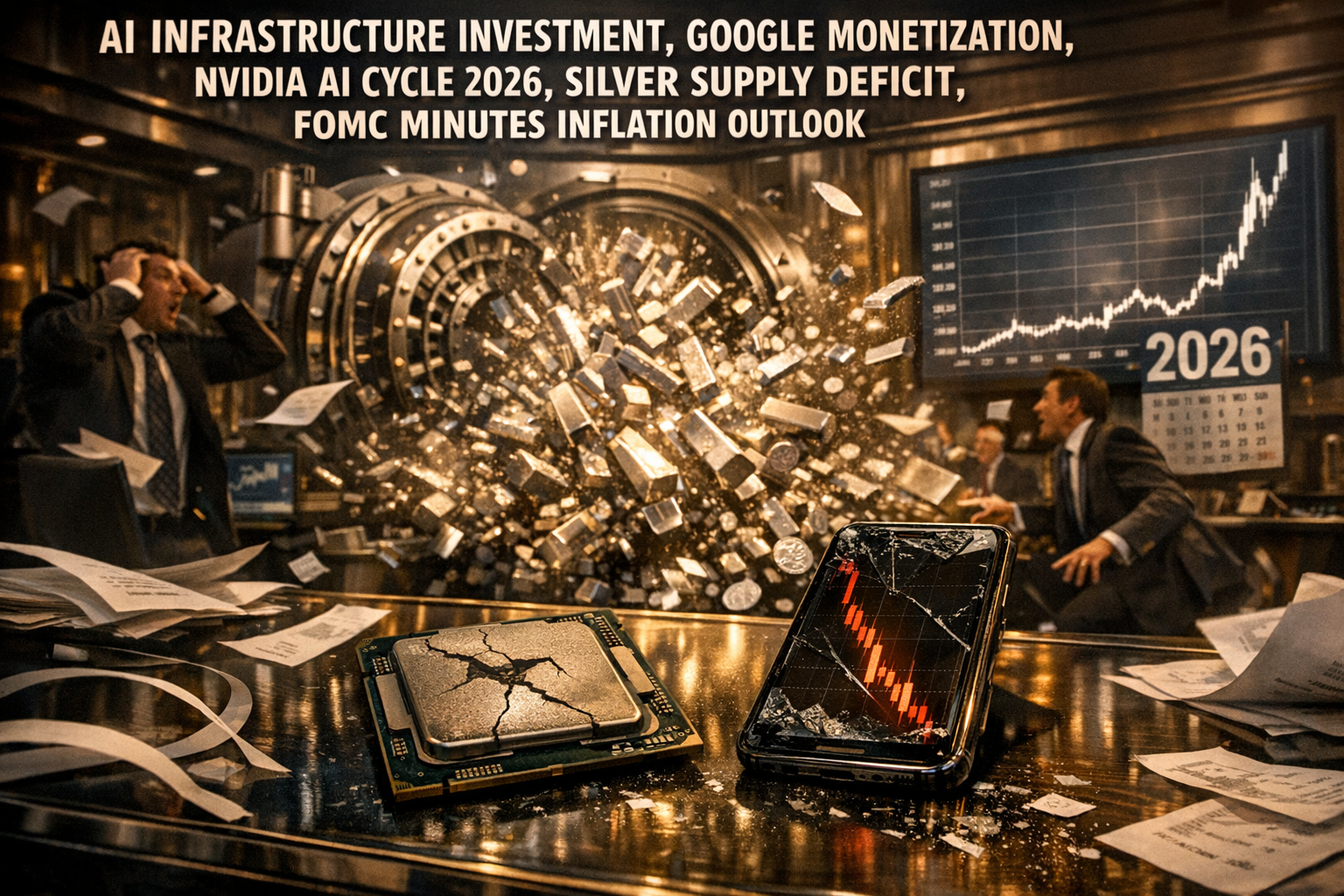
Silver briefly exceeded $80 intraday before retreating to the $74 area.
This “spike then consolidation” also influenced market sentiment.
A narrow risk-off/safe-haven interpretation is incomplete.
Precious metals are increasingly linked to physical-demand themes: energy transition, power infrastructure, and industrial demand.
4) The Core Driver of Silver’s Break Above $80: A Five-Year Cumulative Supply Deficit
The rally is framed around persistent supply shortfalls.
Five consecutive years of deficit.
This year: total demand of 1.24 billion ounces vs. supply of 1.01 billion ounces, implying a 230 million-ounce deficit.
The five-year cumulative deficit is cited at approximately 820 million ounces, supporting a structural interpretation.
A major demand pillar is solar PV.
Panels require silver paste for conductivity.
Incremental demand from grid investment and data-center power needs can reinforce strength across industrial metals and precious metals.
Conclusion: silver’s sharp moves reflect leveraged price action on top of a structural supply-demand gap.
Short-term volatility may persist, but the medium-term narrative is presented as resilient.
5) The 2025–2026 AI Investment Map: Expanding from “NVIDIA-Only” to Include Google
The AI narrative is described as evolving in three phases.
Act 1: GPU Bottleneck = NVIDIA
In 2023–2024, model-performance competition largely translated into training-scale competition, with GPUs as the binding constraint.
This supported a simplified framework equating AI exposure primarily with NVIDIA.
Act 2: AI as a Cloud CAPEX Race
GPUs are the engine, but spending decisions by hyperscalers increasingly drove market outcomes.
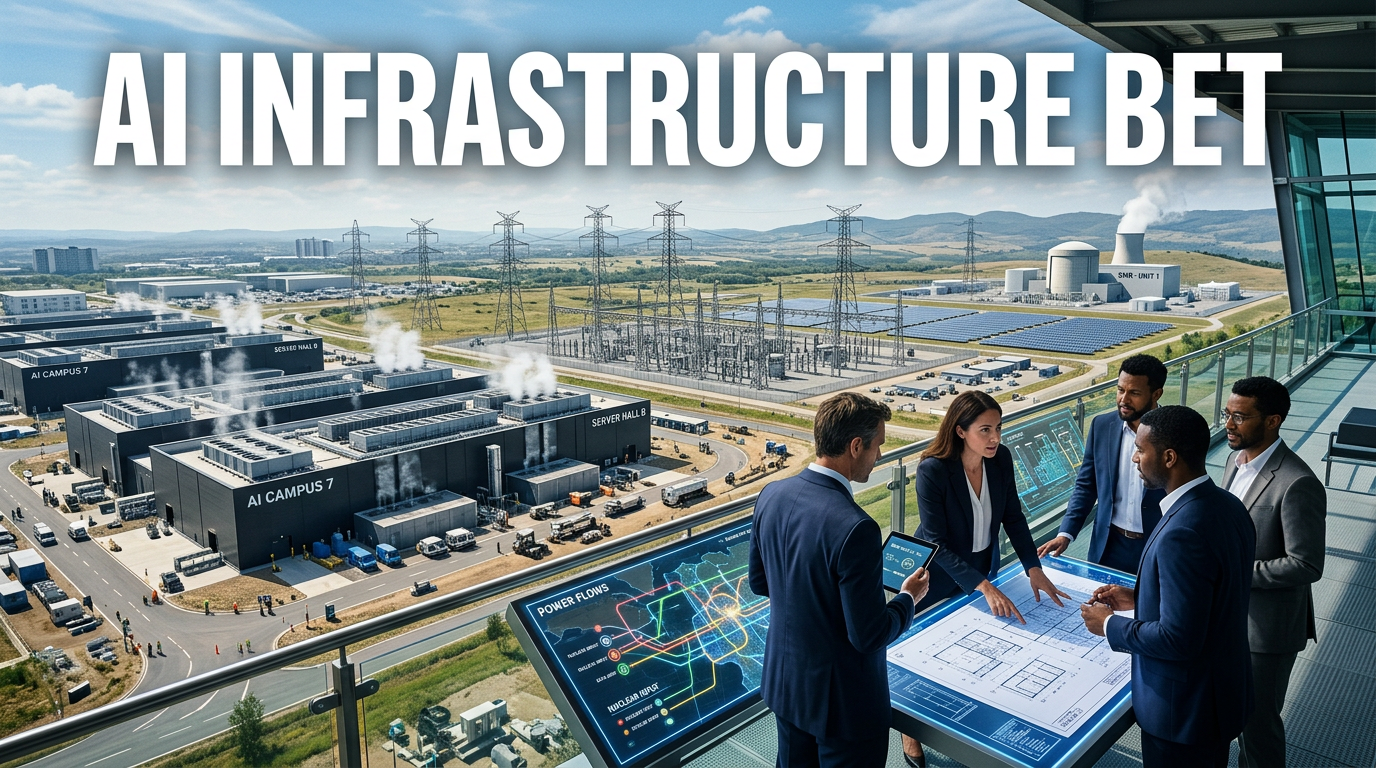
The AI buildout expanded from chips to data centers, networking, power, and cooling.
This phase emphasized “AI infrastructure investment,” with broad attention on CAPEX trajectories.
Act 3: Monetization and Cost Innovation
Into 2026, the central question shifts from how many GPUs are purchased to who can convert customer access into revenue (revenue leverage) and who can reduce compute unit costs (cost leverage).
Within this framework, Alphabet/Google is positioned as strengthening via three levers.
1) Distribution Leverage
Search, YouTube, Android, and Gmail/Workspace provide large installed channels, enabling rapid user-level diffusion once AI features are deployed.
2) Monetization Leverage
Advertising remains a significant cash engine.
If AI-enhanced search and recommendations improve matching efficiency and engagement, monetization can translate into results more directly.
3) Cost Leverage
In-house chips and optimization (e.g., TPU) can partially reduce dependence on NVIDIA and lower compute costs.
As AI economics increasingly resemble a margin and unit-cost game, this can become a differentiating factor.
6) Is NVIDIA Over? The Position Presented: No, but the “Sole Winner” Framework Is Changing
Despite the day’s decline, Bernstein reportedly maintained a $275 price target.
This indicates that parts of the sell-side community continue to view long-term upside as substantial.
The key issue is not the target price itself, but the market’s shifting lens—from GPU shipment momentum to the broader distribution of profits across the AI value chain.
This transition may increase selection complexity in 2026.
7) S&P 500 Outlook (Bank of America): 2026 Likely Driven More by Earnings Than Multiples
Bank of America referenced a base-case S&P 500 level of 7,100.
Upside scenarios were also indicated.
A central point: 2025 benefited materially from valuation multiple expansion, while 2026 is framed as more dependent on earnings growth.
Implication: market premium may shift from “AI exposure” broadly to demonstrable AI-driven profitability.
8) Consumer Pricing Dynamics: Discount-Centric U.S. Consumption and Its Link to AI
U.S. consumption has long relied on coupons, memberships, and dynamic pricing.
The text highlights that AI has increasingly automated these behaviors in 2025.
More than half of consumers reportedly use AI for price comparisons, discount-code search, and product recommendations, with higher conversion rates from AI-driven traffic.
Relevance: AI is not only a productivity tool; it is becoming embedded in pricing, distribution, and marketing processes.
This suggests potential AI beneficiaries beyond semiconductors, including retail, advertising, and subscription models.
9) Key Points Emphasized
Point A: Silver’s surge may signal an energy-transition and power-infrastructure bottleneck, not merely an inflation hedge
If solar, grid expansion, and data-center buildouts accelerate simultaneously, silver increasingly behaves like an industrial necessity rather than only a precious metal.
This dynamic could contribute to higher commodity volatility into 2026.
Point B: The AI “bubble” debate is shifting from valuation to who can reduce compute unit costs and capture margin
From this stage, generic “AI strategy” statements matter less than execution on custom silicon, data-center efficiency, power procurement, and cooling technologies.
AI becomes increasingly a cost-structure and unit-economics story.
Point C: The FOMC minutes matter less for the policy rate level than for the durability of AI CAPEX
A more hawkish tone could affect the pace of hyperscaler CAPEX, with second-order impacts across GPUs, networking, and power infrastructure value chains.
The text frames five core keywords: U.S. equities, S&P 500, Fed (FOMC), rate cuts, inflation.
< Summary >
In thin year-end liquidity, broad weakness across AI bellwethers weighed on sentiment; however, a structural trend break is not established by a single session.
Silver’s surge is attributed to a five-year cumulative supply deficit and rising industrial demand led by solar PV, indicating a structural component.
The AI narrative is expanding from a GPU-bottleneck framework centered on NVIDIA to include monetization and cost-innovation competition in which Alphabet/Google is positioned as relevant.
In 2026, earnings delivery and cost structure may matter more than valuation multiples.
This week, the FOMC minutes are the primary input for assessing the Fed’s inflation and labor-market stance.
[Related…]
NVIDIA Outlook: AI Semiconductor Cycle and 2026 Investment Considerations
Silver Rally Drivers: Supply Deficits and Industrial Demand Shaping the Price Structure
*Source: [ Maeil Business Newspaper ]
– 인텔, 엔비디아에 지분 5.0B 매각 완료ㅣ번스타인, 엔비디아 목표가 275달러 유지ㅣ은 가격 80달러 돌파후 숨고르기ㅣ홍키자의 매일뉴욕