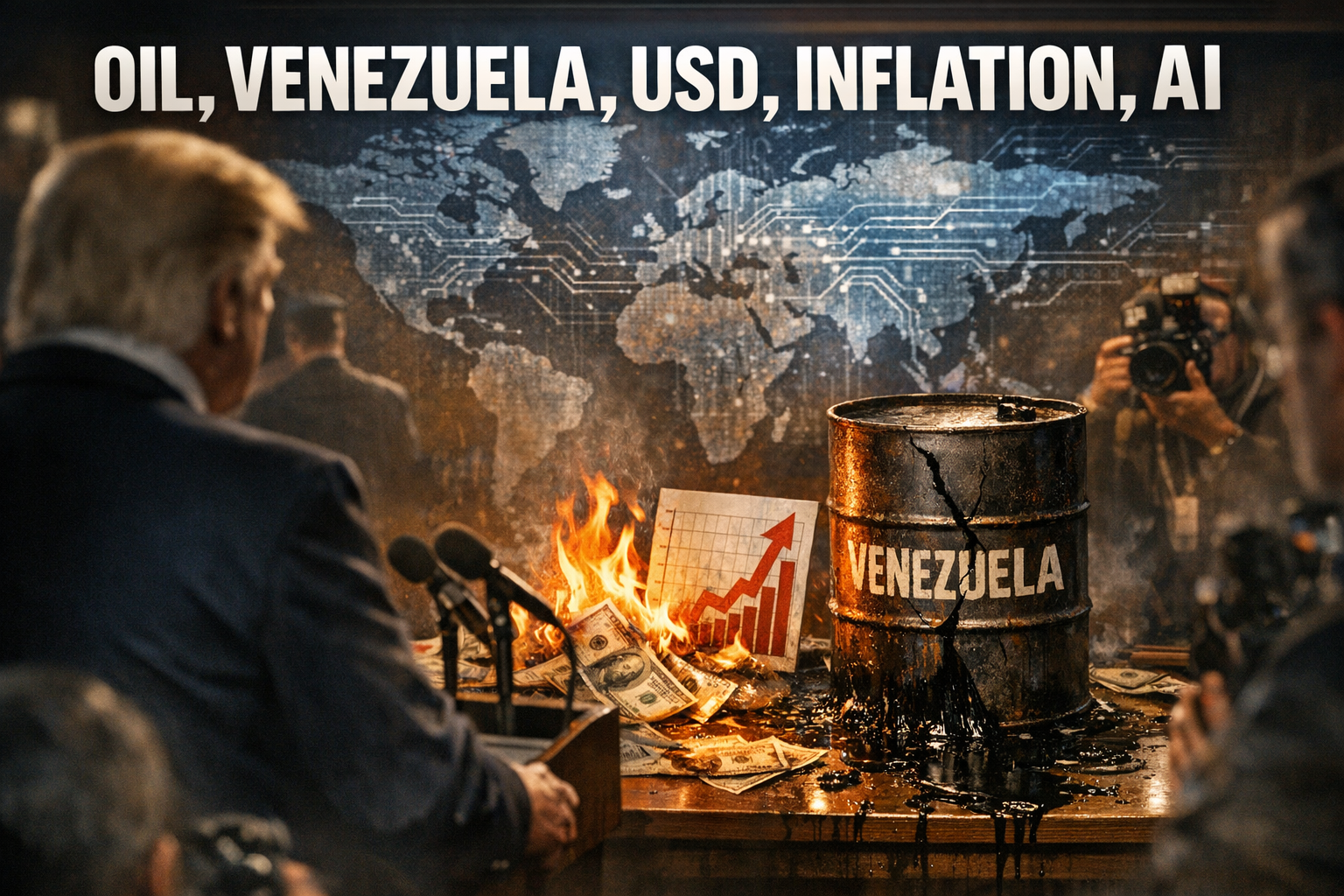
● Trump Vows Venezuela Blitz, Oil-Dollar Shockwave
Why Trump’s “Airstrikes on Venezuela / Capture of Maduro” Remarks Matter: 5 Key Risks Covering Oil, USD, Inflation, Supply Chains, and AI-Defense Tech
This is not a standalone foreign-policy headline. It links directly to whether international crude prices re-rate, whether USD strength extends, whether inflation risks re-emerge, whether global supply chains face spillover into South America, and whether a shift toward AI- and drone-centric warfare accelerates specific industries.
This report summarizes the verifiable takeaways from the press remarks in a news-brief format, outlines 2–3 market scenarios across commodities/FX/equities/rates, and highlights several under-discussed investor-relevant points.
1) News Briefing: Key Messages That Can Be Treated as Fact From the Press Remarks
1-1. Points Emphasized by Trump’s Side
– Framed as an “arrest/capture operation in Caracas”
– Emphasized that “Maduro and his spouse are individuals indicted in the United States” and that the objective is to bring them to court (DoJ-driven law-enforcement framing)
– Repeatedly highlighted “no U.S. military casualties” and “demonstrated U.S. capabilities,” referencing integrated operations across air/ground/sea/space
– Signaled deterrence by suggesting potential for larger secondary strikes if necessary
1-2. Economy-Relevant Language (Direct Implications)
– Stated that the U.S. does not want Venezuela to be controlled by “someone else” (e.g., China/Russia/Iran)
– Suggested U.S. “management/operation” until a “safe transfer of power” is achieved (implying extended governance involvement)
– Publicly referenced “oil infrastructure rebuilding” and potential “corporate participation,” particularly by energy firms
2) Stated Rationale vs. Market Impact: Separate the Layers
2-1. Stated Rationale (Official Narrative): Drugs, Public Safety, Law Enforcement
Repeated emphasis centered on “drugs, gangs, harm to Americans, and law enforcement.” The messaging connected to prior indictments (referencing 2020) and positioned the action as legitimate law enforcement.
2-2. Market-Relevant Layer: Energy Leverage and Hemispheric Reordering
Markets are more sensitive to who controls Venezuela’s governance and energy flows, which directly affects the speed and direction of production/export normalization and influences broader Latin American political alignment.
3) Macro Scenarios: Implications for Oil, USD, Rates, and Inflation
3-1. Scenario A: Escalating Geopolitical Risk (Highest Market Shock)
Conditions:- Increased pushback from regional countries (e.g., Brazil/Colombia/Mexico), or- China/Russia move beyond diplomatic signaling into material economic or military measures, or- Prolonged internal resistance and security deterioration within Venezuela
Likely market reactions:- International crude: risk premium repricing; elevated probability of sharp short-term upside volatility
– USD: potential strength via flight-to-quality dynamics (USD index higher)
– Inflation: energy-led inflation pressure could re-emerge; rate-cut expectations may be pushed out
– Global supply chains: higher freight/insurance/transaction costs could transmit inflation via South American routes and counterparties
3-2. Scenario B: “Shock Then Containment” (Stabilization Case)
Conditions:- No meaningful escalation beyond the initial action, and- A relatively rapid roadmap for Venezuelan oil normalization is communicated
Implications:- International crude: high near-term volatility, but potential medium-term stabilization if supply-increase expectations rise
– USD: safe-haven demand may fade; marginal easing of USD strength pressure
– Inflation: energy-driven inflation risks could moderate if crude stabilizes (trade protectionism remains a separate variable)
3-3. Scenario C: Extended “Management” plus Infrastructure Rebuild (Sector-Level Impact)
Conditions:- The U.S. sustains involvement at an operational level over an extended period, and- Oil infrastructure reconstruction becomes concrete via private-sector-led projects
Implications:- Potential beneficiaries: energy infrastructure, refining, oilfield services, and related equipment/engineering value chains
– U.S. domestic political incentive to frame outcomes as “energy price stabilization” could increase policy follow-through
4) Cross-Asset Checklist: What Moves First
4-1. Commodities: Oil and Gold Can Rise Simultaneously
In geopolitical events, oil (risk premium/inflation impulse) and gold (safe haven) can appreciate concurrently. If escalation risk remains non-trivial, concurrent upside moves are plausible.
4-2. FX: KRW-USD Is Sensitive to Both USD Strength and Risk-Off Flows
Key variables are the direction of the USD index and the marginal foreign flow into Korean risk assets. Geopolitical stress typically reduces risk appetite and pressures KRW weaker.
4-3. Equities: Energy/Defense/Defense-AI Depends on Budget and Procurement, Not Headlines
Repeated emphasis on military technology, precision operations, and unmanned/aerospace capabilities can transition from short-lived “theme” to sustained budget allocation and procurement (drones, satellites, ISR, analytics), shaping medium-term sector dynamics.
5) AI Trend Lens: “Productization” of Warfare
5-1. Core Point Beyond the “AI Bubble” Debate
The recurring themes were accuracy, intelligence dominance, integrated operations, and unmanned/aerial capability. This points less to consumer-app monetization and more to state-budget-driven AI demand in defense/intelligence/surveillance and precision strike.
5-2. Technical Keywords to Monitor
– ISR (Intelligence, Surveillance, Reconnaissance): satellites/drones/signals intelligence combined with AI analytics
– Autonomous and swarming drones: low-cost, high-leverage force multiplication
– Edge AI: on-site identification and decision-making with reduced dependence on connectivity
– Cyber/electronic warfare: pre-kinetic disruption of command, sensors, and infrastructure
6) Under-Discussed Investor-Relevant Points (6)
6-1. Beyond “Oil Price”: The Market Prices Perceived Control Over Oil Flows
Even without immediate production increases, markets can react to signals that the U.S. intends to shape Venezuelan oil flows. When the issue shifts from volume to control, volatility can rise.
6-2. “Management Until Transfer” Increases Duration Uncertainty
For conflict-related risk, duration is often the dominant variable. If end-state timing is unclear, firms tend to reduce investment and operate more conservatively, which can translate into higher costs and pressure on margins and inflation.
6-3. Latin America as Supply-Chain Back-End: Commodities, Food, Energy, Minerals
The region is embedded in global value chains across raw materials, agriculture, energy, and minerals. Rising tensions can lift logistics and transaction costs globally.
6-4. The “Drug” Rationale Functions as a Domestic Political Narrative Engine
From a market perspective, the key variable is less the rationale’s validity and more whether it sustains domestic support for prolonged involvement. If support is durable, markets may begin pricing a longer-duration regime.
6-5. U.S. Pressure Is Not Limited to Tariffs: Resources, Currency, and Security Can Bundle
Protectionism can extend beyond tariffs when resource control and security actions are integrated. This combination can amplify safe-haven flows and tighten global financial conditions at the margin.
6-6. AI Growth May Be More Driven by Government Procurement Than Consumer Apps
If precision operations are showcased, AI/data/satellite/drone ecosystems can scale via government budgets. Relative demand resilience through the cycle can support valuation re-rating for selected segments.
< Summary >
– The central framing combined a drugs/law-enforcement rationale with an explicit signal that the U.S. seeks to prevent rival influence and may “manage” the transition.
– From a market standpoint, this is a geopolitical catalyst with potential to impact crude, the USD, inflation expectations, and supply-chain costs concurrently.
– If escalation or prolonged instability materializes, oil, gold, and the USD could rise together, while rate-cut expectations may be deferred.
– If contained, medium-term crude stabilization is possible on expectations of Venezuelan supply normalization.
– The AI implication is a shift toward defense-oriented procurement (ISR, drones, satellites, edge analytics) rather than consumer-app demand as the primary growth driver.
[Related Articles…]
- The Real Driver of International Crude Swings: How Geopolitical Risk Is Priced
- What Happens If USD Strength Resumes: FX and Asset-Market Scenarios
*Source: [ 경제 읽어주는 남자(김광석TV) ]
– [LIVE] 트럼프 기자회견 : 베네수엘라 공습과 마두로 생포. 경제적 파급영향은? [즉시분석]
● Trump Claims Venezuela, Airstrikes Ignite Oil Shock, Dollar Spike, AI War Boom
Trump: “The United States Will Govern Venezuela” — Three Market Shocks from Airstrikes and Maduro’s Capture: Crude Oil, the U.S. Dollar, and an “AI War Economy”
This report focuses on three points:
1) Why the direction of global crude oil has shifted toward a “near-term spike risk.”
2) The mechanism by which USD strength/weakness hinges on whether conflict expands.
3) A core issue often undercovered: how this event could accelerate an AI- and drone-centric war economy, linking energy dominance to currency dominance.
1) Breaking news summary: what is happening now
Key headlines
- President Trump stated that the United States would effectively administer Venezuela until a “safe transfer of power.”
- Following U.S. airstrikes, President Nicolas Maduro (and spouse) was reportedly captured; Trump referenced the possibility of trial in the United States (New York or Miami).
- Statements included “all military options remain on the table,” “fleet on standby,” and potential ground-force deployment.
- The administration publicly promoted entry of major U.S. oil companies into Venezuela to rebuild infrastructure with multi-billion-dollar investment.
- The messaging explicitly emphasized strengthening U.S. influence in the Western Hemisphere and constraining China’s regional footprint.
2) Trump press conference: policy intent in five lines
1) “The United States will remain in Venezuela” → signals an ongoing management framework rather than a one-off strike.
2) “Govern until transfer of power” → implies a transitional administration/occupation-like posture.
3) “Punish narcotics (narco-terror)” → provides a legal/legitimacy frame.
4) “Deploy U.S. oil companies” → openly states an economic objective (restructuring energy supply chains).
5) “Exclude external powers (e.g., China) from the Western Hemisphere” → direct geopolitical and geo-economic confrontation.
3) Stated justification vs. strategic objective: a two-layer structure
Layer 1 (justification): narcotics and security
- Maduro has prior U.S. legal exposure (e.g., 2020-era cases) tied to narcotics-related allegations, supporting a law-enforcement narrative.
- The framing also aligns with domestic political priorities around border security, crime, and narcotics.
Layer 2 (objective): energy dominance + Western Hemisphere control + China containment
- Venezuela is widely categorized as having symbolic-scale proven oil reserves.
- However, degraded production, refining, and transport infrastructure has historically limited effective supply capacity.
- The stated plan to deploy U.S. oil majors to rebuild infrastructure implies potential control over incremental supply capacity, not merely reserves.
4) Economic transmission: how crude, inflation, and FX may move
This event is likely to reintroduce a geopolitical risk premium into global pricing.
A. Global crude oil: “future supply expansion” vs. “war premium”
- Near term: the war premium is more likely to dominate. Infrastructure-led supply expansion is time-intensive, while retaliation and escalation can occur immediately. Result: higher volatility and upside risk.
- Mid term: scenarios diverge:1) Stable U.S. control and successful rebuilding → rising supply expectations could cap or pressure prices lower.
2) Broader backlash (regional left-leaning governments, BRICS-aligned responses, China/Russia linkages) → sustained upward pressure via a persistent risk premium.
B. Inflation: oil moves into headline costs
- Oil volatility transmits to logistics, manufacturing input costs, and power pricing, consistent with cost-push inflation dynamics.
- This can indirectly influence the Federal Reserve path by destabilizing rate-cut expectations.
C. FX (U.S. dollar): escalation drives safe-haven demand
- As geopolitical risk rises, capital tends to rotate toward USD and U.S. Treasuries. Escalation therefore increases the probability of USD strength.
- If markets interpret the event as contained and short-duration, the USD may face renewed depreciation pressure.
D. Gold: “war risk + liquidity” is supportive
- Gold is sensitive to risk aversion and liquidity conditions. Incremental war risk is typically supportive for gold pricing.
5) Sector and investment implications: pressure points and potential opportunities
1) Energy (refining, E&P, oilfield services)
- If Venezuelan rebuilding becomes operational, mid- to long-term activity could lift demand across equipment, refining, and oilfield services.
- This requires stable political and military control; uncertainty implies elevated volatility and risk of overpricing on expectations.
2) Defense / drones / satellites and intelligence assets
- Modern conflict increasingly rewards information dominance, precision strike, and unmanned systems rather than manpower.
- Structural demand may persist for drones, ISR (intelligence, surveillance, reconnaissance), satellite systems, and cyber capabilities.
3) AI trend: warfare execution shifting into the AI value chain
- Beyond crude oil, a key implication is that AI becomes state capacity, not only commercial innovation.
- Target identification, imagery interpretation, signals intelligence, autonomous drone navigation, and logistics optimization connect directly to AI, data centers, and semiconductor demand.
- Geopolitical risk can therefore act as a catalyst for sustained AI infrastructure investment.
6) Undercovered critical points (analyst view)
Point 1) “Control oil to defend the currency” as an implicit objective
- Energy prices affect inflation; inflation influences rates and the USD. Energy dominance therefore supports macroeconomic control and currency resilience.
- Treating the event purely as a regional military issue risks missing the macro-financial dimension.
Point 2) The key asset is the right to rebuild infrastructure, not reserves
- Value is realized through the full chain: upstream production, midstream transport, downstream refining, and sales.
- The commitment to U.S.-led infrastructure restoration implies governance influence over the value chain and export capacity.
Point 3) A Panama-1989-style regime-change template could trigger regional domino effects
- The stated narcotics rationale coexists with an explicit regime-transfer and governance posture.
- If perceived as replicable, neighboring governments may react defensively, embedding a structural risk premium in market pricing.
7) Variables to monitor (four drivers likely to shape markets)
1) Whether U.S. ground-force deployment materializes (escalation signal)
2) Response intensity from China and Russia (diplomatic, sanctions, military cooperation)
3) Speed and feasibility of restoring Venezuelan export and refining capacity (realistic supply impact)
4) OPEC+ policy response (production cuts/increases)
< Summary >
- The “U.S. governance of Venezuela” statement is positioned as a geo-economic shock combining energy dominance, Western Hemisphere control, and China containment, rather than a standalone military episode.
- Near-term effects skew toward higher crude volatility and upside risk, with safe-haven flows supporting USD strength and potentially gold strength.
- Mid-term outcomes bifurcate: stable control and successful rebuilding could pressure oil lower; regional spillover and proxy dynamics could sustain higher prices.
- A central implication is the acceleration of an AI-, drone-, and intelligence-asset-centered war economy, potentially reinforcing structural demand for AI infrastructure.
[Related links…]
-
Global crude outlook: key variables shaping oil through 2026
https://NextGenInsight.net?s=global%20crude%20oil -
FX (USD) scenarios: how geopolitical risk can drive USD strength
https://NextGenInsight.net?s=exchange%20rate
*Source: [ 경제 읽어주는 남자(김광석TV) ]
– [속보] 트럼프 “미국이 베���수엘라 통치” : 베네수엘라 공습과 마두로 생포. 경제적 파급영향은? [즉시분석]
● US Maduro Takedown Oil Power Grab WTI Cap China Warning Mexico Cartel Shock Global Risk Surge
The Market’s Core Signal Behind the U.S. “Maduro Removal”: Why It Disrupted Crude Oil, WTI, U.S.–China Tensions, Emerging-Market Risk, and Global Supply Chains Simultaneously
This development should not be interpreted as a standalone “Venezuela regime change” headline.
From an investment perspective, the more material issues are: (i) a U.S. design to cap the upside in global oil prices (WTI), (ii) control over the operational command of Venezuelan crude, (iii) Mexico cartel-related rhetoric spilling into North American supply chains and border policy, (iv) signaling to China that access to oil may remain but rule-setting authority rests with the U.S., and (v) the mechanism through which such events amplify volatility across risk assets (equities and crypto).
1) News Briefing: Key Developments Confirmed to Date
Event summary
Nicolas Maduro is described as having been captured through a U.S. special operations mission and transferred to New York for trial.
The stated U.S. justification is narcotics trafficking (“war on drugs”), framed as a “perfect operation” with zero U.S. military casualties.
Key points in Trump’s remarks
He referenced enforcement against illegal Venezuelan oil shipments and indicated that the U.S. will be strongly involved in Venezuela’s oil industry going forward.
He referenced the “world’s best oil company,” implying advance preparation rather than an ad hoc response.
Mexico-related remarks
While describing relations with Mexico’s president as positive, he stated that cartels effectively “run Mexico.”
He claimed to have repeatedly offered assistance to remove the cartels, stating Mexico declined out of fear.
China-related remarks
Asked about a Chinese delegation meeting Maduro, he emphasized a good relationship with Xi Jinping and added that China would still obtain oil, focusing on oil access rather than diplomacy.
2) Investment Interpretation: The Core Issue Is Operating Control of Oil Flows, Not Politics
(1) A signal aimed at suppressing oil prices, not driving them higher
Political instability in producing states typically supports crude prices.
However, the rhetoric repeatedly suggests an aversion to a “reduced supply, higher price” outcome, indicating an intent to reframe Venezuela as a supply normalization/expansion variable rather than a supply disruption shock.
(2) The critical variable is not volume, but control of the valve
The phrase “strong U.S. involvement” signals potential redesign of Venezuela’s production, exports, and payment rails.
Market implications:
- Near term: elevated WTI volatility driven by geopolitical headlines.
- Medium to long term: Venezuelan barrels may flow predominantly through U.S.-approved channels, potentially altering discount structures and the pricing regime.
(3) Why the “return to interventionism” question matters
A perceived success case can raise expectations of similar interventions elsewhere.
If markets begin pricing geopolitical intervention as a recurring policy option, emerging-market risk premia could structurally rise.
3) Why Mexico Cartel Rhetoric Matters for Markets: A Supply-Chain and Policy Risk Channel
(1) Border and security stress tends to reprice supply-chain costs first
Cartel-focused rhetoric can translate into tighter border controls or security-driven hardline actions.
The first-order impact is typically through inflation channels: higher transport, insurance, customs friction, and longer lead times.
(2) This can affect the rate path
Higher supply-side costs can increase inflation persistence and reduce central-bank room for rate cuts.
Accordingly, the cartel narrative is not only political; it can force a reassessment of inflation and rates.
4) The Message to China: “Oil Access May Continue, but the U.S. Sets the Rules”
(1) Why Trump answered a China question with “oil”
Prioritizing oil access over diplomatic framing suggests the objective is less about regime change itself and more about reshaping the oil distribution order.
(2) Potential extension of the U.S.–China trade conflict
If tensions expand from tariffs and technology into the energy value chain (production, shipping, payments, insurance, vessels/ports), the dispute may become more durable.
If “who obtains Venezuelan resources via which channels” becomes contested, sanctions and secondary measures can create direct operating risk for firms.
5) Asset-Market Checkpoints: How to Frame Equities, Oil, and Crypto
(1) Oil (WTI/Brent): supply disruption premium vs U.S.-driven normalization
- Near term: high sensitivity to military/political headlines; sharp swings are plausible.
- Medium term: if the U.S. effectively accelerates normalization (or expansion), upside may be capped.
The key is execution: operational control, export restart velocity, and sanctions architecture changes, not rhetoric.
(2) U.S. equities and global equities: the energy-cost channel influences inflation expectations
Oil stabilization is generally supportive for risk assets, but repeated intervention increases policy uncertainty and risk premia.
Markets may face offsetting forces: “lower energy inflation” versus “higher geopolitical/policy uncertainty.”
(3) Bitcoin and Ethereum: volatility rises on geopolitics; direction depends on USD and rates
The dominant transmission channel is oil → inflation → rates.
Higher rate expectations typically pressure crypto; stabilized oil and softer inflation can relieve pressure.
6) Underappreciated Points
Point A: The central keyword was “oil operations,” not “democracy”
China-related responses prioritized oil, and Venezuela’s future was framed as U.S. involvement, consistent with an energy-flow framework.
Point B: Elevating “cartels” targets the border–inflation–rates linkage
Security escalation can harden policy, raise supply-chain costs, and shift the volatility regime once priced by markets.
Point C: Venezuela is more about sanctions, payments, and insurance than barrels
Price and flow outcomes depend less on incremental production and more on how crude is legalized/normalized through specific settlement currencies and shipping/insurance networks.
7) Forward Monitoring: Practical Data Checklist
- Changes in Venezuelan crude export destinations (buyer mix).
- Signals of sanctions relief versus secondary-sanctions tightening.
- WTI term structure (contango/backwardation) as a read on near-term tightness versus medium-term supply expectations.
- Early indicators of tighter Mexico border policy; shipping and logistics metrics as leading signals.
- U.S. dollar index and inflation expectations (breakevens), with direct implications for crypto and growth equities.
< Summary >
The “Maduro removal” issue is primarily an oil operating-control and distribution-order event rather than a purely political headline.
The rhetoric indicates limited tolerance for a sustained WTI spike and implies potential U.S.-driven efforts to normalize or expand effective supply.
Mexico cartel framing may translate into stricter border policy, raising supply-chain costs and feeding into inflation and rates, increasing cross-asset volatility.
The China signal can be read as “access to oil remains possible, but rule-setting authority is U.S.-led,” implying a pathway for the U.S.–China conflict to extend into the energy value chain.
[Related Posts…]
- International oil volatility checklist for rapid market shifts (https://NextGenInsight.net?s=international%20oil%20prices)
- How global supply-chain restructuring affects Korean corporates (https://NextGenInsight.net?s=supply%20chain)
*Source: [ Maeil Business Newspaper ]
– [홍장원의 불앤베어] 베네수엘라 마두로 축출의 진짜 의미. 멕시코 카르텔도 떨고 있다
● Gold-Stocks Surge, Cash Crash Signal
A rare 50-year episode: simultaneous rallies in gold and equities may signal currency debasement rather than a speculative bubble (and why post-war gold is unlikely to “crash”)
This report focuses on five points:1) Why “gold crashes when wars end” is typically a short-lived effect (including the Russia–Ukraine case)
2) The practical meaning of the BIS “dual-bubble” warning (a “bubble” does not necessarily imply an imminent collapse)
3) The core logic behind the “gold could rise at least 5x” framework (matching US gold holdings to M2)
4) Structural reasons silver could move more than gold (gold–silver ratio, supply tightness, AI-driven demand)
5) A 2026 liquidity scenario linking stablecoins, Treasuries, Fed leadership change, and the end of QT
1) One-line headline: “Gold and equities rising together is a once-in-50-years event; the driver may be cash avoidance, not risk appetite”
The key interpretation is that simultaneous strength in gold (traditionally defensive) and equities (traditionally risk-on) should not be viewed solely as a bubble signal.
This pattern can reflect broad-based repricing driven by currency debasement, where investors reduce cash balances and rotate into financial and real assets as the unit of account weakens.
2) Will gold crash when the war ends? “A tactical pullback is possible, but the structural drivers remain”
The framework presented is:
- A ceasefire or peace agreement is typically a short-term headwind for gold.
- However, gold’s response to major international conflicts tends to be time-limited and often partially priced in.
Key observations:
- During the Russia–Ukraine war, gold reacted for roughly 2–3 months before retracing.
- Current levels may already embed part of a “war premium.”
- If hostilities end, incremental downside may be more limited than commonly assumed.
Additional risk framing:
- A resolution can reduce immediate fear but may lower the threshold for future conflicts if deterrence credibility declines, particularly if the US reduces its “global policing” role. This can reintroduce geopolitical risk over the medium term.
3) Interpreting the BIS “dual-bubble” warning: not necessarily “bubble equals collapse,” but “currency-unit instability”
The BIS message highlights the unusual and potentially unstable nature of gold and equities rising together. The counter-interpretation is that such a configuration can appear during periods when the currency unit is being repriced.
Historical reference:
- After the 1971 Nixon Shock (suspension of dollar–gold convertibility), markets did not experience a simple “loss of trust equals equity collapse” outcome.
- Instead, multiple asset classes (equities, real estate, gold) rose together in an “everything rally,” consistent with a weaker currency unit translating into higher nominal asset prices.
Core implication:
- The primary risk may not be standard inflation alone, but erosion of confidence in the currency’s purchasing power and stability.
4) The “gold at least 5x” rationale: matching US gold holdings (8,133 tonnes) to M2
The most quantitative argument presented anchors gold’s long-cycle upside to money supply and debt dynamics rather than event-driven catalysts (war headlines, short-term rate moves).
Method summary:
- US official gold holdings: 8,133 tonnes
- US M2 (as cited): approximately USD 5.2 trillion
- Converting M2 coverage into an implied gold price yielded an illustrative level near USD 20,000/oz
- This corresponds to roughly “5x or more” versus prevailing levels (as framed)
Key point:
- The claim is not a precise target forecast; it is a valuation framework linking gold to monetary debasement and balance-sheet expansion dynamics.
5) A 2026 liquidity mechanism: stablecoins, Treasury demand, the end of QT, and a potential Fed leadership shift
The central question is Treasury absorption: who provides marginal demand for US government debt.
Four liquidity channels discussed:
- Stablecoin growth: private issuers may expand purchases of short-dated Treasuries as reserve assets
- Potential Fed chair transition: could increase the probability of a more accommodative policy bias
- Post-QT conditions: once quantitative tightening ends, balance-sheet expansion becomes a renewed possibility if conditions warrant
- Relative global easing constraints: other regions may have less room to cut, potentially making US easing comparatively larger
Why this links to gold:
- Liquidity can support equities, but in a fragmented geopolitical environment (deglobalization and elevated geopolitical risk), part of incremental liquidity may rotate into defensive stores of value.
6) Why silver may move more than gold: higher volatility, gold–silver ratio mean reversion, and tight supply
Silver is framed as a higher-beta expression of the precious-metals cycle.
Key drivers:
- Structural volatility: silver often exhibits 1.5–2.0x the volatility of gold
- Gold–silver ratio: historical references cited near 10:1 versus current levels around 70–80:1, implying potential mean-reversion tailwinds
- Industrial demand: AI data centers, semiconductors/electrification, 5G, and solar benefit from silver’s electrical conductivity
Implication:
- If AI-linked infrastructure buildout accelerates (data centers, power grids, electrification), silver can tighten on supply-demand fundamentals independent of gold’s purely monetary narrative.
7) Korea-specific consideration: monitoring the local gold premium and separating physical vs ETF strategies
Domestic pricing can deviate from global benchmarks due to supply-chain constraints and episodic demand surges.
Key points:
- Korea lacks a domestic commercial gold-mining base; import lead times and logistics constraints can amplify local dislocations.
- When demand spikes, physical-market premiums can widen materially.
- During high-premium periods, physical accumulation may be inefficient; ETFs may offer a more cost-effective exposure.
Practical monitoring:
- Compare KRX gold market pricing versus an FX-adjusted international benchmark to quantify premium dispersion.
Additional use case:
- The premium can function as a sentiment/overheating indicator rather than only a transaction cost.
8) Bitcoin vs gold: avoid “digital gold” equivalence; focus on shared liquidity regimes
The argument is that gold and bitcoin differ materially in structure and function:
- Gold: physical asset with stronger attributes related to anonymity and resistance to control
- Bitcoin: increasing institutionalization (e.g., ETFs) but retains higher risk-asset sensitivity
Observed co-movement is framed as:
- Not stable correlation, but episodic co-movement during liquidity expansions.
9) Three underemphasized takeaways
Key takeaway 1: A war’s end may not “end” gold’s bid; it can initiate repricing of future conflict risk if deterrence weakens.
Key takeaway 2: The dominant driver is less “war headlines” and more the structural question of who finances US fiscal deficits and absorbs Treasuries amid shifting global demand.
Key takeaway 3: The 2026 liquidity outlook is partly a policy-choice and political-cycle variable, not only an economic-data function.
Summary
Simultaneous strength in gold and equities—a rare 50-year configuration—may be more consistent with currency debasement dynamics than purely speculative excess. A ceasefire can be a short-term negative for gold, but structural forces (debt, liquidity, geopolitical fragmentation) remain. The “5x” framework is anchored to matching US gold holdings to M2 as a debasement-based valuation lens. Silver may offer higher beta due to volatility, potential gold–silver ratio normalization, and AI/electrification-driven industrial demand. Korea-based investors should treat local premiums as both a cost and a sentiment indicator and separate physical and ETF execution accordingly.
[Related]
- https://NextGenInsight.net?s=gold
- https://NextGenInsight.net?s=stablecoin
*Source: [ 경제 읽어주는 남자(김광석TV) ]
– [풀버전] 50년만의 특이현상, 전쟁 끝나면 금값 폭락하나? 금과 주식 동반 급등의 본질적 이유 | 경읽남과 토론합시다 | 양베리(조규원)