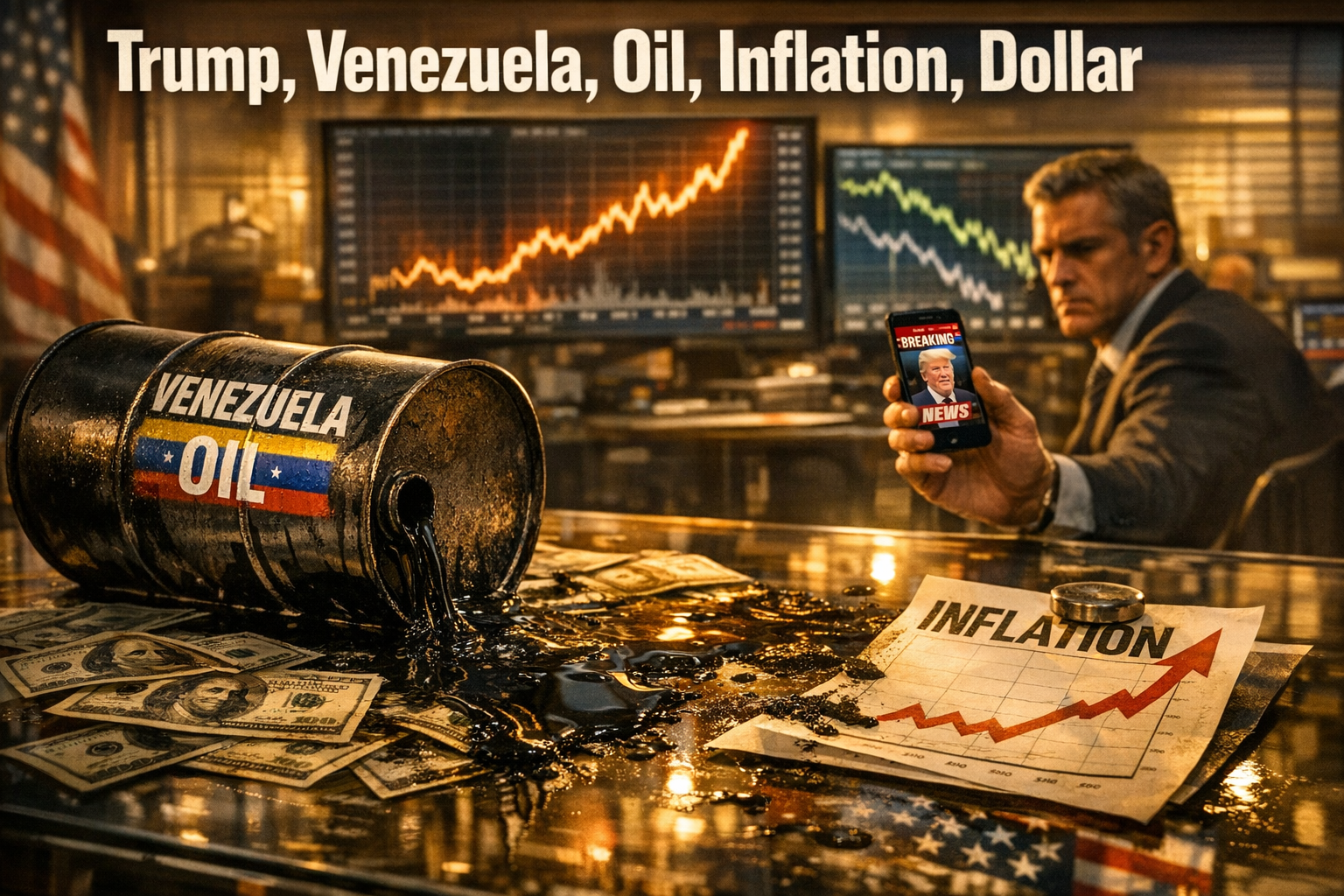
● Trump Bombshell, Venezuela Strike Fears Jolt Oil, Inflation, Dollar, Defense Winners and Losers, Trump ETFs Under the Microscope
How a Trump “Venezuela Airstrike” Scenario Could Disrupt Markets + An Investor-Focused Breakdown of Five Trump-Launched ETFs
This report covers three areas:
First, where capital is likely to rotate during a Trump-driven Venezuela shock (beneficiaries vs. at-risk sectors).
Second, how to identify secondary (indirect) beneficiaries that are often overlooked in mainstream coverage.
Third, an investor checklist for analyzing five Trump-launched ETFs by construction logic, flow dynamics, and risk factors rather than by name recognition.
1) News Briefing: Core Market Reactions Under a Hypothetical “Surprise Venezuela Strike”
A direct strike or intensified quasi-military pressure on Venezuela should be treated less as political news and more as a macro catalyst affecting energy, inflation, the U.S. dollar, and defense concurrently.
Given Venezuela’s direct linkage to oil supply and sanctions, markets often react in the sequence below.
1-1) First Shock: Oil Prices and Repricing Across the Energy Value Chain
Heightened supply-disruption risk can lift crude prices, triggering repricing from upstream production to downstream refining and then to transport/services.
The key distinction is pricing power: entities that can pass through costs versus those that cannot.
-
Potential beneficiaries (relative)
Upstream producers with high crude exposure and cash flows that are sensitive to oil prices.
U.S. shale and Permian-related services, drilling, and equipment value chains. -
Caution (case-by-case)
Refining and chemicals may face margin pressure from higher feedstock costs; product spreads and inventory valuation become decisive.
1-2) Second Shock: Inflation Expectations and Reassessment of the Rate Path
Higher oil prices can reaccelerate inflation pressures.
Markets may reassess the feasibility and timing of Federal Reserve rate cuts, increasing bond yield volatility.
This becomes an inflation and policy-expectations event rather than a purely geopolitical headline.
Key related factors: renewed global supply-chain concerns can propagate to freight rates, commodity inputs, and inventory policies.
1-3) Third Shock: Stronger U.S. Dollar and Risk-Off Positioning
Rising geopolitical risk typically supports a stronger dollar and pressures emerging-market assets.
A shift toward U.S.-centric (USD-denominated) assets may follow.
2) Sector Beneficiary Map: Extending Beyond Direct Winners to Indirect Beneficiaries
2-1) Energy: Look Beyond Producers to Services and Infrastructure
-
Direct beneficiary axis
Upstream producers where earnings respond immediately to oil price upside. -
Indirect beneficiary axis (often undercovered)
Oilfield equipment/services and midstream pipelines can show higher operating leverage when higher oil prices revive investment (capex).
Typical transmission: oil up → expectations of higher output → increased orders for equipment and services.
2-2) Defense and Security: Sustainment, Maintenance, and Electronic Warfare Tend to Persist
Defense often reacts quickly to escalation headlines, with short-term attention on munitions and platforms.
Over the medium term, more durable exposure can include maintenance (MRO), parts supply, and electronic warfare/ISR segments tied to recurring budget execution.
Key differentiators:
- Order backlog
- Government contract structure (including price-adjustment provisions)
- Supply-chain bottlenecks (component lead times)
2-3) Commodities and Transportation: If Maritime Risk Expands, Insurance and Freight Can Reprice
Venezuela alone may not reset global freight markets; however, accumulated geopolitical shocks can raise marine insurance premiums and route risk premia, pushing logistics costs higher.
This often returns as margin pressure in corporate earnings.
2-4) Sectors Potentially at Risk: Airlines, Consumer, Emerging Market Exposure
- Airlines/transportation (fuel cost pressure)
- Consumer sectors (real purchasing power compression)
- Emerging markets (USD strength + capital outflow risk)
3) Five Trump-Launched ETFs: Focus on Structure, Not Branding
While the source references “five Trump-launched ETFs,” the actionable investment framework is best captured by four structural checks rather than product names.
3-1) Checklist (1): Index-Tracking vs. Theme/Factor Construction
- Index-based: typically lower volatility; weaker thematic signal
- Theme/factor-based: can rise quickly under one-way flows; can reverse quickly when flows turn
3-2) Checklist (2): Concentration Risk (Top 10 Weight)
Excessive Top 10 concentration effectively turns an ETF into a small basket.
When the narrative fades, the entire ETF can de-rate simultaneously.
3-3) Checklist (3): Expense Ratio + Volume (Liquidity) + Bid-Ask Spread
Political theme ETFs often start with low volume and wider spreads.
Execution prices can become meaningfully less favorable; monitor trading volume and spreads before positioning.
3-4) Checklist (4): Rebalancing Rules (Frequency and Method)
Frequent rebalancing may improve trend capture but can increase costs and tracking error.
Infrequent rebalancing can result in delayed exposure (buying after the move).
4) Five Undercovered Points
4-1) The Primary Transmission May Be Sanctions, Payments, and Insurance More Than Physical Supply
Markets can reprice faster on settlement constraints, shipping uncertainty, and rising insurance costs than on immediate volume disruptions.
4-2) In Oil Spikes, the Strongest Exposure Is Often Where Cash Flow Converts Immediately
Entities with lightweight cost structures and improved capacity for buybacks/dividends may re-rate faster than those where higher revenue is offset by rising capex.
4-3) Geopolitical Risk Often Resolves Into “Inflation Reacceleration vs. Growth Deceleration”
Markets typically process the same headline through this framework; reactions can diverge across growth equities, value equities, and bonds.
4-4) Trump-Linked ETFs May Function More as Flow Vehicles Than Policy Instruments
Political themes can attract event-driven inflows around elections or major headlines, followed by rapid outflows after the catalyst passes.
This can skew the profile toward regime-based trading rather than long-horizon allocation.
4-5) The Largest Risk Is Often Positioning Asymmetry, Not the Headline Itself
If the market is already heavily positioned long energy/defense, “sell-the-news” dynamics can emerge even on positive catalysts.
Tracking positioning and flows alongside price action can be critical.
5) Practical Monitoring: Daily Data to Track This Theme
- WTI/Brent levels and options-implied volatility (near-term risk intensity)
- U.S. Treasury yields (especially the 2-year: rate-cut expectations)
- Dollar index (risk-off signal)
- Fund flows into energy/defense ETFs (theme flow confirmation)
- Refining spreads (crack spreads) and maritime freight indicators (logistics cost pressure)
6) Next Step: Convert the “Five Trump ETFs” Into a Comparative Table
The ETF names/tickers are not provided here. To compile a precise comparison table (fees, composition, top holdings, volatility, volume), the five tickers or names are required.
Once provided, the output can be structured as:
- Side-by-side comparison table across all five products
- Preferred macro regimes for each ETF structure
- Key risks (liquidity, concentration, policy sensitivity)
< Summary >
Venezuela risk is a macro catalyst that can propagate through oil prices, inflation expectations, and USD strength.
Beneficiaries may extend beyond upstream energy into oilfield services and midstream infrastructure as capex expectations recover.
In defense, sustainment/MRO, parts, and electronic warfare/ISR exposures may be more durable than short-lived platform headlines.
Trump-linked ETFs should be evaluated by construction logic, concentration, liquidity, and rebalancing rules rather than branding.
Sanctions, settlement friction, and insurance/logistics costs can drive price action before measurable physical supply changes.
[Related Articles…]
Oil-spike rotation strategies that emphasize durable cash flow beneficiaries
https://NextGenInsight.net?s=oil
Defense investing framework: why backlog and MRO can drive performance
https://NextGenInsight.net?s=defense
*Source: [ 소수몽키 ]
– 트럼프의 깜짝 베네수엘라 공습, 새롭게 주목받는 수혜주들/ 트럼프가 직접 출시한 ETF 5종 살펴보기 +@ 라이브/멤버십 전용 자료(CES 참고용)
● US Liquidity Party, Korea Policy Paralysis, 2026 Bond Yield Shock Looms
The United States Lifts Asset Prices via a “Liquidity Party,” While Korea Endures Under a “Policy-Constraint Structure”: Five Key 2026 Market Watchpoints (Sovereign Yields, FX, Shock Episodes, Stagflation Risk, Policy Capacity)
This report covers:
- Why a “second IMF-style FX crisis” is unlikely, yet Korea may experience greater economic pain (reframing the definition)
- How US-driven liquidity expansion can function less as “US growth” and more as “global burden shifting”
- The most critical 2026 indicator: the US long-term Treasury yield, which may matter more than FX levels
- Why assets can rise while real activity locks into low growth (post-effects of an Everything Rally)
- Structural reasons Korea faces constraints across rates, fiscal policy, and stimulus, and potential response scenarios
1) One-Line Headline (News Style)
United States: Rising probability of liquidity-centric policies aimed at supporting growth and asset prices into the midterm election period.
Korea: Prolonged KRW weakness increases the likelihood of a “policy stalemate,” constraining rate cuts, domestic demand support, and reform efforts simultaneously.
Markets: A superficially supportive rally may coexist with higher bond and FX volatility, increasing the probability of intermittent “shock episodes” (sharp drawdowns and rebounds).
2) Why a “Second IMF-Style FX Crisis” Is Unlikely (Reframing the Definition)
The central conclusion is clear: a 1997-type crisis defined by external payment default (inability to service external debt) appears highly unlikely.
- FX reserves: approximately USD 430 billion (adequacy is a separate question, but not consistent with an “imminent default” narrative)
- External balance sheet: a shift from a net debtor profile in the past to a profile closer to a net external creditor
- Short-term external debt dependence: lower vulnerability to abrupt short-term funding shocks than in the past
Key risk framing: even if “default-type FX crisis” risk is low, a sharp rise or rapid volatility in FX can transmit shocks to corporates, households, and the financial system, potentially producing IMF-like severity in lived economic outcomes.
3) Why Korea May Be More Exposed: Not an “FX Crisis,” but a “Policy-Constraint Crisis”
If KRW weakness persists, Korea faces a multi-layered dilemma:
- Constraints on rate cuts: easing amid KRW depreciation can intensify capital outflow and FX instability concerns
- Constraints on domestic stimulus: elevated inflation and FX instability reduce the effectiveness of stimulus and increase side-effect risks
- Constraints on restructuring and reform: higher FX and financial volatility raises political and social costs, delaying structural measures
- Rising polarization: divergence between export sectors (potential FX benefit) and domestic sectors (cost pressure) may accumulate into employment and income stress
Korea’s more realistic risk is not a sudden collapse, but a low-growth lock-in combined with gradual erosion of resilience.
4) Why the US May Choose a “Liquidity Party”: Midterms and Asset-Price Politics
A recurring message: US conditions may improve less through competitiveness gains and more through liquidity-driven support.
- Political timing: incentives to defend growth and asset prices ahead of midterms
- Mechanism: lowering the purchasing power of money and supporting asset prices to generate wealth effects
- Potential outcome: an “everything rally” spanning equities, real estate, gold, and crypto
A key global implication: liquidity does not remain contained domestically. Increased US liquidity can shift inflation, financial instability, and FX pressure outward to other economies.
5) The Core 2026 Watchpoint: US 10-Year Treasury Yield Ahead of FX
The key warning: if the Fed cuts short rates but long rates do not decline, markets may be pricing inflation and fiscal risk.
- Curve steepening: short rates fall while long rates remain elevated or rise, limiting effective easing in financial conditions
- Bond-shock trigger: a sharp rise in long rates pressures equity valuations, real estate, and EM FX simultaneously
- US fiscal burden: rising interest expense increases the policy incentive to achieve lower long-term yields
Implication: swings in US long-term yields may coincide with higher KRW/USD volatility and broader risk-asset instability.
6) Why “Shock Episodes” May Repeat: Liquidity Flowing into Assets Rather Than Real Growth
If liquidity is absorbed through productivity, investment, and innovation, it can translate into sustainable growth. The concern is a different pathway:
- Liquidity channels into asset prices rather than innovation or higher value-added production
- Small catalysts can trigger abrupt “risk-off” moves followed by rapid recoveries
Market structure may therefore resemble an upward drift punctuated by frequent, sharp volatility regimes.
7) Korea Response Framework: “FX Stability” as Both a Financial and Industrial Issue
A core point is that “no FX crisis” is not a sufficient conclusion. The priority is demonstrating credible policy controllability to markets.
- In rapid selloff zones around KRW 1,500–1,700 per USD, funding conditions for corporates can tighten abruptly
- If this triggers defaults or credit stress, the economy can face systemic shock even without external-payment default
- FX functions not only as a price but as a switch for credit and liquidity conditions
The key 2026 task for Korea: in an environment where monetary and fiscal tools have limited ability to lift potential growth, rebuild resilience via structural, institutional, and industrial policy measures.
8) AI Trend Lens: Whether AI Converts into Real-Economy Gains Becomes the Divider
Applied to the 2026 macro framework:
- If AI links CapEx to productivity to wages/employment to real activity, liquidity-led markets may be absorbed by growth
- If AI remains primarily a valuation theme, higher long rates may increase the frequency of shock episodes
- Large-scale Big Tech investment (data centers, power, semiconductors) can interact with Treasury and corporate yields, affecting overall financial conditions
AI in 2026 functions both as a secular theme and as a macro variable influencing rates and liquidity.
9) Under-Discussed Core Takeaways
- Pitfall of the FX-crisis frame: the more realistic risk is not default, but policy constraints and real-economy drying-up driven by FX volatility
- Primary alarm is US long-term yields, not FX level: if long yields remain high, global conditions may not ease even with Fed cuts
- Liquidity party is asset-price politics rather than growth: policy incentives may prioritize perceived wealth effects into midterms
- Korea’s core issue is limited policy room: rate, fiscal, and FX constraints must be managed simultaneously
- Shock episodes are a response domain: if sharp drawdowns and rebounds are structural, indicator-driven risk management becomes essential
10) 2026 Checklist (Indicators / Events)
- US 10-year Treasury yield: repeated failures to decline and/or abrupt spikes
- KRW/USD volatility: speed and disorderly moves, not only the level
- Liquidity indicators: money supply growth, financial conditions, USD liquidity transmission
- Inflation: rate of change versus level (household-perceived price pressure)
- AI investment cycle: linkage to productivity (including power, semiconductor, and data-center real-economy indicators)
< Summary >
A 1997-type IMF FX crisis defined by external-payment default appears unlikely.
However, prolonged KRW weakness can constrain Korea’s rate policy, domestic stimulus, and structural agenda simultaneously, reinforcing low-growth dynamics and polarization.
The US has incentives to expand liquidity and support asset prices into midterms, with potential spillovers that shift burdens to other economies.
The primary 2026 warning signal is US long-term Treasury yields rather than FX alone, and investors should anticipate recurring sharp volatility regimes.
[Related…]
- https://NextGenInsight.net?s=exchange-rate
- https://NextGenInsight.net?s=stablecoin
*Source: [ 경제 읽어주는 남자(김광석TV) ]
– [풀버전-하편] 미국은 유동성 파티, 한국은 정책이 묶였다 자산 상승 뒤에 숨어 있는 위험한 유동성 | 심층토론 – 김대호, 노영우 (4, 5, 6편)
● US Venezuela Takeover Oil Shock Dollar War China Squeezed Latin America Dominoes
Scenario: US “Direct Administration” of Venezuela — Where the True Spillovers May Emerge (Oil, the Dollar, China, and Latin America Geopolitics)
Viewing this solely as a “regime change in Venezuela” risks missing the primary transmission channels.
This report structures the issue across:
1) Global oil prices and supply-chain reconfiguration,
2) Dollar dominance (petrodollar) vs. pressure for RMB settlement,
3) Containment of China’s influence in Latin America,
4) Potential spillover targets (Colombia, Cuba, Mexico),
5) Key watch points for US refiners and energy firms (heavy crude exposure)
1) What happened: “Detention → Interim arrangement → US direct administration”
The stated sequence is rapid.
After reports of US strikes, the detention of President Nicolas Maduro and his spouse is said to have occurred within hours, followed by an announcement that the US would directly administer Venezuela.
The critical issue is not the speed of leadership change, but the post-event governance path.
Venezuela’s Supreme Tribunal is described as instructing the vice president to serve in an acting capacity, while US statements reference an “interim president’s swearing-in.” However, the vice president reportedly reiterated that Maduro is the only president and called for his release.
This implies persistent internal resistance and factionalization even under a nominal pro-US transition.
Near-term market reaction may be constrained given weekend timing; the larger question is whether a sustained increase in the Latin America risk premium emerges.
2) US stated rationale: The scalability of the “narco-state” framing
The stated justification is summarized as a single claim:
The Maduro government allegedly institutionalized drug trafficking as a state activity.
The key characteristic is the framing’s scalability.
If institutionalized internationally, it can serve as a template for broader pressure against Colombia (cocaine distribution), Mexico (cartel influence), and Cuba (anti-US alignment).
Beyond Venezuela, this creates a mechanism to consolidate Latin America-wide political risk under a single narrative, with implications for global risk-on/risk-off conditions.
3) “Next target” scenario: Potential spillovers to Colombia, Cuba, and Mexico
The text cites a warning directed at Colombia’s president. If accurate, the signaling is explicit.
From an investment and macro perspective, the spillover pathway can be decomposed as follows:
1) Even if a pro-US leadership change occurs, stabilization may take time
2) During the transition, the probability of diplomatic or military friction with nearby anti-US actors may rise
3) A stronger “cartel/anti-US bloc” frame could lower the threshold for additional intervention
This trajectory would amount to re-securing Latin America as a US strategic rear area, directly intersecting with efforts to constrain China’s regional footprint.
4) Major axis (I): Heavy crude, global oil prices, and structural upside for US refiners
Venezuela is referenced as holding one of the world’s largest oil reserves (approximately 330 billion barrels). The market-relevant variable is crude quality rather than volume.
The argument emphasizes:
US shale output is predominantly light crude, while Venezuela and Canada are more heavy crude-weighted.
Heavy crude typically requires specialized refining configurations due to higher impurity content. The US, particularly with historical investments in heavy-crude processing capacity, may be structurally advantaged if supply access normalizes.
If sanctions are relaxed or supply routes are reconfigured, US refining and energy firms could see valuation support through feedstock optimization and margin dynamics.
Key company exposures cited:
- ExxonMobil: Potential claims related to prior expropriations; possible re-access to development rights
- ConocoPhillips: Similar asset/compensation/development-rights sensitivity
- Chevron: Direct linkage via existing operational presence and contractual relationships
On the other side, China is positioned as a potential loser if discounted Venezuelan crude supply is curtailed, forcing higher-cost sourcing and affecting global refining margins and product balances.
Monitoring should therefore extend beyond headline oil prices to the light–heavy spread and refining margin transmission channel.
5) Major axis (II): Petrodollar vs. RMB settlement and signaling on dollar primacy
The narrative links the Venezuela scenario to the petrodollar system (USD-denominated oil settlement). It references historical cases (Iraq under Saddam Hussein; Libya under Muammar Gaddafi) as examples of challenges to USD settlement and subsequent removal, and argues Venezuela sought to expand RMB settlement with China.
Under this framing, the event is not only a security operation but also a lever in the contest over settlement infrastructure and dollar primacy.
Statements characterized as “warnings” can be interpreted as red-line signaling toward China and aligned counterparties rather than purely legal justification-building.
For investors, the relevant spillovers run through FX markets, the USD cycle, and emerging-market capital flows.
6) Broader picture: “Pressure on China → potential extension toward Middle East energy networks”
The strategy is summarized as applying military and economic pressure on China, with Latin America framed as a potential “rear-area threat” to the US.
The reference to hypersonic missile risk evokes historical security sensitivities and implies a motive to reassert control over the strategic environment in the Western Hemisphere.
The text also points to the Middle East as a possible next theater, noting China’s push for RMB settlement in the region and the potential leverage created by low oil prices on Middle East fiscal positions.
Market focus should therefore prioritize shifts in global energy supply chains and settlement practices rather than isolated tactical headlines.
7) Venezuela domestic variable: “Guyana annexation attempt” and compounding intervention rationales
The text states Venezuela’s oil exports contracted materially (described as a “one-tenth” level) and references an attempted annexation related to newly discovered oil in neighboring Guyana. Guyana’s Commonwealth association is cited as a factor increasing sensitivity for the UK and the US.
The combined rationale set—oil asset seizure + narcotics + cross-border dispute—can materially strengthen the case for external intervention. The text also claims pre-strike messaging included “stopping drugs” and “returning stolen oil.”
8) Investor checklist: Market signals to monitor
- Oil price direction: Monitor the light–heavy spread rather than headline prices alone
- Refining margins: Track US Gulf Coast refiner profitability indicators
- Latin America political risk premium: CDS levels, currency weakness, and evidence of capital outflows
- DXY and major FX volatility: Assess whether settlement pressures appear in observable market pricing
- Front-line shifts in US–China competition: Evaluate potential expansion from Latin America toward the Middle East
9) Priority points often underweighted in mainstream coverage (3 items)
1) The core contest may be settlement architecture, not leadership change
Focus on military developments can obscure the emphasis on RMB settlement and signaling to defend USD-based energy settlement norms. This has longer-horizon implications for FX and emerging-market capital allocation.
2) More actionable than oil price: the heavy-crude chain and US refining configuration advantage
The key variable is not only “oil up or down,” but the availability of heavy crude feedstock and the refinery system’s ability to monetize crude differentials. The first-order market response may occur in refining margins, utilization rates, and product spreads.
3) Latin America is not a local issue; it is a US homeland security and logistics rear-area variable
Under a rear-area threat framework, the issue intersects with US security posture, maritime logistics, and energy arteries, making it relevant to global supply-chain risk management.
< Summary >
A US “direct administration” scenario in Venezuela is framed as more than regime change: it may connect to broader Latin America pressure (Colombia, Cuba, Mexico), constraints on China’s regional influence, and defense of USD-based settlement norms.
For markets, monitoring should extend beyond crude prices to heavy-crude availability, refining margins, FX volatility, and emerging-market risk premia.
[Related Articles…]
- International Oil Price Outlook: Five Key Variables for the 2026 Energy Market
- In an Era of FX Volatility: Interpreting USD Strength and Emerging-Market Capital Flows
*Source: [ Jun’s economy lab ]
– 미국의 베네수엘라 직접 통치 후 벌어질 일