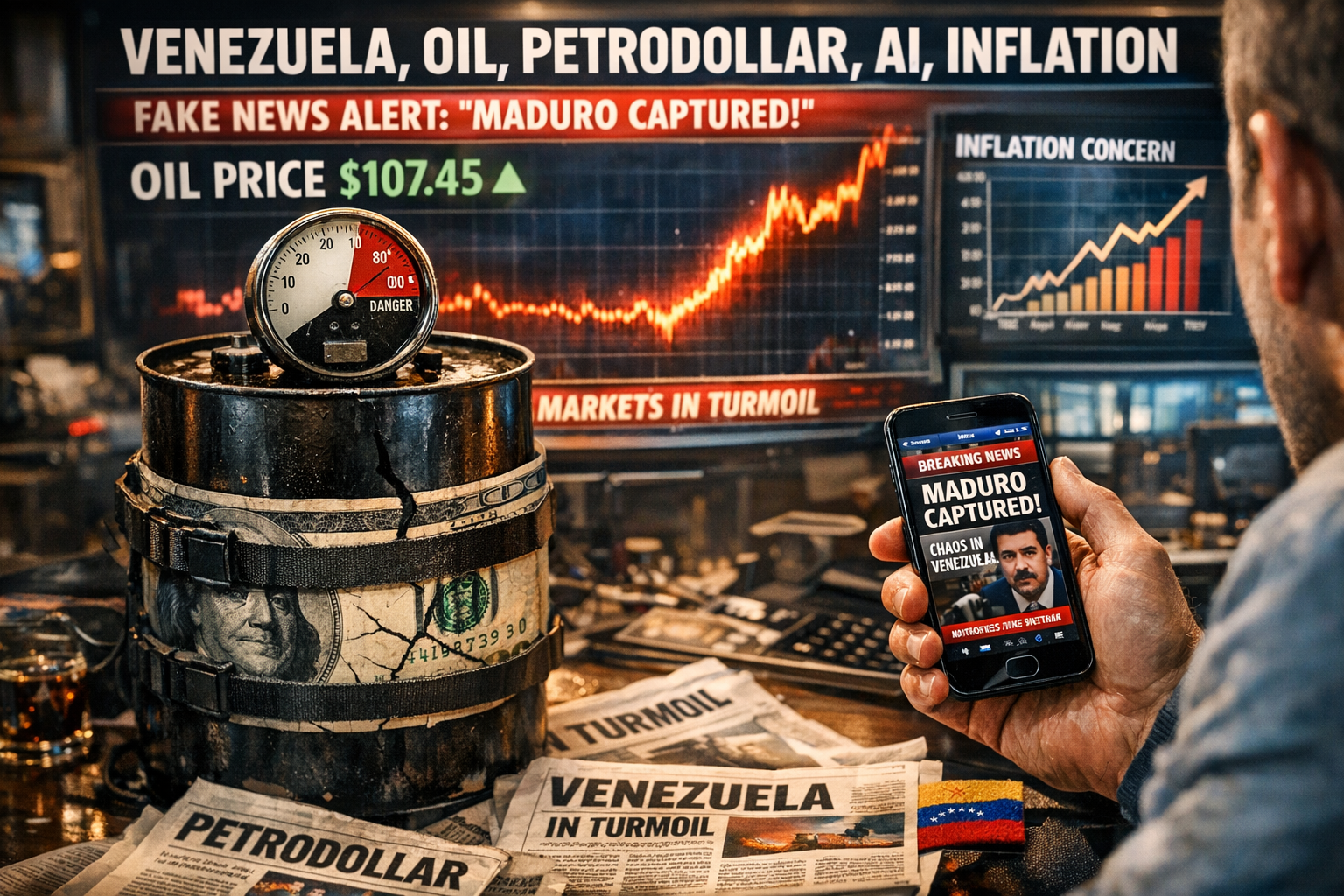
● Maduro Snatch, Oil Shockwave, Dollar Surge, Russia Bleeds, China Stumbles, AI Power War
If the “Maduro Captured” Scenario in Venezuela Were Real: Key Second-Order Effects Across Oil, the Dollar, Russia, China, and AI Competition
This report focuses on the following points:
1) Why Venezuela is a more destabilizing variable than “oil” alone
2) How oil-price stability can transmit into US inflation, interest rates, and global equities
3) Where Russia (war-financing capacity) and China (external assets, energy access, AI competitiveness) face exposure
4) Why markets typically price the “disruption scenario” before the “stabilization scenario”
5) Why the refining and crude-quality mix (heavy vs. light) can be the primary profit driver
1) Fact check: “Maduro captured” is headline risk regardless of verification
The scenario assumes US special forces capture Maduro and his spouse and transfer them to New York.
Even if unverified, such a headline can drive volatility: confirmation implies acute geopolitical risk; denial can still trigger rumor-driven price swings.
From an investor perspective, scenario-based market reactions may matter more than binary true/false assessment.
2) Why Venezuela: the constraints are refining, quality, and infrastructure—not reserves
Venezuela has large reserves, but scaling exports and production faces structural bottlenecks.
Three core bottlenecks
1) Limited production and refining infrastructure
Resource endowment is not monetizable without extraction, transport, refining, and product distribution capacity.
2) High heavy-crude share
Venezuelan crude is predominantly heavy, requiring complex refining and higher impurity treatment (e.g., sulfur).
This makes the crude discounted but limits the set of refiners that can process it efficiently.
3) Sanctions and political risk restrict capital and technology inflows
Refining expansions and maintenance are capital- and technology-intensive; sanctions and instability materially inhibit investment.
3) Core mechanism: US light crude + Venezuelan heavy crude can create refining-chain synergies
This is the central economic logic of the scenario.
Why blending can improve economics
The US shale system produces a relatively higher share of light crude, while Venezuela is heavy-crude dominant.
Blending can optimize refinery feedstock, improve yields, and expand the product slate depending on configuration.
US geographic advantage
The US Gulf Coast concentrates large-scale refining capacity.
Stable Venezuelan inflows could affect utilization rates and margins across the crude-to-refining-to-petrochemicals value chain.
4) Second-order effect #1: a petrodollar reinforcement pathway
The first proposed spillover is strengthened USD centrality in energy settlement.
Key points
The greater the share of oil settled in USD, the more structural demand for USD liquidity is embedded in global trade.
Recent discussions of alternative settlement options have raised questions about the durability of the petrodollar framework.
If the US exerts influence over Venezuelan supply and reinforces USD-based settlement conventions, the outcome would be USD-supportive.
This links directly to FX dynamics.
Changes in energy settlement and supply-chain control can affect near-term USD expectations and increase EM currency volatility.
5) Second-order effect #2: oil stability → lower inflation pressure → more scope for rate cuts → risk-asset repricing
This is the primary transmission channel monitored by investors.
Why oil affects inflation directly
Energy costs feed into transport, manufacturing inputs, and agricultural production.
Oil-price stabilization can reduce inflation pressure, altering rate-path expectations.
Federal Reserve rates and markets
Disinflation typically increases expectations for rate cuts, affecting equity valuation—especially duration-sensitive growth and technology segments.
The chain is oil → inflation → rates → equities.
6) Second-order effect #3: indirect pressure on Russia via energy prices
The mechanism is straightforward.
Russia’s fiscal capacity and war sustainability are highly sensitive to energy export revenues.
If increased supply helps pull prices lower, Russia’s cash flows could tighten.
This could influence bargaining power and endurance in the Ukraine conflict context.
Venezuela therefore functions as a commodity and war-economy lever rather than a purely regional issue.
7) Second-order effect #4: China’s exposure may be less about losses and more about energy access and AI competitiveness
This section is a central element of the scenario.
1) External asset and contract risk (lending and long-term offtake)
China has provided funding to Venezuela, with repayment structured via oil shipments and long-term supply arrangements.
Regime change or contract renegotiation would increase uncertainty around recoverability and supply security.
2) Strategic layer: cheaper US energy can improve AI infrastructure economics
AI competitiveness is driven by chips, data centers, and power.
Training and inference growth increases strain on grids, transformers, transmission, and supporting infrastructure.
Lower US energy costs could improve operating economics for AI at scale and confer a longer-term competitive advantage.
This extends beyond industry into national power, given AI’s linkage to defense, intelligence, and cyber domains.
8) Market scenario framing: stabilization success vs. failure and disorder
Case A) Stabilization (expanded US influence → normalized supply and refining operations)
– Downward or stable oil-price expectations
– Disinflation expectations strengthen
– Rate-cut expectations increase
– Potential tailwinds for US refining and petrochemical value chains
– More supportive conditions for AI infrastructure investment (data centers, power, cooling)
Case B) Disorder or confrontation (internal resistance, regional pushback, indirect China/Russia responses)
– Near-term oil spike via supply-disruption premium
– Higher risk-asset volatility (potential equity drawdowns)
– Potential bid for safe havens; gold strength possible
– Higher EM risk premium (wider sovereign spreads and FX volatility)
A key market property is that disruption probability is often priced faster than stabilization outcomes.
9) Under-discussed drivers
Key point 1) The objective is not “taking crude,” but controlling refining-chain throughput and margins
Crude is globally available, but influence increases materially when refining, blending, logistics, and settlement infrastructure are shaped together.
Key point 2) The petrodollar is supported by settlement rails and supply reliability as much as by currency status
USD settlement dominance is reinforced by stable supply and entrenched market conventions, not only by coercive power.
Accordingly, Venezuela is also a financial-order variable.
Key point 3) AI’s binding constraint is not only chips, but power prices and grid delivery speed
Power generation, transmission, transformers, cooling, and gas-fired backup are integral to scalable AI deployment.
Lower energy prices can reduce training and inference operating costs over time.
Key point 4) Short-term oil spikes are more common than immediate stabilization benefits
Political and military shocks often introduce a supply-disruption premium early.
Longer-term stabilization logic can coexist with near-term spike risk.
10) Investor checklist (macro)
– Inflation: whether oil weakness changes the inflation path
– Rates: whether disinflation shifts Federal Reserve policy expectations
– Dollar centrality: whether energy settlement reinforces structural USD demand
– Commodities: whether oil, gold, and industrial metals reflect “stability” or “conflict” pricing
– FX: whether EM FX volatility rises as a risk-off signal
< Summary >
Venezuela is not only a political-transition risk; it can affect oil supply chains, refining value chains, USD-based energy settlement, the inflation-to-rates channel, and strategic vulnerabilities for both Russia and China.
If stabilization succeeds, the pathway is oil stability → lower inflation pressure → stronger rate-cut expectations; however, near-term outcomes may be dominated by disruption risk, including oil spikes and higher risk-asset volatility.
Lower US energy costs could also influence the long-run economics of AI infrastructure by easing power-related constraints for data centers.
[Related…]
Oil volatility is rising: why energy markets may destabilize again in 2026
The AI data-center power war: grids, transformers, and cooling are the real bottlenecks
*Source: [ 내일은 투자왕 – 김단테 ]
– 베네수엘라 마두로 생포? 트럼프의 큰 그림은 이렇습니다 ㄷㄷ