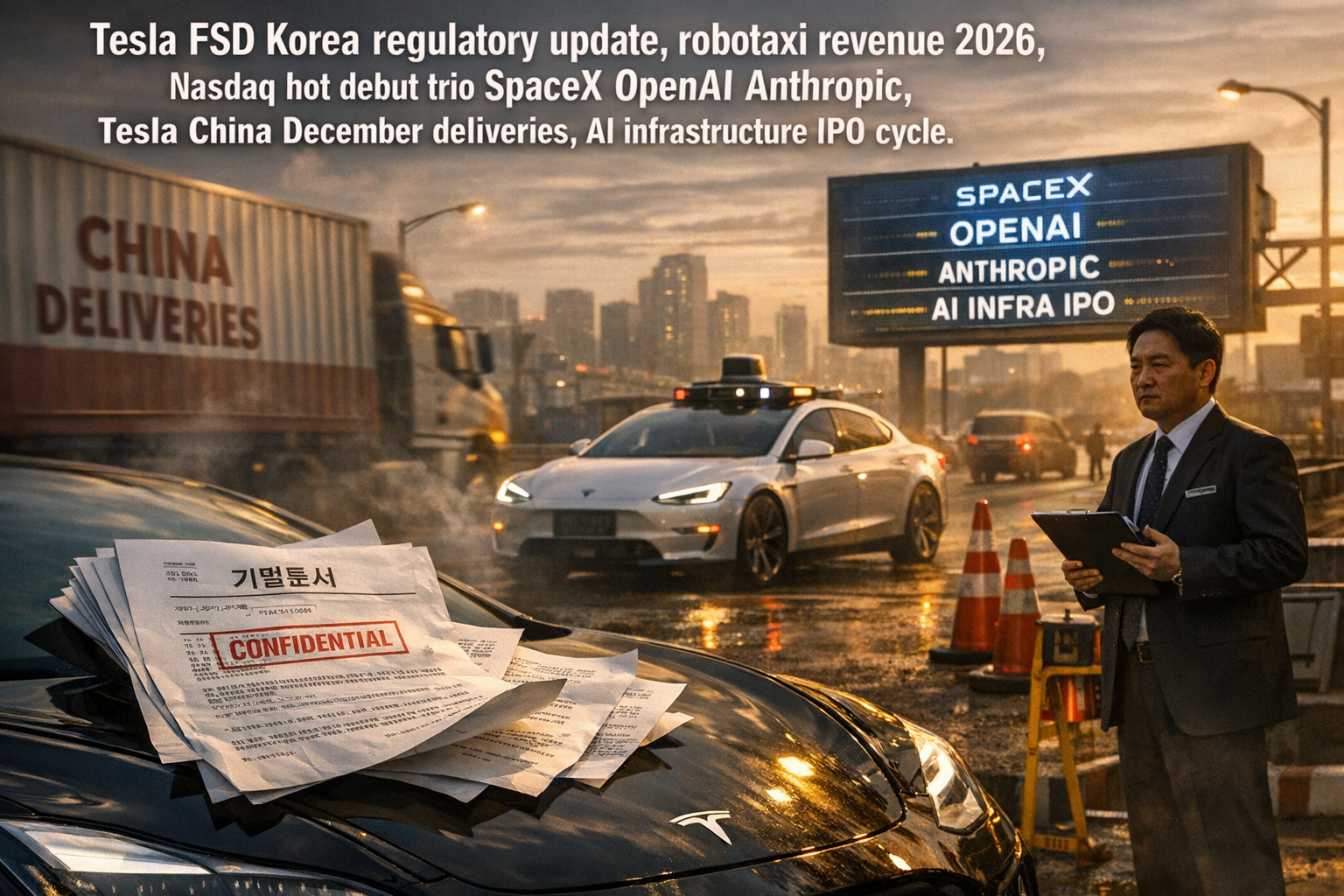
● Korea Flags Tesla FSD Probe, Rule Chaos Sparks Market Shock
Korean Expressway Corporation’s Official “Tesla FSD” Test-Drive Document Signals a Larger Shift: The Focus Is Moving Beyond “Pass/Fail”
This report covers:1) Why the Korean Expressway Corporation’s FSD test document matters more for the start of formal observation than for any single “result.”
2) Why the bus-only lane issue should not be framed as a pure technology shortfall, and where the real bottleneck likely sits.
3) Why equities rose despite a U.S. PMI downside surprise: a policy/geopolitics-driven tape.
4) What Tesla China’s sharp December rebound implies for EV demand narrative reassessment.
5) Why Hyundai publicly referenced Tesla as a benchmark for “AI internalization,” and what it signals domestically.
1) Headline takeaway: Markets are pricing “policy, geopolitics, and regulation” more than “economic prints”
Across the developments discussed here, the common thread is:
Even when growth signals weaken, shifts in policy/geopolitics/regulation can reprice risk assets first.
2) U.S. PMI at 47.9: Slowing activity, with residual cost pressure
PMI printed at 47.9, below the 50 threshold, indicating contraction in manufacturing. It was below consensus (48.3) and down versus the prior reading, reinforcing a “slower recovery” signal.
A key negative mix remains:
- Growth softening (weaker demand)
- Manufacturing prices index at 58.5 (ongoing input-cost pressure)
This combination complicates clean easing expectations, as the Federal Reserve must weigh growth support against re-accelerating inflation risk. The print is therefore relevant less as a standalone growth datapoint and more as a factor shaping the pace of rate-cut expectations.
3) Why equities rose anyway: Policy events dominated the pricing function
Despite weak PMI, the S&P and Dow advanced, led by energy and financials.
The driver cited was a U.S.-Venezuela policy/geopolitical development, interpreted by markets as affecting crude supply and control dynamics. Energy reacted immediately.
The broader point: current market structure is not a linear “macro print → index move” linkage. When policy/geopolitics impacts dollar liquidity expectations and energy price risk premia, sector rotation can dominate even amid recession concerns.
4) Tesla China December deliveries: 97,171 units — an early break in the “EV demand collapse” narrative
Tesla China reported 97,171 December deliveries, its second-highest monthly result on record:
- +3.6% year-over-year
- +12% month-over-month
In the most competitive EV market, the data argues against a categorical “demand has fully broken” conclusion. While annual trends may differ, monthly momentum improved into year-end, indicating demand can re-engage when pricing, model mix, and incentives align.
A secondary consideration: if crude supply risk rises, operating-cost narratives can regain relevance, potentially supporting EV value propositions in cost-sensitive segments.
5) Core issue: The Korean Expressway Corporation “Tesla FSD” test-drive document — the key signal is not pass/fail
5-1) Why formal observation is starting now: operational response to a rising incident cluster
The stated backdrop is a surge in highway incidents involving adaptive cruise control. The exercise is less an endorsement or criticism of Tesla and more an institutional step to understand how driver-assistance and partial automation behave in real traffic and what risks must be managed.
When authorities shift from “exclusion” to “management,” the framing changes from “allow vs. ban” to “under what conditions, with what data, and under what accountability.”
5-2) Evaluation highlights: generally positive highway flow tracking; controversy concentrated in bus-only lane rules
The document’s substance can be summarized as:1) Forward traffic-flow detection capability is described as broadly adequate.
2) Misinterpretation of bus-only lanes leading to overtaking/acceleration behavior was flagged.
Some coverage emphasized (2) as evidence the system is unsuitable for local roads. The more precise interpretation is that this is less a collapse in core driving capability and more a localization gap tied to region-specific operating rules.
5-3) The bus-only lane issue: primarily a policy/rule interpretation and data bottleneck
Bus-only lanes can vary by time window, vehicle class, and segment, and rely on layered signage and road markings. This is not solved by lane-keeping vision alone; it requires a rule layer that answers: “Is this lane permitted for this vehicle, at this time, on this segment?” supported by localized datasets.
Accordingly, remediation is more likely to be delivered via software updates, rule encoding, and map/rule integration rather than hardware changes. The wording that the system did not sufficiently recognize traffic law is consistent with this framing.
6) Overseas vs. domestic media framing: different questions produce different conclusions
Overseas coverage tends to emphasize relative performance versus human drivers. Domestic coverage prioritizes compliance with local traffic law and institutional fit. These are different evaluation lenses: once capability clears a baseline, the residual work becomes localization and regulatory design. This divergence explains why the same evidence can be read as “technically capable” abroad and “needs legal adaptation” domestically.
7) The largest signal: status is shifting from “experimental topic” to “reviewed and managed topic”
Whether FSD is immediately commercialized locally is secondary to the fact that a public authority has placed it on an official, documented review track. Once formal documentation begins, stakeholders across OEMs, suppliers, insurers, and regulators adjust. Automated driving requires co-development of regulation and liability frameworks; this shift increases path dependence even if timelines extend.
8) Cumulative 1,000,000 km threshold: as data accumulates, regulators move from “ignore” to “measure”
Reported cumulative domestic FSD mileage exceeded 1,000,000 km, with the inference that the total is concentrated in Model S/X and Cybertruck due to eligibility constraints affecting Model 3/Y.
As cumulative exposure grows, regulators are more likely to quantify incident rates, disengagement frequency, ODD boundaries, and liability allocation rather than rely on binary restriction logic. This measurement phase is a material regime change for market participants.
9) RDW (Netherlands) February approval hypothesis: why Model 3/Model Y expansion expectations are emerging
A scenario was referenced in which a February RDW approval related to FSD could become applicable to China-produced vehicles. This is not confirmed, but it is framed as an observable, trackable hypothesis.
If realized, the impact in the local market would be outsized because Model 3 and Model Y constitute a large portion of sales. An expansion of eligible vehicle coverage would accelerate changes across data accumulation, regulatory posture, insurance frameworks, and consumer expectations. Pre-emptive observation by authorities can be interpreted as preparation for this potential step-function.
10) Hyundai’s public reference to Tesla: competitive framing is shifting to “AI internalization”
A notable industrial signal is Hyundai citing Tesla not as an EV benchmark but as an example of end-to-end AI capability internalization: data collection, labeling, large-scale training, and data-center operations.
This implies a reframing of durable advantage from batteries/motors/manufacturing efficiency toward owning the data flywheel and the operating system for AI at scale.
11) Under-discussed points (key investor-relevant takeaways)
1) The test outcome is less important than the start of a formal administrative process. Once documented, regulation tends to evolve toward measurement and management rather than binary permission.
2) The bus-only lane controversy highlights gaps in localized rule datasets and encoding, not necessarily fundamental autonomy weakness. The binding constraints shift toward rule formalization and liability design.
3) Equity resilience despite PMI weakness illustrates a tape where liquidity/policy/crude dynamics can outrank macro prints in the short term.
4) Tesla China’s rebound does not negate EV cyclicality; it suggests demand can reappear when price/model/policy configurations turn supportive.
5) Local FSD debate is likely to expand into insurance, accident liability, and road-infrastructure data standards, linking automotive, financial (insurance), and regulatory ecosystems.
< Summary >
The Korean Expressway Corporation’s FSD test is more significant for initiating formal observation and documentation than for any pass/fail framing. The bus-only lane issue appears primarily related to localized rule/data bottlenecks rather than core driving capability. The U.S. PMI underscored slowing growth, but markets priced policy and geopolitics (notably crude-related dynamics) more heavily. Tesla China’s December rebound supports reassessing simplistic “EV demand collapse” narratives. Hyundai’s reference to Tesla signals that the competitive axis is shifting toward AI capability internalization.
[Related Links…]
- Tesla FSD domestic regulatory changes: where the process stands
https://NextGenInsight.net?s=FSD - Why equities held up despite a weaker U.S. PMI: policy and liquidity dynamics
https://NextGenInsight.net?s=PMI
*Source: [ 오늘의 테슬라 뉴스 ]
– 한국 도로공사 FSD 테스트? 결과보다 중요한 건 왜 지금 관찰하기 시작했는가?
● Tesla 2026 Boom and Chaos, Robotaxi Revenue, FSD Surge, Deregulation Tailwind, China Sales Spike, EPS Shock
In 2026, Tesla’s “Inflection” and “Tesla Noise” May Spike Simultaneously: Consolidated View on Robotaxi Revenue Recognition, FSD Expansion, Regulatory Tailwinds, China Deliveries, and the EPS Gap
The case for 2026 as Tesla’s most dynamic year can be summarized in four points:
First, robotaxi (including Cybercab) could reach the point where revenue begins to be recognized in reported results.
Second, Tesla’s valuation framework may shift decisively from hardware (EVs) to software and autonomy (FSD/robotaxi).
Third, near-term EPS may remain constrained, amplifying disagreement and volatility.
Fourth, US political and policy variables could accelerate autonomy-related regulatory change.
1) 2026 Tesla: Executive News Brief (Key Points)
1-1. 2026 may represent the widest gap between “future EPS” and near-term EPS
Tesla’s profit model is transitioning from primarily vehicle sales to software subscription and mobility-network economics driven by FSD/robotaxi.
Until this shift is reflected in reported line items, near-term EPS can remain pressured by vehicle mix, incentive dynamics, and pricing strategy.
As a result, 1H26 may be characterized by the largest disconnect between valuation expectations and current-period earnings.
1-2. The start of robotaxi revenue recognition can reset the investment framework
Robotaxi-related revenue could begin to appear in financial statements as early as Q1–Q2 under certain commercialization paths.
Market focus could shift from deliveries, automotive margin, and ASP toward metrics such as revenue per ride, rider growth, and network expansion.
1-3. Shifts in US media coverage (e.g., collision-avoidance narratives) and why they matter
Mainstream reporting on autonomy success cases can signal improving social acceptance.
This can influence the pace of regulatory adaptation, insurance underwriting, and commercial rollout.
1-4. Strong China volumes are a double-edged factor: units vs margin
Strength in China supports delivery stability.
However, regional margin differences (North America vs China) can result in weaker-looking EPS even when unit volumes are resilient.
1-5. Trump–Musk dynamics and autonomy deregulation as potential accelerants
A more permissive regulatory environment aligned with technological progress is a key variable.
For autonomy, policy design (standards, reporting requirements, certification) can be a binding constraint; changes here can materially affect the commercialization timeline.
2) The core opportunity in 2026: Tesla’s transition toward a software-led earnings model
2-1. “Step-change valuation” versus conventional growth
A step-change implies a structural shift in the profit model, not incremental revenue growth.
Hardware-led EV companies often remain anchored to manufacturing valuation regimes tied to margins, competition, and cyclicality.
Software and network models can command different multiples due to scalability and operating leverage.
The 2026 focus is whether Tesla begins to substantiate this transition through accounting outcomes (revenue recognition and margin profile), not narrative alone.
As this occurs, traditional valuation anchors (e.g., near-term P/E) may become less explanatory, with increased emphasis on future cash flows and network value.
This environment can increase equity volatility regardless of broader macro conditions.
2-2. Why “future EPS” can expand while near-term EPS remains constrained
Automotive revenue remains the dominant mix, and near-term growth can be limited by incentives, regional mix, and pricing.
If China’s mix increases, units may improve while margins compress.
This can create conditions where reported EPS underwhelms while long-duration expectations rise, amplifying valuation disputes and headline sensitivity through 2026.
3) 2026 downside risk: three triggers that can amplify “Tesla noise”
3-1. Recurrent framing: “Why is the stock rising with low EPS?”
When Tesla outperforms, recurring critiques centered on valuation normalization and earnings mismatch often re-emerge.
In 2026, the gap between autonomy-driven expectations and reported EPS can make this framing more persistent.
3-2. Volatility as an event: drawdowns can become part of the narrative
Tesla has historically been viewed as capable of 30–40% peak-to-trough corrections.
In 2026, upside catalysts (robotaxi milestones) may coincide with near-term automotive or margin disappointments, increasing the probability of alternating rallies and sharp declines.
Macro factors (including rate-cut expectations) can further intensify swings.
3-3. China strength may not translate into “impressive earnings”
Higher China volumes are constructive, but investors typically require evidence of improving profitability and recurring revenue dynamics.
This can produce a period of ambiguous reported results alongside elevated expectations, increasing interpretive disagreement.
4) Robotaxi/Cybercab update: what increased testing visibility implies
4-1. More sightings of testing in Austin and the Bay Area may indicate late-stage pre-commercial routines
Reports reference frequent testing in Austin and limited activity in the Bay Area.
While anecdotal, repeated day-and-night operation can indicate expansion of safety coverage and operational validation.
4-2. Removing the safety driver is the commercial inflection
With a safety driver, robotaxi operation functions primarily as a demonstration.
Without a safety driver and with paying customers, the model becomes a platform business; markets typically assign materially higher value to this transition.
4-3. Cybercab positioning: lowering unit economics to scale the network
Emphasis is placed on a lower-cost vehicle design.
Lower vehicle cost shortens payback periods and improves per-ride unit economics, supporting faster network expansion.
Cybercab should be evaluated primarily as a scaling instrument for a robotaxi network, not only as a new vehicle product.
5) FSD status: from “technology debate” to “social adoption”
5-1. The “destination input → engage → park” workflow as an investor signal
This indicates a more complete end-to-end user experience.
Autonomy adoption tends to accelerate when the experience is continuous across the full trip, enabling monetizable ride services.
5-2. Mentions of Korean road-environment assessment: implications for data and localization
References include generally positive assessments with exceptions for specific scenarios (e.g., unprotected left turns).
The key issue is whether the system can be effectively fine-tuned with local data.
If training is North America-centric, performance gaps in local rules and edge cases become a localization cost and execution question.
5-3. Why shifts in mainstream US media posture matter
The 2026 determinant is willingness to trust and pay, not continued technical argumentation.
Positive framing around safety outcomes can influence regulators, insurers, municipalities, and consumer sentiment, affecting rollout velocity.
6) China volumes and regional mix: growth and profitability can diverge
6-1. Strong monthly China volumes support near-term sentiment
A figure of approximately 97,000 units in December is cited (domestic plus exports).
This can be interpreted as demand resilience.
6-2. Margin remains the binding variable
A higher China mix alongside weaker North America can compress blended margins.
Reported EPS may fall short of expectations, enabling renewed criticism that autonomy expectations are overstated.
This dynamic is a recurring fuel source for 2026 volatility.
7) Donald Trump vs Elon Musk: autonomy regulation could shift into a speed-driven regime
7-1. Autonomy is a combined technology-and-policy game
Commercialization is shaped by policy constraints such as crash reporting requirements, exemptions, standardization (federal vs state), and driver requirements.
7-2. Deregulation can reprice the entire autonomy complex
If regulation becomes more permissive, the market may pull forward robotaxi timelines from “eventual” to “within several quarters.”
This can increase equity volatility and influence broader growth sentiment.
8) Five under-discussed points
8-1. 2026 may be defined less by “earnings improvement” and more by changes in accounting composition
Market re-rating may depend more on the emergence of recurring-revenue classification and a demonstrable margin profile shift than on absolute revenue size.
This is a key trigger for moving beyond a manufacturing multiple.
8-2. Near-term EPS softness can be a normal feature of transition-stage companies
When hardware remains dominant while software begins scaling, interim quarters can appear structurally inconsistent.
This can increase mispricing risk due to divergent interpretations.
8-3. The robotaxi profit center is operations, not only autonomy performance
Economic outcomes depend on dispatch, maintenance, cleaning, insurance, and utilization.
Once operating KPIs emerge (utilization, wait times, incident handling, insurance cost), evaluation shifts from technology debate to business underwriting.
8-4. China strength can produce “good news, down stock” sessions
Positive volume data can be offset by margin and mix concerns, creating counterintuitive price action that may become frequent in 2026.
8-5. 2026 may influence the broader AI investment framework
Autonomy can become a high-visibility case of AI monetization in the physical world.
If validated, attention may rotate from generative AI toward robotics, edge AI, and real-economy deployment, potentially driving relative re-rating across adjacent sectors (semiconductors, sensors, mapping/data, insurtech).
9) Practical investor requirements to capture the opportunity
The framework implies that opportunity accrues to investors able to tolerate structural noise. Key conditions:
First, separate near-term EPS cadence (quarterly reporting) from long-duration autonomy narratives (robotaxi/FSD).
Second, avoid overreacting to regulatory headlines; track directionality in standards and frameworks.
Third, treat volatility as a structural feature and size exposure accordingly.
This regime can be highly sensitive to macro variables such as the S&P 500, Nasdaq risk appetite, and rate-cut expectations, increasing the importance of maintaining a clear, written investment thesis.
< Summary >
Tesla’s 2026 setup may represent an inflection where robotaxi/FSD-driven software-like earnings begin to appear in reported results.
However, automotive mix shifts (North America vs China) and incentive/pricing dynamics can keep near-term EPS muted, increasing dispute intensity and volatility.
Shifts in mainstream media tone and a more permissive US autonomy regulatory trajectory can accelerate commercialization timelines.
The central determinant for 2026 is less “current EPS” and more whether recurring revenue structures and operating KPIs begin to emerge.
[Related Articles…]
- Why the robotaxi market may shift into monetization from 2026
- How autonomy deregulation can affect global equity markets
*Source: [ 허니잼의 테슬라와 일론 ]
– [테슬라] 2026년은 테슬라 도약의 해! 그러나 동시에 극심한 ‘테슬라 노이즈’가 예고되어 있습니다.● Nasdaq Shock Trio, SpaceX OpenAI Anthropic, Mega IPO Money Flood, Microsoft Market Cap Threat
Could They Challenge Microsoft’s Market Cap? The “Nasdaq Hot Debut Trio” (SpaceX, OpenAI, Anthropic) Reshaping Wall Street in 2026 — Key Points
This report focuses on four items:
1) Why IPO discussions have intensified now (the underlying drivers of funding demand).
2) The rationale that three IPOs alone could exceed the “total 2025 U.S. IPO proceeds.”
3) Post-IPO metrics the market will scrutinize: profitability, customer retention, cost structure, and CAPEX.
4) A less-covered point: these IPOs do not “end” the AI bubble debate; they change the rules of the market.
1) Issue Summary (Headline Style)
Wall Street is reportedly grouping SpaceX, OpenAI, and Anthropic as the most closely watched candidates for a Nasdaq debut as early as this year. The core point is that they are viewed not as early-stage startups, but as scaled players already influencing industry structure and policy environments.
The Financial Times indicated that these listings could enable fundraising not in the single-digit billions, but in the tens of billions of dollars. Some commentary further argues that these three deals alone could surpass the total capital raised across approximately 200 U.S. IPOs in 2025.
Separately, a simple aggregation of private-market valuations has fueled claims that their combined market capitalization could approach Microsoft-scale levels.
2) The “Hot Debut Trio” at a Glance: Commonalities and Differences
2-1. Common Theme: From a “Growth Story” to a “Cash/Infrastructure Story”
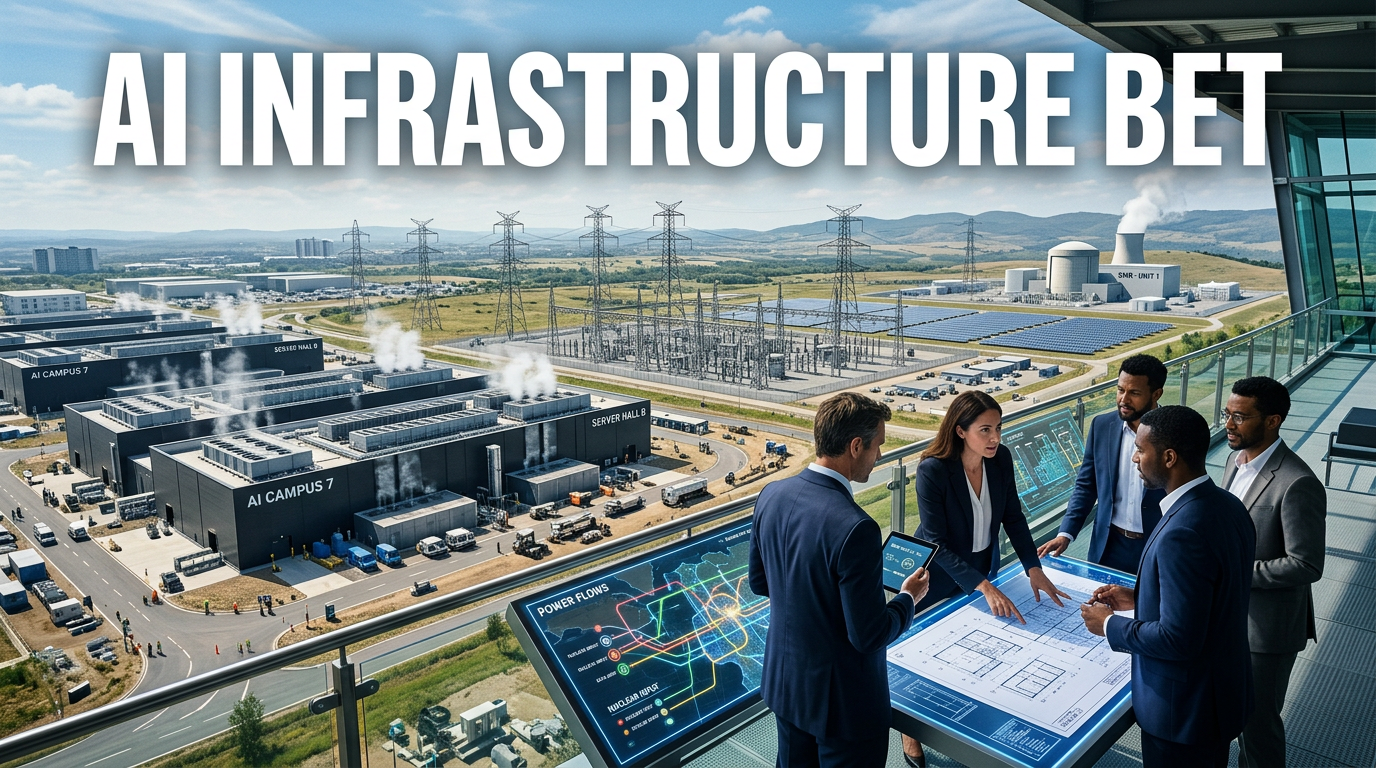
All three are viewed as entering a scale-economics phase. The growth ceiling is increasingly determined by stable access to AI infrastructure—data centers, power, and semiconductors—rather than marketing-driven user growth. Capital access becomes a central competitive variable alongside technology.
2-2. SpaceX: Industrialization of Space (Launch Vehicles, Satellites, Connectivity) + Defense/Policy Leverage
SpaceX is positioned as a vertically integrated platform spanning launch, orbit (satellites), and services (connectivity). As IPO expectations rise, investors are likely to prioritize the durability of cash-generating segments (e.g., satellite internet and government contracts) over technical milestones alone.
2-3. OpenAI: The Growth Paradox Driven by Surging Compute Costs
As competition intensifies, training and inference costs rise, alongside escalating spend to secure talent, data, and GPUs. IPO interpretations diverge:
- One view frames it as a growth accelerator to fund demand-driven expansion.
- Another frames it as an increased reliance on public-market capital due to high cash burn.
Public-market scrutiny is likely to emphasize unit economics and margin structure at least as much as headline revenue growth.
2-4. Anthropic: Monetizing the “Safety/Trust” Positioning
Anthropic seeks differentiation not only via model capability, but through safety and enterprise trust (governance, compliance, risk management). In an IPO context, evaluation is likely to shift from narrative to measurable enterprise outcomes—how much customers pay and for how long.
3) Why IPO Discussion Is Rising Now: Two Market Scenarios
3-1. Scenario A (Constructive): “First-Mover” Investment to Scale AI Infrastructure
The central argument is that AI competition is shifting from model concepts to access to power, data centers, and semiconductor supply chains. In this phase, the ability to deploy large capital quickly can materially affect competitive positioning, making an IPO a potential acceleration mechanism.
3-2. Scenario B (Cautionary): Rising Cash Burn and Greater Reliance on Public Markets
An alternative view treats IPOs less as optional growth events and more as responses to funding pressure. In generative AI, if inference costs do not improve relative to revenue growth, profitability can deteriorate. Post-IPO, markets may prioritize unit economics and margin sustainability over top-line growth rates.
4) IPOs Do Not End the Debate; They Shift the Battlefield to Disclosed Metrics
A public listing converts the “bubble vs. substance” discussion from narrative to audited, recurring disclosure. Each quarter, the market will focus on:
- Profitability (operating margin, contribution margin, cash flow)
- Customer retention/expansion (retention, NRR-type indicators)
- Cost structure (compute, labor, data costs, cost of revenue)
- Capital expenditures (CAPEX: data centers, servers, GPUs, power contracts)
This disclosure cycle can influence broader market positioning, supporting the view that these are generational-scale entries into public markets.
5) Underemphasized Points in General Coverage
5-1. Not a “Technology Event,” but a Capital-Market Rebalancing Event
Coverage often concentrates on valuation comparisons (e.g., whether they can exceed Microsoft). More structurally, large AI listings could redirect capital flows from incumbent megacaps and index vehicles toward an “AI infrastructure and compute economics” complex, potentially reinforcing sector rotation.
5-2. After Listing, the Decisive Variable Becomes Compute Unit Cost, Not Model Claims
Pre-IPO positioning can lean on “best model” narratives. Post-IPO, investor focus shifts to stable delivery at competitive cost and scale. Competitive advantage increasingly reflects procurement (power/GPU/data center access) and operational efficiency.
5-3. “Bubble” Is a Price Debate; IPOs Force a Structure Debate
Bubble narratives emphasize potential near-term repricing. Large-scale public listings can encourage institutions to build longer-duration exposures, potentially altering market structure even if prices remain volatile.
5-4. “Not Following Macro, but Moving Macro”
IPOs typically depend on macro conditions (rates, liquidity). At this scale, these issuers can stimulate power demand, semiconductor allocation, and data-center investment cycles—variables that may feed back into inflation expectations (power/equipment/construction), U.S. rate expectations, and global supply-chain dynamics.
6) 2026 Outlook: Checklist for a Potential Repricing Toward “AI CAPEX Season”
A re-evaluation toward “AI capital expenditure season” is more likely if the following conditions align:
- AI infrastructure investment continues to exceed prior guidance
- Data-center power bottlenecks ease (power contracts, transmission, cooling)
- Semiconductor supply (especially AI accelerators) keeps pace with demand
- Post-IPO financials show compute expense does not structurally erode gross margins
- Regulatory/safety constraints do not materially limit customer expansion (especially enterprise/public sector)
7) Post-IPO Metrics Likely to Be Prioritized by Investors
- Gross margin: primary indicator of monetization durability
- Free cash flow: key measure separating scalable growth from capital dependence
- CAPEX guidance: pace of data-center and power expansion
- Customer concentration: dependency risk on a limited number of large customers/partners
- Disclosed regulatory/litigation risks: costs that become explicit after listing
< Summary >
SpaceX, OpenAI, and Anthropic are positioned as scaled companies with potential IPOs that could materially affect U.S. issuance volumes. If listed, quarterly disclosure will refocus evaluation on profitability, retention, cost structure, and CAPEX. The central issue is less “bubble vs. reality” and more the shift of AI competition from models to compute unit economics and infrastructure access, with potential second-order effects on capital allocation.
[Related…]
- U.S. IPO market re-acceleration: how large deals redirect capital flows (NextGenInsight.net?s=IPO)
- Expansion in AI infrastructure investment: data centers, power, and semiconductors driving the cycle (NextGenInsight.net?s=AI)
*Source: [ Maeil Business Newspaper ]
– MS를 뛰어넘는 시총이 나온다고? “나스닥 핫 데뷔 삼인방” #shorts