● Trump-Backed ETF Blitz-2026 Power Grab
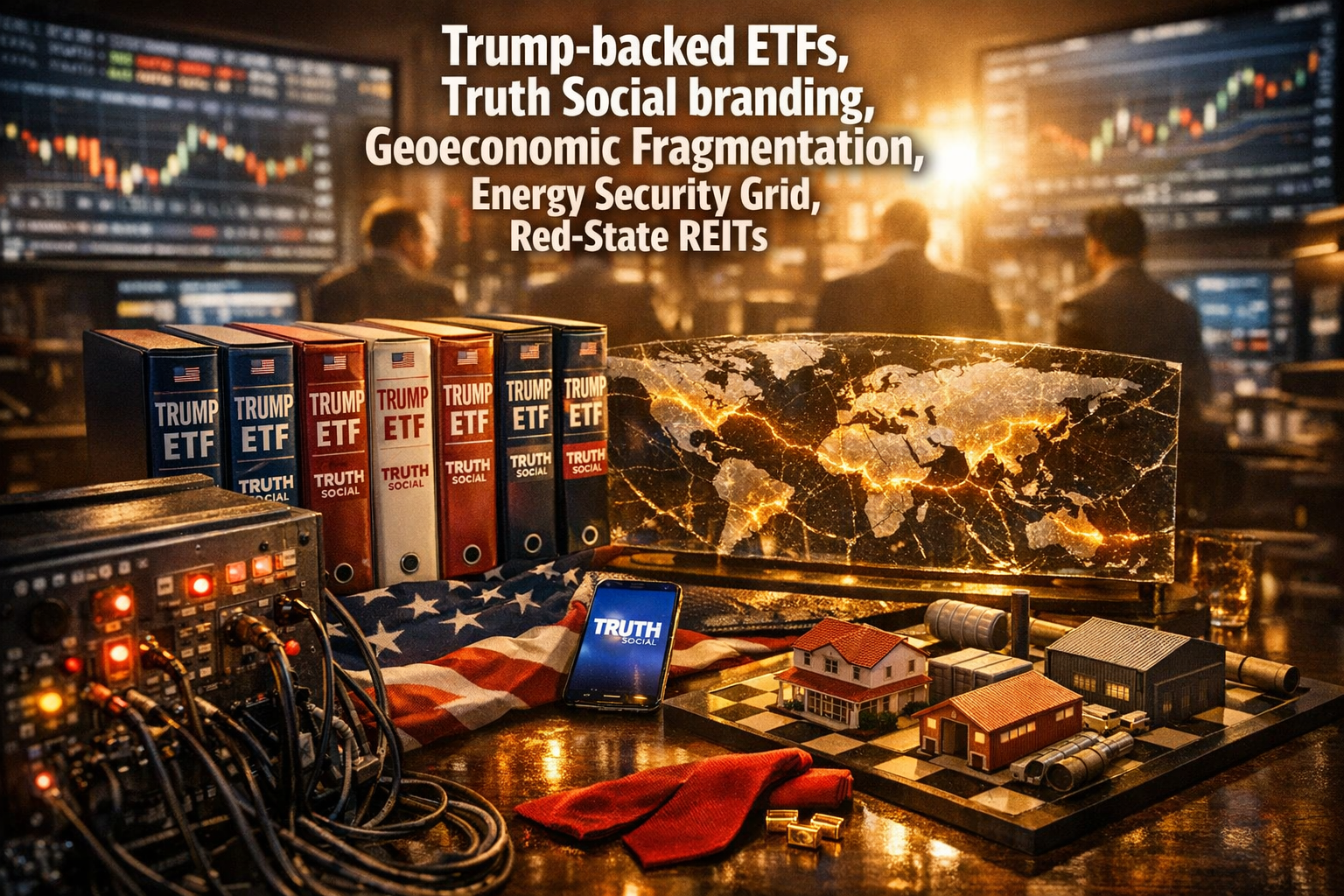
How Five “Truth Social” ETFs Branded by Trump Media (DJT) Could Reshape the 2026 Investment Landscape
(Next-generation growth, defense/cyber, energy/power, flagship U.S. brands, and red-state REITs)
This report covers:
1) A news-style summary of the five ETFs launched under Trump Media (DJT) branding via “Truth Social,” including positioning and underlying sector exposures
2) A structural interpretation of why these ETFs may be read as policy signaling (i.e., potential leadership themes) in a 2026 “super-year”
3) A framework focused less on the ETF vehicles and more on expected U.S. policy-driven capital flows and the direction of regulation, procurement, and contract awards
4) Actionable sector checklists: key risks, monitoring indicators, and regimes that differentiate beneficiaries vs. non-beneficiaries
1) News Briefing: What the Five “Truth Social ETFs” from DJT Imply
The core issue is not the launch of five ETFs, but the labeling of selected industries as priorities tied to a political brand: next-generation growth, national security, energy security, domestic U.S. consumption, and red-state assets.
ETFs function as condensed expressions of market narratives. In this context, the lineup can be used as a policy-and-capital-flow heuristic for 2026: where funding, regulatory posture, and administrative emphasis may tilt.
Key themes: America-first orientation, security (defense plus cyber), energy security (traditional energy plus power infrastructure and nuclear), domestic consumption/brands, and red-state real assets. The common design feature is exposure to areas where policy-supported demand can persist despite macro volatility (rates, inflation, recession risk).
2) One-Page Summary of the Five ETFs (Ticker – Concept – Exposure Profile)
2-1. TSNF: “Next Frontier” (Next-generation growth)
Positioned as a next-generation growth basket, with characteristics resembling a broad technology package: space and defense-adjacent technology, AI infrastructure (semiconductors, data centers, power), robotics/drones, and smaller allocations to quantum and blockchain themes.
A notable feature is the high weight to space-related exposures, implying policy optionality for continued support of space as a strategic priority.
Core sector clusters (reorganized):
- High exposure to space/satellites/launch systems/cislunar infrastructure-related companies
- AI semiconductors, semiconductor equipment, and data center ecosystem exposures
- Robotics and drones
- Smaller allocations to quantum and blockchain
2-2. TSSD: “Security & Defense” (Security/defense)
Combines traditional defense contractors with cybersecurity under a single “security” umbrella. While defense and cybersecurity are often separated in thematic products, this structure treats cyber as integral to national security.
The implied thesis is that modern conflict and strategic competition drive both kinetic defense spending and cyber/infrastructure protection in parallel.
2-3. TSES: “Energy Security” (Energy security)
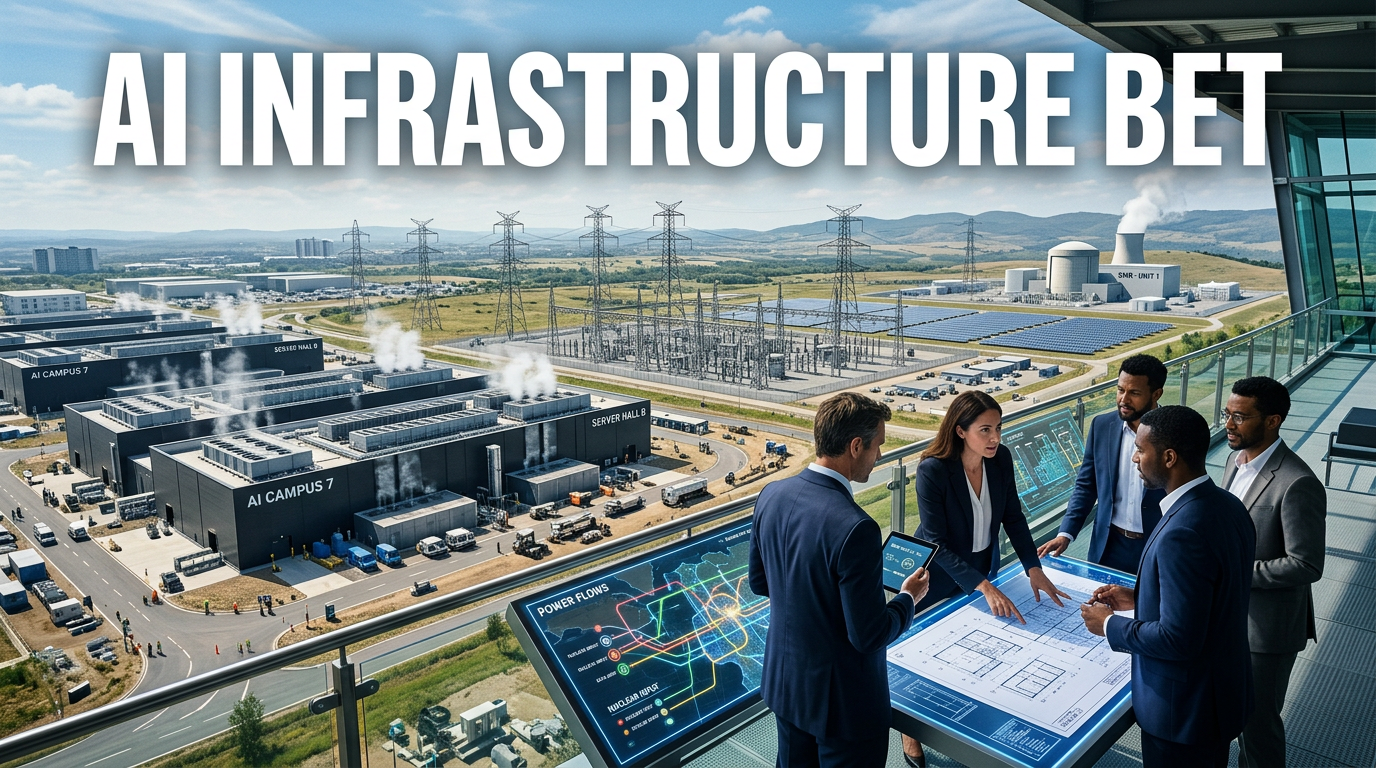
This may be among the most practically grounded 2026 concepts, reflecting the link between AI/data center expansion and power availability constraints.
Exposure profile:
- Traditional energy (including large integrated oil) plus
- Power/utilities plus
- Nuclear-linked generation plus
- Power equipment, grid, and gas turbine supply-chain exposures
All consolidated under the “energy security” label.
2-4. TSIC: “American Icon” (Flagship U.S. brands)
Structured as a U.S. domestic flagship brand basket: large-format retail, consumer staples exposure, streaming, and major quick-service brands typically associated with U.S. consumer leadership.
This functions less as a high-beta thematic trade and more as a potential quality/defensive allocation during growth slowdowns.
2-5. TSRS: “Red State” (Red-state REITs/real estate)
Targets REITs and real estate-related equities tied to U.S. states that are typically Republican-leaning. This is a politically mapped asset basket.
The critical evaluation is not political affiliation as a return driver, but rate sensitivity (direct for REIT multiples) and regional fundamentals such as migration, industrial development, logistics demand, and housing supply-demand.
3) How to Read the Five ETFs as 2026 “Leadership Theme” Signals
3-1. Focus on policy mix, not the ETF vehicle
The primary utility is not as a buy signal, but as a lens on policy-driven capital allocation. Policy tends to redirect incentives, risk premia, and funding.
Common denominators:
- National security: defense plus cyber (digital defense)
- Energy security: oil/gas plus power/nuclear plus grid (a constraint for AI infrastructure)
- America-first/domestic orientation: flagship U.S. brands plus red-state assets (symbolic political mapping)
These areas can remain strategically prioritized even under shifting macro conditions.
3-2. Why TSNF’s space tilt matters: space as defense + industry + data
Space exposure increasingly reflects functional demand:
- ISR, communications, and navigation as defense infrastructure
- Launch and satellite manufacturing as industrial capacity and supply chain
- Earth-observation data supporting mapping, agriculture, insurance, climate, and military applications
As space transitions from “tech theme” to “strategic infrastructure,” valuation drivers can shift toward procurement, contracts, and long-duration revenue visibility.
3-3. Why TSES aligns with AI: the grid as a bottleneck
AI and data center competition ultimately becomes power procurement competition. The inclusion of nuclear, utilities, and grid equipment is consistent with this constraint-based framework.
In 2026, the gap between data center buildout and grid expansion capacity can keep power infrastructure in the center of the narrative (transmission, transformers, grid modernization).
3-4. Why the defense + cyber pairing is structurally strong: hybrid conflict
Defense spending is event-sensitive; cybersecurity demand is reinforced even in non-crisis periods through regulation, insurance requirements, and enterprise risk management.
The combination can reduce single-theme cyclicality relative to pure defense exposure and strengthens the policy narrative via “defense budgets plus critical infrastructure protection.”
4) Under-discussed Core Point: Treat This as a Policy Signaling Package
4-1. These ETFs may function as policy-marketing instruments
Traditional ETF launches largely respond to investor demand. This lineup also appears to package policy messaging into investable products.
The key question is not near-term ETF performance, but whether the included industries gain advantage over the next 12–24 months via:
- Regulatory easing/tightening
- Government procurement and contract awards
- Tax policy, subsidies, and permitting timelines
4-2. More important than constituents: repeatable inclusion logic
Constituents can change; the selection logic tends to persist.
The repeated logic across the five products: “bundle areas the U.S. seeks to control domestically—security, energy, infrastructure, supply chain, and domestic symbols.”
If this logic persists, these themes can recur as market narratives through 2026.
4-3. Embedded risks: fees and political event risk
Fees are not low. For thematic products with higher volatility, elevated expense ratios can impair long-run compounding.
Political event risk is also material: policy acceleration can amplify upside, while opposing public sentiment, legislative constraints, litigation, or regulatory reversals can increase volatility.
5) 2026 Investor Checklist: How to Use This Framework Without Buying the ETFs
5-1. TSNF (Next Frontier): identify the intersection of “space + AI infrastructure”
Monitoring indicators:
- Launch and satellite deployment schedules (event-driven catalysts)
- Government/defense contract wins (cash-flow visibility)
- Semiconductor/data center capex cycles (durability of AI demand)
5-2. TSES (Energy Security): regimes where “power bottlenecks” intensify
Monitoring indicators:
- Data center expansion announcements vs. grid buildout pace
- Nuclear, gas turbine, transmission, and transformer order cycles
- Evidence of “reliability premium” in energy markets beyond spot price moves
5-3. TSSD (Defense/Cyber): the intersection of geopolitics and regulation
Monitoring indicators:
- Geopolitical risk, defense budgets, export controls
- Major cyber incidents followed by regulatory tightening and budget expansion
5-4. TSIC (American Icon): quality/defense during growth deceleration
Monitoring indicators:
- Pricing power and brand resilience under weaker consumption
- Margin stability in earnings reports
5-5. TSRS (Red State REITs): separate rates from regional supply-demand
Monitoring indicators:
- Rate direction (direct impact on REIT multiples)
- Migration trends, industrial/logistics development, and housing supply-demand by region
6) Conclusion: 2026 leadership will not be limited to these five, but the policy frame may start here
These ETFs translate a specific policy worldview into investable language. In an event-heavy year, clear labels can shape market narratives.
The two axes most directly linked to broad market structure are:
- TSES (Energy Security), tied to the physical constraint of AI infrastructure (power)
- TSSD (Security), combining defense with cybersecurity under a unified budget and infrastructure-protection rationale
TSNF (Next Frontier) offers upside exposure but spans multiple high-volatility themes; a more disciplined approach is to focus on overlap segments such as space/defense/AI infrastructure.
Trump Media (DJT), under the “Truth Social” brand, launched five ETFs (TSNF, TSSD, TSES, TSIC, TSRS) spanning next-generation growth (space/AI/semiconductors/robotics), security (defense plus cyber), energy security (traditional energy plus power and nuclear), flagship U.S. brands (domestic consumption), and red-state REITs (politically mapped real assets). The primary analytical use is not as a purchase recommendation, but as a framework for interpreting 2026 U.S. policy and capital-flow priorities. Power infrastructure constraints (AI buildout) and the combined defense/cyber axis are likely to recur as dominant themes.
[Related Articles…]
- https://NextGenInsight.net?s=Trump
- https://NextGenInsight.net?s=Space
*Source: [ 소수몽키 ]
– 현직 대통령 트럼프가 직접 출시한 ETF, 2026년 주도주 답안지일까
● Venezuela Flashpoint, Geoeconomic Fragmentation, Oil Shock, Gold Surge, Growth Slump
The Venezuela Crisis: Why It Matters—Geoeconomic Fragmentation Linking the Middle East, Taiwan, and Russia–Ukraine, and the Next Direction for Oil, Rates, and Growth
This report consolidates four points:1) Why the Venezuela situation is not a regional South America issue but a potential global conflict risk
2) Why the Middle East (Iran), the Taiwan Strait, and the Russia–Ukraine war are connected through the same mechanism (geoeconomic fragmentation)
3) Market transmission channels: crude oil, gold, and global growth (trade/supply chains)
4) Three key issues often underweighted in mainstream coverage (separately summarized)
1) Situation Brief: Why Venezuela Is Being Interpreted as a Signal Similar to the Middle East/Taiwan
Key term: Geoeconomic fragmentation
Conflict risks increasingly propagate across energy, supply chains, financial sanctions, and alliance structures, reducing the likelihood that shocks remain localized.
Framework:
- Pre-1980: groundwork for globalization
- 1980–2022: globalization (stronger global value chains) → upward bias to growth
- Post-2022: Russia–Ukraine war + rising protectionism + renewed coercive diplomacy → accelerating fragmentation
In this context, Venezuela is positioned as a test case for fragmentation expanding into military, energy, and financial domains.
2) Domestic Vulnerability in Venezuela: Quantitative Markers of Prior Economic Breakdown
Venezuela’s external spillover risk is amplified by its history of systemic economic collapse.
(1) Output contraction
- Prolonged negative growth during 2014–2021
- References to annual contractions near -30% at the trough, indicating severe erosion of productive capacity
(2) Sharp decline in GDP per capita
- Rapid downward trend since 2013
- A shrinking economic base typically weakens political legitimacy and institutional stability
(3) Hyperinflation (functional impairment of the state)
- 2018–2019 inflation referenced in the tens of thousands percent range
- Consistent with currency dysfunction and breakdown of basic economic coordination
Domestic polarization increases the probability of external involvement through competing legitimacy claims and security alignments.
3) International Reaction: Visible Realignment into U.S.-Aligned vs China/Russia-Aligned vs Neutral Positions
The primary issue is not only internal division, but the external segmentation of the international system.
(1) U.S.-aligned / supportive
- Japan: emphasis on democratic restoration
- Israel: support for U.S. decisiveness
(2) Neutral / cautionary (international-law framing)
- UN: concern that use of force sets destabilizing precedent
- Germany, Spain, and others: emphasize restraint on international-law grounds, regardless of legitimacy debates
(3) Critical / condemnatory
- China: condemns hegemonic behavior
- Russia: characterizes action as unjustified use of force and violation of sovereignty
- North Korea: signals hostility toward the U.S., including missile activity
This alignment can become precedent-setting and may be referenced to justify future actions across the Middle East, the Taiwan Strait, and the Russia–Ukraine theater.
4) Primary Market Response Channels: Oil, Gold, and Global Growth
Geopolitical risk transmits rapidly into asset prices, corporate earnings, and central-bank reaction functions.
(1) Crude oil
- Near term: escalation, export disruption, or tighter sanctions → upward pressure via supply-risk premia
- Medium/longer term: if output and exports are stabilized under credible control, price stability is also plausible
- Direction depends on an escalation scenario versus a containment scenario
(2) Gold (safe-haven demand)
- Fragmentation tends to support structurally higher demand for reserve-like assets
- Strength is more sensitive to declining confidence in rules and institutions than to episodic conflict headlines
(3) Global growth (trade, supply chains, investment)
- Under globalization, higher trade-to-GDP supported growth momentum
- Transition from stagnating globalization to fragmentation implies lower trade intensity and incremental drag on growth
- Firms may shift from global CAPEX optimization toward reshoring/friend-shoring, raising costs and weighing on both inflation and growth
Associated macro linkages: inflation dynamics, interest-rate path sensitivity, supply-chain risk premia, crude oil levels, and safe-haven flows.
5) AI Trend Implication: Unmanned Warfare as a Catalyst for Faster Fragmentation
The military application of AI (e.g., drones and unmanned systems) can reduce the political and human-cost barriers to engagement, potentially increasing the frequency of conflict events.
Higher event frequency encourages more conservative supply-chain design, raising transaction and resilience costs. AI therefore influences not only productivity potential but also the operating cost of global commerce via security-driven reconfiguration.
6) Three Underweighted Issues
1) Erosion of international law can be a larger financial risk than conflict duration
- Conflicts may end, but weakened rules create persistent precedent
- Structural increase in sovereign risk premia can raise global capital costs, affecting both emerging and developed markets
2) Oil is less a “supply shock” story than a “control” story
- The common heuristic “war equals higher oil” is incomplete
- Medium-term outcomes depend on who controls production and export channels; stabilization can also lower risk premia
- Venezuela should be assessed as an energy-supply-chain reconfiguration issue, not only a conflict headline
3) Venezuela is less a preview of Taiwan/Middle East escalation than a testbed for alliance sorting
- The key variable is how states choose alignment or neutrality, and which criteria dominate (law, interests, security)
- Once alignment hardens, trade rules and supply-chain architectures change, directly impacting earnings and allocation decisions
7) Practical Monitoring Checklist
(1) Middle East: intensity of domestic unrest and crackdown in Iran + degree of U.S. involvement
- Higher rhetorical and operational escalation tends to increase the energy risk premium
(2) Taiwan Strait: whether military tension translates into sanctions/export controls
- Semiconductors and advanced equipment have high pass-through to global inflation via supply constraints
(3) Russia–Ukraine: persistence of a prolonged stalemate
- Protracted conflict pressures European growth and indirectly depresses global trade
(4) Market indicators: Brent crude, gold, USD, shipping freight rates, relative strength of defense and energy sectors
- Market indicators often move ahead of headline confirmation
< Summary >
The Venezuela situation should be evaluated as a signal of geoeconomic fragmentation and alliance realignment, not a localized South American event. As international-law credibility weakens and blocs consolidate, structural effects on crude oil, gold, and global growth become more persistent. AI-enabled unmanned warfare may further raise conflict frequency and supply-chain costs, reinforcing fragmentation pressures.
[Related Links…]
- Geopolitical risk and its impact on oil, rates, and FX (NextGenInsight.net?s=geopolitics)
- Global supply-chain realignment: winners and losers from reshoring/friend-shoring (NextGenInsight.net?s=supplychain)
*Source: [ 경제 읽어주는 남자(김광석TV) ]
– 다음은 중동인가 대만인가. 베네수엘라 사태가 남긴 섬뜩한 신호 | 클로즈업 – 베네수엘라 이슈 분석 2편
● KOSPI Surges, Wall Street Stalls, Nvidia Hype Fizzles
Why the KOSPI Is Rising Alone, Why U.S. Equities Have Stalled, and Why NVIDIA’s “Autonomous Driving” Did Not Lift the Stock (Including an Investment Roadmap for 1H 2026)
This note consolidates three points:
1) Why the KOSPI is rising rapidly, led by large-cap stocks
2) Why the Nasdaq/U.S. equities are range-bound despite positive headlines (liquidity, sentiment, positioning)
3) The core reasons NVIDIA’s “autonomous driving/physical AI” announcement did not drive the share price, and key checkpoints for 1H 2026
1) Market Snapshot (News-Style Briefing)
Korea: The KOSPI remains firm as index heavyweights (Samsung Electronics, SK hynix) are lifted by foreign flows and expectations.
U.S.: The Nasdaq has moved sideways since November. Intraday rebounds are repeatedly sold into, reflecting softer risk appetite.
Key point: This is not a broad synchronized rally; Korea is advancing faster than peers, warranting scrutiny of rally quality.
2) Why the KOSPI Is Rising: Flows and Positioning Are Leading Fundamentals
2-1. Early-year “reset effect” channels incremental capital into large caps
At the start of the year, risk-taking often increases. When foreign capital concentrates in large caps, the index can rise quickly.
If index heavyweights lead, the KOSPI can appear to “run ahead” relative to underlying breadth.
2-2. Foreign cash buying combined with futures selling creates program-driven dislocations
A common pattern is foreign investors buying cash equities while selling index futures.
This can trigger program-driven selling in KOSPI 200 baskets, enabling selective accumulation of preferred large caps at favorable levels.
Mechanics:
1) Futures selling increases index pressure
2) Program trading mechanically sells KOSPI 200 baskets
3) Foreign investors absorb the supply, concentrated in targeted large caps
This can create an apparent contradiction: visible selling pressure alongside resilient index performance.
The underlying dynamic may be selective accumulation in cash equities.
2-3. The rally is not broad-based; small/mid-cap participation remains limited
Relative weakness in the secondary market indicates a large-cap, index-driven advance rather than a generalized risk-on regime.
In such setups, momentum chasing typically carries higher risk than pullback-based entry.
3) Why U.S. Equities Are Not Advancing: Three Drivers Behind the Post-November Range
3-1. Year-end liquidity effects have not fully normalized
Balance-sheet and funding dynamics around year-end can temporarily tighten liquidity.
Continued stagnation into January suggests positioning frictions may be reinforcing the liquidity effect.
3-2. Deceleration in prior leaders limits index upside
When prior market leaders stall, indices often become range-bound.
Recent rotation toward names such as Alphabet indicates the market is less concentrated in a single AI bellwether trade.
3-3. Failed seasonal rally and renewed sensitivity to rates/inflation
A weak post-holiday tape can dampen sentiment and increase de-risking behavior.
If tariffs/supply-chain issues re-emerge, inflation concerns can intensify, raising rate-path sensitivity and increasing pressure on growth-heavy indices.
4) Why NVIDIA’s Autonomous Driving Announcement Did Not Lift the Stock
4-1. The market is prioritizing near-term earnings visibility over long-duration narratives
Autonomous driving, robotics, and physical AI remain large secular themes.
However, in the current regime, the market is more focused on timing and visibility of revenue and earnings contribution.
NVIDIA’s valuation already embeds substantial long-term optionality, shifting the marginal driver toward near-term execution and guidance.
4-2. Retail flow rotation suggests reduced “single-winner” positioning
Retail flow shifting away from NVIDIA toward other large-cap technology names is a signal that the market is not treating NVIDIA as the sole AI proxy.
In the U.S., such flow shifts can amplify volatility when layered on top of institutional positioning.
4-3. Physical AI requires a broader capex transmission mechanism across the value chain
Limited immediate price response does not necessarily reflect a weak theme; monetization requires demand to propagate across sensors, robotics, factory automation, and vehicle platforms.
A more investable lens is whether and where capex becomes visible, rather than focusing only on headline announcements.
5) Why the Hyundai Motor/Boston Dynamics Robotics Angle Is More “Real-World”
Robotics can move markets when linked directly to factory deployment and measurable productivity gains.
Equity markets typically respond faster to identifiable cost-reduction or profit-impact pathways than to consumer adoption narratives with longer timelines.
Industrial use cases can offer clearer ROI frameworks than household general-purpose robotics in the near term.
6) Key Checkpoints for 1H 2026 (Investor Roadmap)
6-1. Korea: Can the index advance be sustained beyond semiconductors?
Semiconductors have been the primary driver, but further gains may require broader sector rotation (autos, biotech, dividends, asset-heavy sectors, defense).
If foreign flows continue to combine cash buying with futures-driven pressure, pullback-based strategies may be more rational than chasing strength.
6-2. U.S.: Nasdaq direction depends on re-acceleration in leadership
If major AI infrastructure beneficiaries remain range-bound, index-level upside can remain limited even in a constructive macro backdrop.
For 1H 2026, key issues include whether AI infrastructure capex re-accelerates and whether gains concentrate in a single supplier or distribute across platforms and enablers.
7) Most Material Points Often Underemphasized in Common Media Coverage
1) The KOSPI’s strength may reflect foreign positioning optimized for index impact rather than a broad-based fundamental re-rating.
Headlines emphasize HBM and earnings expectations, but index behavior can be driven earlier by flow structure.
2) NVIDIA’s muted reaction is less a negative read-through and more evidence of a regime shift from narrative-driven to earnings-visibility-driven pricing.
This does not imply the theme is broken; it indicates announcements alone have diminished marginal impact.
3) Physical AI/autonomous driving is not a single-company theme; it is primarily an industrial productivity and cost-reduction theme expressed through capex.
Market sensitivity is likely to be higher where deployment decisions, procurement, and capex commitments become observable.
< Summary >
The KOSPI’s advance is largely driven by foreign large-cap flows and cash-futures dynamics that influence program trading.
U.S. equities have been range-bound due to liquidity/positioning frictions and stalled leadership.
NVIDIA’s autonomous driving announcement did not lift the stock because the market is emphasizing near-term earnings visibility over incremental narrative optionality.
For 1H 2026, Korea likely requires broader rotation beyond semiconductors, while the U.S. hinges on renewed AI infrastructure capex momentum and leadership breadth.
[Related…]
Latest posts on the KOSPI uptrend and interpretation of foreign flows
Latest posts on NVIDIA and AI trends following CES
*Source: [ Jun’s economy lab ]
– 코스피만 오르는 이유 / 엔비디아 자율차 / 미국증시는 왜 안 오르는가?