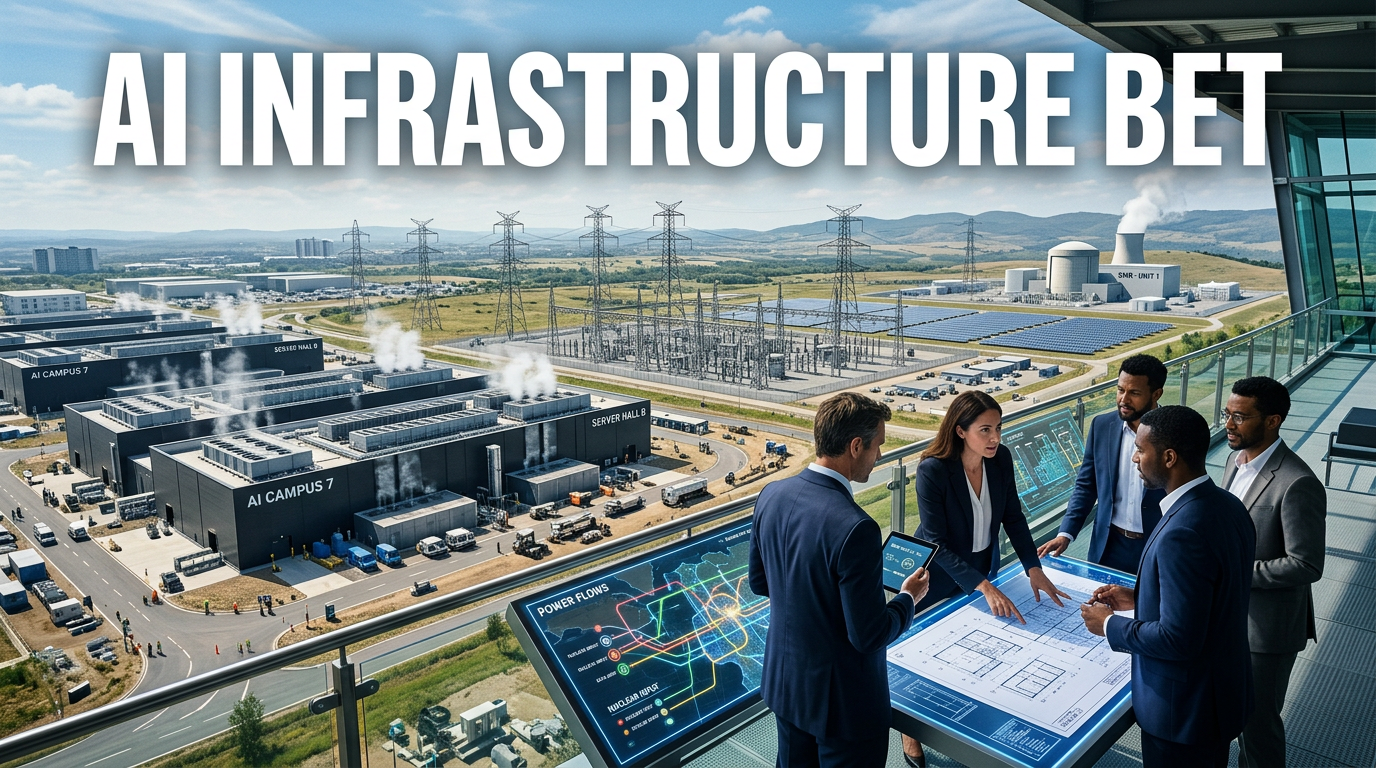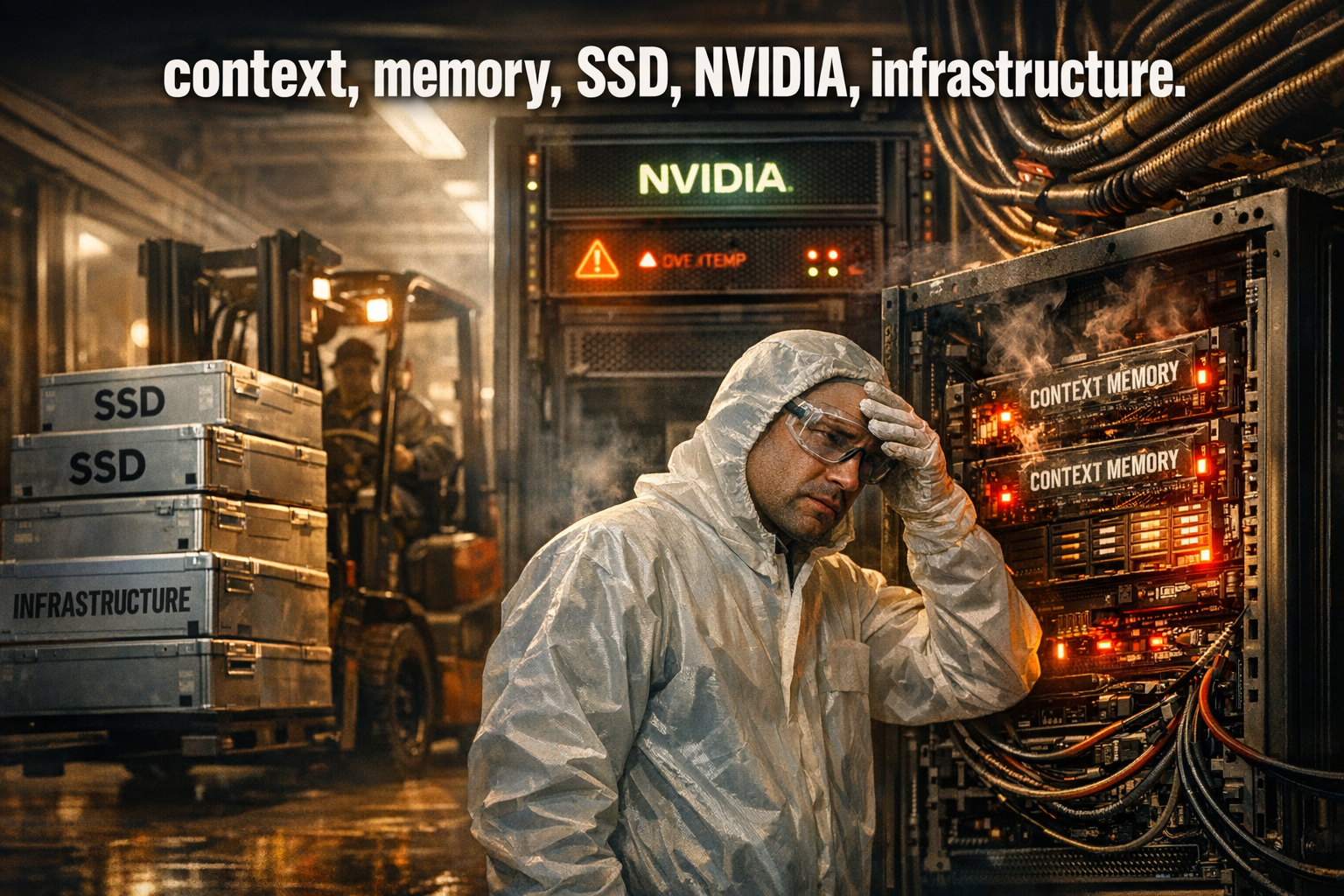
● Context Crunch – SSD Surge – AI Memory Bottleneck
Jensen Huang’s Key Message at CES: The AI Bottleneck Is Not GPUs but “Context (Memory)” (Making SSD/Storage a Core Component)
This report consolidates four points.
1) Why the market focused on storage (SSDs) following NVIDIA’s CES keynote
2) What “context is the bottleneck” implies for technology shifts (redefining the roles of KV cache, HBM, and SSDs)
3) The chain-reaction structure behind coordinated moves across SanDisk, Seagate, Western Digital, and Micron
4) Under-discussed implications: impacts on AI monetization models, data center design, and semiconductor cycles
1) News Brief: Why NVIDIA’s CES Keynote Made SSDs the Market’s Focal Point
Key headline
NVIDIA CEO Jensen Huang stated that “context is the new bottleneck, not compute,”
highlighting a shift in AI infrastructure from a GPU-centric framework to an expanded stack spanning GPUs, memory, and storage.
Market reaction (summary)
Storage/SSD value-chain names (including SanDisk, HDD vendors, and memory manufacturers) moved higher in tandem.
The market interpreted this as a narrative expansion from “AI = GPUs” to “AI = data movement and memory (memory/storage).”
2) Translating the Message for Investors: AI Has Entered a Phase Where “Memory” Drives Economics
Core message
“Compute is no longer the bottleneck; context (the amount of information that must be retained) is the bottleneck.”
What “context” means
To sustain multi-step conversations and tasks, AI systems must continuously retain prior dialogue, documents, plans, and intermediate outputs.
As the total retained state grows, it increasingly constrains performance and cost.
Why it is growing now
Agentic AI extends task length and statefulness.
Earlier chatbots often ended after a single “question-answer” exchange.
Agents execute longer sequences: “goal assignment → research → comparison → decision → execution (booking/sending/organizing).”
This workflow requires persistent state, history, and document summaries, driving rapid context expansion.
3) Technology Stack: KV Cache, HBM, and Why SSDs Are Pulled Into the Critical Path
KV cache (Key/Value cache) = the model’s working memory
LLMs rely on fast access to prior tokens and intermediate states to continue generation.
KV cache is a primary mechanism for retaining those intermediate representations.
Constraint: KV cache benefits from speed, but capacity is limited
The fastest tier is GPU memory (e.g., HBM), but capacity is finite.
As context length increases, HBM alone becomes insufficient,
leading to more frequent eviction and recomputation, GPU underutilization, and latency variability.
Response: redesigning the memory hierarchy
KV cache and intermediate state that cannot fit in HBM are increasingly extended to higher-capacity, high-performance SSD tiers.
This positions storage not only as a persistence layer but as a performance-enabling component.
Summary
HBM = ultra-low latency, high bandwidth, high cost, limited capacity.
SSD = higher latency but far larger capacity, with rapidly improving performance.
Scaling “accumulated memory” increasingly requires coordinated use of both tiers.
4) Why SanDisk Emerged as a Key Beneficiary: The Pure-Play SSD Exposure
Why SanDisk was highlighted (investment framing)
When SSDs become the theme, companies with higher SSD revenue exposure exhibit higher thematic sensitivity.
Relative to diversified peers, pure-play storage exposure can translate more directly into price reaction.
Why related names moved together
HDD vendors (e.g., Seagate, Western Digital) also rose as the market priced in a broader structural increase in data center storage demand.
Why memory manufacturers (e.g., Micron) were included
The message also implies that memory and storage are the primary constraints in AI infrastructure, supporting expectations for DRAM/HBM/NAND demand.
5) Under-Discussed Point ①: If Inference Cost Structure Shifts, Data Center CapEx Rebalances Toward Storage
Many commentaries stop at “SSD demand will increase.” The larger change is the cost structure.
Prior structure
AI investment = GPU-led CapEx (GPU cost dominated server economics)
Emerging structure
AI investment = balanced design across GPUs + networking + memory + storage
As context length grows, storage shifts from a passive capacity layer to an active driver of performance and latency.
Implications
Cloud and data center operators must optimize storage tiers (SSDs), data pipelines, and rack-level architectures, not only GPU count.
This can reshape line-item CapEx allocation over time and broaden the universe of AI infrastructure beneficiaries.
6) Under-Discussed Point ②: The “Financialization of Context” Begins (Long-Term Memory AI Increases Lock-In)
Longer context changes the user experience into systems that can retain historical interactions over extended periods.
Industry and investment relevance
As long-term memory becomes reliable, AI shifts from a tool to a persistent collaborator.
This increases the feasibility of subscription-driven recurring revenue and strengthens data-driven customer lock-in.
Storage is not only component demand
It becomes foundational infrastructure that can increase service LTV (customer lifetime value).
7) Under-Discussed Point ③: Storage Re-Ents a Speed Race (Beyond NAND: Interfaces and Architecture)
Rising SSD demand is necessary but insufficient; the key question is which SSD characteristics are required.
SSD requirements for AI workloads
Beyond raw capacity, priorities shift toward low latency, high IOPS, parallelism, and stable QoS.
Key watch items include not only NAND price cycles, but also data-center SSD product mix, controller/firmware differentiation, and tighter integration with server platforms.
8) Investor Checklist: Quantitative Indicators to Validate the “SSD Theme”
1) Data center SSD exposure (enterprise/hyperscaler revenue mix)
Data center exposure has higher linkage to AI demand than consumer/PC SSDs.
2) Positioning within NAND/DRAM cycles
This is not solely a short-term catalyst; it may reflect a change in demand composition within the broader semiconductor cycle.
3) AI infrastructure spending trends (cloud CapEx)
Track whether hyperscalers expand investment not only in GPUs but also in storage and networking.
4) Valuation and theme overheating risk
Theme-driven rallies can front-run fundamentals; validate whether shipment volumes, ASPs, and margins follow.
5) Macro variables
Rates and the USD can affect growth-equity multiples; theme volatility may increase accordingly.
Inflation dynamics and central bank communication remain relevant risk variables.
9) One-Page Summary: How the CES Message Redrew the AI Infrastructure Map
Before
AI performance = more GPUs, faster GPUs
After
AI performance = balanced optimization across GPUs + memory (HBM/DRAM) + storage (SSDs) + networking
Conclusion
In the agentic AI era, “memory (context)” becomes as economically important as “compute.”
This reframing elevated SSDs/storage as a primary focus following CES.
< Summary >
At CES, Jensen Huang emphasized that the new AI bottleneck is context (memory), not compute.
As context length increases, KV cache and intermediate states exceed what HBM alone can economically support, elevating SSDs into the memory hierarchy.
This message drove attention to SSD pure-plays such as SanDisk and, more broadly, to the storage and memory value chain.
The key implication extends beyond incremental SSD demand: it can alter data center investment allocation and intensify competition around long-term memory and customer lock-in in AI services.
[Related Posts…]
Post-CES: Semiconductor and AI Infrastructure Investment Takeaways
Why SSDs Address the AI Bottleneck: Data Center Storage Trends
*Source: [ 내일은 투자왕 – 김단테 ]
– CES에서 젠슨황이 콕 찝어준 투자 정답지?
● Nvidia Rubin Mass-Production Ignites CapEx Shock, Power Bottleneck, Taiwan Risk
NVIDIA Enters Mass Production of “Rubin,” Oral Wegovy Launches in the U.S., Truist Sets Palantir Target at $223: The Market’s “Next Chapter” in Focus
This report consolidates three core developments.
First, NVIDIA’s formal move into “Rubin” mass production and the key investor variables it introduces (Blackwell capex, depreciation risk, and power-grid constraints).
Second, Novo Nordisk’s U.S. launch of oral Wegovy, how it reshapes the obesity-drug competitive landscape, and why it is increasingly traded in tandem with Eli Lilly.
Third, Truist’s “Buy” initiation on Palantir with a $223 price target, reframed through cash flow, public/private expansion, and platform dynamics rather than a generic “AI theme.”
A separate section summarizes under-covered points: a 5-year average power interconnection queue and accelerated product cycles creating “stranded GPU asset” risk, and the impact of Taiwan/TSMC risk on the AI value chain.
1) U.S. Equities: News-Driven Check
Index performance
Nasdaq (+0.4% range), S&P 500 (+0.3% to +0.4% range), and Dow (+0.3% range) advanced in tandem.
Semiconductors strengthened intraday, expanding gains versus the early session.
Sector and single-name highlights
Micron surged (6% to 7% range). Semiconductor equipment names such as Lam Research advanced. Uber traded higher. Growth/technology led.
NVIDIA rose in the 1% range on Rubin-related news.
Tesla declined in the 3% range.
This week’s macro calendar (highest sensitivity first)
The key question is whether December labor data shifts expectations for January policy.
Services PMI (final) → ADP private payrolls → ISM services → initial jobless claims → Friday payroll report.
With a high probability of policy hold already priced in, upside labor surprises could increase volatility.
2) NVIDIA: What “Rubin Mass Production” Signals (Upside and Downside Scenarios)
Core headline
NVIDIA stated at CES 2026 that it has begun mass production of its next-generation AI chip, Rubin.
Key points referenced: TSMC 3nm process, potential first adoption of HBM4, inference performance up to 5x vs. Blackwell, training up to 3.5x.
(1) Near-term positive: signals the AI semiconductor cycle may be extending
Markets remain sensitive to whether AI infrastructure capex is decelerating or being sustained.
Rubin mass-production messaging supports expectations that next-generation demand can be pulled forward, contributing to risk-on sentiment across semiconductors.
(2) Key investor risk: Blackwell depreciation and payback uncertainty
Hyperscalers are deploying Blackwell at scale. If “next-generation mass production” arrives rapidly, CFO-level capital planning becomes more complex.
AI data-center investments have long lead times from installation to monetization; a major step-up in performance can compress the economic life of existing systems.
(3) Power constraints can amplify Rubin-related downside
The binding constraint is increasingly electricity, permitting, and grid interconnection—not GPUs.
With average power interconnection queues cited at approximately 5 years and certain regions pausing data-center permitting, hardware can arrive before usable capacity exists.
In that scenario, GPUs can sit idle while product cycles advance, increasing “warehouse obsolescence” and re-igniting concerns about AI capex overshoot.
(4) NVIDIA expands into physical AI (robotics/autonomy), increasing competitive pressure on autonomy narratives
Rubin positioning extended beyond data centers to humanoid robotics and autonomous driving, including foundation-model approaches and robotics platforms.
This broadens the ecosystem through which future compute demand may scale, increasing competitive overlap with autonomy-centric equity narratives.
Investor checklist
① Hyperscaler capex guidance (earnings-call language on order stability vs. adjustment)
② Data-center power contracting and permitting progress (grid buildout, generation additions, PPAs)
③ TSMC 3nm and advanced packaging (CoWoS) capacity and the pace of U.S. manufacturing expansion
3) Novo Nordisk: U.S. Launch of Oral Wegovy and the Obesity-Drug Competitive Shift
Event
Novo Nordisk launched oral (pill) Wegovy in the United States.
Why markets view this as material
In a category historically dominated by injectables, convenience can expand the addressable market and increase new patient adoption.
Coverage and employer-plan decision frameworks may evolve, and improved adherence may support persistence.
Why Eli Lilly remains linked
The category is increasingly traded as a growing market rather than a single-winner dynamic.
Positive category developments can support multiple leaders, reinforcing “obesity therapeutics” as a consolidated mega-theme.
Investor checkpoints
① Coverage and reimbursement expansion velocity
② Supply stability (API availability and manufacturing capacity)
③ Safety headlines and label-update risk
④ Competitor pipelines (next-generation oral agents and combination therapies) and key clinical readouts
4) Palantir: Truist “Buy” and a $223 Price Target
Headline
Truist initiated coverage on Palantir with a Buy rating and a $223 price target.
Why Palantir now (beyond a generic “AI” label)
The core equity case combines government/defense reference strength with private-sector expansion and platform-like productization.
Multiple support depends on contract durability, positioning as a data operating layer, and sustained progress in cash flow and profitability.
Market interpretation
The price target reflects a reframing rather than a single catalyst.
Compared with hardware, software has fewer visible supply bottlenecks, but ROI validation is faster through budgeted adoption and renewals.
If hardware capex debates intensify, software franchises with government exposure may be viewed as relatively defensive growth within the broader AI complex.
5) Why Oil Has Not Spiked on Geopolitical News: Structural Change in the Oil Market
Key point
Geopolitical headlines have generated more limited price reactions than in prior cycles.
Drivers
OPEC’s marginal influence is weaker, while U.S. shale-driven supply elasticity has increased, reinforcing the U.S. as a de facto net-exporting system.
U.S. output has been referenced at record levels, supporting a “buffer” narrative against episodic shocks.
Macro linkage
Muted oil spikes can reduce near-term inflation pressure, indirectly affecting policy expectations.
Markets continue to price the chain: oil → inflation → rates → USD, with spillovers into USDKRW and international investor realized returns.
6) Geopolitical Risk: Taiwan as a Direct AI Value-Chain Risk
Observed signals
Prediction-market pricing has reflected renewed attention to Taiwan-related escalation scenarios through 2026, alongside political signaling that reinforces the narrative.
Investment relevance
Taiwan risk is no longer separable from earnings risk.
Disruption to TSMC would directly impair NVIDIA and broader AI semiconductor supply, including leading-edge nodes and roadmap continuity.
Geopolitical risk increasingly maps to technology delivery risk.
7) Wealth-Gap Data: Labor Income Lags Asset Prices
Key data point
Since 2008, the Dow has risen multiple-fold, while hourly wage growth has lagged materially; the labor hours required to purchase one unit of the Dow has increased by more than 4x.
Implication
When productivity and returns to capital outpace wage growth for extended periods, asset ownership becomes a primary driver of perceived economic divergence.
This dynamic supports structural participation via retirement systems and the continued expansion of ETFs and retail-investor market access.
8) U.S. Minimum Wage Dispersion by State and City and Its Inflation Transmission
Federal vs. state/local floors
Even with a low federal floor, large cities can operate at materially higher wage levels.
This contributes to localized price dispersion for identical services and retailers and can lift services inflation.
Why investors monitor it
Wages form the floor for services inflation.
Pass-through mechanisms include tipping norms, dining prices, and rent-linked cost transfer, reinforcing the persistence of “sticky” services inflation.
9) Under-Covered Critical Points (Separate Summary)
Point A. The core risk of “Rubin mass production” is the capital timetable, not the benchmark
AI data-center buildouts are constrained more by power, facilities, and operations than by GPU procurement.
If GPU generation cycles accelerate, systems can age before full utilization, increasing the probability of delayed—not canceled—capex execution with market impact.
Point B. Grid constraints may appear as revenue recognition delays rather than demand destruction
Demand is often tracked via orders; increasingly, the binding metric is energized racks in operation.
This creates scenarios where demand persists but monetization timing shifts.
Point C. Taiwan risk can become a persistent valuation discount across the AI complex
Given TSMC’s centrality, elevated tension alone can pressure multiples structurally.
This is a cross-market volatility factor, not a single-name issue.
10) Investment Framework
Current market state in one sentence
AI growth expectations remain intact, while rate sensitivity, power constraints, and geopolitical risk increase the probability of pacing and timing adjustments.
Key monitoring structure
① This week’s labor data → rate repricing risk and higher growth-stock volatility
② NVIDIA product cycle → semiconductor momentum vs. capex deferral debate
③ Obesity therapeutics → cash-flow-oriented growth re-rating within healthcare
④ USD direction and USDKRW implications → direct impact on cross-border realized returns
⑤ Macro cross-currents (oil shock dampening, higher geopolitical risk) → inflation-path recalibration
< Summary >
NVIDIA’s Rubin mass-production messaging supports AI semiconductor momentum but increases downside scenarios tied to Blackwell depreciation, capex deferrals, and power constraints.
Novo Nordisk’s U.S. launch of oral Wegovy may expand the obesity-drug market and can support category-wide trading linkages, including with Eli Lilly.
Palantir’s $223 target reflects reframing toward platformization, cash flow, and public-to-private expansion rather than a pure thematic AI multiple.
Oil’s muted response reflects structural supply elasticity, while Taiwan risk increasingly functions as a direct, persistent volatility and valuation factor for the AI value chain.
[Related links…]
USD trends and USDKRW outlook: key checkpoints for global capital flows in 2026
*Source: [ Maeil Business Newspaper ]
– 엔비디아, 신형 AI칩 ‘루빈’ 양산 돌입ㅣ노보노, 미국에서 경구용 위고비 출시ㅣ트루이스트, 팔란티어 ‘매수’&목표가 223달러ㅣ홍키자의 매일뉴욕