● China Storms CES, Korea Fights Back, Japan Pivots to Subscriptions
CES 2026 Smart Home Tour Key Takeaways: “China’s Scale and Pricing” vs “Korea’s Empathy and Platform” vs “Japan’s Content Shift”
This article includes the following:
1) How TCL and Hisense ‘occupied with scale’ in the space vacated by Samsung (LVCC).
2) How far LG’s ‘Affectionate Intelligence’ has become a reality with robots and platforms (ThinQ 3C).
3) How Bosch is transforming from a “hardware company → software/agentic AI company” (significance of reducing manufacturing efficiency by 70%).
4) The reason Sony and Honda’s ‘AFEELA’ are focusing on ‘selling time after autonomous driving’ with a subscription model rather than specs.
5) The realistic direction showcased by Roborock and Ceragem’s ‘Robotics/Wellness capturing the market beyond humanoids’.
1) First noticeable change in the exhibition: “Relocation of Chinese companies” is not just an event
Core Point
– TCL fills the ‘vacant space’ of Samsung in the main exhibition hall (LVCC).
– Hisense took over TCL’s existing location and expanded the exhibition scale simultaneously.
– Hisense CEO’s comment: “We no longer follow trends. We create trends.”
Interpretation (Why it’s Important)
– This is not just the enlargement of a booth but a sign that China is occupying global distribution, buyer, and media traffic.
– Companies rising to the ‘center’ of the exhibition are likely to propose the standards (function, price, design) from the following year.
Points to Consider from an Economic Perspective
– As the global supply chain undergoes reorganization, “mass production + low cost + rapid copy + quick commercialization” becomes stronger.
– If they capture the “affordable standard” using price as a weapon, even premium brands will find it hard to protect their margins.
2) LG Electronics: ‘Affectionate Intelligence’ materializes not just in words but in “robots + platforms + accessibility details”
2-1. Fixing AI’s Direction as “Affectionate”
– Last year’s declaration (empathetic AI) was concretized this year as “immersing into the context of the home.”
– Moving from zero labor (zero housework) to targeting genuine labor gaps like ‘moving laundry from washer to dryer’.
2-2. Significance of ‘Auntie Robot’: Not a Humanoid Show but a ‘Commercially Available Robot’
– Presented scenarios that perform real tasks like taking out laundry, moving it, and organizing it.
– The key from the professor’s comment: “Design shows intent to lower price by not excessively using expensive components.”
– Conclusion: Household robots are more likely to open the market as ‘practical types that perform specific tasks’ rather than ‘completely human-like’.
2-3. Gaming Room/Sound: Strategy to Sell ‘Community+Software’ rather than Products
– The explanation that made the space together with the gamer community is crucial.
– Xboom speakers are evolving from “device sales” to “experience+community+SW packages.”
– Flow aiming to provide personalized experiences by classifying preferences like AI personas DJ.
2-4. Accessibility Details: This is where Truly ‘Warm’ AI Distinguishes Itself
– Refrigerator doors that open with a gentle touch.
– Rotating structure to easily fetch deep-seated ingredients.
– Designed for wheelchair users to hang and remove clothes in the styler.
– Detergent insertion/removal structure considering strength issues of the elderly.
2-5. Turning Point of ThinQ (3C)
– Control: Remote control/monitoring.
– Care: Monitor conditions and detect anomalies earlier with AI logic.
– Up (ThinQ Up): Function upgrades even after purchase based on customer feedback.
Economically/Industrially Important Point
– As hardware margin competition intensifies, platform-based “update/maintenance/care” becomes the core of recurring revenue.
– This 3C structure serves as a stepping stone for smart homes to move from ‘device display’ to ‘subscription economy.’
2-6. B2B Points: LG is transitioning from ‘appliance company’ to ‘vehicle components/display/AI convergence company’
– Entire windshield display + expansion to side/rear seats.
– Realizing “contextual services” like landscape sharing and sign-language-voice translation with AI.
– Part that one can feel the increasing B2B proportion trend at the venue.
3) Bosch: The Scariest Aspect at CES is the “Manufacturing Industry Executing AI Transformation”
Core Point
– Bosch declared, “We are transforming from a hardware company to a software company.”
– Transitioning manufacturing to agentic AI with Microsoft.
– Mentioned examples of cost reduction by 70% through factory efficiency.
Why It’s Important (Key Point to Highlight in the Blog)
– The essence of appliances/automobiles/robots competition ultimately lies in productivity.
– 70% cost reduction creates both “product price competitiveness” and “R&D reinvestment capability,” giving the power to dominate the market long-term.
– If this trend grows, the competition will split based on ‘manufacturing AI operational capability’ rather than the brand.
Example of Lifestyle-focused AI (Steak Cooking)
– Not only giant LLMs but also reducing ‘mistakes (burns)’ with context recognition and auto control creates consumer value.
– Investment in reskilling (re-education) all employees is crucial.
4) Hisense vs TCL: The Next Phase After “Copying Speed” is “Contextual AI Experience”
4-1. Hisense: Warning Sign from the Feeling of “Seeming Like a Samsung Hall”
– Quickly absorbing familiar UX such as refrigerator display, recipes, door knock, styler, etc.
– Still evaluated as “rapidly following trends” rather than “creating trends.”
– However, the real threat is the combination of ‘speed + low-cost supply.’
4-2. TCL: Escalating to the Next Level with Scale Expansion + More Sophisticated ‘Contextual Space Experience’
– Attempt to design “situation-based experiences” rather than just listing functions, like sensing circumstances (sitting before, cooking start) by spaces such as “living room/kitchen” to link lighting/climate/device.
Investment/Market Perspective
– When Chinese companies capture the ‘affordable standard,’ premium companies must strongly differentiate in “empathy/care/service/trust.”
– Failure to do so will crush margins as even premiums face price pressure.
5) Sony·Honda ‘AFEELA’: Selling a Platform of “Time After Autonomous Driving” Instead of Specs
Core Point
– AFEELA presence grew bigger in place of Sony once being in the main CES flow.
– Focused more on “what will be done inside the car (content/games/entertainment)” rather than specs.
– Offers content experience with a 3-year subscription at vehicle purchase.
Why It’s Important
– Redefining the ‘car = digital space,’ not just as a ‘machine.’
– Even if Korean companies are good at in-vehicle hardware/displays, falling behind in content/service management might lose the top end of the value chain (subscription revenue).
6) Roborock: The Real Game in “Home Robotics” Opens Without Humanoids
Last Year’s Point
– Strategy to reduce ‘pre-processing labor’ by using a robot vacuum’s arm to clean slippers/toys/trash.
This Year’s Point (Most Impactful)
– Concept of a robot vacuum with ‘legs’ to climb stairs presented.
– Approach to solving the issue of having to lift it manually from the first floor to the second floor in two-story homes.
Core Interpretation
– Robotics focused on solving specific problems (stairs/pre-processing) will become mainstream before expensive general-purpose humanoids.
– Korean appliances need a strategy to rapidly commercialize “robot modules that fill lifestyle gaps” rather than competing with “fancy humanoids.”
7) Ceragem: Going Beyond an ‘Massage Chair Company’ with a “AI Wellness Home Platform”
Core Point
– Won 12 Innovation Awards.
– Situated its booth in the Digital Health Zone to emphasize medical device certification/healthcare identity.
– Designed the entire home as a health experience with “7 care areas (mental/beauty/sleep, etc.).”
Data Flow is Core
– Measures stress/bio states → Transfers to IoT devices → Tailored massage/shower/bed settings.
– Structure moving from device sales to “personal data-based customized service.”
Personal Styler (Refresh Booth) Idea
– Custom combination of sauna, oxygen, sound/video therapy, aroma tailored individually.
– AI provides immersive recovery by generating ‘environment experiences’ like forests/space/desert based on today’s condition.
Brain Learning Space (Brain + AI Coach)
– Measures brain wave (internal/external) through a band → Sets optimal environment for kids in real-time.
– Expands to learning assistance, career/psychological counseling.
Industrially Important Point
– When ‘appliances’ transition to healthcare, the critical factors are sensor/data/regulatory response (certification) + subscription service models.
8) “The Really Important Line Often Missed by Other News/YouTube” Summarized Separately
1) ‘Booth relocation’ at CES is not about showing off a brand, but a signal of who will propose global standards.
2) The threat from China is not technological prowess but ‘speed + low-cost supply,’ which changes consumer choices even in an inflationary environment.
3) Winners are not those owning ‘giant LLMs’ but companies that understand customer context to commercialize “just the AI needed” at a matched price.
4) Bosch’s 70% cost-saving manufacturing AI is likely to make the appliance/robot price war even more brutal.
5) The essence of a smart home is not device connectivity but an “updateable platform” like Control-Care-Up with a recurring revenue structure.
6) Problem-solving robotics like ‘legged vacuum cleaners’ capture the market faster than humanoids.
7) Automobiles have now moved from being a hardware industry to a digital space industry that layers content subscription.
< Summary >
CES 2026 was a stage where China (TCL·Hisense) aimed for ‘affordable standard’ by occupying the exhibition center with scale and price.
LG is moving to platform-based competition, concretizing affectionate intelligence with robots and ThinQ (3C: Control-Care-Up).
Bosch stood on the side of significantly increasing the price war scale by drastically reducing manufacturing costs with agentic AI.
Sony·Honda AFEELA fills the time after autonomous driving with content, strengthening the subscription model.
Roborock·Ceragem showed that practical robotics and AI wellness platforms can change the market more realistically than humanoids.
[Related Articles…]
- Who Will Win the Smart Home Platform Competition by 2026?
- How Agentic AI is Revolutionizing Manufacturing Productivity
*Source: [ 티타임즈TV ]
– [CES2026] LG전자, 보쉬, 하이센스, TCL, 소니, 로보락, 세라젬 부스 투어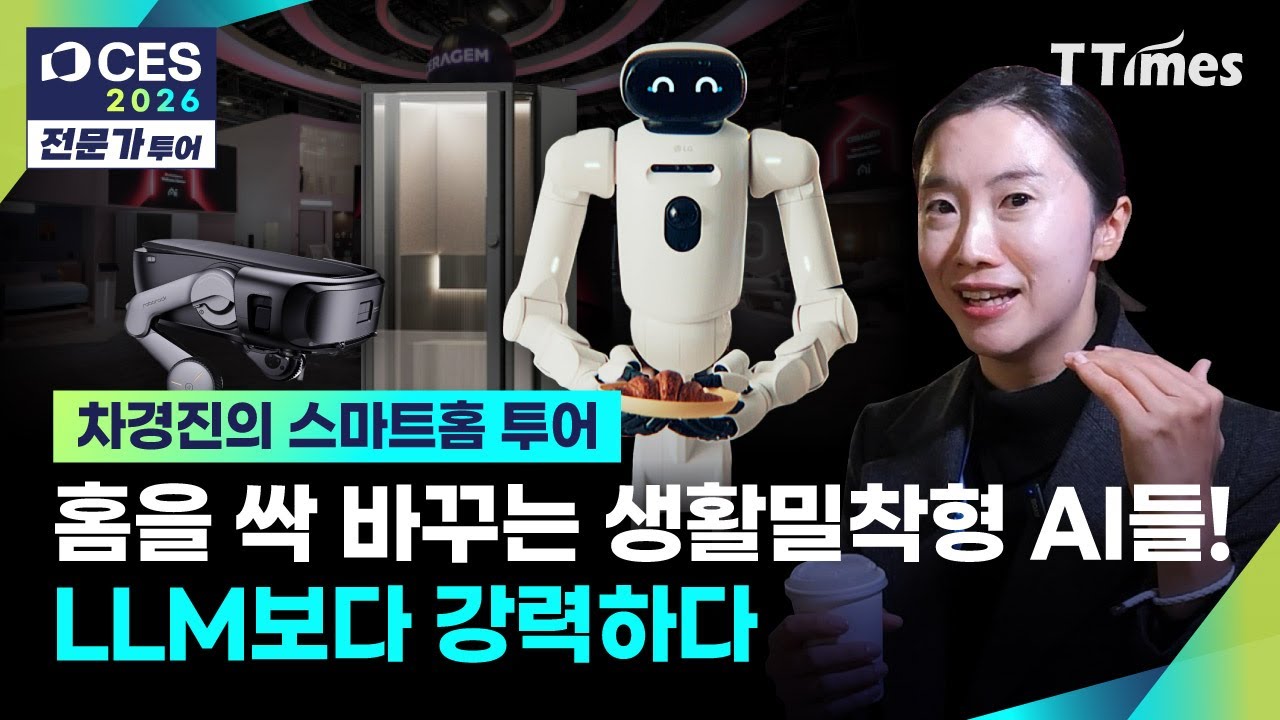
● CES 2026 AI Smart Glasses Go Mainstream, Cheap Light Monochrome Wearables Shake Up Big XR
CES 2026 Smart Glasses “Everyday AI Glasses” Enter Full Commercialization Stage (Translation·Guidance·Presentation Subtitles·Teleprompter)
In this article, we’ll cover the “AI Glasses (Smart Glass)” trends showcased at CES2026. We’ll break it down not as a mere product introduction, but through these four key points:
① Why suddenly ‘affordable, ultra-light, monochrome displays’ became the trend
② How Chinese companies dominate this market through ‘manufacturing+AI+distribution’
③ The ‘killer use case’ people are willing to pay for, even without color AR
④ The gap Korean companies can fill if they enter this market now (a truly important point)
We’ll summarize these points like a news article.
1) One-Line News: The Star of CES2026 is ‘AI Worn Like Glasses’ Rather Than ‘Large, Heavy XR’
At CES2026, ultra-lightweight smart glasses worn like everyday glasses captured more visitor attention than “immersive XR devices (AR/VR).”
The core point is this:
The market is shifting from selling immersion (big screens) to a method of continuously wearing and ‘embedding information’ in daily life.
This trend is significant because when wearables shift from “hobby devices” to “productivity devices,” it opens up corporate application (B2B) and subscription revenue models. This ultimately connects to macroeconomic trends like global supply chain restructuring, consumer recovery, and tech stock volatility.
2) Key Points for Companies: A Battle Not of ‘Functionality Competition’ But of ‘Wearability·Battery·Control Methods’
2-1) Rokid: Positioning as ‘Conversational Glasses’ with “Choice of AI” as a Weapon
Rokid presented its flagship glasses at $599, including various “everyday functions” like translation/script/camera/music.
An interesting point was the structure allowing users to choose different AIs for conversations, not fixed on one, showing options like ChatGPT, DeepSeek, Microsoft Copilot. Essentially, the glasses are moving toward being an AI Router (Selectable Agent) rather than just hardware.
However, there are clear drawbacks.
The monochrome display (green tone) may disappoint those expecting immersive AR. Instead, it was quite convincing for purpose-driven productivity like “meeting/speech teleprompters.”
2-2) Even Reality: All-In on “Battery+Design” While Foregoing Color
Even Reality made a strong impression in terms of wearability.
In videos, there were comments like ‘I thought it was the glasses they normally wore,’ indicating a strong focus on fashion item-level design.
Their most significant decision was this:
They firmly stated there’s no plan for color displays.
The reason is simple.
Color consumes too much battery → We prioritize “basic information provision”. They also emphasized the message that it “lasts two days.”
Another interesting aspect is the control method.
While Meta experiments with future-oriented inputs like neural bands (EMG), Even chose a ring for scroll/on-off as an “immediately familiar input.”
This has a high chance of spreading more quickly in the real market.
Ultimately, Even is betting on “productivity for use right away at work tomorrow” rather than an “AR future.”
2-3) Moji: Demonstrating China’s Truly Threatening Model with “B2B Supply Version”
Moji received two CES innovation awards and split its lineup into a display-less model (20g range) and a display model (30g range).
But more importantly is their business model.
Moji stated that they will not sell B2C at all.
Instead, they showed a B2B supply ODM/partner model connected to companies like Lenovo and Oppo.
This is important because,
Smart glasses are still in a period where there isn’t a “big consumer brand hit,”
and “many brands spread diversely.”
In this phase, B2B suppliers gain volume
and accumulate parts/production/quality data while jumping to the next generation.
This is a typical pattern of how China captures new hardware markets.
2-4) XREAL: Earning Money First with “Large Displays” and Then Expanding with Glasses
XREAL is somewhat different from other teams.
They still have a strong point in clear large screen display experiences.
The 3D demo had a clear sense of depth,
but the heat (thermal) was noticeable enough.
And an important point.
XREAL mentioned X1 and similar proprietary chips.
In other words, they are aiming for vertical integration controlling displays/optics/chips, rather than just being a simple glass brand.
This directly affects margins and ecosystem control in the long run.
Another feature was reality functions like “adjusting transparency.”
Darkening while watching movies, brightening when talking.
Accumulating such UI/UX brings them closer to “always wear.”
3) Summary of Function Trends: Standard Specs of CES2026 Smart Glasses
The functions repeatedly mentioned in the original article have virtually become standard.
- Real-time interpretation/translation subtitles: Dialog-style subtitles as default, like Chinese→English/Korean
- Guidance (Navigation HUD): Based on “one-line information” such as turn instructions, travel time, destination details
- Presentation/meeting teleprompter: Displaying scripts and erasing read parts are now introduced
- Music playback + spatial sound: Moving towards replacing earphones
- Camera (photo/video): Instant shooting system with a press function
- Input method experiments: Moving from only voice to less unnatural operations like ring/gesture
4) The Real Conclusion from This CES: “Monochrome + Long-Lasting + Naturalness” Sells Before “Color AR”
People often think of Smart Glasses = Fancy AR = Color Graphics.
However, what was verified at CES2026 is the exact opposite.
It doesn’t matter if it’s monochrome (green)
Instead, these three have become more important:
- Battery: The message of lasting “two days” instead of just one day becomes compelling
- Wearability: ‘Not standing out as glasses’ to ensure daily use
- Information density: Not a lot of graphics at once, but focusing on “the one line needed right now”
This trend fits with consumer psychology.
In a situation where high-interest rates aren’t entirely reversed,
people are more likely to open their wallets for small, definitively useful budget-friendly options rather than expensive “wow” devices.
5) The Most Important Content Not Often Mentioned on Other YouTube/News (My Core Point Summary)
This is where the real core point is.
The Smart Glasses war at CES2026 is not a battle of “hardware specs”
but a fight for dominance in ‘work data/conversation data/context data’ that arises the moment AI is attached.
5-1) Smart Glasses Are Not a ‘New Phone’ But a ‘New Input Device’
There are many expressions about replacing smartphones,
but realistically, they first establish themselves as auxiliary channels for input/output.
In other words, they hijack habits by layering on top of the phone before eliminating it.
In this stage, the competition is not the screen size but
how naturally they connect to “context-aware AI.”
5-2) “Monochrome Display” May Not Be Due to Technical Limitations But Consideration of ‘Regulation/Social Acceptance’
As you move toward color and large screens,
issues around recording privacy, visual interference, and over-immersion debates increase.
Conversely, monochrome + one-line information
face much less social resistance and are adopted faster in work environments.
5-3) The Scary Part of China Is Not ‘Brand’ But ‘Production Network’
If B2B supply types like the Moji case grow,
China will quickly dominate standard parts/standard form factors.
Later, “glasses that only need AI to be installed” will be spread in large numbers.
Once this structure is established, it becomes difficult for Korea, which is strong in individual hardware contests,
and instead has to counterattack with industrial software/security/work-specialized AI.
5-4) The Real Money Comes from ‘B2B Subscriptions’ Not ‘Hardware Sales’
Things like meeting subtitles, interpretations, onsite work instructions, education/manual displays
are ultimately areas that companies pay monthly subscriptions for.
Smart glasses are the terminals,
and the revenue comes from enterprise AI services (work automation).
This ties into the AI semiconductor/cloud competition,
and ultimately affects related companies’ performance and tech stock volatility.
6) How Korea Should Enter Now: Target 3 Gaps Instead of “Direct Hardware Competition”
- Industry-specific packages: “Subtitles + work instructions + inspection” sets for manufacturing/logistics/hospital/construction sites
- Security/privacy: Control camera/recording, process on-device, integrate with enterprise MDM
- Optimization for Korean/East Asian languages: Meeting subtitle accuracy, honoring terms/specialist vocabulary dictionaries, intonation adaptation
In summary,
Korea might be late for “making beautiful glasses,” but
there’s still a chance with “work functions companies pay for.”
< Summary >
CES2026 smart glasses focused more on “everyday AI glasses worn daily” than “immersive XR.”
Rokid centered on selectable AI and multiple functions, Even on design and battery while foregoing color, Moji on expanding B2B supply, and XREAL on large screen displays and proprietary chip-based strategies.
The market’s battleground is not color AR but ultra-lightweight, long-lasting, natural input and productivity use cases like “meeting subtitles/interpreting/teleprompters.”
The real key takeaway is not hardware but dominance over ‘context data + work subscriptions,’ with remaining gaps for Korea in industry-specific, security, and language optimization areas.
[Related Articles…]
Core Summary of Next-Gen Wearable Trends Seen at CES 2026
Smart Glass Market Outlook: The Sequence in Which AI Wearables Replace Smartphones
*Source: [ 티타임즈TV ]
– [CES2026] 실시간 통역, 길안내, 발표 자막…AI 안경이 일상에 온다