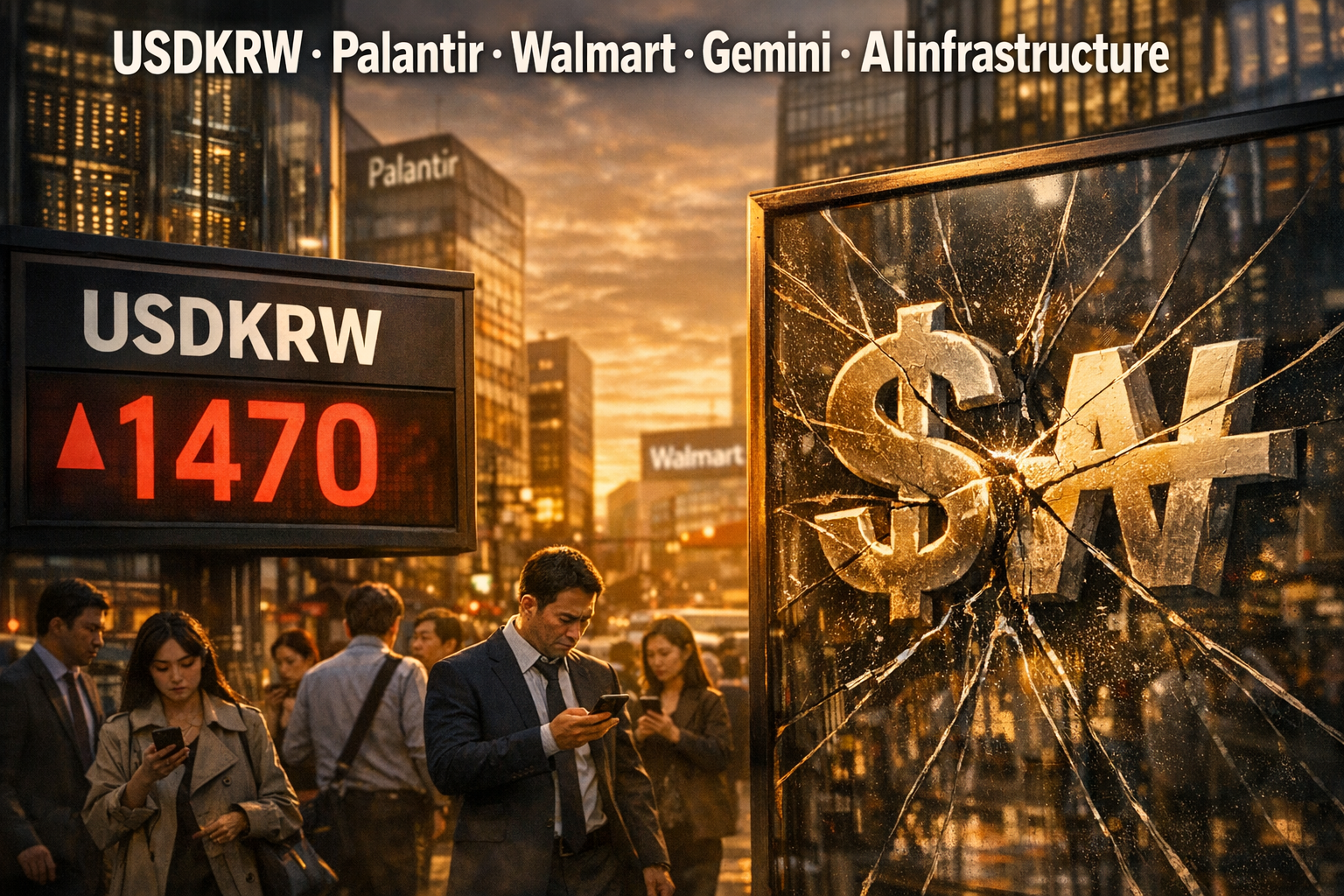
● Dollar-Won 1470 Shock, Palantir 235 Hype, Walmart Nasdaq-100 Jolt, Gemini Checkout Takeover
USD/KRW Retests 1,470; Palantir Target Raised to $235; Walmart Added to Nasdaq-100 — Key Market Signals Only
Today’s note covers three items:1) The structural drivers behind USD/KRW retesting 1,470, organized by rates, capital flows, and policy risk.
2) Why Palantir (PLTR) target upgrades to $235 reflect a broader re-rating of “defense + AI software,” not simple optimism.
3) How Walmart’s Nasdaq-100 inclusion and Google’s Gemini shopping features may re-accelerate US consumption and reshape valuation frameworks across Big Tech and retail.
A separate section highlights the most under-discussed points.
1) US equities/sector tone: “Indices slightly lower; messaging centered on policy (regulation)”
- Major indices (Nasdaq, S&P 500, Dow, Russell) opened weaker.
- Financials underperformed, driven by a specific catalyst.
Key catalyst: “10% cap on credit-card interest rates” rhetoric → renewed regulatory risk for financials
- Negative read-through for payments/consumer finance, including Visa and Mastercard.
- Could fit a midterm-election strategy emphasizing household affordability.
- Implication: even with solid earnings, financials may face an incremental “policy discount” in valuations.
Semiconductors: US-centric momentum remains intact
- Broadcom strengthened; Intel consolidated after a sharp run-up.
- Rising geopolitical risk (including Taiwan-related concerns) supports a “US manufacturing/US supply chain” premium.
2) This week’s macro calendar: December CPI as the rate-path trigger
Key events
- December CPI: direct implications for the pace and timing of rate cuts.
- Major bank earnings: JPMorgan, Citi, Wells Fargo, Bank of America, Morgan Stanley, Goldman Sachs, BlackRock.
- Fed Beige Book: on-the-ground read of demand, labor, and pricing.
Market’s primary question
- Labor data point to deceleration rather than a sharp drop.
- The next step is whether inflation materially cools or proves sticky.
- A stable CPI print can reopen the easing narrative and reprice rate-cut expectations.
Important linkage
- Lower inflation can shift rate expectations toward easing, potentially weakening the dollar.
- For Korea, that transmission may not hold mechanically (see FX section).
- If China-driven disinflation intensifies, the narrative may move toward “low growth + disinflation” rather than recession.
3) Market cap/capital flows: “Gold and silver resume signaling function”
- Commentary noted silver market cap exceeding Nvidia as a symbolic datapoint.
- Some forecasts suggest gold could outperform the S&P 500 over consecutive periods.
Why it matters
- Strength in gold/silver is less about a commodity cycle and more about hedging policy uncertainty and tail risks.
- Not sufficient to conclude stagflation, but consistent with renewed safe-haven preference.
4) China property → rising “zombie firms”: Japan-style stagnation warning, with near-term US offset
Reframed for markets:
(1) “Lost decade” risk: supporting non-viable firms can stall growth
- Extension/evergreening of loans allows weak projects to persist.
- Rising share of service-sector firms unable to cover interest expense.
(2) China may be more vulnerable than Japan was: lower per-capita income base
- Japan entered its downturn with stronger developed-economy savings/asset buffers.
- China remains exposed to a middle-income constraint.
(3) Why this can be tactically constructive for the US: “exported disinflation” from China
- Weak domestic demand pushes China toward higher utilization via exports.
- Price competition (EVs, steel, batteries, consumer goods) can depress global goods prices.
- This can indirectly temper US inflation, giving the Fed greater room to justify easing.
Key drawback: intensifying protectionism/tariffs
- US and Europe may raise trade barriers to protect domestic industries.
- Supply-chain reconfiguration (reshoring/friend-shoring) may accelerate.
US equities implication
- Less about “China risk breaks the entire US market,” more about dispersion:
- Caution on segments with high China exposure in consumer/tech.
- Relative support for US domestic manufacturing, defense, power/energy infrastructure, and AI infrastructure.
5) USD/KRW retests 1,470: a regime where KRW can weaken even if the USD softens
- USD/KRW rebounded from the 1,430s to retest the 1,460–1,470 range.
- Intraday price action indicates heavy two-way flows, with upside ultimately prevailing.
Why “USD weakness → KRW strength” may fail
- US–Korea rate differentials may not normalize quickly, sustaining USD preference in carry/allocations.
- If political risk around central-bank independence rises, the USD path can be volatile while risk-averse flows remain anchored in US assets.
- Korea’s FX is highly sensitive to external balances, energy terms, positioning, and foreign flows, allowing “non-textbook” outcomes.
Practical investor checklist
- Do not assume CPI downside automatically stabilizes USD/KRW.
- FX direction can diverge as “US drivers” and “Korea-specific flow/risk premium” interact.
6) Walmart added to Nasdaq-100 on 1/20 + Google Gemini shopping: “US consumption’s next level is one-screen checkout”
(1) What Walmart’s Nasdaq-100 inclusion signals
- The index remains tech-heavy, but “tech-enabled retail operations” are increasingly treated as platform assets.
- Walmart is being re-rated as a data + logistics + fintech-enabled ecosystem, not merely offline retail.
(2) Gemini-enabled shopping: search → recommendation → payment in one interface
- Natural-language prompts (e.g., “recommend a lightweight laptop under $1,000”) return structured options.
- Core feature: instant checkout without leaving the chat/search experience.
- Expanded image-based discovery: uploading a part image to find exact matches or substitutes.
(3) Why it can fit US consumption patterns
- US consumption behavior often optimizes for friction removal and time savings.
- AI shopping compresses search, comparison, and checkout, potentially accelerating adoption.
Investment implications
- Walmart’s inclusion is not only an index event; AI commerce interfaces can lift conversion economics at the platform level.
- This may re-route value capture across advertising/search (Google) and payments/logistics (retail platforms).
7) Palantir: the meaning of a Citi target raised to $235 (AI software with quasi-sovereign budget backing)
- With shares around ~$180, further target increases imply continued demand despite valuation debates.
Core framework for Palantir
- Not a standard enterprise SaaS narrative.
- The model originated in defense/intelligence/government deployments and expanded into commercial use (not the reverse).
- With heightened geopolitical risk, defense spending is structurally harder to cut; AI-driven automation can attract incremental budget allocation.
Bottom line
- Palantir is increasingly priced as both an “AI theme” and a “defense/national security budget” proxy, enabling idiosyncratic momentum versus the typical rate/growth cycle.
8) AI bottleneck shifts from chips to power (nuclear/SMRs/grid infrastructure becomes “AI infrastructure”)
- Recent messaging emphasizes that scaling AI requires firm baseload power, not only GPUs.
- Big Tech is competing for power access: nuclear restarts, colocated generation and data centers, SMR initiatives, and diversified power sourcing.
Why it matters
- Without power availability, incremental GPU capacity cannot be fully utilized.
- The competitive axis is shifting from semiconductor procurement to power procurement and grid access.
Most under-discussed points
1) Financial weakness is not primarily earnings-related; it reflects a change in the regulatory premium
- If credit-card rate caps become actionable policy, valuation frameworks for consumer finance can reset.
2) China’s property weakness is functioning less as “acute crisis” and more as a persistent disinflation engine
- Prolonged weakness supports low-priced exports that can suppress US CPI, while increasing protectionism is the key trade-off.
3) The essence of Gemini shopping is not “the end of search,” but control of the payment UX
- Recommendation is commoditizing; integrating checkout turns the interface into the operating layer of purchasing, affecting retail, ads, and fintech simultaneously.
4) USD/KRW cannot be explained by CPI alone
- The conventional “USD down = KRW up” relationship can break; investors must incorporate Korea-specific flows, rate differentials, and risk premia.
< Summary >
- US equities opened slightly lower; financials weakened on renewed regulatory risk tied to potential credit-card rate caps.
- December CPI is the key trigger for repricing the rate path.
- Gold and silver strength signals heightened hedging demand and policy uncertainty.
- China’s property/zombie-firm dynamics raise long-stagnation risk; China’s low-priced exports can suppress US goods inflation but may intensify protectionism.
- USD/KRW retested 1,470; KRW can weaken even if the USD softens due to rate differentials, flows, and risk premia.
- Walmart’s Nasdaq-100 inclusion and Gemini shopping highlight a shift from “recommendation” to “checkout UX control,” with implications for consumption and valuation.
- Palantir’s $235 target upgrades reflect a “defense + AI software” re-rating supported by durable budget dynamics.
- AI’s binding constraint is increasingly power availability; nuclear/SMRs/grid infrastructure are emerging as strategic AI enablers.
[Related Articles…]
- https://NextGenInsight.net?s=exchange%20rate
- https://NextGenInsight.net?s=palantir
*Source: [ Maeil Business Newspaper ]
– 원달러환율 1470원 다시 터치ㅣ시티, 팔란티어 매수&목표가 235달러 상향ㅣ월마트 1월 20일나스닥100 편입ㅣ홍키자의 매일뉴욕