
● Silent Hiring Apocalypse, AI Job Slaughter, Robot Takeover
The content I’m about to discuss isn’t just about the fear of “layoffs.”
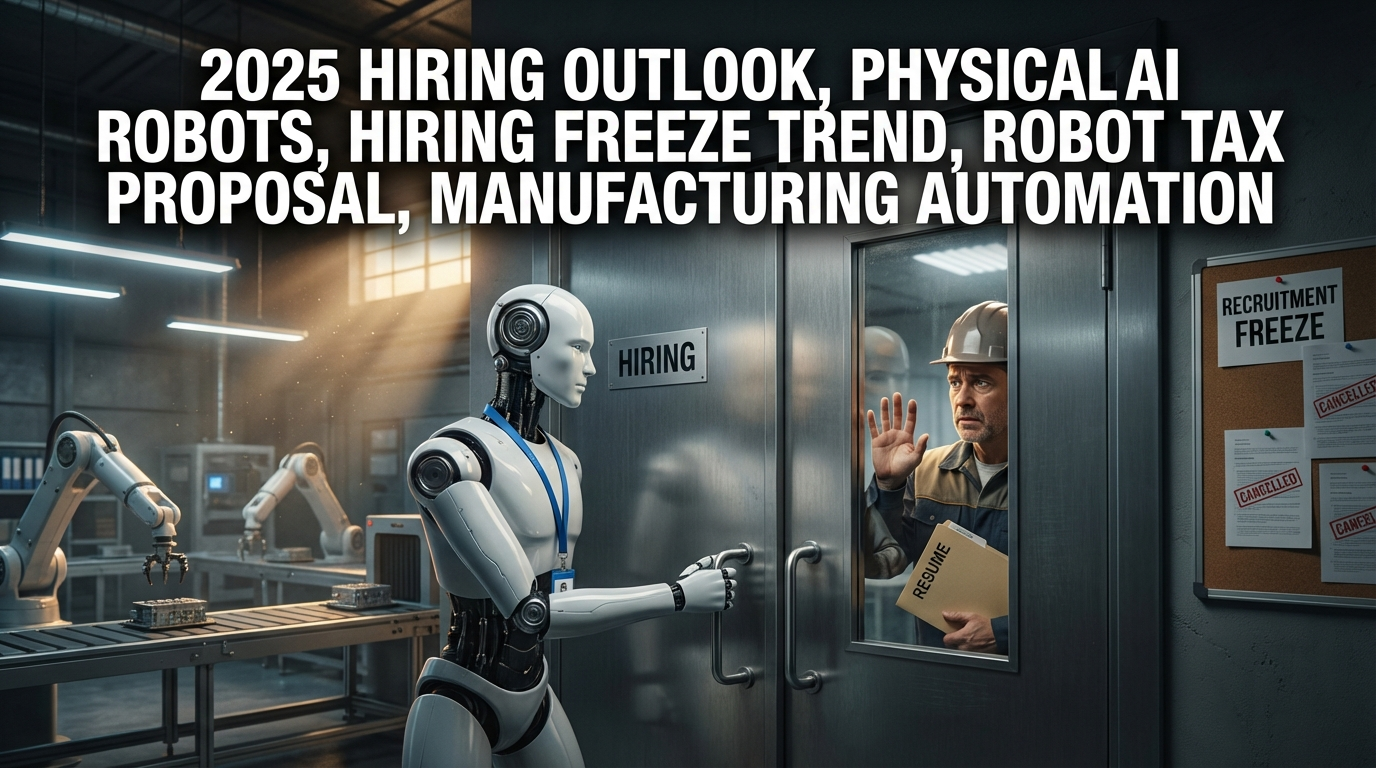
It covers everything from the phenomenon of the “hiring door” already closing, the counterattack of “Physical AI” threatening blue-collar workers beyond white-collar ones, to discussions on social safety nets like the “Robot Tax” that we must know to prepare for this.
If you read this article to the end, you will be able to clearly grasp the reality of the “quiet hiring end” that news outlets don’t cover, and future survival strategies.
So, let’s start the story that penetrates the core point of the 2025 economy and AI trends right now.
The Shock of the AI Era, the Beginning of a ‘Hiring Freeze’ Scarier than ‘Layoffs’
1. Structural Changes in Global Big Tech and the Labor Market
Looking at recent global economic outlooks, the most prominent feature is that companies are adopting a strategy of not hiring people at all, rather than letting them go.
The trend of reducing white-collar jobs is becoming distinct, centered around US Big Tech companies.
This can be seen as a structural change due to the introduction of AI technology, not just a simple recession.
Under the pretext of “management efficiency,” companies are firmly closing the hiring doors for jobs replaceable by AI.
They have chosen a strategy of “natural attrition” and “redeployment” to reduce the workforce size naturally while avoiding the costs and backlash associated with firing existing employees.
Ultimately, what we are witnessing now should be interpreted as the early stage of the “end of work” where entry itself becomes impossible, rather than a prelude to mass layoffs.
2. The Cold Wave in the Domestic Job Market: Even Developers Are No Exception
This AI job change trend is being applied just as strictly to the domestic market.
The standing of software developers, who were treated as “precious commodities” in the past, is even narrowing.
According to a recent report by the Korea Labor Institute, the proportion of new hiring notices for software developers plummeted from 53.5% in 2022 to 37.4% in 2024.
In just two years, nearly half of the doors for new hiring have closed.
This suggests that the demand for entry-level developers has decreased rapidly due to the development of AI coding tools.
The phenomenon where companies leave only experienced workers or a few talents who can utilize AI, while reducing new hiring itself, is highly likely to spread to all job groups in the future.
3. The Emergence of Physical AI: Crisis Spreading to the Blue-Collar Sector
If AI has threatened office jobs until now, Physical AI is now targeting manufacturing and service industry sites.
The keyword receiving the most attention at global tech expos like CES is definitely innovation in the robot industry.
A representative example is the humanoid robot ‘Atlas’ from Boston Dynamics, acquired by Hyundai Motor Company.
Hyundai plans to deploy these robots into actual factories starting in 2028.
If robots that mimic or surpass human physical abilities, going beyond simple repetitive tasks, are deployed to the field, manufacturing jobs considered the domain of blue-collar workers will also face fundamental changes.
This is the realization of “labor substitution” in the true sense that the 4th Industrial Revolution will bring.
4. The Necessity of Social Safety Nets: Discussions on Robot Tax and Basic Income
As the speed of technological development accelerates, discussions to mitigate the social shock caused by job reductions are also gaining momentum.
It is a question of how society will share the profits generated as AI and robots replace human jobs.
Experts advise that safety mechanisms in the form of introducing a “Robot Tax” or “Basic Income” are needed to reduce transitional confusion.
The logic is that companies should be taxed corresponding to the labor costs saved and productivity increased through AI and robots to support the retraining or livelihood stability of the unemployed.
This will become an essential economic policy trend not just for welfare, but to prevent the collapse of the economic ecosystem that would occur if human workers with purchasing power disappear.
[In-Depth Analysis] The ‘Silent Restructuring’ Not Mentioned in News and Our Response
Most news focuses only on the phenomena that ‘robots are coming’ or ‘hiring has decreased,’ but the core point I see is different.
The scariest part is that companies have chosen the quiet method of a “hiring freeze” instead of the noisy method of “layoffs.”
This can be a fatal kicking away of the ladder for those in their 20s and job seekers just about to enter society, rather than the generation in their 30s and 40s currently employed.
In other words, the polarization of the labor market will become extreme, and the gap between “those who wield AI” and “those replaced by AI” may reach a level that cannot be bridged by effort alone.
Therefore, we must now focus on cultivating “judgment” and “collaboration skills” that AI cannot replace, beyond simply learning job skills.
Also, as the future promising technologies of Physical AI and the robot industry grow, it is time to seriously consider a career pivot to new job groups that maintain/repair robots or train AI.
< Summary >
- Era of Hiring End: Companies are proceeding with ‘quiet reductions’ by stopping new hiring instead of layoffs, which is a structural change due to AI adoption, not a simple recession.
- Domestic and International Status: Entry barriers for white-collar jobs have risen, such as US Big Tech as well as domestic developer new hiring plummeting in two years (53.5% → 37.4%).
- Spread of Physical AI: Automation is rapidly spreading to blue-collar areas such as manufacturing due to the development of humanoid robots (Hyundai Motor Company scheduled to deploy robots in 2028).
- Social Alternatives: Discussions on building social safety nets such as introducing a robot tax and basic income have emerged as essential economic agendas in preparation for the disappearance of jobs.
- Key Suggestion: As entry barriers for new hires rise, preparation for a transition to new job duties related to the robot industry, along with AI utilization skills, is urgent.
[Related Articles…]
1. 2025 Hiring Market Outlook and the Future of Jobs
2. The Revolution in Manufacturing Changed by Hyundai Motor and Physical Robots
*Source: 뉴스토마토