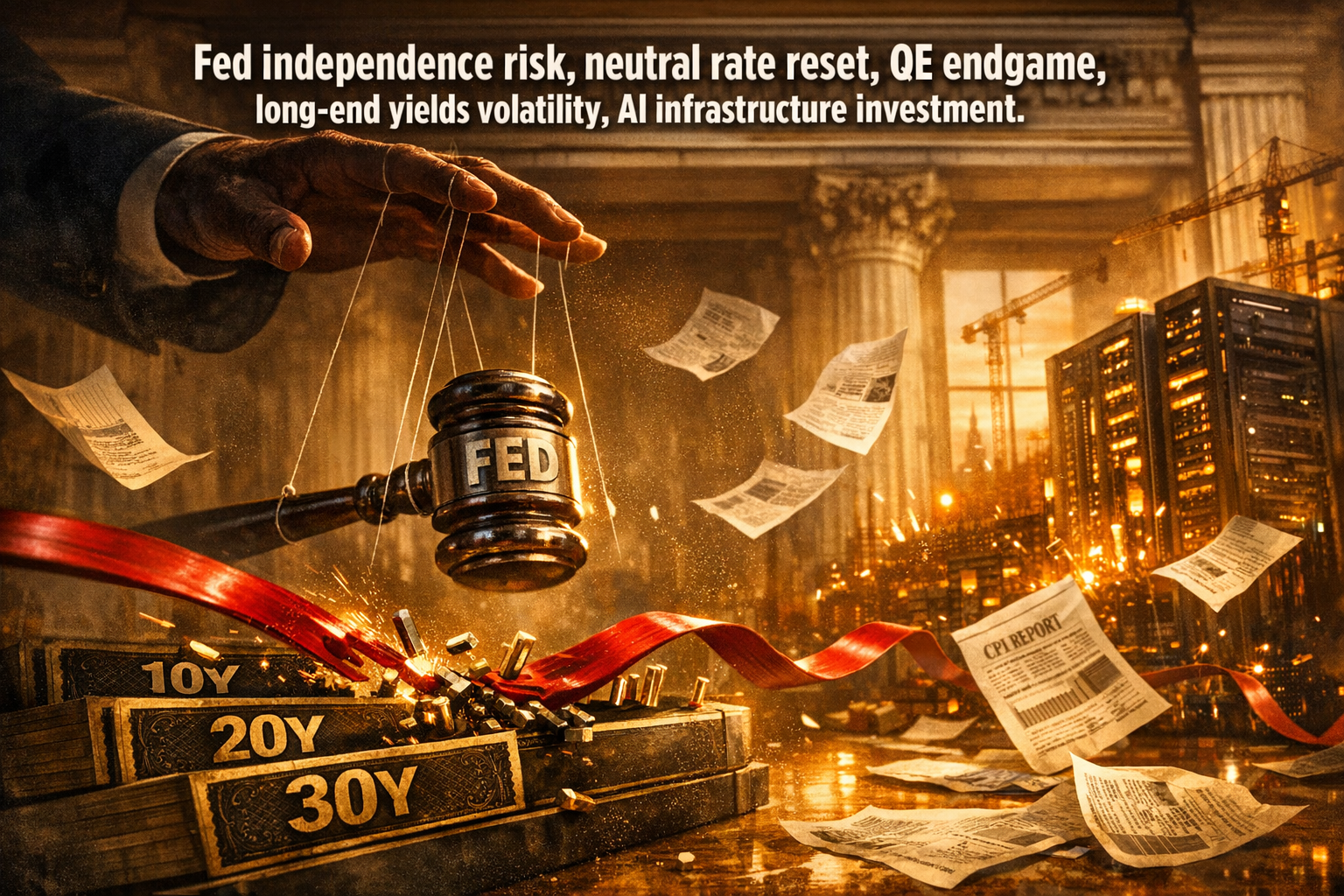
● CPI Relief Masked by Fed Independence Shock – Neutral Rate Reset, QE Endgame
US CPI at 2.7% Offers Relief, but Markets Are Focused on Different Variables: Beyond a January Rate Cut (Fed Independence, Neutral Rate, and QE Scenarios)
This report covers:1) Why the latest US CPI (headline 2.7%, core 2.6%) is being interpreted as supportive for risk assets.
2) Why a January FOMC rate cut remains difficult despite the CPI print.
3) The market’s primary focus beyond CPI: risks to Federal Reserve independence, a re-anchoring of the neutral rate, and a potential pathway toward QE—and how these factors connect.
4) A frequently missed dynamic: policy credibility erosion can weaken Treasury demand and push long-end yields higher.
1) Headline Summary (News-Style)
① CPI release
- Headline CPI: 2.7%
- Core CPI: 2.6%
- Core came in modestly below expectations (around 2.7%), reducing concerns of an upside inflation surprise.
② Immediate market reaction
- US Treasury yields (notably the 10-year) moved lower.
- Equities (Dow, S&P) saw a modest improvement in risk appetite.
- Market tone remained cautious; CPI alone was not viewed as decisive for trend direction.
③ January rate-cut probability
- CPI marginally improved expectations for easing, but conditions remain insufficient for an immediate January cut.
- Upcoming inflation data (including PCE), financial conditions, and policy credibility considerations are increasingly important.
2) Why CPI Is Viewed as Supportive: Composition Matters More Than the Headline
① Why core inflation matters more than headline
- Food and energy are volatile; central banks emphasize core measures to assess underlying trends.
- Core at 2.6% below expectations supports the view that disinflation is progressing.
② Core services inflation as the key focus
- Services inflation, particularly shelter, has been the most persistent component.
- A deceleration in shelter inflation (slower increases rather than outright declines) is interpreted as constructive.
③ “Goldilocks” setup: growth holds while inflation cools
- A combination of resilient growth and easing inflation typically supports risk assets.
- The CPI print is therefore framed as relief rather than a shock.
3) Why a January FOMC Cut Remains Unlikely
① Fed calculus: improved inflation does not require urgency
- Absent a sharp deterioration in labor markets, the Fed has limited incentive to rush “insurance” cuts.
- Policy credibility is a higher-priority constraint, making it difficult to pivot based on a single CPI release.
② Policy framing: policy rate vs. inflation
- With the policy rate above inflation (positive real rates), policy remains restrictive.
- While cuts could occur without immediately turning accommodative, the Fed remains cautious about reigniting inflation.
4) The Larger Variable Beyond CPI: Fed Independence Risk and the “Rate Paradox”
This section addresses the primary market driver: institutional and political risk increasingly outweighs single data prints.
① Political pressure scenario
- Intensified pressure on Chair Powell could raise concerns around erosion of Federal Reserve independence.
- The objective may extend beyond a single January cut, potentially aiming at broader regime change: neutral-rate reassessment → larger easing cycle → conditions that could enable QE.
② Why the neutral rate matters
- Sustaining materially lower policy rates requires a lower perceived neutral rate to preserve internal policy coherence.
- A downward reset of the neutral-rate framework would make lower rates easier to justify under similar inflation outcomes.
③ A pathway to QE requires lower rate levels first
- QE is more readily deployed when policy rates have already fallen substantially, shifting it from an emergency tool to an executable policy option.
- Political incentives may favor liquidity-supportive policies ahead of midterm election dynamics.
④ The paradox: credibility loss can lift long-end yields
- If markets perceive monetary policy as politically influenced, the “credibility premium” embedded in Treasuries can weaken.
- Long-term yields could rise even if the Fed seeks lower rates.
- Potential sequence: reduced policy credibility → weaker Treasury demand → higher long-end yields → tighter financial conditions.
5) Practical Monitoring Framework (By Investor Type)
[A. Rates / fixed income]
- Front-end rates: sensitive to CPI/PCE-driven repricing of near-term cuts.
- Long-end rates: may be driven more by policy credibility and independence risk than by inflation prints.
- Signal: if the 10-year rallies on CPI but reverses higher within days, it may indicate credibility risk being priced in.
[B. Equities / growth (including AI)]
- CPI stability supports valuation, but a renewed rise in long-end yields can pressure duration-sensitive sectors.
- Key check: whether “resilient growth + cooling inflation” persists as AI-related capex (data centers, power, semiconductors) links into real activity.
[C. FX / emerging markets]
- Instability in US long-end yields tied to credibility risk can increase USD volatility.
- For Korea, FX constraints can dominate domestic rate policy; the Bank of Korea’s stance may be influenced more by KRW dynamics than by local easing considerations.
6) Key Points Often Underemphasized
Key Point 1) Even with favorable CPI, rising concerns about Fed independence can re-steepen or reprice the long end higher.
This can offset CPI-driven support for equities via higher discount rates.
Key Point 2) Interpreting political pressure solely as a push for a single near-term cut may miss the broader regime-risk channel.
If the neutral-rate framework and future leadership positioning become central, markets may react more to appointments, institutional signals, and rhetoric than to macro data.
Key Point 3) Traditional macro indicators (inflation, employment) may be insufficient to explain asset pricing in isolation.
Geopolitics, legal/political events, and tariff policy uncertainty can increasingly drive risk premia.
7) Forward Checklist (Event Calendar Lens)
- PCE inflation: potentially more consequential than CPI given the Fed’s preference.
- FOMC: greater emphasis on dot plot and statement tone (credibility and financial-conditions assessment) than the binary decision.
- US long-term Treasury supply/demand: auction results, foreign participation, and term-premium dynamics.
- Tariffs and policy actions: potential inflation re-acceleration via import prices.
< Summary >
- Headline CPI at 2.7% and core at 2.6% reduced upside inflation shock risk and provided near-term relief.
- A January FOMC rate cut remains constrained.
- The dominant variable is increasingly “Fed independence risk → weaker policy credibility → long-end yield volatility.”
- Political pressure may be interpreted as part of a broader framework shift involving the neutral rate and, potentially, conditions consistent with future QE.
[Related…]
- CPI: What markets are actually watching after the CPI print: credibility, not only rates (NextGenInsight.net?s=CPI)
- Federal Reserve: How Fed independence concerns can drive US Treasury yields (NextGenInsight.net?s=Fed)
*Source: [ 경제 읽어주는 남자(김광석TV) ]
– [LIVE] CPI ‘물가 쇼크’ 나올까? 1월 금리인하 단행되나? [즉시분석]
● CPI Calm, Fed Frozen, Memory Mania, Power Crunch
December Core CPI at 2.7% (In Line): What Actually Drives Markets Now—The Subtext Behind a 95% Hold Probability, the Trap in Micron’s $400–$550 Price Targets, and the Next Investment Map Shaped by “Power = AI Bottleneck”
This report focuses on three points:
1) Why the December CPI being “fine” should not be the conclusion (how Federal Reserve independence risk can alter the rate path).
2) The core logic behind BofA raising Micron’s target to $400, and how the same framework extends to Samsung Electronics and SK Hynix (the real implication of the shift from training to inference).
3) How Trump’s “no residential power-bill increases” stance can reshape data centers, utilities, and SMR positioning (the substantive implications often omitted from headlines).
1) Macro: December CPI (Core 2.7%) In Line with Consensus
Key headlines
- December CPI matched market expectations.
- Initial reaction: no inflation shock.
- Separate issue: whether the Fed can comfortably pivot toward rate cuts remains unresolved.
Market interpretation (news-style)
- The print was “benign,” but not clearly supportive of imminent easing.
- Consistent with FedWatch showing a 95% probability of a rate hold.
- The data functioned more as justification for holding rates than as a catalyst for cuts.
Investor checkpoints
- In early 2026, markets appear more sensitive to policy risk (Fed independence and executive-branch pressure) than to CPI alone.
- Beyond headline inflation, the U.S. rate trajectory and Fed communication are likely to be the primary drivers of asset pricing.
2) Larger Variable Than CPI: “Powell Criminal Investigation” Narrative and Distortion of the Rate Path
Key points cited in reporting
- Media reports of a criminal investigation related to costs tied to the Fed building renovation.
- Criticism and concern expressed by former Fed chairs and Treasury officials, increasing the potential for political and institutional backlash.
Interpretation (reframed)
- The issue is less about the individual and more about perceived erosion of policy credibility.
- When independence is questioned, pre-emptive rate cuts can be interpreted politically, incentivizing more conservative Fed behavior.
- As a result, even a neutral CPI print may not translate into near-term easing.
Conclusion
- Market pricing appears to be shifting from a textbook “disinflation leads to cuts” framework toward a regime where institutional credibility risk increases policy rigidity.
3) Semiconductors: BofA Raises Micron Price Target from $300 to $400
Report flow (news-style)
- BofA raised Micron’s price target to $400.
- Some institutions issued more aggressive revisions (e.g., $325 to $550).
- UBS and Mizuho also moved into the $390–$400 range.
Rationale for aggressive target increases
- Supply expansion requires 2–3 years due to fab build-out timelines, implying low supply elasticity.
- Pricing power skews toward suppliers, suggesting a seller’s market could extend into 2026.
- Equity valuation appears to be re-rating ahead of a definitive peak in the memory cycle.
Implications for Korea-focused investors
- Micron is frequently treated as a “thermometer” for the DRAM/HBM complex.
- If the #3 player is re-rated on this basis, operating leverage for top-tier suppliers (Samsung Electronics and SK Hynix) may be structurally higher.
4) AI Investment Map Rotation: What “Training → Inference” Practically Means
Core analogy (condensed)
- Expanding GPU compute is insufficient if memory/data throughput remains the constraint.
Investment implications
- Training phase: compute (GPUs) and leading-edge foundry capacity carry outsized weight.
- Inference phase: real-time data access becomes the bottleneck, supporting HBM, high-capacity server DRAM, storage, and networking demand.
Resulting shift within semiconductors
- Market focus broadens from GPUs to memory—particularly HBM and server DRAM—as system-level bottleneck mitigators.
- This rotation expands the set of primary beneficiaries within the AI semiconductor stack.
5) Policy/Industry: Trump’s “Residential Power Bills Must Not Rise” Message
Surface message
- Data-center load growth should not be passed through to households via higher electricity rates.
Structural implication
- Transmission expansion and generation build-out costs may be allocated more directly to large incremental users (big tech), strengthening a beneficiary-pays framework.
- For hyperscalers, this can increase near-term costs; however, faster approvals and accelerated build timelines could partially offset over the long run.
Linked investment themes
- Utilities and grid infrastructure: improved ability to charge premium rates to large contracted buyers.
- Data centers: shift from public-grid dependence toward dedicated procurement and direct infrastructure investment.
- AI infrastructure capex may rotate from “GPU purchase” toward power, grid, cooling, land, and permitting constraints.
6) SMR Re-Emergence: Power Bottlenecks as a Practical Catalyst
Why SMR is being reconsidered
- The policy direction effectively pressures data centers to secure dedicated generation sources.
- SMR aligns with on-site or dedicated-supply strategies for large, stable loads.
Market references
- Oklo: positioned around dedicated data-center power supply concepts.
- NuScale Power: discussed in the context of design certification and validation.
- Nano Nuclear: exposure to micro-reactor and niche applications.
Key framing
- SMR should be evaluated as a policy, grid, and permitting-driven project category rather than a purely technology-led equity theme.
- Sector dynamics can change materially when project financing and contracted offtake structures become viable.
7) Consumer Finance: “Credit Card Interest Rate 10% Cap” and Sector Impact
News-style summary
- Potential negative implications across the card payments ecosystem, including Visa and Mastercard.
- Margin compression could result in reduced credit availability for higher-risk borrowers.
Investor considerations
- The issue extends beyond card issuers to consumer-credit profitability and could spill into cyclicals via lending standards.
- Policy risk premia may remain elevated as cost-of-living politics intersect with election-cycle incentives.
8) Company: JPMorgan Comments on Apple Card and Earnings Constraints
News-style summary
- Apple Card-related activity (including potential acquisition or business involvement) may constrain net income expansion.
Interpretation
- Banks may prioritize regulatory capital, compliance, and risk management over scale-driven growth in the current environment.
- As embedded finance expands, banks may face both growth opportunities and increased regulatory burdens.
9) Big Tech: Alphabet Market Cap Reaches $4 Trillion—What It Signals
Drivers of relative strength
- In an inference-driven phase, distribution, data quality, and deployment channels can matter as much as model performance.
- Assets such as YouTube, Search, and Android support monetization and deployment leverage.
Investor checkpoint
- AI competition may increasingly be determined by productization and distribution rather than model benchmarks alone.
10) Supplement: Amazon/AWS—Why Data Centers and Autonomous Logistics Link
- AWS remains a core pillar of cloud infrastructure.
- If AI infrastructure expansion translates into sustained cloud capex, AWS valuation frameworks may regain support.
- Autonomous trucking and logistics investments reinforce an “AI + automation” cost-efficiency narrative.
11) Market Snapshot (Based on Source)
- Nasdaq: intraday reversal and gains.
- S&P 500: modestly higher.
- Dow: slightly lower.
- Semiconductors: AMD strong; Intel rebounded; Micron volatile.
- Card payments: pressured by policy risk.
- Crypto: Bitcoin around $92,000; broader sentiment remains weak.
12) Key Takeaways Often Missed in Mainstream Coverage
1) CPI was used as justification for holding rates, not as a signal for cuts
- With Fed independence controversy, the Fed may have stronger incentives to act conservatively even when inflation data are benign.
2) The substance behind Micron target hikes is the inference bottleneck thesis (HBM/server DRAM)
- This is not only a cyclical recovery narrative; memory is being reclassified as essential AI infrastructure due to workload mix shifts.
3) The power-bill stance is an industrial policy mechanism: attach costs to hyperscalers to accelerate buildout
- It may simultaneously expand utilities, data centers, and SMR-linked opportunity sets.
4) AI investment is broadening from GPUs toward power infrastructure
- The next inflection point is more likely to come from power procurement, grid capacity, and permitting than from model iteration alone.
< Summary >
- December core CPI at 2.7% matched expectations, but markets are treating it as support for a rate hold rather than a catalyst for cuts.
- As Fed independence risk rises, the Fed may behave more conservatively, reinforcing high hold probabilities.
- BofA’s Micron target increase reflects the shift from training to inference, elevating the importance of HBM and server DRAM as bottleneck solutions.
- The power-bill policy stance implies a cost-allocation shift toward hyperscalers, reinforcing combined themes across utilities, data centers, and SMRs.
[Related Links…]
- https://NextGenInsight.net?s=CPI
- https://NextGenInsight.net?s=HBM
*Source: [ Maeil Business Newspaper ]
– 12월 근원 CPI 2.7% 컨센서스 부합ㅣBofA, 마이크론 목표가 400달러로 상향ㅣJP모건, 애플카드 인수가 순이익 제한ㅣ홍키자의 매일뉴욕