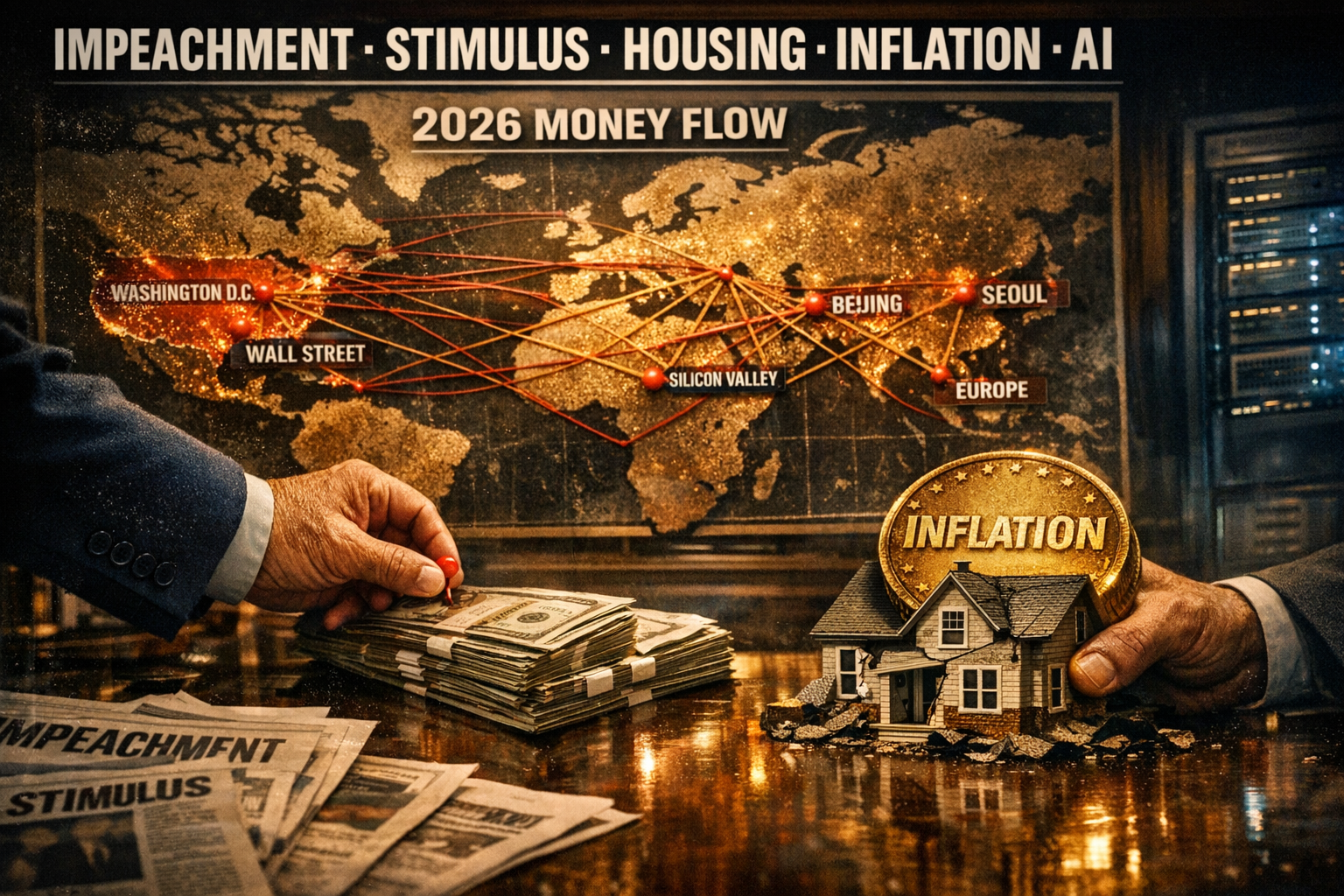
● Trump Impeachment Threat Sparks 2026 Stimulus Frenzy, Consumers Housing Travel Poised to Surge
Why Trump’s “If We Lose the Midterms, I’ll Be Impeached” Comment Matters: The 2026 Beneficiary Map for U.S. Stimulus and Consumer Recovery May Shift
This report covers:
- First, the rationale behind Trump’s “midterm loss = impeachment” framing, interpreted not as a political event but as a trigger for an accelerated policy push.
- Second, key issues such as directed MBS purchases, a credit card rate cap, and restrictions on institutional home purchases, reorganized through the lenses of market rates, liquidity, and consumer sentiment.
- Third, ahead of the 2026 U.S. midterms, potential beneficiaries in consumer, retail, housing, and travel—presented in a news-style format—where capital may rotate after an AI-led market.
- Fourth, a set of under-discussed core points, emphasizing market reaction mechanics over policy feasibility.
1) News Briefing: Why Markets Reacted to Trump’s “Midterm Loss = Impeachment” Remark
[Key remark]
Trump reportedly told Republican House members that if he loses the 2026 midterm elections, Democrats will “find a reason” to impeach him.
Given two impeachment attempts during his first term, the statement effectively frames the midterms as a defensive battle for political continuity.
[Market interpretation]
Midterms are typically treated as a referendum on the incumbent party, implying a structurally challenging setup for the governing party.
The explicit reference to impeachment is viewed as signaling a stronger push for an “affordability” package designed to improve household economic conditions ahead of the election cycle.
[Investment takeaway in one line]
Despite the political framing, the practical implication is an increased emphasis on liquidity support (rates and credit) and consumer cost relief (credit, gasoline, inflation).
2) Policy Decomposition: How “Vote-Seeking” Measures Transmit to Markets
2-1. Directing MBS Purchases via Housing GSEs -> Attempt to Lower Mortgage Rates
[What happened?]
Reports indicate direction to housing-related government-sponsored entities to conduct large-scale purchases of mortgage-backed securities (MBS).
[Simplified interpretation]
This functions as a policy-driven attempt to reduce mortgage rates and lower the cost of homeownership.
[Why it matters]
U.S. housing demand is highly credit-dependent; mortgage rate declines can transmit quickly into consumer sentiment and perceived financial conditions.
Trump’s messaging that mortgage rates are at a multi-year low is consistent with midterm-oriented communication objectives.
[Transmission path]
Lower mortgage rates -> higher home transactions and remodeling activity -> improved demand for building materials, appliances, furniture, and home improvement -> improved earnings expectations in consumer and retail segments
2-2. “Credit Card APR Cap at 10%” -> Low Feasibility, High Headline Impact
[What happened?]
Trump indicated a desire to cap credit card interest rates at 10% by the first anniversary of taking office.
[Feasibility check]
Rate caps typically face significant legislative, lobbying, and litigation constraints, making implementation difficult.
Comparable attempts to limit card fees and late charges have previously been weakened through legal challenges.
[Why markets still monitor it]
Regardless of enactment probability, repeated rhetoric targeting financial institutions can create near-term volatility in financials (banks and card issuers).
Such drawdowns may be interpreted as tactical entry opportunities driven by headline risk rather than durable fundamental deterioration.
2-3. “Restrict Institutional Home Purchases” -> Strong Message, Mixed Sector Impact
[What happened?]
Trump attributed housing price pressures to institutional buyers and communicated intent to restrict or ban institutional home purchases.
[Key point]
While some data-based counterarguments suggest institutional influence may be smaller than implied, the political framing aligns with “first-time and young homebuyer affordability.”
[Investment lens]
The primary effect is likely on housing market sentiment rather than home prices alone.
Improving sentiment can lift transaction volumes, which can stimulate related consumption (remodeling, appliances, moving services, and furniture).
2-4. Push to Lower Oil and Gasoline Prices -> Direct Targeting of Perceived Inflation
[What happened?]
Trump met with energy CEOs and urged higher drilling activity, reiterating the objective of lowering oil and gasoline prices to stabilize inflation.
[Why oil is an election variable]
Gasoline prices can affect voter sentiment rapidly and are therefore a high-priority target during election-adjacent periods.
3) 2026 Macro Framing: Potential Rotation from AI Leadership Toward “Policy–Consumption–Rates”
A central message is that capital concentration through 2025 has skewed toward AI-linked segments (semiconductors, cloud, data centers), while 2026 may require greater attention to consumer-facing real-economy exposure amid midterm-driven policy initiatives.
Five macro variables to monitor
- Rising rate-cut expectations can support not only growth equities but also consumer cyclicals.
- Disinflation can improve real purchasing power.
- Reduced recession risk can reopen discretionary spending.
- U.S. equity performance often reflects these shifts via sector rotation.
- Markets frequently react first to changes in expectations rather than to realized central bank actions.
4) Investment Ideas (Based on the Source): Potential Beneficiary Sectors and ETFs Under an “Affordability” Drive
4-1. Consumer Cyclicals: Early Responders When Spending Reaccelerates
[Logic]
Mortgage relief signals + rhetoric pressuring credit card rates + efforts to lower gasoline prices = a policy narrative focused on reducing recurring household costs.
If this narrative intensifies, discretionary spending may reaccelerate relative to staples.
[ETF angle referenced]
Broad consumer-cyclical baskets with exposure to autos, retail, e-commerce, and home improvement were highlighted as candidates.
4-2. Retail Distribution: Broad “Consumer Recovery” Baskets Such as XRT
[Logic]
A core goal of stimulus-style messaging is to increase household spending, making retail a potential early-cycle beneficiary.
Mid- and low-priced retailers, apparel, general merchandise, department stores, and mall-linked exposure can exhibit higher beta during bottoming and rebound phases.
[Point]
Segments that were among the weakest in prior periods can benefit from base effects during a policy-support window.
4-3. Housing-Linked Consumption: Transaction Volume Can Trigger a Spending Chain
[Logic]
Housing tends to generate follow-on demand once transaction volumes rise, supporting appliances, furniture, building products, and renovation categories.
Mortgage-rate easing signals can be interpreted as positioning to activate this chain.
4-4. Travel, Dining, and Experience Spending: Direction Set by Gasoline Prices and Sentiment
[Logic]
If gasoline prices decline and perceived inflation stabilizes, experience-oriented spending (travel and dining) often recovers relatively early.
Examples referenced include travel, restaurants and cafes, and delivery-linked spending.
5) Under-Discussed Core Points: Market Reaction Mechanics Over Policy Feasibility
Core point 1) Headline-driven market shocks can matter more than policy enactment
Measures such as credit card rate caps are likely to face obstacles. However, markets can reprice quickly on headlines, creating tactical trading windows.
Core point 2) The objective is not equity-market support but monthly expense relief
Mortgage costs, credit card interest, gasoline prices, and inflation (including tariff posture) directly affect recurring household outflows.
Under this framework, affordability indicators may influence market direction more than AI headlines in 2026.
Core point 3) Midterms tend to increase the intensity of messaging and policy push
As elections approach, messaging may become more aggressive and policies more directly tied to household experience.
This implies a time-varying ramp rather than a constant policy impulse through 2026.
Core point 4) AI leadership may persist, but capital dispersion can increase
The implication is not that AI ends, but that policy-driven attention may broaden relative performance opportunities across consumer, housing, and retail.
6) Weekly Checklist: Indicators Linking Policy Signals to Market Transmission
- Mortgage rate trend (leading signal for housing sentiment)
- Oil and gasoline prices (near-real-time gauge of perceived inflation)
- Credit spreads and delinquency rates (financial-sector volatility trigger under recurring credit-regulation rhetoric)
- Retail sales and consumer sentiment (confirmation that policy narratives translate into spending)
- Sector rotation indicators (whether concentration in mega-cap technology moderates)
Trump’s “midterm loss = impeachment” framing is interpreted less as political rhetoric and more as a signal of intensified affordability-focused policy efforts through 2026.
Key components include efforts to lower mortgage rates via MBS purchases, repeated messaging on credit card rate caps, restrictions on institutional home purchases, and pressure to reduce energy prices—converging on a household-cost-reduction narrative.
Following an AI-led phase, relative opportunities may broaden toward consumer cyclicals, retail (including XRT), housing-linked consumption, and travel/dining segments.
Market pricing may be driven more by headline-induced volatility and capital rotation than by the ultimate feasibility of each policy proposal.
[Related Articles…]
-
https://NextGenInsight.net?s=Trump
Summary of how changes in Trump policy may affect global equities -
https://NextGenInsight.net?s=Mortgage
Beneficiary sectors and key U.S. housing market points under falling mortgage rates
*Source: [ 소수몽키 ]
– 올해 중간선거 지면 대통령 끝? 트럼프 선거 올인 선언의 수혜주들
● Cash Meltdown, 2026 K-Shaped Wealth Split, Trump Midterms, Fed Chair Shock, Geopolitical Panic
The Era When Cash Becomes Worthless: 2026 at the “K-Shaped Crossroads” and the Capital Flow Pathways to Wealth (Trump Midterm Strategy, Next Fed Chair, Geopolitical Risk)
This report consolidates three topics:1) Why accelerating “purchasing-power erosion (inflation)” can become a key inflection point for asset markets in 2026
2) How the three major 2026 events (Trump midterm strategy, the next Federal Reserve Chair, geopolitical instability) may influence markets via global capital flows
3) What retail investors and salaried professionals can change to improve their odds of moving into the “upper tier” of a K-shaped outcome
1) News Briefing: Core Points Reframed in a Financial-News Format
[Breaking] “Cash becomes worthless” is not merely rhetorical; perceived inflation is already signaling stress
Everyday prices (e.g., lunch costs) are rising without corresponding quality improvements, implying repeated exchanges of the same goods/services for more money. This indicates faster perceived currency debasement (inflation). Failure to respond may increase the probability of real wealth erosion.
[Focus] The primary 2026 macro frame: Trump’s midterm-election strategy
Interpretation of 2026 policy, liquidity, and fiscal operations should incorporate potential political incentives tied to midterm objectives. Under this frame, markets may repeatedly oscillate between “growth-stimulus expectations” and “inflation re-acceleration concerns.”
[Watchlist] Three major events likely to drive 2026 volatility1) Trump midterm-election strategy (policy direction and intensity)
2) Appointment of the next Federal Reserve Chair (potential shift in monetary-policy tone)
3) Escalation of geopolitical instability (potential trigger for sharp risk-premium repricing)
[Conclusion] 2026 may further accentuate a K-shaped structure
The gap may widen between holders of high cash balances and those reallocating toward assets aligned with capital-flow direction. Outcomes may be driven less by rhetoric and more by structural allocation choices.
2) 2026 Global Outlook: How Three Events May Redirect Capital Flows
2-1. Trump Midterm Strategy: A “Liquidity Mode” Driven by Stimulus Expectations
Core logic
Incumbent administrations often prefer policies that improve perceived economic conditions ahead of elections. Markets may discount a more accommodative stance (fiscal, regulatory, industrial policy), which can revive risk appetite.
Typical market signals
- USD strength/weakness is more likely to be headline-driven and volatile rather than trend-stable
- Equity markets may show stronger concentration in “policy-beneficiary” sectors
- When inflation concerns rise, rates volatility can increase materially
Investor checklist
- Whether fiscal measures (spending packages, supplemental budgets, tax cuts) are priced in through expectations ahead of realized activity
- The margin impact of supply-chain policies such as tariffs, subsidies, and reshoring incentives
2-2. Next Federal Reserve Chair: “Communication Tone” Matters More Than the Rate Level
Why it matters
Rate cuts/holds are important, but markets reprice the forward path primarily via the Fed’s language and guidance. A chair transition can reset the communication regime, creating conditions for asset repricing.
Potential scenarios (investment lens)
- More hawkish tone: higher long-term yields, valuation pressure on growth equities, potential USD support
- More dovish tone: renewed risk appetite and liquidity expectations, with concurrent inflation vigilance
Key point
- The initial messaging often becomes the market’s anchor
- Direction frequently becomes clearer through subsequent speeches, congressional testimony, and press conferences rather than on the appointment headline itself
2-3. Geopolitical Risk: Often Ignored Until It Becomes a Direct Cost
Primary transmission channels to assets
- Higher energy, freight, and insurance costs → corporate cost pressure → inflation impulse → implications for the rates path
- Supply-chain disruption → inventory strategy shifts → capital rotation toward defense, energy, commodities, and logistics
Signals retail investors can observe
- Oil, shipping rates, and specific commodity spikes passing through into consumer prices
- Markets often respond first via prices (oil, freight indices, credit spreads) before narratives converge
3) The Mechanism Behind “Cash Becoming Worthless”: Inflation and the K-Shaped Structure
When the same product costs more without productivity gains, purchasing power is declining. The K-shaped divergence can be summarized:
Upper tier (wealth side)
Cash is converted into assets (equities, real estate, bonds, commodities, cash-flow assets) to hedge inflation and, in some cases, monetize it.
Lower tier (vulnerability side)
Wage growth tends to lag living costs → real income compression. Higher cash allocation increases exposure to purchasing-power loss.
The core 2026 question
Where is capital positioned: in cash, or in assets?
4) Portfolio Framework for 2026: Separate “Defense” and “Opportunity”
4-1. Defensive pillar: Structure resilient to inflation and volatility
Cash is useful as optionality, but an excessive allocation can erode real value during inflationary phases. A mix of cash, short-duration safe assets, and diversified exposures can reduce the probability of large drawdowns.
4-2. Opportunity pillar: Rotation toward policy-, technology-, and supply-chain-driven flows
In election-driven policy cycles, markets can front-run directionality before fundamentals fully reflect it. Capital can rotate quickly into industrial-policy beneficiaries, reshoring themes, energy/infrastructure, and defense/security.
4-3. Rebalancing rule: Rules-based response over prediction
In event-heavy years, single-point forecasts are less reliable; interval-based rebalancing can be a key driver of outcomes. When monetary policy (rates) and fiscal policy (spending) send mixed signals, volatility tends to rise; pre-defined allocation bands can improve execution discipline.
5) AI Trend (Fourth Industrial Revolution) View: Why 2026 Capital Flows May Converge on AI Infrastructure
In 2026, AI may be treated less as a theme and more as infrastructure investment. Because AI is closely linked to productivity and margins, capital may favor segments perceived to have more durable earnings even amid inflation and rate volatility.
Key market focus areas within AI1) Computing infrastructure (data centers, power, cooling, networking)
2) Semiconductor value chain (accelerators, HBM, packaging, equipment)
3) Enterprise AI (workflow automation, security, data platforms)
4) Regulation and policy (data sovereignty, national-level AI investment)
Why it may matter more in 2026
- Heightened geopolitical risk can accelerate domestic supply-chain and technology-sovereignty investment
- Election-cycle policy initiatives can more readily connect to AI infrastructure spending
6) Under-Discussed but Material Points
1) The core of “cash debasement” is not fear but a reset in the price reference framework
If the benchmark for evaluating wages, savings, and assets changes, holding cash can imply structural real-value erosion.
2) 2026 may feature faster repetition of “policy events → rates language → capital reallocation”
More frequent policy headlines combined with a Fed-chair transition can repeatedly disrupt the market’s implied rate path. The practical priority is a portfolio rule set designed to reduce fragility during volatility.
3) The K-shaped split may reflect a gap in “asset-allocation language,” not only income
Understanding macro drivers (rates, liquidity, FX, policy) can enable earlier repositioning. In 2026, this can function as risk management rather than general education.
7) Five 2026 Keywords Connected as a Single Framework (SEO)
When assessing the 2026 global outlook, the probability of inflation re-acceleration, changes in the communicated rate path, liquidity supply intensity, and flexible asset-allocation design may be decisive.
< Summary >
- 2026 may amplify a K-shaped market as perceived inflation accelerates and widens real-wealth dispersion.
- Key variables: (1) Trump midterm strategy, (2) next Federal Reserve Chair and communication regime, (3) geopolitical risk.
- A cash-heavy stance can impair real value; a two-track allocation approach—defense (volatility control) and opportunity (policy and AI-infrastructure flows)—may improve robustness.
- The priority is not prediction but a rebalancing rule set that remains effective across repeated event-driven shocks.
[Related Articles…]
- Trump-related variables and 2026 market dynamics: https://NextGenInsight.net?s=trump
- Assets that tend to move first in liquidity-driven markets: https://NextGenInsight.net?s=liquidity
*Source: [ 경제 읽어주는 남자(김광석TV) ]
– 돈이 휴지가 되는 시대, ‘이렇게’ 부자가 생겨납니다 | 클로즈업
● KOSPI 5000 Frenzy, Yen Shock, Nvidia China Bombshell
KOSPI 5,000: “Possible Next Week?” + Takaichi “JPY Shock” + Nvidia “China Variable” — Three Core Scenarios That Could Drive Markets Next Week
This report consolidates three market-moving themes in a news format.
1) Conditions for a move from KOSPI 4,700 to 5,000 (and why only institutions are buying)
2) How “Takaichi PM risk” could transmit from JPY to rates and KRW
3) Why Nvidia is not selling off despite seemingly negative headlines (China regulation/tariffs/grey-market demand)
Key point: the primary downside risk may be policy response rather than headline “bad news.”
1) [Korea Equities Flash] KOSPI extends rally above 4,700… 5,000 remains technically feasible, but positioning signals rising fragility
1-1. Why the current rally is unusual: the issue is market structure, not liquidity
The defining feature is leadership concentrated in one buyer category.
Foreign participation is limited, retail buying is not aggressive, and institutions (financial investment firms) are driving most of the upside.
In a broad-based advance, multiple buyer segments typically rotate and support pullbacks. A single-buyer, momentum-like advance can increase drawdown risk when the trend reverses.
1-2. ETF inflows: are “institutional buys” conviction or flow-driven?
A practical interpretation is flow classification.
When capital enters via ETFs, the corresponding purchases are often recorded as financial investment (institutional) buying.
As a result:
Retail capital flows into ETFs → ETF-related execution is booked under financial investment → the index rises while direct spot buying by retail/foreign investors appears muted.
1-3. Rising cash balances and margin debt: a late-cycle risk combination
Client cash balances are reported above 90T KRW, alongside increasing margin financing.
This can support further upside, but also implies:
Any catalyst can trigger a faster, larger correction due to leverage-sensitive positioning.
Key vulnerability: if rate-cut expectations weaken, leveraged capital typically deleverages first.
1-4. Three practical conditions for KOSPI 5,000
Condition A: U.S. equities (Nasdaq) resume upside and break higher
Global risk appetite remains the principal anchor. If U.S. equities stall, Korean equities are prone to a faster sentiment reversal.
Condition B: USD/KRW stabilizes without policy-driven shocks
If the market anchors around the 1,500 area, corporate and institutional decision-making can become more risk-averse. Policy steps perceived as investor-unfriendly can abruptly weaken sentiment.
Condition C: Breadth improves (KOSDAQ and small/mid-cap recovery)
If only large-cap indices rise while KOSDAQ underperforms, participation and risk appetite may deteriorate. This is often interpreted as a late-stage signal: prices rise while engagement narrows.
2) [Japan Politics/FX Flash] Takaichi and a potential lower house dissolution… weaker JPY → higher inflation pressure → rising rate/FX volatility
2-1. Why a “lower house dissolution” matters for Korea
Japan’s lower house effectively holds governing power, and dissolution can reset the political landscape. If political uncertainty rises, the market may first react via JPY weakness.
2-2. Why the 160 area in USD/JPY is a risk zone: potential policy “hammer” (intervention/tighter policy)
Excessive JPY weakness raises import prices and inflation pressure, increasing the probability of tighter policy.
Key risk: if tightening is delayed, it may ultimately be implemented abruptly, increasing market shock potential. Prolonged currency weakness can raise the likelihood of more forceful policy action later.
2-3. Transmission to Korea (KRW) and local assets
Traditional channels (JPY weakness → Japan competitiveness → Korea export pressure) remain relevant but are now intertwined with USD strength, CNY dynamics, and Japan policy.
Primary volatility channel:
Higher JPY volatility → broader Asia FX volatility → USD/KRW instability → increased foreign risk-off behavior
This can compress equity valuation multiples, particularly in export-sensitive sectors.
3) [U.S./Semiconductors Flash] Nvidia faces a flood of “China regulation/tariff” headlines… yet the stock is resilient
3-1. Conflicting signals: “China reduces purchases” vs. “U.S. may open a path for H200”
Policy messaging is mixed: China emphasizes domestic alternatives, while the U.S. intermittently signals potential licensing flexibility.
This can be interpreted as a transition test from outright technology denial toward a tariff/fee-based framework.
In other words, the policy regime may shift from “prohibit sales” to “allow sales but monetize via tariffs/charges,” changing market pricing of the risk.
3-2. Why Nvidia is not falling materially
Three factors explain limited downside reaction:
1) China revenue exposure is less of a single-stock trigger than in prior cycles
AI infrastructure demand is large and increasingly diversified across U.S. hyperscalers, the Middle East, and Europe, reducing the immediate earnings shock implied by China headlines.
2) Grey-market and indirect demand is difficult to eliminate
Even under restrictive policy signals, practical demand for training compute tends to create persistent grey channels (Hong Kong, resellers, indirect procurement).
3) Markets are prioritizing fundamentals: shipments, margins, guidance, and supply capacity
Headlines are discounted rapidly into a single question: the measurable impact on volumes, pricing, and supply.
4) [Macro Briefing] CPI was benign, but markets are increasingly sensitive to other variables
4-1. Why softer CPI may not translate into imminent rate cuts
Inflation may be moderating, but labor-market and political constraints can limit the Fed’s speed of action.
Equity valuation is most sensitive when the rally is primarily driven by rate-cut expectations; if that expectation becomes less certain, multiples can compress quickly.
4-2. Oil and geopolitical risk: a tail risk for inflation re-acceleration
Geopolitical tensions and rising oil prices elevate inflation risk.
The market’s most adverse mix:
Higher FX + higher oil = renewed cost pressure + delayed rate cuts
This combination tends to increase cross-asset volatility.
5) [Real Assets/Capital Rotation] Where does capital go after an equity rally? Early signals in regional real estate
5-1. What it means when illiquid listings suddenly transact
When properties that failed to sell for over a year begin receiving multiple inquiries within a short period, it can signal a shift in capital allocation toward that region or asset class.
5-2. Core mechanism of asset rotation: gains do not stay in cash
After realizing equity gains, capital often reallocates rather than remaining in cash—toward real estate, bonds, commodities, or digital assets.
When this accelerates, the market dynamic resembles an inflation-hedge competition more than a single-asset bubble.
6) The most material point: policy risk may outweigh headline risk
6-1. The key risk to KOSPI 5,000 may be policy response, not negative headlines
Efforts to defend the currency could involve measures perceived as investor-unfriendly.
Examples include constraints on FX convenience, tighter regulation, or liquidity controls. Such steps can undermine sentiment independent of index direction.
6-2. Institution-led rallies often inflect when retail participation accelerates
Broad public participation does not appear as extreme as in prior peak cycles.
However, late retail inflows frequently coincide with short-term market peaks.
Risk management should focus less on whether 5,000 is reached and more on the pace of leverage expansion (margin and other leveraged exposures) during the advance.
6-3. Nvidia’s “bad news” is also a test case for a tariff-centered trade regime
Signals suggest a shift from “ban” toward “permit with monetization.” If institutionalized, the semiconductor/AI supply chain becomes more explicitly linked to U.S. fiscal incentives via tariff revenue.
7) Next-Week Checklist (Execution-Oriented)
1) USD/KRW: whether the trend turns despite continued intervention signals
2) USD/JPY near 160: policy statements and any change in BoJ tone
3) Nasdaq breakout failure/success: the sentiment engine for KOSPI beta
4) Client cash balances and margin debt: speed of leverage build-up
5) Semiconductor policy/demand (especially memory): whether concentration around HBM and servers intensifies
< Summary >
KOSPI 5,000 is technically attainable, but concentrated institution-led flows and rising leverage increase the probability of a fast, sharp correction on any catalyst.
A Takaichi-driven political uncertainty scenario could pressure JPY; the 160 area raises intervention/tightening risk that can transmit into KRW volatility and broader risk-off behavior.
Nvidia’s China headlines are being priced as a potential shift from “prohibition” to “permission with tariffs,” while indirect demand channels may persist; markets remain focused on guidance, supply, and realized shipments.
The primary downside risk is not the headline itself but policy actions taken to defend FX stability that could weaken investor sentiment.
[Related]
- KOSPI 5,000 Era: Identifying the True Uptrend Driver Through Flow Analysis
- USD/KRW 1,500 Scenario: Portfolio Repositioning Under KRW Weakness
*Source: [ Jun’s economy lab ]
– 코스피 다음주 5000 돌파가능성, 다카이치 총리 리스크, 엔비디아 악재