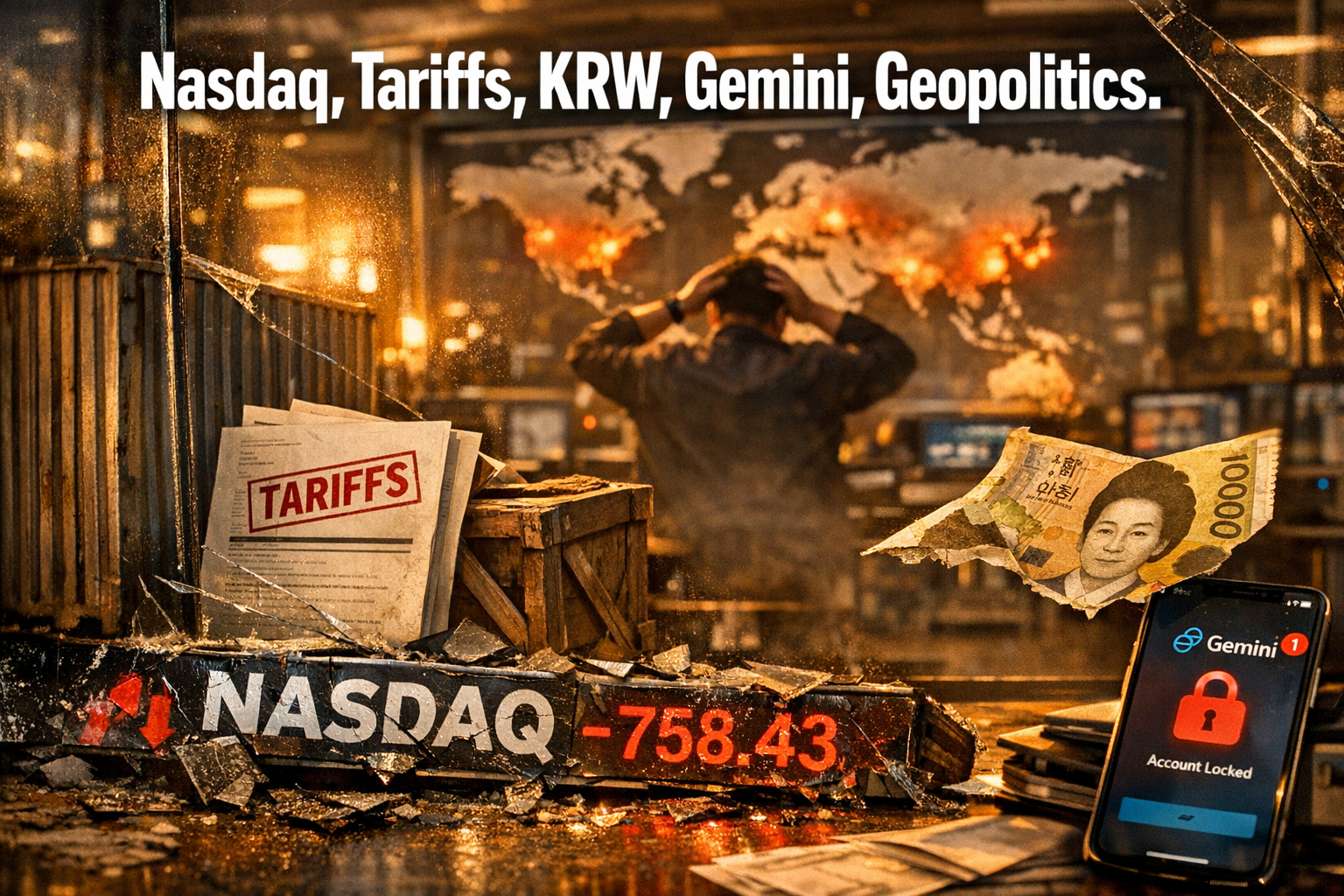
● Nasdaq Slumps, Iran Shock, Rate Cut Hopes Crushed, Won Jitters, Gemini Data Power Grab
Three Key Drivers Behind the Gradual Nasdaq Pullback + Overnight Market Variables at a Glance (KRW, Tariffs, Google Gemini)
This report consolidates four items:1) The geopolitical risk flow and scenarios (Iran + Greenland) that acted as the primary trigger for the Nasdaq decline
2) How PPI and retail sales altered rate-cut expectations (Fed, inflation, rate path)
3) Why FX reacted to a single policy remark (KRW/USD, Korea fundamentals)
4) Why Google Gemini’s “proactive personal-data” capability may reshape the AI competitive landscape
1) Overnight Market Summary (News-Style Brief)
[US Equities]
The Nasdaq declined to approximately -1.5%, with pronounced weakness concentrated in technology. The Dow and S&P 500 also fell, while the Russell 2000 (small caps) declined less, suggesting a partial rotation from mega-cap leadership into smaller-cap segments.
[One-Line Market Interpretation]
Following an extended run-up in large-cap technology, geopolitical risk catalyzed selling pressure, while inflation and consumption data added incremental downside via the rates channel.
2) Three Primary Variables Behind Today’s Nasdaq Decline (By Importance)
2-1. #1: Geopolitical Risk (Iran) — Uncertainty with Low Predictability
[Core News Flow]
Reports indicated the US warned American citizens in Iran to leave, which the market interpreted as an elevated probability of military action.
[Why This Is Immediately Negative for Risk Assets]
Geopolitical shocks are difficult to quantify in earnings models or valuation frameworks. Iran-related risk is directly linked to energy price spike risk, which can lift inflation expectations and reduce the probability of near-term Fed easing.
[Most Material Tail Risk: Strait of Hormuz]
In an extreme scenario, disruption such as a blockade of the Strait of Hormuz could create bottlenecks for crude oil and LNG logistics from Saudi Arabia, Iraq, and the UAE, raising concerns about a sharp increase in global energy prices.
[Concurrent “Safe-Haven” Positioning]
Strength in real assets such as gold, silver, and copper aligns with a broader risk-off pattern.
2-2. #2: PPI (Producer Prices) — Signs of Sticky Inflation
[What Happened]
November PPI on a year-over-year basis printed above expectations (referenced in the low-to-mid 3% range), reinforcing concerns that inflation pressures may remain persistent.
[Why PPI Pressures Equities]
PPI reflects input-cost inflation and can later pass through to consumer inflation. If sustained, it reduces the Fed’s flexibility to cut rates and increases the probability of a “higher for longer” rate path.
[Additional Layer: Political vs. Monetary Policy Friction]
If rate cuts are delayed due to inflation, perceived tension between political actors and the Federal Reserve may intensify. Policy uncertainty typically compresses equity multiples.
2-3. #3: Retail Sales — Strong Demand Weakens the Case for Rapid Rate Cuts
[What Happened]
November retail sales exceeded expectations, indicating resilient US consumer demand.
[Why Positive Growth Data Can Be a Near-Term Headwind]
With rate-cut expectations a key market driver, stronger activity reduces the Fed’s urgency to ease. In environments where the discount-rate effect dominates, equities can decline despite supportive growth signals.
[Magnitude Consideration]
As these releases reflect November rather than December conditions, they likely acted as incremental headwinds rather than the decisive driver.
3) Not Only Iran: The Greenland Variable — Multi-Front Risk Premium Expansion
[Key Point]
Messaging interpreted as US intent to increase control over Greenland, alongside local and international pushback, was cited as an additional geopolitical friction point.
[Why This Matters for Markets]
Concurrent risk sources (Middle East + Arctic security) increase the risk premium more than a single isolated event, which is particularly detrimental to technology valuations that are sensitive to discount rates.
4) FX: Market Impact of the “KRW Weakness vs. Strong Fundamentals” Remark
[What Happened]
Following meetings with Korean counterparts, the US Treasury Secretary (Scott Bessent) stated that discussions included recent KRW weakness that appears inconsistent with Korea’s strong fundamentals.
[Why FX Moves Without Immediate Action]
FX is expectation-driven. Remarks from senior US policymakers can be interpreted as a signal that KRW is excessively weak, effectively capping upside in USD/KRW in the near term.
[Asset-Market Implication]
This is not purely an FX issue; it can influence capital flows into Korean equities and bonds. Improved KRW stability may reduce foreign investors’ currency-loss risk and can be marginally supportive for Korean risk assets.
5) Trump Tariff Policy: Supreme Court Decision Delayed = Reduced Near-Term Market Impulse
[Market Takeaway]
With the legal determination on tariff-policy validity delayed, the issue functioned more as a “wait-state” factor than a directional driver overnight.
[Why It Remains Relevant]
Tariffs affect import prices and supply chains, feeding into inflation dynamics and the Fed’s rate path. A delay extends the duration of policy uncertainty.
6) AI Trend: Why Google Gemini’s “Proactive Data Use” Is Strategically Material
[Update Summary]
Gemini is expected to leverage user data (e.g., Gmail, photos, search) proactively—without explicit prompts each time—when contextually relevant. The capability is designed as opt-in due to privacy sensitivity and is expected to roll out first in the US.
[Why This Can Shift the Competitive Landscape]
Beyond model quality, durable advantage increasingly depends on proprietary data and integration into daily workflows. Google controls high-frequency personal data hubs (Gmail, Calendar, Photos, Search), structurally supporting a personal-assistant positioning.
[Investment Relevance]
If adoption scales, AI may move from “search substitute” to an automation layer for work and daily life. The competitive axis shifts from traffic to lock-in, potentially increasing long-term cash-flow durability for platform leaders.
7) Key Points Often Underemphasized (Investor-Oriented Reframing)
Point A: The Decline Was Primarily About Discount Rates and Risk Premiums, Not Earnings
Geopolitical risk → energy price concerns → inflation expectations → reduced Fed rate-cut expectations.
This chain can pressure high-multiple sectors such as the Nasdaq even without meaningful changes to earnings expectations.
Point B: Russell 2000 Outperformance Signals Both Rotation and Mega-Cap Fatigue
After concentrated mega-cap gains, modest shocks can lead large caps to de-rate first, with flows temporarily shifting toward less-extended segments. This can reflect either a constructive internal adjustment or a pause in the prior market leadership engine.
Point C: Geopolitical-Driven Selloffs Often Fade, but Conditions Matter
Standalone geopolitical events frequently translate into short-lived volatility. However, if the shock transmits via energy prices into inflation and the Fed reaction function, market impact may persist. The key variables are crude oil trends and inflation expectations (e.g., breakevens, energy futures).
8) Investor Checklist (Near-Term Monitoring)
1) Whether Middle East developments translate into higher energy prices (crude benchmarks, energy-sector response)
2) Whether inflation re-accelerates (PPI pass-through into PCE)
3) Whether rate-cut expectations shift further out (Treasury yields, rate futures)
4) Whether USD/KRW stabilizes (implications for foreign flows)
5) Whether mega-cap weakness is absorbed via rotation or broadens into a sustained risk-off move
< Summary >
The primary driver of the Nasdaq decline was Iran-centered geopolitical risk, with PPI and retail sales contributing by weakening near-term rate-cut expectations. Concurrent Greenland-related headlines added to the risk premium, while real assets (gold, silver, copper) reflected risk-aversion. The US Treasury’s remark that KRW weakness appears inconsistent with strong fundamentals had an immediate FX impact, while a tariff-related legal decision delay reduced the day’s directional impulse. In AI, Google Gemini’s proactive personal-data utilization increases the probability of a shift toward personal-assistant dominance via proprietary data and workflow integration.
[Related Posts…]
- Nasdaq volatility drivers and next checkpoints: https://NextGenInsight.net?s=Nasdaq
- USD/KRW outlook and the mechanism of policy remarks moving markets: https://NextGenInsight.net?s=FX
*Source: [ 내일은 투자왕 – 김단테 ]
– 잘 나가던 증시에 새로운 변수!?
● Supreme Court Stalls Trump Tariff Ruling, 150B Refund Bomb, Plan B Duties Loom
The U.S. Supreme Court Again Delays a Ruling on the Legality of “Trump Reciprocal Tariffs”: USD 150bn Refund Risk, Minimizing Market Disruption, and a “Plan B” Tariff Framework
This report consolidates four points:1) Why the Court has twice postponed a definitive ruling (legal doctrine and macro/market impact considerations).
2) Three realistic “compromise ruling” scenarios beyond a binary valid/invalid outcome.
3) Why an invalidation would not end tariff risk (Plan B: migration to product-specific tariffs under Sections 232/301, etc.).
4) How FX, inflation, and supply-chain risk connect from the perspective of Korean corporates and investors.
1) News Briefing: What has happened
The U.S. Supreme Court has twice deferred a decision on whether Trump-era “reciprocal tariffs” (country-specific tariffs) are unlawful or unconstitutional. Market expectations for rulings around the 9th and 14th (Korea time) were not met. The next potential window cited by market participants is the 20th–21st (not confirmed).
Core issue:Can the executive branch, citing emergency authority, impose broad country-specific tariffs (effectively a tax) at scale?
2) The Stakes Are Material: Why “Tariff Refunds” Influence the Court
Trump’s side argues that an adverse ruling could trigger refunds in the trillions of dollars; a practical estimate referenced is approximately USD 150bn (about KRW 220tn).
Key implications:1) Fiscal-deficit pressure (refund funding could require increased Treasury issuance).
2) Litigation spillover (expanded claims by global corporates and major U.S. retailers/importers).
3) Single-event market volatility risk (simultaneous reactions across equities, rates, and the USD).
This is not solely a legal matter. It is a macro event transmitting through import prices, supply-chain reconfiguration, corporate margins, and FX.
3) Legal Issues: Why “Invalidation Risk” Remains Prominent
Two principal legal axes:1) Whether the “national emergency” rationale under IEEPA (International Emergency Economic Powers Act) is sufficiently supported. A long-running U.S. trade deficit may not qualify as a distinct emergency condition.
2) Tariffs function as taxation, and taxation authority rests with Congress. The breadth of country-specific tariffs imposed via executive authority raises separation-of-powers concerns.
An additional vulnerability:Including allies (e.g., Korea, Japan) alongside adversaries increases tension with the “emergency economic threat” justification.
4) Why the Court Delayed Twice: Legal Ruling Versus Market Disruption
A central interpretation is that while the ruling is primarily doctrinal, the Court cannot ignore potential economic and market impacts.
Repeated delays may function as a de facto shock-mitigation mechanism:
- Allowing expectations to disperse and be partially priced in
- Reducing the probability of a single abrupt repricing when a decision is released
As delays extend, corporates and investors tend to implement contingency measures, enabling markets to absorb uncertainty progressively. The transmission path (expectations → positioning/hedging → pricing) can matter more than the headline outcome.
5) The Outcome Is Not Binary: Three Practical “Compromise Ruling” Scenarios
Given refund exposure, politics, and executive-power constraints, compromise outcomes are plausible. Three operational scenarios:
Scenario A: Prospective invalidation; no refunds for past collections
Tariffs are deemed unlawful going forward, while previously collected amounts remain untouched to limit market and fiscal disruption.
Scenario B: Limited refunds only to plaintiffs
Refund eligibility is restricted to parties that filed suit, reducing aggregate fiscal exposure.
Scenario C: Hybrid approach (time- and scope-segmented remedies)
Examples include refunds only for collections after a specified date, or carve-outs by product category or contract structure.
Market sensitivity may hinge more on refund scope and timing than on the legal holding itself, with implications for Treasury yields, USD direction, and corporate earnings guidance.
6) Critical Point: Even If Invalidated, Tariff Risk Likely Persists (“Plan B”)
An invalidation of country-specific reciprocal tariffs would not necessarily eliminate tariffs. The executive branch may shift from country-based to product-based measures.
Key instruments:
- Trade Expansion Act, Section 232: National-security basis for tariffs/quotas on specific products (e.g., steel, autos, critical components).
- Trade Act, Section 301: Retaliatory tariffs addressing unfair trade practices (frequently used in U.S.–China disputes).
- Trade Act, Section 201 and related safeguards: Industry-protection mechanisms enabling targeted import restrictions.
Strategic implication:A shift from country-based to product-based tariffs increases operational complexity. Responses move from market allocation to bill-of-materials optimization, origin rules, and supply contracts.
7) Market Impact: FX, Inflation, and Supply Chains
This event affects long-run cost structures across three channels:
(1) Foreign exchange
If invalidation increases expectations of tariff relief, USD weakness could emerge. Conversely, renewed tariff escalation under Plan B could support USD strength via risk-off dynamics and renewed trade friction.
(2) Inflation
Tariffs can raise import prices and feed inflation. Invalidation/relief may reduce pressure. A shift to product-specific tariffs could intensify price pass-through in selected sectors (autos, appliances, components).
(3) Supply chains
Product-based tariffs force firm-level restructuring: sourcing decisions, origin compliance, and component substitution. Reshoring/nearshoring incentives may strengthen.
8) Key Focus Areas Under-Discussed in Market Commentary
The core issue is not preferential treatment toward or against a political figure. The case requires a remedy design that balances legal doctrine, fiscal consequences, and market stability.
Primary monitoring points:1) Not only validity, but refund scope (who) and timing (past vs. future)
2) If reciprocal tariffs are constrained, the speed and breadth of Plan B (232/301) activation
3) Whether tariffs transition from a policy tool to a persistent risk premium embedded in asset prices
These factors influence capex, inventory, and pricing strategy, with downstream effects on U.S. growth, global trade flows, and Korea’s export channels.
9) Near-Term Checklist (Around the 20th–21st Window)
Upon release of a decision, prioritize:
- The Court’s interpretation of IEEPA scope (limits on presidential emergency authority)
- Remedy design: full/partial refunds, plaintiff-only refunds, and prospective-only application
- Immediate executive response: existence of a substitute 232/301 tariff roadmap
- U.S. Treasury market reaction (re-emergence of fiscal burden concerns)
- Commentary from major retailers/importers (e.g., Walmart, Costco) on pricing pass-through and supply-chain adjustments
Summary
The U.S. Supreme Court’s repeated delay on the legality of Trump-era reciprocal tariffs indicates a decision environment shaped by legal doctrine as well as fiscal refund exposure (~USD 150bn), market-stability considerations, and political risk. A compromise remedy—limiting refunds by scope, eligibility, or timing—appears plausible. Even under invalidation, tariff pressure may persist via a shift to product-specific measures under Sections 232/301 and related tools, potentially increasing operational complexity and uncertainty. For investors and corporates, the critical variables are refund design, effective dates, and the speed of any Plan B rollout, which collectively drive repricing across FX, inflation expectations, and supply-chain risk.
[Related…]
- Tariffs: comprehensive review of effects on FX, inflation, and exports — https://NextGenInsight.net?s=tariffs
- Managing heightened FX volatility: strategies for corporates and investors — https://NextGenInsight.net?s=fx
*Source: [ 경제 읽어주는 남자(김광석TV) ]
– [속보] 미국 연방대법원, 트럼프 상호관세 위법 여부 두번 연속 결론 못 내… 20~21일 선고 가능성 [즉시분석]
● Bessent Jawbones Won, Trump Tariff Ruling Stalls, Markets Jitter
Bessent’s “KRW Weakness Is Inconsistent With Fundamentals”: Intent and Market Implications + Three Signals from the Delayed Supreme Court Ruling on Trump Tariffs
This note addresses two variables—USD/KRW and the US Supreme Court’s tariff ruling—that could materially influence broader market pricing. It covers: (i) the transmission of Bessent’s verbal intervention to KRW and Korean assets, (ii) mechanisms through which tariffs could remain in effect regardless of the ruling, (iii) potential FX-related leverage in Korea’s future negotiations, and (iv) an investor checklist.
1) Breaking News Summary (Briefing Format)
1-1. US Supreme Court Delays Ruling on Trump Tariffs Again; No Published Schedule
Market expectations that a decision could be released “today at 10:00” were not met. The key point is not a simple delay, but the absence of any announced timeline. This shifts uncertainty from a short-dated event risk to a potentially extended positioning risk.
1-2. US Treasury Secretary Bessent Signals Verbal Intervention in USD/KRW: “KRW Weakness Is Inconsistent with Fundamentals”
After discussions with Korea regarding FX market conditions, Bessent publicly stated:
- “Recent KRW weakness is inconsistent with Korea’s strong economic fundamentals.”
- “Korea’s impressive economic performance makes it a key US partner in Asia.”
In FX markets, such language is typically interpreted as verbal guidance, with implications for USD/KRW volatility.
2) Core Interpretation: The Message That Tariffs May Persist Regardless of the Court Decision
2-1. Even If the Court Rules the Tariffs Unlawful, Similar Effects Could Be Preserved Under Other Statutory Authorities
A central message was:
- If the Supreme Court rules the measures unlawful, the administration would accept the decision, but alternative legal bases are available to achieve comparable effects.
This reduces the likelihood that the court event translates directly into tariff removal. The risk shifts from a “judicial outcome” framework to a “policy persistence” framework.
2-2. Limited Scope for Counterparties to Reset Negotiations on the Basis of a Court Decision
Tariff outcomes are influenced by power dynamics as well as legal interpretation. Counterparties may have limited ability to claim a full reset of negotiations without increasing retaliation or enforcement risks. As a result, a court decision may not reset the negotiation framework as much as markets may initially price.
3) Core Interpretation: Why the KRW Comment Was Made (Three-Layer Intent Analysis)
3-1. Immediate Effect: Downside Pressure on USD/KRW and Potential Volatility Compression
Remarks by a US Treasury Secretary can function as quasi-official guidance. The phrasing “inconsistent with fundamentals” makes sustained KRW weakness harder to justify narratively, potentially supporting KRW in the near term or limiting the speed of depreciation. This can transmit to Korean risk assets, including foreign investor flow dynamics.
3-2. Medium-Term Effect: Persistence Matters More Than a Single Statement
Verbal intervention is more effective when repeated. The key question is whether similar messaging will recur and become embedded as an ongoing policy signal, or whether it remains a one-off event.
3-3. Most Important: Potential Elevation of FX into the Negotiation Agenda
Beyond stabilization messaging, the statement can be interpreted as signaling enhanced US attention to KRW dynamics and the potential to raise FX as part of broader discussions (trade, supply chains, security, investment). This increases the probability that FX becomes an explicit lever within future bilateral negotiation frameworks.
4) Market Checklist: Indicators to Monitor (Investor-Oriented)
4-1. USD/KRW: Volatility May Matter More Than the Level
A modest spot move is less important than reduced volatility, which can facilitate foreign participation and improve risk sentiment. FX stability can act as a behavioral anchor for equity flows.
4-2. Tariff Risk: Focus on Executive Branch Alternatives, Not Only the Court Date
Tariff risk is no longer solely an event-date trade tied to the court calendar. Investors should monitor post-ruling pathways for rapid policy substitution under other legal authorities. This links to global supply chains, inflation expectations, and rate pricing.
4-3. Korea: FX Could Become an Attached Issue in Trade and Industrial Negotiations
Although FX is often framed as a financial variable, it can be bundled with trade balances, investment commitments, and industrial policy in negotiations. If the US begins to operationalize FX messaging, Korea may increase policy communication frequency and coordination.
5) Under-Discussed but Material Points (Condensed)
-
(1) “Inconsistent with fundamentals” is frame-setting, not merely supportive language
The message implies that renewed KRW weakness would require justification from Korea’s policy stance or market structure. It also positions the US to claim prior signaling if depreciation resumes. -
(2) Tariffs are shifting from a “court-resolution” story to a “policy-duration” story
Markets may assume the ruling resolves uncertainty, but the messaging suggests continued policy optionality. This can influence global equity pricing, inflation expectations, and the expected policy rate path. -
(3) FX may become a lever to influence Korea’s bargaining position
KRW stability can be framed not only as Korea’s domestic objective but also as a tool within US negotiation strategy, potentially reshaping the bilateral agenda.
< Summary >
The US Supreme Court has delayed the Trump tariff ruling without publishing a schedule, extending uncertainty. Treasury Secretary Bessent’s statement that KRW weakness is inconsistent with fundamentals functions as verbal guidance that may support KRW and reduce USD/KRW volatility in the near term. However, tariffs may remain in effect even after a ruling via alternative legal mechanisms, limiting the “decision equals resolution” narrative. The primary strategic implication is a clearer signal that FX could be incorporated as leverage in future negotiations involving Korea.
[Related…]
- USD/KRW volatility and implications for Korean equities and exporters: https://NextGenInsight.net?s=환율
- Renewed US tariff risk: impacts on global supply chains and inflation: https://NextGenInsight.net?s=관세
*Source: [ Maeil Business Newspaper ]
– [속보] 베센트의 원달러 환율 구두개입. 美대법원, 관세 판결 하긴 하는걸까? I 홍장원의 불앤베어