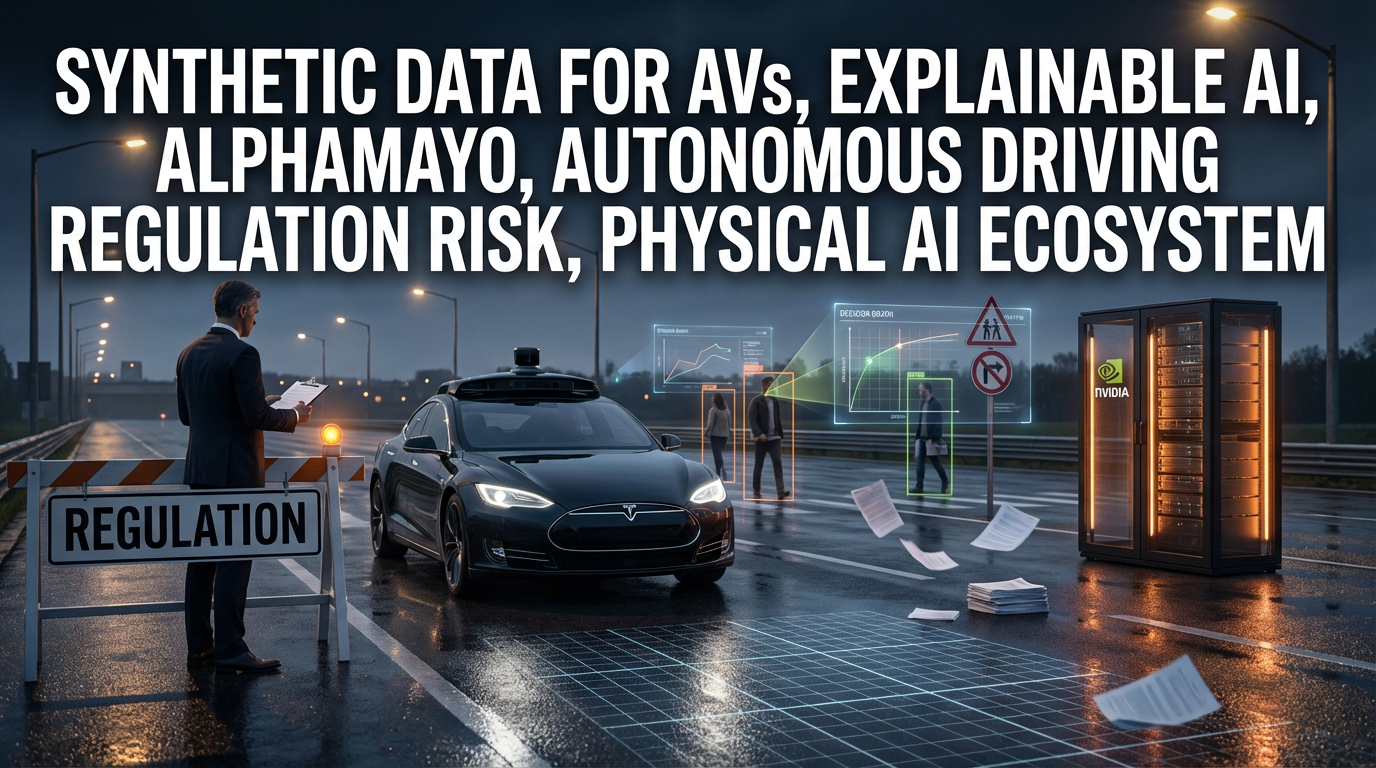
● Nvidia AlphaMayo Shakes Up Self-Driving, Explainable AI Cracks Regulation and Edge-Case Chaos
Why NVIDIA’s ‘AlphaMayo’ Is Upsetting the Autonomous Driving Field: “Explainable AI” Simultaneously Targets Regulation and the Long Tail
This piece contains the following.
1) Why full autonomy is blocked even when vehicles “drive well” (two bottlenecks: technical + regulatory).
2) The core point scene shown by NVIDIA AlphaMayo (when a ball rolls out it predicts a child/dog may follow → preemptive deceleration as a meta action).
3) Structural differences between Tesla FSD (black-box end-to-end) and NVIDIA (explainable VLA).
4) The battleground between synthetic data (simulation) and real driving data, and why both are needed.
5) Who will dominate the physical AI era going forward (NVIDIA = Android, Tesla = Apple perspective).
1) News briefing: There are exactly two bottlenecks for why autonomous driving is not happening
Although autonomous driving is already convenient and shows zones where it statistically becomes safer, the reason full autonomy is delayed is simple.
“Driving skill” alone does not finish the game.
First bottleneck: technical long tail (edge cases)
– A pedestrian suddenly appearing from a dark alley
– A delivery scooter cutting in abruptly at a complex intersection
– Sudden unpredictable events (extreme cases hypothetically include variables like an earthquake)
→ The hardest part is sufficiently training for these rare situations.
Second bottleneck: social/institutional regulatory risk (liability)
– If an accident occurs, who is responsible?
– Can the decision be explained?
– Is the form acceptable to regulators?
→ Ultimately, autonomous driving without explainability cannot convince the public nor pass institutional approval.
The solution NVIDIA proposed is precisely the direction of AlphaMayo.
This point is not a simple technical demo but a variable that could change investment logic in the EV market and semiconductor market going forward.
2) Why AlphaMayo is chilling: The car thinks and shows that thinking in words
The most striking scene in the original source was this.
A ball rolls out between parked cars on both sides → the system infers the risk that a child/dog might follow out → it preemptively performs a meta action like decelerating.
The core point is not simple perception (detection) but reasoning → action being tied together as one unit.
In modern terms this can be seen as closer to a VLA (Vision-Language-Action model).
And more importantly, it publishes “that decision process to people.”
– “Avoid the construction vehicle”
– “Yield to the pedestrian, so stop”
– “Keep distance because the scooter ahead is dangerous”
It frames the system’s intent as sentences and shows them.
This matters because it directly connects to autonomous driving’s biggest challenges: regulatory approval/liability.
If the AI is explainable, regulators, insurers, and courts can handle the “basis for the decision.”
3) Structural difference: Tesla FSD (black box) vs NVIDIA AlphaMayo (explainable structure)
Summarizing as the original source put it.
Tesla’s current approach is end-to-end and drives well, but from the outside it is close to a black box.
In other words, it is hard to view why it turned left or why it stopped in a way that a person can understand.
By contrast, AlphaMayo places a reasoning core like a ‘Cosmos Reason backbone’ at its center,
emphasizing a pipeline that connects perception → sentence-form situation interpretation → action.
A realistic question arises here.
“Won’t adding a reasoning process degrade real-time responsiveness?”
NVIDIA claims processing within 0.1–1 seconds, but this needs verification in real-world commercial settings.
Musk voiced a similar nuance when he said “you can get to 99% but the last 1% of the long tail is super hard,” which is the same context.
4) Data strategy war: Synthetic data (NVIDIA) vs real driving data (Tesla)
This is actually the most important part from an investment perspective.
While model architecture matters, in the end the data engine wins autonomous driving performance competitions.
NVIDIA: synthetic data + simulation centered
– The rate at which you collect data on real roads cannot capture the long tail fast enough
– So create rare situations by the hundreds of thousands/millions for training
– Platforms like Omniverse (sim) + Cosmos (realism/variation pipeline) are described to support this
→ Advantage: strong at massively generating edge cases (favorable for scaling)
But a critical weakness was also mentioned.
Sim-to-Real gap
– Simulation, no matter how realistic, is not the real thing
– You cannot perfectly implement physical laws and real-world variables, so it can “go wrong in reality”
→ Therefore simulation alone cannot be the endgame.
Tesla: real driving data centered
– The actual fleet collects data by driving on real roads
→ Advantage: higher real-world fit and faster optimization in actual user environments
→ Disadvantage: slow to collect truly rare accident/situation data
The conclusion aligns with the original source.
Both are needed
– Synthetic data is advantageous for “creating long-tail cases”
– Real data is advantageous for real-world fit and verification
Thus, the future winner is likely not a company that insists on only one approach, but one that balances both engines well.
5) Market landscape interpretation: NVIDIA as ‘Android’, Tesla as ‘Apple’
This analogy is quite sharp.
Tesla tightly controls vertical integration (vehicle-software-data) in an Apple-like way.
NVIDIA provides chips/platforms/toolchains that lay the foundation for an ecosystem in an Android-like way.
Investors should focus on simple points here.
– Tesla can continue to lead on the “final product experience”
– NVIDIA can become the “standard platform that most car/robot companies build on”
If the leadership battle extends from “technical demos” to an ecosystem war,
the key variable becomes which standardization wins for AI semiconductors supply chains and autonomous driving computing platforms.
This trend could, in a prolonged period of easing interest rates, stimulate valuations for growth stocks (especially AI hardware/platforms).
6) “Really important points” that other news/YouTube covers less
From here I will reinterpret one step further from my perspective.
Point A: The next battleground of autonomous driving is not “accident rates” but an “explainable liability system”
People’s fear is not only about “accident probability” but also about “a system whose reasons are unknown.”
Therefore, even if it becomes statistically safer, public sentiment does not shift easily.
What AlphaMayo offered is a hint toward an AI form that can pass institutions rather than just technology.
Point B: The COC (cause–effect chain) dataset is actually a data strategy aimed at the insurance/law/regulation market
The original source said, like a math explanation, “don’t just give the answer, but give the solution process to be graded.”
This is not merely model performance improvement but can become an “audit/record system” that can be submitted if an accident occurs later.
In other words, dataset design itself can be a weapon to break through regulation.
Point C: NVIDIA is targeting not just autonomous driving but a ‘physical AI operating system’
Many pieces fixate on “who wins autonomous driving, Tesla or NVIDIA,” but looking bigger, NVIDIA seems intent on grouping robots, logistics, factory automation, and industrial robots under the same approach.
If this succeeds, it could affect manufacturing productivity beyond the automotive sector (macroeconomically impacting global supply chains).
Point D: The essence of synthetic data is flipping the ‘cost function’
Real data takes time and long verification.
Synthetic data accelerates with “money and compute.”
This ultimately ties directly to AI semiconductor demand (compute) and is one reason AI trends can persist even in a slow economy (demand arises from research/development activity).
7) One-line conclusion: AlphaMayo gifted ‘explainability for autonomous driving’, and that opens the door to commercialization
Technically, it pushes a simulation/synthetic data strategy to better capture the long tail,
and socially, it brought a structure that can verbalize “why it made that decision.”
If this combination succeeds, autonomous driving becomes not just a function but
the core infrastructure of the physical AI era,
and it is highly likely that both NVIDIA and Tesla will sit at the center of that wave.
< Summary >
– The reasons full autonomy is blocked are two bottlenecks: technical (long-tail edge cases) + social (regulation/liability).
– NVIDIA AlphaMayo demonstrated a core point where it predicted a child/dog might follow when a ball rolled out and decelerated by performing a “reasoning→action” flow.
– The core point is that instead of a black box, an “explainable AI” aims to persuade regulators and the public.
– NVIDIA aims to mass-learn the long tail using synthetic data/simulation (Omniverse·Cosmos), while Tesla accumulates real-world suitability with real driving data.
– The likely winner will be the side that balances synthetic + real data and seizes the physical AI ecosystem, not one that sticks to only one approach.
[Related posts…]
- The Impact of the NVIDIA AI Semiconductor Ecosystem on the Global Supply Chain
- Changes in Autonomous Driving Regulation and the New Winners in the Insurance Market
*Source: [ 월텍남 – 월스트리트 테크남 ]
– 게임체인저 엔비디아 알파마요가 보여주는 소름돋는 장면들 ㄷㄷ..