● Physical-AI Boom,K-Robots Crush China Mislabel,Security-Driven Exports
CES 2026 Summary: The real reason the question “Isn’t this made in China?” poured onto K-robots
This article covers exactly four things properly.
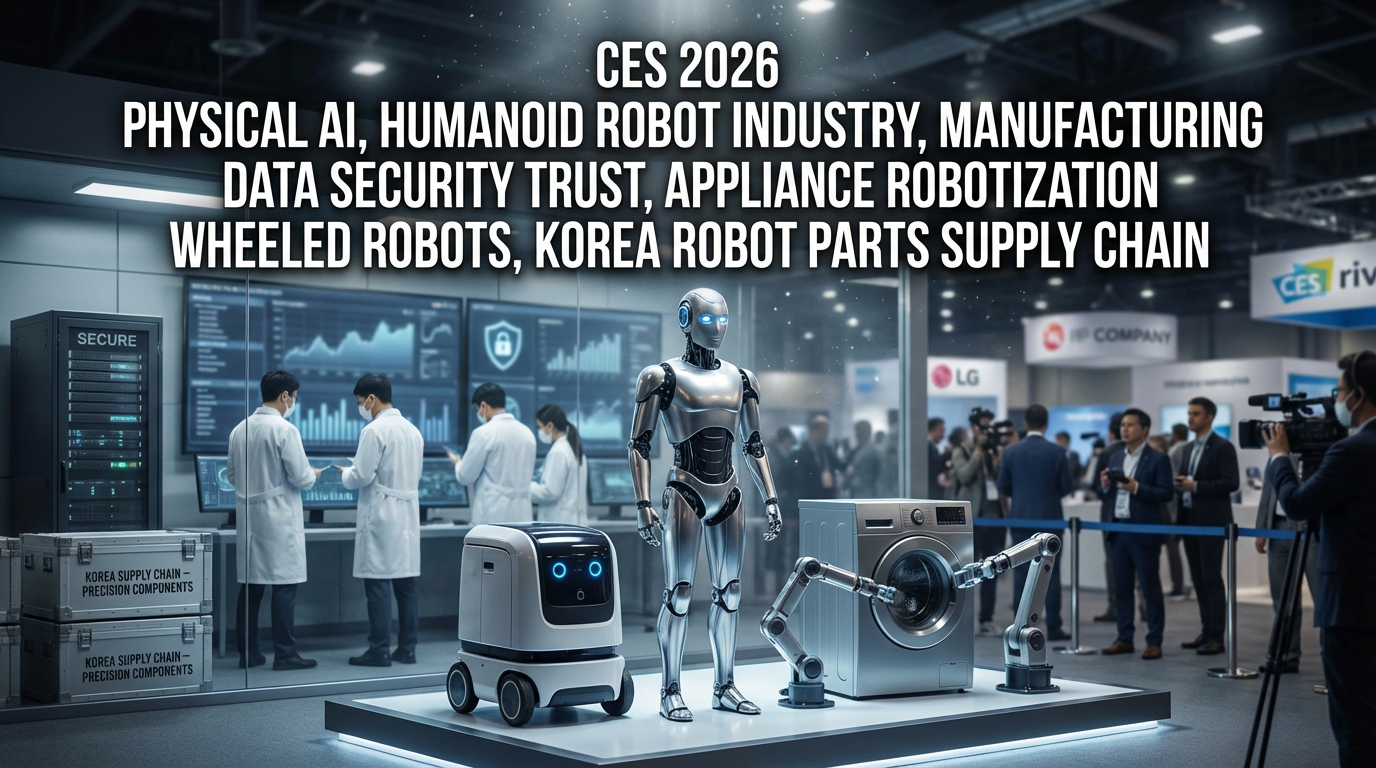
1) The core point reason for calling CES 2026 the ‘first year of Physical AI’ (not the number of exhibition halls, but from an industry structure perspective).
2) Why Korean humanoids received more business questions even after dispelling the misconception “Isn’t it from China?” amid China’s volume offensive.
3) How far appliance robotics has come (including strategy differences between LG, Samsung, and Chinese appliance makers) and why wheeled humanoids are realistic.
4) A point other news outlets often miss: the leverage Korea must seize right now — “manufacturing data + security trust” — and a preparation checklist to turn CES participation from ‘exhibition’ into ‘export’.
1) CES 2026 one-line conclusion: the focus shifted from screen AI → ‘AI with a body’
The scene at CES 2026 was less about “AI became smarter” and more about “AI actually began to move” being the core point.
Humanoid/robotics-related booths surged to an estimated 70–80, making ‘Physical AI’ not just a trend but a signal of industrial transition.
2) Why it’s the ‘first year of Physical AI’: demos moved from show to ‘work’
Until last year, focus was on conversation and perception (vision/voice), which often ended at “Oh, that’s interesting.”
This time, AI controlled the robot’s actual movement, breaking many areas people thought “robots can’t do that.”
In other words, the value of AI shifted from model performance (talking well) to “context understanding → safe execution.”
3) More important than numbers: the robot ecosystem is being reorganized like a ‘parts industry’
One impressive case on site was a hand-specialized company declaring it would supply hands to robots worldwide via an SDK.
This matters because robots are no longer just a complete-product battle; like the auto industry, the value chain is starting to split into parts (hands/actuators/sensors/power/OS).
For Korean companies, this opens significant B2B supply-chain positions as parts specialists.
4) “Isn’t this from China?”: the biggest achievement Korean humanoids gained at CES
At the Korean Humanoid Pavilion (Humanoid Max Alliance), a common question was “Isn’t this from China, are you sure it’s Korean?”
That question itself paradoxically broke the formula that “only China does this,” and Korea actively ingrained brand trust, even attaching national flags.
5) Difference between Chinese and Korean demos: ‘performance’ vs ‘deployment imagination’
If Chinese booths focused on flashy showing like fighting and dancing,
Korean booths prominently displayed “scenes of working in factories.”
Audience reactions differed accordingly.
Chinese robots get a reaction of “fun,”
whereas Korean robots prompt business questions like “Can this come into our factory?”
This is not just a difference in impression but means differing probabilities of converting to revenue.
6) Why Korea is advantaged in robots: manufacturing = data = AI competitiveness
Humanoids are “half machine, half AI,” and AI is ultimately a data battle.
Korea’s hidden weapon here is manufacturing-floor data.
In particular, tacit knowledge that is not in manuals — the know-how of skilled workers — is abundant on factories, which is the core point.
7) Linking to the global trend: why the next battlefield after AI is ‘Physical AI’
Generative AI has mostly become strong in the digital world (documents/images/code).
Next is the stage where robots in the physical world “see → decide → pick → move → assemble.”
What’s needed here are not text data but process data/work motions/sensor logs and other real-world data.
If Korea rapidly secures and standardizes this in industrial sites, its position in global supply chains can change significantly.
8) Appliance robotics: “The moment humanoids enter the home could come faster than you think”
LG was a representative case.
Rather than a complete humanoid dominating the home,
a quicker commercialization path is “robots filling the gaps appliances can’t”.
Examples: clearing chairs/toys so a robot vacuum can pass, moving laundry to the washer/dryer, etc.
9) Why LG chose ‘wheels’ over ‘legs’: three commercialization factors (price · safety · efficiency)
For home use, bipedal locomotion may look cool but has three major practical variables.
– Price: more joints/motors/control drives BOM up sharply
– Energy efficiency: wheels are overwhelmingly superior
– Safety: fall risk is critical in home environments (especially with children/elderly)
So the argument “wheeled is more reasonable for homes” gained persuasive power.
10) CES strategies of Samsung · LG · Chinese appliance makers: function vs scenario vs trust
Chinese makers (TCL/Hisense, etc.) are already threatening with “bigger, cheaper, better features,” and the gap is closing.
Therefore Korea’s winning points are not hardware specs but ‘experience design (scenarios)’ and ‘security/trust.’
On site, repeat reactions like “Chinese products feel somewhat insecure” were important.
11) Security in the robot era is not an ‘option’ but a ‘purchase condition’
Factories are security themselves.
Process sequences, equipment layouts, and work know-how are all trade secrets, and robots move around like mobile CCTV.
If a backdoor issue appears, deployment itself becomes impossible.
Thus, humanoid adoption will likely require ‘security certification/trust brand’ as a contract condition.
12) Assessment of Chinese robots (in the on-site tone): hardware leads, AI is still in the early war
There was recognition that China leads on the hardware side.
However, observers noted “design variety is lacking and many look similar.”
Another important point: some Chinese demos showed signs of remote control, hinting that “truly autonomous AI has not fully integrated yet.”
The conclusion leaned toward “it’s just the beginning, so it’s not time to give up.”
13) Why Hyundai-Boston Dynamics ‘Atlas’ dominated CES: it showed ‘AI partner + deployment site’ together
To sum up the reason for the explosive interest in one line:
“The best machine + the best AI collaboration (DeepMind) + an actual factory to deploy it (Hyundai Motor) looked like a single set.”
When it looks like a business plan rather than a tech demo, market reaction changes.
14) Spatial computing (XR/AR glasses) and Physical AI come as a set
Robot learning is now a battle to quickly convert human motions into data,
and XR attaches as the ‘learning interface’ for that.
Scenarios appeared where a person wears XR to demonstrate motions and virtual/real robots follow via imitation learning.
15) The scary point of Chinese AR glasses: “light, clean, ready to use”
At this CES, China-centered lightweight glasses surged.
The strategy prioritized practical functions (translation/notifications/simple queries) over image/immersion competition, trimming excess.
By contrast, Korean company presence felt relatively weak.
16) CES participation strategy changes: from ‘looking around’ to ‘export combat’
Now CES is no longer enough if you just “go and read trends.” That’s a loss.
You need a prepared product + prearranged meetings + on-site lead collection + post-event follow-up to get results.
On site, companies like Qualcomm/AWS used gatherings of partners where actual business ran as a showcase, which is a hint.
17) News-style summary (core point issues only, arranged like a timeline)
- Issue 1: Humanoid booths surged to 70–80 → Physical AI confirmed as a megatrend
- Issue 2: The Korean pavilion broke the “only China does this” frame and drew industrial deployment questions
- Issue 3: Appliances are rapidly moving toward ‘robotization’ → wheeled/scenario-based solutions can commercialize first
- Issue 4: China has hardware strength, Korea’s winning edges are manufacturing data, trust/security, and experience design
- Issue 5: XR is surging as a robot learning interface, China attempts market capture through lightweight designs
18) The most important content other YouTube/news outlets often omit (core point insights for blog use)
1) Korea’s real weapon is not ‘robot finished products’ but the nation-level accumulation capability of manufacturing data.
Being a manufacturing powerhouse now means not bragging about production volume but being the source of Physical AI training data.
2) The top line of humanoid deployment contracts is likely to become ‘security/trust.’
Robots roam factories, so trust comes before performance.
The on-site reaction that “if it’s Korean, it’s more trustworthy” is not just pleasant sentiment but the seed of future order-winning capability.
3) Home humanoids will open not via a ‘bipedal walking race’ but via ‘scenario (persona) competition.’
Who can productize scenarios for senior care, single-person households, and families with children faster may decide the market.
4) The robot ecosystem will become a structure where ‘parts/SDK supply chains’ make big money like the auto industry.
Korea has strengths in actuators/motors/parts manufacturing, so B2B supply positions are promising alongside finished products.
19) (From an SEO perspective) Points that connect to the global economic outlook after 2026
Physical AI is not a simple tech trend but an issue that triggers a re-evaluation of manufacturing productivity.
Especially amid supply-chain reshuffling, “which country runs robots better and more safely” becomes direct competitiveness.
This trend can stimulate corporate investment independently of macro variables like expectations of interest rate cuts and will directly create demand for semiconductors (especially on-device/edge), robot parts, and industrial data platforms.
< Summary >
CES 2026 confirmed the first year of Physical AI as humanoid companies surged to 70–80.
The Korean humanoid pavilion broke the perception that “only China does this” and succeeded in drawing ‘factory deployment’ questions.
China is strong in hardware, but Korea can compete on manufacturing data, security trust, and experience design.
Appliances are more likely to robotize quickly via wheeled + scenario-centered approaches than by bipedal competition.
CES must now be approached as a B2B sales battle with preparation, not just an exhibition, to achieve results.
Related posts…
- 2026 humanoid robot market: B2B segments Korean companies can capture
- AI device security as national competitiveness: how ‘trust’ pays in factories and homes
*Source: [ 티타임즈TV ]
– [CES2026] “이거 중국 것 아니에요?” K-로봇의 저력